A French Word to Live By
Translate Carte to English
/kaʁt/
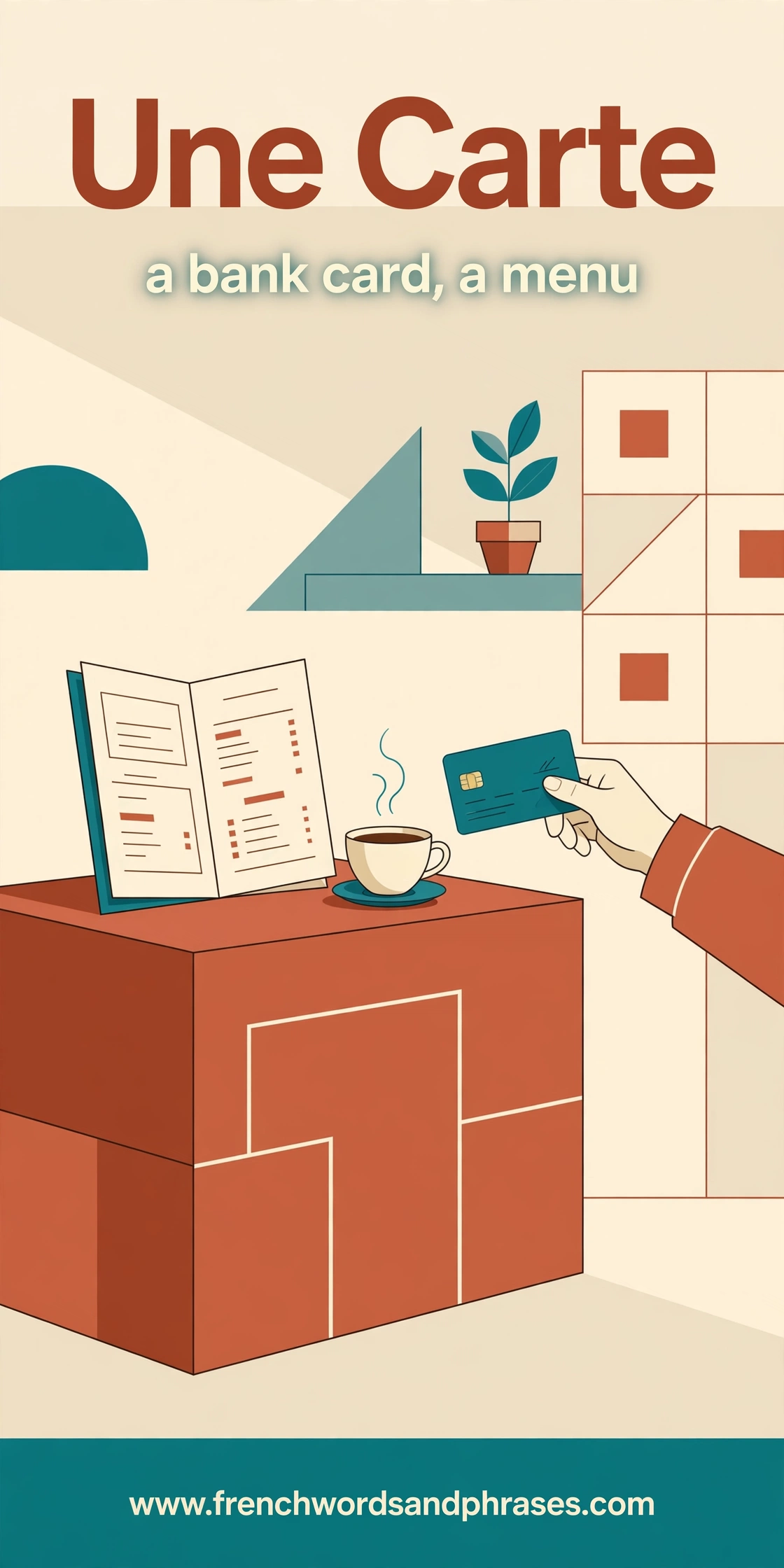
Une carte means a bank card, a menu.
The waiter sets down a leather-bound book, the card machine blinks at the till, and one small word is already running the whole evening — la carte, in both of its lives.
In this guide, you’ll learn what carte means in English, how to use it with its articles, how to form its plural, and how it appears in everyday French. Explore French examples, English translations, and practice quizzes.
Understanding the French Noun Carte
Carte is a feminine French noun. Like every French noun, it has a gender, and it is learned together with its article: la carte.
It has two great everyday meanings. At the bank and at the till, une carte is a card — above all the bank card you pay with: payer par carte. At the restaurant, la carte is the menu — the full list of dishes you choose from: la carte des vins, the wine list. One word, two lives, and context always tells you which one is meant.
Gender: Feminine
Definite article: la — la carte (the card; the menu)
Indefinite article: une — une carte (a card; a menu)
Plural: les cartes (the cards; the menus)
English equivalents: A bank card; a menu.
One important point: at a French restaurant, la carte and le menu are not the same thing! La carte is the whole list of dishes, from which you choose freely — manger à la carte. Le menu is a fixed-price set meal. Ask for one meaning the other and you will still eat well — but now you know.
Experience the Word
Carte is more than plastic, and more than paper. It is the moment of choosing — the card that says yes at the till, the menu that opens the evening like a story.
Imagine a small restaurant in Lyon. The waiter brings the carte, bound in leather, and for a moment the whole table falls silent — reading, dreaming, deciding.
You have not just paid, and not just ordered. You have chosen — par carte, and from la carte.
How to Use Carte in French: Complete Guide
Let’s explore how carte works in French, beginning with its articles.
Carte and Its Articles
French nouns are almost never used alone. The small word in front of the noun — the article — does a great deal of work.
Carte with the Definite Article (La, Les)
Used for a particular card or menu — the one in your hand.
| Number | French |
|---|---|
| Singular | la carte |
| Plural | les cartes |
Example
La carte des vins est très longue.
The wine list is very long.
Carte with the Indefinite Article (Une, Des)
Used when you speak of a card or a menu in general: a card, some menus.
| Number | French |
|---|---|
| Singular | une carte |
| Plural | des cartes |
Example
Je paie toujours avec une carte.
I always pay with a card.
Carte in Short Phrases (Par carte, À la carte…)
Carte takes no partitive article — instead, it lives inside the phrases of restaurants and tills.
| Expression | In English |
|---|---|
| par carte | by card |
| à la carte | from the full menu, choosing freely |
| la carte des vins | the wine list |
| une carte bancaire | a bank card |
| une carte de visite | a business card |
Example
Vous pouvez payer par carte, bien sûr.
You can pay by card, of course.
Quick Quiz 1
Complete the sentence:
Je préfère payer ______ carte, c’est plus simple.
Reveal the answer
par
Je préfère payer par carte, c’est plus simple.
I prefer to pay by card, it’s simpler.
The Plural of Carte
Carte adds a simple -s: les cartes.
| Number | French |
|---|---|
| Singular | la carte |
| Plural | les cartes |
Example
Elle collectionne les cartes postales anciennes.
She collects old postcards.
Carte with Possessive Adjectives (Ma, Ta, Sa…)
Possessives agree with the noun, not with the owner — and carte is feminine, so it takes ma, ta, sa.
| Owner | French |
|---|---|
| my | ma carte |
| your (tu) | ta carte |
| his / her | sa carte |
| our | notre carte |
| your (vous) | votre carte |
| their | leur carte |
Example
J’ai oublié ma carte à la maison.
I forgot my card at home.
Quick Quiz 2
Complete the sentence:
J’ai perdu ______ carte bancaire.
Reveal the answer
ma
J’ai perdu ma carte bancaire.
I lost my bank card. (Carte is feminine, so my is ma.)
Carte with Demonstrative Adjectives (Cette, Ces)
Used to point: this card here, those menus there.
| Number | French |
|---|---|
| Singular | cette carte |
| Plural | ces cartes |
Example
Cette carte est expirée.
This card has expired.
Carte with Adjectives
Some adjectives come before the noun — nouvelle, petite, grande — and the rest follow it. All of them agree with carte, which is feminine.
| Adjective | With Carte |
|---|---|
| nouvelle (new) | une nouvelle carte |
| petite (small) | une petite carte |
| grande (large) | la grande carte |
| ancienne (old) | une carte ancienne |
| bancaire (bank) | une carte bancaire |
| perdue (lost) | ma carte perdue |
Example
Le restaurant propose une nouvelle carte chaque saison.
The restaurant offers a new menu every season.
Quick Quiz 3
At a restaurant, what is the difference between la carte and le menu?
Reveal the answer
La carte is the full list of dishes you choose from; le menu is a fixed-price set meal.
Everyday Expressions with Carte
Carte deals in paying, choosing — and in one or two expressions about honesty and freedom.
| Expression | In English |
|---|---|
| payer par carte | to pay by card |
| manger à la carte | to eat choosing from the full menu |
| la carte des vins | the wine list |
| jouer cartes sur table | to lay one’s cards on the table, to be frank |
| donner carte blanche | to give someone a free hand |
| une carte de fidélité | a loyalty card |
Example
Le chef m’a donné carte blanche pour le dessert.
The chef gave me a free hand with the dessert.
Words from the Same Family as Carte
Learn these together and the whole restaurant falls into place.
| French | In English |
|---|---|
| le menu | the set menu |
| l’addition | the bill |
| un portefeuille | a wallet |
| les espèces | cash |
| un distributeur | a cash machine (ATM) |
| commander | to order |
Example
Après le repas, nous avons demandé l’addition.
After the meal, we asked for the bill.
Quick Quiz 4
How do you say the wine list in French?
Reveal the answer
la carte des vins
La carte des vins de ce restaurant est célèbre.
This restaurant’s wine list is famous.
Carte in Everyday French: Real-Life Examples
Now that you know the word, let’s see how carte appears in everyday French.
Example 1 — Paying
Je peux payer par carte, s’il vous plaît ?
Can I pay by card, please?
Example 2 — At the restaurant
La carte des desserts est très tentante.
The dessert menu is very tempting.
Example 3 — Lost
Je n’ai plus ma carte, je l’ai perdue.
I don’t have my card anymore, I lost it.
Example 4 — Choosing
Peut-on voir la carte, s’il vous plaît ?
Can we see the menu, please?
Example 5 — Cash or card
Elle paie toujours en espèces, jamais par carte.
She always pays in cash, never by card.
Example 6 — A new menu
Le restaurant change sa carte au printemps.
The restaurant changes its menu in the spring.
Beyond Translation: The Meaning of Carte
English needs two words — a card and a menu — where French calmly keeps one: carte.
To say carte is to hold the evening in your hands.
It is the bank card in the wallet and the wine list in the restaurant — and behind both, the same idea: a small card, covered in writing, that opens a world of choices.
How to Remember the French Noun Carte
Remember it this way: Carte is feminine — la carte — and it lives two lives: paying, and choosing.
- You pay at the till — tu paies par carte.
- You open the menu — tu lis la carte.
- You ask for the wines — la carte des vins.
The key idea is la carte to pay, la carte to choose — one word, two lives.
Test Your Knowledge of Carte
Let’s see how much you’ve learned. Try answering these questions before revealing the answers.
Question 1
Is carte masculine or feminine?
Reveal the answer
Feminine — la carte.
Question 2
How do you say to pay by card in French?
Reveal the answer
Payer par carte.
Question 3
Translate: Do you have a loyalty card?
Reveal the answer
Vous avez une carte de fidélité ?
Question 4
What does manger à la carte mean?
Reveal the answer
To eat choosing freely from the full menu — not a fixed set meal.
Question 5
Complete the sentence:
J’ai oublié ______ carte à la maison.
Reveal the answer
ma
J’ai oublié ma carte à la maison.
I forgot my card at home.
Your Final Challenge
Can You Use It?
How would you say this in French?
“My new bank card arrives tomorrow.”
Reveal the answer
Ma nouvelle carte bancaire arrive demain.
My new bank card arrives tomorrow.
A little French. A little curiosity. A richer everyday life.
LEARN FRENCH ONE WORD AT A TIME