A French Word to Live By
Translate Premier to English
/pʁə.mje/
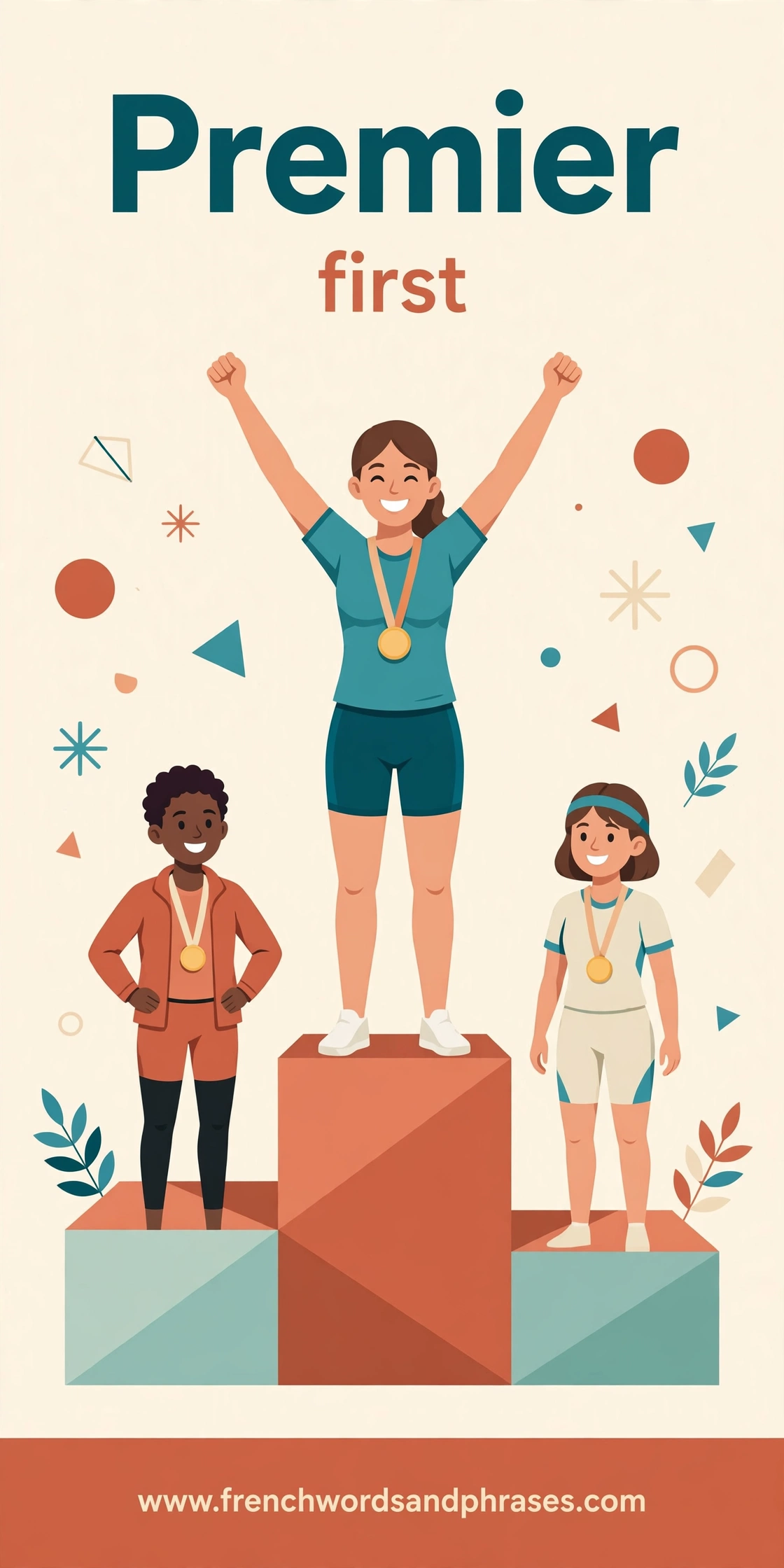
Premier means first.
The whole village is at the station for the first train of the spring timetable, and the mayor himself holds a ribbon across the platform. « Le premier train de la saison ! » Premier is the adjective of beginnings: the first step, the first page, the first name on the list — number one in the order of things.
In this guide, you’ll learn what premier means in English, how its feminine première is formed, why it stands before the noun, and how it differs from a plain number one. Explore French examples, English translations, and practice quizzes.
Understanding the French Adjective Premier
Premier is a French ordinal adjective — the adjective of rank one. It comes from the Latin primus, first, foremost. Unlike most French adjectives it stands BEFORE the noun: le premier jour, the first day. Its feminine is première, with a grave accent that changes the sound: premier ends in a soft -ié, première opens to -ière.
It means first — first in time (le premier train, the first train), first in order (la première page, the first page), first in rank (le premier prix, the first prize). It also lives in grand fixed phrases: le premier ministre, the prime minister; la première dame, the first lady; en premier, first of all. Note the family trap: a film’s opening night is une première — a premiere.
Type: Ordinal adjective — rank and order (the adjective of number one)
Answers the question: Lequel dans l’ordre ? — Which in the order? (Answer: the first)
Changes form: premier / première; premiers / premières — the feminine takes ère
English equivalents: First; prime (in premier ministre); opening (une première, a premiere).
One important usage detail: premier stands before its noun — le premier jour, la première fois — and in dates French uses it for the first of the month only: le premier mai, the first of May, but le deux mai, le trois mai for the days after. With a title it makes rank: le premier ministre is not just a minister who came first, he is the head of the government.
Experience the Word
Premier is the adjective of thresholds — everything that opens a series wears it: the first tooth, the first snow, the first word of a letter.
Imagine the school photograph on the first day of term: the smallest children in the front row, knees together, cards in their hands — premier jour d’école, and nobody in the picture will ever be quite that new again.
You have not just counted to one. You have marked the beginning of a story — and every story needs its premier.
How to Use Premier in French: Complete Guide
Let’s explore how premier works in French, beginning with the whole word on one card.
Premier at a Glance
Before the details, here is the whole word on one card.
The Whole Word on One Card
Meaning, type, position and forms — premier in four lines.
| Point | Premier |
|---|---|
| Meaning | first — number one in an order |
| Type | ordinal adjective — rank, time and order |
| Usual position | before the noun — le premier train |
| Form | premier / première — première / premières in the feminine and plural |
Example
C’est mon premier jour ici.
It is my first day here.
The Four Forms of Premier
Premier changes for the feminine: the ending -ier becomes -ière, and the sound opens with it.
| Form | Premier | Example |
|---|---|---|
| Masculine singular | premier | le premier jour — the first day |
| Feminine singular | première | la première page — the first page |
| Masculine plural | premiers | les premiers jours — the first days |
| Feminine plural | premières | les premières pages — the first pages |
Example
Les premières fleurs arrivent en mars.
The first flowers arrive in March.
Quick Quiz 1
What is the feminine of premier?
Reveal the answer
première
La première fois — the ending -ier becomes -ière, with a grave accent.
The first time.
The Feminine of Premier: Première
Première is not premier with an -e stuck on: the whole ending changes, -ier to -ière, and so does the sound.
| Situation | Example |
|---|---|
| Masculine | le premier train — the first train |
| Feminine | la première classe — first class (on a train) |
| Why | -ier adjectives make their feminine in -ière: premier → première, dernier → dernière |
| The plural | premières — les premières neiges, the first snows |
Example
Elle voyage en première classe.
She travels in first class.
Where Premier Goes: Before the Noun
Premier is one of the adjectives that lead: it stands before the noun, like a number — because that is almost what it is.
| Pattern | Example |
|---|---|
| Before the noun | le premier matin — the first morning |
| With a possessive | mon premier livre — my first book |
| Standing alone (a pronoun’s job) | le premier est arrivé — the first one arrived |
| After the noun | only in a few fixed names: la classe de première — the school year called première |
Example
Mon premier mot, paraît-il, était « maman ».
My first word, apparently, was ‘mummy’.
Quick Quiz 2
How do you say ‘my first house’ — ma maison première or ma première maison?
Reveal the answer
ma première maison
Premier stands before the noun, and maison is feminine, so première.
My first house.
More Premier: First Among Others
Premier does not compare with plus like ordinary adjectives — it IS the top of the scale. French expresses the ideas around it with fixed frames.
| Degree | Example |
|---|---|
| The first of all | le tout premier — the very first |
| First of all (in speech) | en premier, d’abord — first, firstly |
| At first sight | au premier regard — at first sight |
| First-class / top quality | de premier choix — of the finest quality |
Example
C’est le tout premier livre qu’il a écrit.
It is the very first book he wrote.
Everyday Expressions with Premier
Premier runs the calendar, the government and the railway — a very busy adjective.
| Expression | In English |
|---|---|
| le premier ministre | the prime minister |
| la première fois | the first time |
| le premier mai | the first of May (a holiday in France) |
| en première classe | in first class |
| une première | a premiere — the opening night of a film or play |
Example
Le premier mai, on offre du muguet.
On the first of May, people give lily of the valley.
Quick Quiz 3
What is une première at the cinema?
Reveal the answer
A premiere — the very first showing of a film.
La première du film est ce soir.
The film’s premiere is this evening.
Close Cousins: Premier, Deuxième, Dernier
The order shelf: premier opens the series, dernier closes it, and the ordinals march between them.
| Word | The difference |
|---|---|
| premier / première | first — the head of the line |
| deuxième / second | second — deuxième for a longer series, second when there are only two |
| dernier / dernière | last — the tail of the line, premier’s mirror |
| prochain | next — the one coming after now, not a rank |
Example
Le premier chapitre est court, le dernier est magnifique.
The first chapter is short, the last is magnificent.
Watch Out: The Traps Around Premier
The traps: putting premier after the noun, and building dates the English way.
| Trap | The truth |
|---|---|
| le jour premier | premier leads: le premier jour — always before the noun |
| le premier juin, le deuxième juin | only the 1st takes premier: le premier juin, then le deux juin, le trois juin — plain numbers |
| premier = « prime » everywhere | prime minister is le premier ministre, but a prime number is un nombre premier — check the fixed phrase |
| writing première without the accent | the feminine always carries è: première — the accent is the sound |
Example
Le premier juin, les écoles organisent la fête de fin d’année.
On the first of June, the schools organise the end-of-year party.
Quick Quiz 4
How do you say ‘the second of June’ — le deuxième juin or le deux juin?
Reveal the answer
le deux juin
After the first, French dates use plain numbers: le deux juin, le trois juin.
The second of June.
Premier in Everyday French: Real-Life Examples
Now that you know the word, let’s see how premier appears in everyday French.
Example 1 — Travel
Le premier train part à six heures.
The first train leaves at six o’clock.
Example 2 — Reading
J’ai lu la première page trois fois.
I read the first page three times.
Example 3 — First time
C’est la première fois que je viens ici.
It is the first time I have come here.
Example 4 — A date
Le premier mai est un jour de fête.
The first of May is a holiday.
Example 5 — Rank
Elle a gagné le premier prix.
She won the first prize.
Example 6 — First class
Ils voyagent en première classe.
They travel in first class.
Beyond Translation: The Meaning of Premier
Premier comes from the Latin primus — first, foremost, the one at the head. English borrowed the same root for prime and premiere, and French kept the whole family at home: the premier ministre leads the government, la première classe leads the train, and une première leads a film into the world.
To say premier is to stand at the head of a line and turn around: everything after it is a series.
It is also the adjective of tenderness — mon premier amour, sa première école — because beginnings, in French as in life, are the part we never forget.
How to Remember the French Adjective Premier
Remember it this way: Premier means first — it stands before the noun, and its feminine première changes the whole ending.
- It leads the noun — le premier jour, la première page, never after.
- The feminine turns — premier becomes première, with è and a new sound.
- Dates are its kingdom — le premier mai, then plain numbers: le deux, le trois.
The key idea is premier / première = first; before the noun; le premier mai but le deux juin.
Test Your Knowledge of Premier
Let’s see how much you’ve learned. Try answering these questions before revealing the answers.
Question 1
What does premier mean?
Reveal the answer
First — number one in an order of time, place or rank.
Question 2
What is the feminine of premier?
Reveal the answer
Première — la première fois, the first time.
Question 3
Translate: It is my first day.
Reveal the answer
C’est mon premier jour.
Question 4
Where does premier stand — before or after the noun?
Reveal the answer
Before the noun — le premier train, la première page.
Question 5
Complete the sentence:
______ première neige arrive en novembre. (the)
Reveal the answer
La
La première neige arrive en novembre.
The first snow arrives in November.
Your Final Challenge
Can You Use It?
How would you say this in French?
“It is the first time I have come here.”
Reveal the answer
C’est la première fois que je viens ici.
It is the first time I have come here.
A little French. A little curiosity. A richer everyday life.
LEARN FRENCH ONE WORD AT A TIME