A French Word to Live By
Translate Plutôt to English
/ply.to/
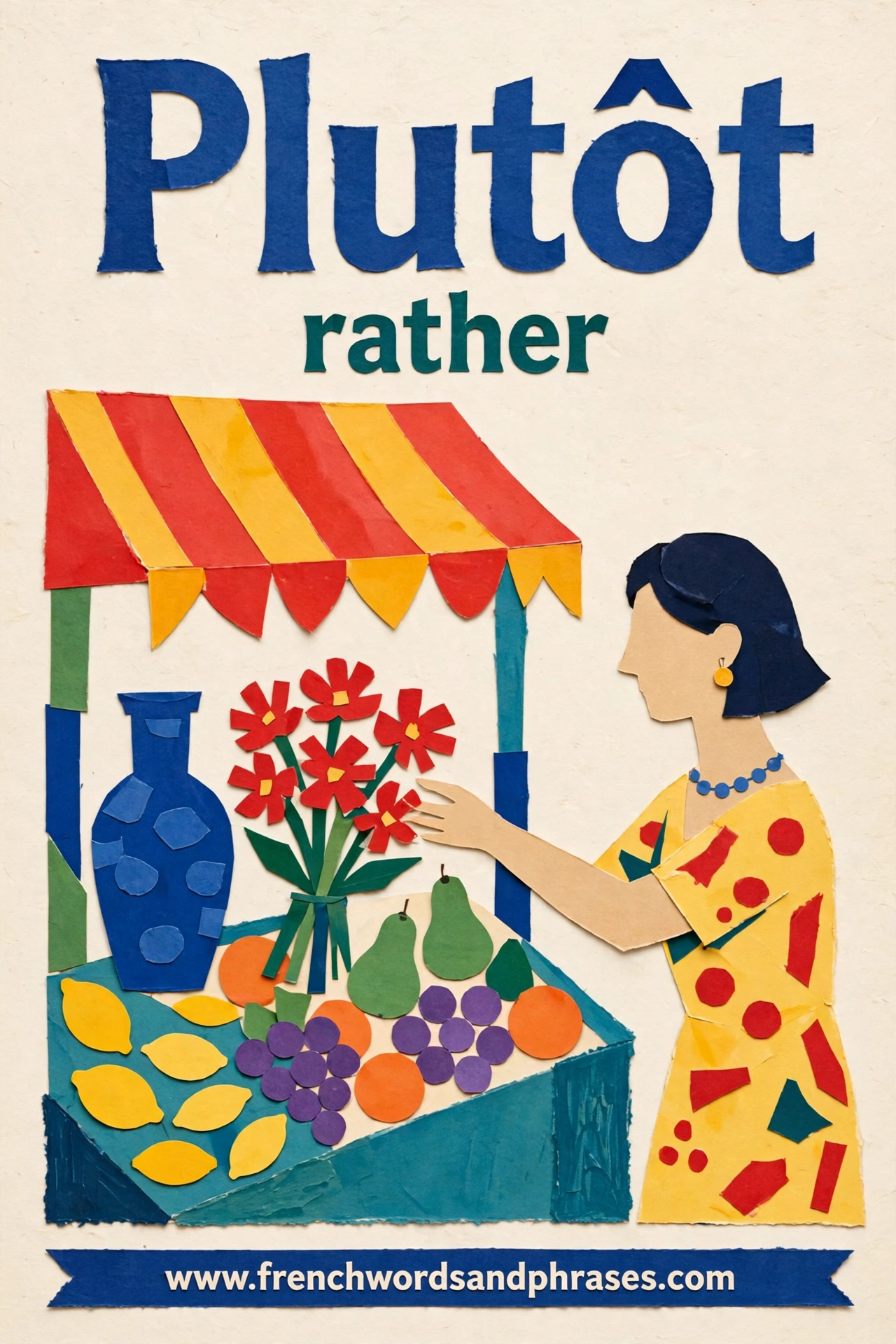
Plutôt means rather.
At the café terrace, the waiter hovers with his pencil: tea or coffee? She looks at the sky, at the hour, and decides: « Un thé, plutôt. » Not coffee — tea, plutôt: rather. The smallest of preferences, carried by one small word.
In this guide, you’ll learn what plutôt means in English, how it chooses between options and softens judgements, how it differs from plus tôt, and the expressions built on it. Explore French examples, English translations, and practice quizzes.
Understanding the French Adverb Plutôt
Plutôt is a French adverb of manner and degree. It is plus (more) plus tôt (early) fused long ago, but today it chooses and it qualifies: rather, instead; and rather, quite. Its spelling — one word, circumflex on the ô — is what separates it from plus tôt, earlier, two words about the clock.
It means rather. Je préfère le thé, plutôt — or more naturally, je prendrai plutôt un thé: I will rather have a tea, I will have a tea instead. It also softens judgements like English rather: c’est plutôt bon, it is rather good. One word, two gentle jobs: choosing, and grading.
Type: Adverb of manner and degree — preference
Answers the question: How? — rather, instead; to what degree? — rather, quite
Changes form: Never — plutôt is invariable
English equivalents: Rather; instead; (plutôt que) rather than.
One important usage detail: plutôt (one word) is preference and degree — plutôt que de partir, rather than leaving. Plus tôt (two words) is the clock — pars plus tôt, leave earlier. The circumflex on plutôt and the space in plus tôt are the whole difference, and French spelling keeps them faithfully apart.
Experience the Word
Plutôt is the adverb of the civilised choice. It never slams a door; it tilts. Tea rather than coffee, the train rather than the car, a film that is plutôt moving — everything in the world of plutôt is a matter of leaning.
Imagine the market stall: the cheesemaker offers a taste of both — « Celui-ci est fort ; celui-là est plutôt doux. » The whole art of French taste lives in that plutôt: not sweet, not mild — rather sweet, doux with a tilt.
You have not just chosen. You have leaned, gracefully, towards one side.
How to Use Plutôt in French: Complete Guide
Let’s explore how plutôt works in French, beginning with the whole word on one card.
Plutôt at a Glance
Before the details, here is the whole word on one card.
The Whole Word on One Card
Meaning, type, position and form — plutôt in four lines.
| Point | Plutôt |
|---|---|
| Meaning | rather, instead |
| Type | adverb of manner and degree — preference |
| Usual position | before the word it qualifies, or after the verb |
| Form | invariable — never changes |
Example
Je prendrai plutôt un café.
I will rather have a coffee (instead).
Where Plutôt Goes in the Sentence
Plutôt stands before the adjective or verb it tilts, and it can close a short answer like a decision: Un thé, plutôt.
| Situation | Pattern |
|---|---|
| Before an adjective | plutôt + adjective — plutôt fatigué |
| Before a verb choice | je préfère plutôt rester — I would rather stay |
| Rather than | plutôt que (de) + noun/infinitive |
| Short answer | — Thé ou café ? — Un thé, plutôt. |
Example
Plutôt que de conduire, prenons le train.
Rather than driving, let’s take the train.
Quick Quiz 1
True or false: plutôt and plus tôt mean the same thing.
Reveal the answer
False
Plutôt (one word) = rather. Plus tôt (two words) = earlier.
Pars plus tôt demain. — Leave earlier tomorrow.
Plutôt Choosing: Rather, Instead
In its first job, plutôt picks one option over another — the adverb of the menu, the itinerary and the plan B.
| Situation | Example |
|---|---|
| Food and drink | Je prendrai plutôt une salade. |
| Transport | Allons-y plutôt en train. |
| Plans | On se voit plutôt demain ? |
| Work | Je préfère travailler plutôt le matin. |
| Weather plans | S’il pleut, restons plutôt à la maison. |
Example
Plutôt la mer ou plutôt la montagne, cette année ?
The sea rather, or the mountains rather, this year?
Plutôt Grading: Rather, Quite
In its second job, plutôt softens an adjective — the French understatement machine.
| Expression | In English |
|---|---|
| plutôt bon | rather good |
| plutôt fatigué | rather tired |
| plutôt cher | rather expensive |
| plutôt content | rather pleased |
| plutôt rare | rather rare |
Example
Le film est plutôt long, mais plutôt beau.
The film is rather long, but rather beautiful.
Quick Quiz 2
Complete the sentence:
______ que de prendre la voiture, allons-y en bus. (Rather)
Reveal the answer
Plutôt
Plutôt que de prendre la voiture, allons-y en bus.
Rather than taking the car, let’s go by bus.
Plutôt and Its Neighbours
Plus tôt is the clock twin; au lieu de is the stronger replacement; assez shares the grading work.
| French | In English |
|---|---|
| plutôt | rather, instead |
| plus tôt | earlier (time) — two words |
| au lieu de | instead of (a firmer swap) |
| assez | quite, fairly (a grading cousin) |
Example
Pars plus tôt, et prends plutôt le train que la voiture.
Leave earlier, and take the train rather than the car.
Plutôt or Plus Tôt? The Famous Pair
The trap of this page, and one of the most tested in French spelling. Ask one question: is it about choice or about the clock?
| Aspect | The Difference |
|---|---|
| plutôt (one word, ô) | preference or degree — plutôt un thé ; plutôt bon |
| plus tôt (two words) | earlier in time — arrive plus tôt |
| Test with earlier | If earlier fits the sentence, write plus tôt |
| Test with rather | If rather fits, write plutôt |
Example
Viens plus tôt, et prends plutôt une chaise près de la fenêtre.
Come earlier, and rather take a chair near the window.
Quick Quiz 3
What does plutôt que mean?
Reveal the answer
Rather than
Plutôt que de regarder la télévision, lis un livre.
Rather than watching television, read a book.
Plutôt in Polite French
Plutôt is the softener of requests and opinions — it lets French speakers disagree, suggest and decline without a single sharp edge.
| Situation | Example |
|---|---|
| A gentle suggestion | On pourrait plutôt commencer par la fin ? |
| A soft no | Je préférerais plutôt rester ici. |
| An opinion, hedged | C’est plutôt une question de temps. |
| A correction, kindly | C’est plutôt le contraire, non ? |
Example
Je dirais plutôt que tout dépend du temps.
I would rather say that everything depends on the weather.
Watch Out: Rather Is Not Earlier
English rather and earlier never collide; French plutôt and plus tôt collide constantly in learners’ notebooks. Keep the clock test close.
| Mistake | Correct French |
|---|---|
| « pars plutôt demain » for leave earlier tomorrow | pars plus tôt demain |
| « je prendrai plus tôt un thé » for I will rather have a tea | je prendrai plutôt un thé |
| « plutôt de partir » alone | plutôt que de partir |
| « plutôt » written without its circumflex in careful writing | plutôt — the ô keeps it apart from plus tôt |
Example
Demain, lève-toi plus tôt, et prends plutôt le bus.
Tomorrow, get up earlier, and rather take the bus.
Quick Quiz 4
Choose the correct French: Leave earlier! — Pars ______ ! (plutôt / plus tôt)
Reveal the answer
plus tôt
It is about the clock, so two words: plus tôt.
Plutôt would mean Pars rather… — rather than what?
Plutôt in Everyday French: Real-Life Examples
Now that you know the word, let’s see how plutôt appears in everyday French.
Example 1 — At the café
Pour moi, plutôt un jus d’orange.
For me, rather an orange juice.
Example 2 — Travel
Plutôt que de voler, prenons le train de nuit.
Rather than flying, let’s take the night train.
Example 3 — Opinions
Le nouveau restaurant est plutôt bon.
The new restaurant is rather good.
Example 4 — Plans
On se retrouve plutôt vers sept heures ?
Shall we meet rather around seven?
Example 5 — Weather
Il fait plutôt frais ce matin.
It is rather chilly this morning.
Example 6 — Advice
Plutôt que de te fâcher, explique-lui calmement.
Rather than getting angry, explain to him calmly.
Beyond Translation: The Meaning of Plutôt
Some adverbs command, and some persuade. Plutôt persuades: it is the diplomacy of French in one word, tilting choices and softening verdicts, letting a whole nation disagree without ever raising its voice.
To say plutôt is to lean — towards the tea, towards the train, towards the kinder reading of the film.
And its spelling carries the moral: one small circumflex separates preference from the clock, plutôt from plus tôt — attention, again, is everything.
How to Remember the French Adverb Plutôt
Remember it this way: Plutôt means rather — it chooses and it grades — and it is one word, against the clock’s two-word plus tôt.
- You choose at the café — un thé, plutôt.
- You grade the film — plutôt long, mais plutôt beau.
- You test the clock — earlier is plus tôt, two words; rather is plutôt.
The key idea is rather — one word for choice and degree; plus tôt (two words) = earlier.
Test Your Knowledge of Plutôt
Let’s see how much you’ve learned. Try answering these questions before revealing the answers.
Question 1
What does plutôt mean?
Reveal the answer
Rather — rather/instead for choices, rather/quite for grading.
Question 2
What is the difference between plutôt and plus tôt?
Reveal the answer
Plutôt (one word) = rather; plus tôt (two words) = earlier.
Question 3
Translate: I will rather have a tea.
Reveal the answer
Je prendrai plutôt un thé.
Question 4
What does plutôt que de mean?
Reveal the answer
Rather than — plutôt que de conduire, rather than driving.
Question 5
Complete the sentence:
Le gâteau est ______ bon. (rather)
Reveal the answer
plutôt
Le gâteau est plutôt bon.
The cake is rather good.
Your Final Challenge
Can You Use It?
How would you say this in French?
“Rather than driving, let’s take the train.”
Reveal the answer
Plutôt que de conduire, prenons le train.
Rather than driving, let’s take the train.
A little French. A little curiosity. A richer everyday life.
LEARN FRENCH ONE WORD AT A TIME