A French Word to Live By
Translate Plus tard to English
/ply taʁ/
Plus tard means later.
The kitchen is full, the soup is on, the phone rings — and a voice says the most useful two words of the French day: « Je te rappelle plus tard. » Not now, not never: later. Everything postponed in France is postponed with plus tard.
In this guide, you’ll learn what plus tard means in English, where it sits in a French sentence, how it grows into à plus tard, and how it differs from ensuite and tout à l’heure. Explore French examples, English translations, and practice quizzes.
Understanding the French Adverb Plus tard
Plus tard is a French adverb of time — literally ‘more late’, the comparative of tard. It points to a moment after the present one: later, later on. It never changes its form, and it works in every register, from the text message to the formal letter.
It means later. On verra plus tard — we will see later. Plus tard can mean a few minutes from now or years from now: the words themselves do not say how long the wait is — the context, a shrug, or a second phrase (plus tard dans la journée, plus tard cette année) does that. Standing at the end of a goodbye, it becomes the famous à plus tard — see you later.
Type: Adverb of time — a later moment
Answers the question: When? — later, after now
Changes form: Never — plus tard is invariable
English equivalents: Later; later on; (in à plus tard) see you later.
One important usage detail: plus tard always looks forward from now. For ‘later’ measured from a past moment — ‘three days later’ in a story — French still uses plus tard: trois jours plus tard, il est revenu, three days later, he came back. And mind the goodbye: à plus tard keeps its à — dropping it turns the farewell into a plain statement.
Experience the Word
Plus tard is the adverb of the gentle postponement. It refuses nothing; it simply moves the thing along the day, or along the year, to a moment when there will be room for it.
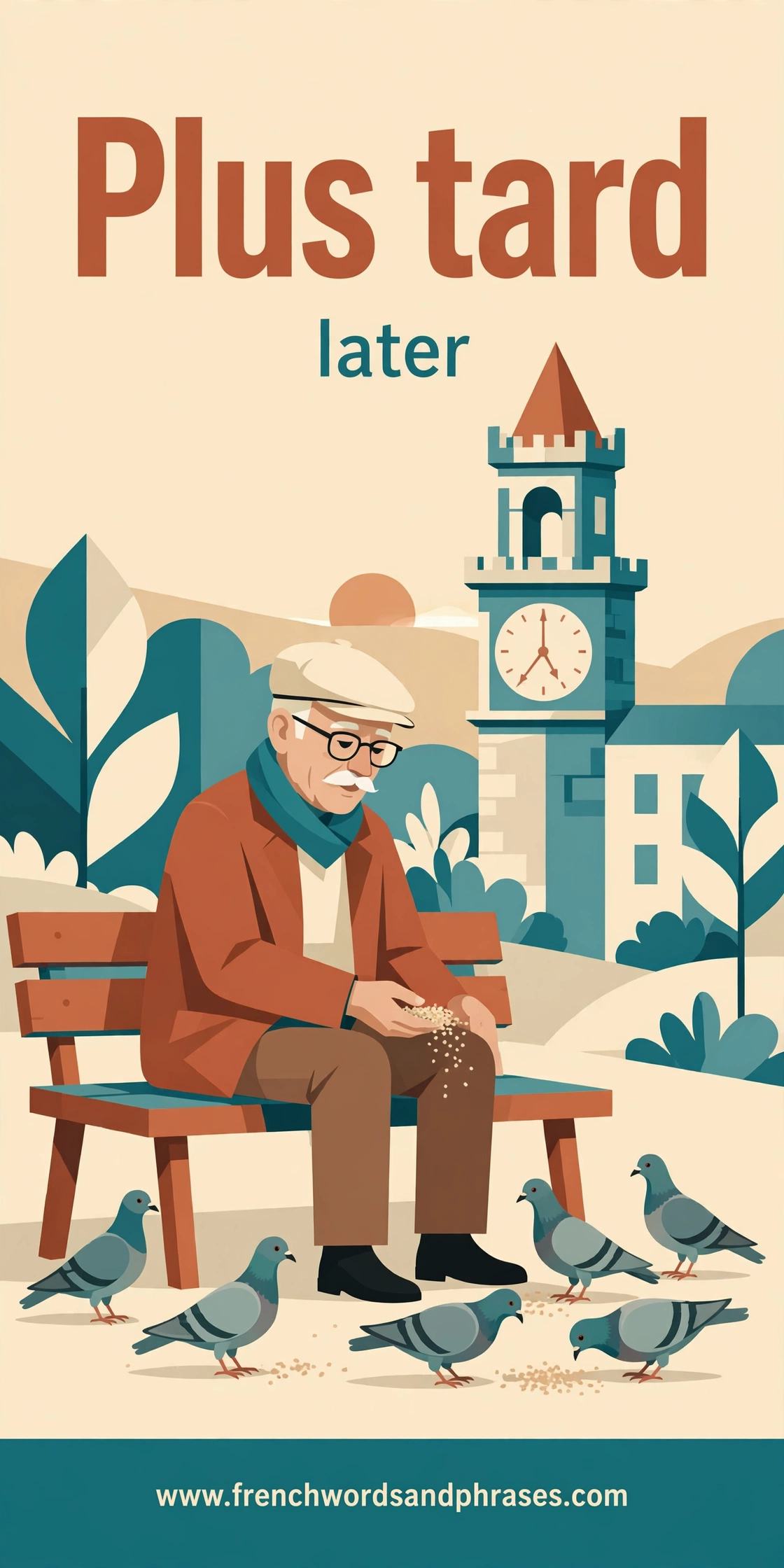
Imagine a French family kitchen at seven in the evening: homework on the table, a pan on the stove, a grandchild asking for a story. « Plus tard », says grandmother, « après le dîner » — and the promise is as good as kept.
You have not just delayed something. You have given the future a small, definite appointment.
How to Use Plus tard in French: Complete Guide
Let’s explore how plus tard works in French, beginning with the whole phrase on one card.
Plus tard at a Glance
Before the details, here is the whole phrase on one card.
The Whole Phrase on One Card
Meaning, type, position and form — plus tard in four lines.
| Point | Plus tard |
|---|---|
| Meaning | later |
| Type | adverb of time — a moment after now |
| Usual position | at the end of the sentence, or after the verb |
| Form | invariable — never changes |
Example
Je finirai ce travail plus tard.
I will finish this work later.
Where Plus tard Goes in the Sentence
Plus tard is an end-of-sentence word: it settles after the verb and its objects, like a date written at the bottom of a page. It can also open a sentence for emphasis.
| Situation | Pattern |
|---|---|
| End of the sentence (most common) | Je te téléphonerai plus tard — I will phone you later |
| After the verb in short sentences | On verra plus tard — we will see later |
| Head of the sentence (emphasis) | Plus tard, + sentence — Plus tard, nous en parlerons |
| Measured from a moment | trois jours plus tard — three days later |
Example
Nous en parlerons plus tard, quand tout le monde sera là.
We will talk about it later, when everyone is here.
Quick Quiz 1
True or false: plus tard can only mean a few minutes from now.
Reveal the answer
False
Plus tard stretches from minutes to years — the context decides.
Plus tard, quand je serai grand… — Later, when I am grown up…
Measuring the Wait: Plus tard with Time Words
Add a measure, and plus tard becomes precise — minutes, days or whole years after the moment you start from.
| French | In English |
|---|---|
| quelques minutes plus tard | a few minutes later |
| une heure plus tard | an hour later |
| trois jours plus tard | three days later |
| des années plus tard | years later |
| plus tard dans la journée | later in the day |
Example
Deux heures plus tard, le train est enfin arrivé.
Two hours later, the train finally arrived.
Plus tard in Promises and Postponements
In daily life, plus tard is the word of the rescheduled plan — the meeting moved, the call returned, the visit promised.
| French | In English |
|---|---|
| je te rappelle plus tard | I will call you back later |
| on verra plus tard | we will see later |
| remettre à plus tard | to put off until later, to postpone |
| à faire plus tard | to do later (on a list) |
| plus tard, peut-être | later, perhaps |
Example
Il a remis la réunion à plus tard.
He postponed the meeting until later.
Quick Quiz 2
Complete the sentence:
Je finirai ce rapport ______. (later)
Reveal the answer
plus tard
Je finirai ce rapport plus tard.
I will finish this report later.
Plus tard and Its Neighbours
French arranges the rest of the day with a small family of words. Plus tard is the general one; each neighbour fixes the wait a little differently.
| French | In English |
|---|---|
| ensuite | then, next (the next step in a sequence) |
| après | afterwards |
| tout à l’heure | in a little while (later today); also: a moment ago |
| bientôt | soon |
| un jour | one day (some day, vaguely) |
Example
D’abord le travail, ensuite le déjeuner, et les messages plus tard.
First work, then lunch, and the messages later.
The Family Behind Plus tard: Tard
Plus tard is built from tard, late — and its family runs from the early bird to the night owl.
| French | In English |
|---|---|
| tard | late — il est tard, it is late |
| tôt | early — the opposite: il est tôt |
| en retard | late, behind schedule (for a person or a train) |
| tarder à | to take a long time to, to delay — il tarde à répondre |
| au plus tard | at the latest — vendredi au plus tard |
Example
Le dossier doit arriver vendredi au plus tard.
The file must arrive by Friday at the latest.
Quick Quiz 3
What does au plus tard mean in: « Rendez-vous à midi au plus tard »?
Reveal the answer
At the latest
Rendez-vous à midi au plus tard.
Let’s meet at noon at the latest.
Plus tard or Ensuite?
Both can follow an event, but they do not mean the same thing. Ensuite names the next step; plus tard simply moves something further away from now.
| Aspect | The Difference |
|---|---|
| ensuite | the next step in an order — first this, ensuite that |
| plus tard | at a later time — the gap can be long and vague |
| Test sentence | On mange, ensuite on se repose. / On en parlera plus tard. |
| Safe rule | Telling a story step by step? ensuite. Postponing something? plus tard. |
Example
Elle a d’abord téléphoné, ensuite elle est partie ; le rapport, elle l’écrira plus tard.
First she phoned, then she left; the report, she will write it later.
Watch Out: Traps with Plus tard
Three traps wait around plus tard — a goodbye that needs its à, a cousin that looks both ways, and an English word order to unlearn.
| Mistake | Correct French |
|---|---|
| Saying « plus tard ! » as a goodbye | À plus tard ! — the farewell keeps its à |
| Confusing tout à l’heure with plus tard | Tout à l’heure means in a little while — and, looking back, a moment ago: il est arrivé tout à l’heure |
| Putting plus tard before the verb, English-style | Je te verrai plus tard — plus tard goes after the verb, at the end |
| « Plus tard que » for later than | Plus tard que prévu — later than expected: keep the que |
Example
Le train est arrivé plus tard que prévu.
The train arrived later than expected.
Quick Quiz 4
How do you say ‘See you later!’ as a goodbye?
Reveal the answer
À plus tard !
The little à turns the time phrase into a farewell.
— On se voit demain ? — Oui, à plus tard !
Plus tard in Everyday French: Real-Life Examples
Now that you know the word, let’s see how plus tard appears in everyday French.
Example 1 — On the phone
Je suis occupé, je te rappelle plus tard.
I am busy, I will call you back later.
Example 2 — At work
Nous finirons la réunion plus tard, après la pause.
We will finish the meeting later, after the break.
Example 3 — Family
Les enfants, on lira l’histoire plus tard, après le dîner.
Children, we will read the story later, after dinner.
Example 4 — A story
Trois ans plus tard, elle est revenue au village.
Three years later, she came back to the village.
Example 5 — Shopping
Je n’ai pas le temps aujourd’hui ; je reviendrai plus tard.
I do not have time today; I will come back later.
Example 6 — A goodbye
Bon, je dois partir. À plus tard !
Well, I have to go. See you later!
Beyond Translation: The Meaning of Plus tard
English says later for the meaning of plus tard — but the French phrase is a small comparison: plus tard, ‘more late’, as if time itself came in degrees and you could always choose a later one.
To say plus tard is to trust the day to make room.
It is the politest refusal in French, the softest promise, and — with its little à — the warmest of goodbyes: à plus tard, see you in the more-late part of the day.
How to Remember the French Adverb Plus tard
Remember it this way: Plus tard is the gentle postponement — nothing refused, everything moved a little further along the day.
- You park it at the end — je te rappelle plus tard.
- You measure with it — trois jours plus tard, il est revenu.
- You add the à for goodbye — à plus tard !
The key idea is later — after the verb, measured from any moment, and à plus tard to say goodbye.
Test Your Knowledge of Plus tard
Let’s see how much you’ve learned. Try answering these questions before revealing the answers.
Question 1
What does plus tard mean?
Reveal the answer
Later — at a moment after now (or after the moment in question).
Question 2
How do you say three days later?
Reveal the answer
Trois jours plus tard.
Question 3
Translate: I will call you back later.
Reveal the answer
Je te rappelle plus tard.
Question 4
What does au plus tard mean?
Reveal the answer
At the latest — vendredi au plus tard, by Friday at the latest.
Question 5
Complete the sentence:
On verra ______. (later)
Reveal the answer
plus tard
On verra plus tard.
We will see later.
Your Final Challenge
Can You Use It?
How would you say this in French?
“I am busy now; I will call you back later.”
Reveal the answer
Je suis occupé maintenant ; je te rappelle plus tard.
I am busy now; I will call you back later.
A little French. A little curiosity. A richer everyday life.
LEARN FRENCH ONE WORD AT A TIME