A French Word to Live By
Translate Pied to English
/pje/
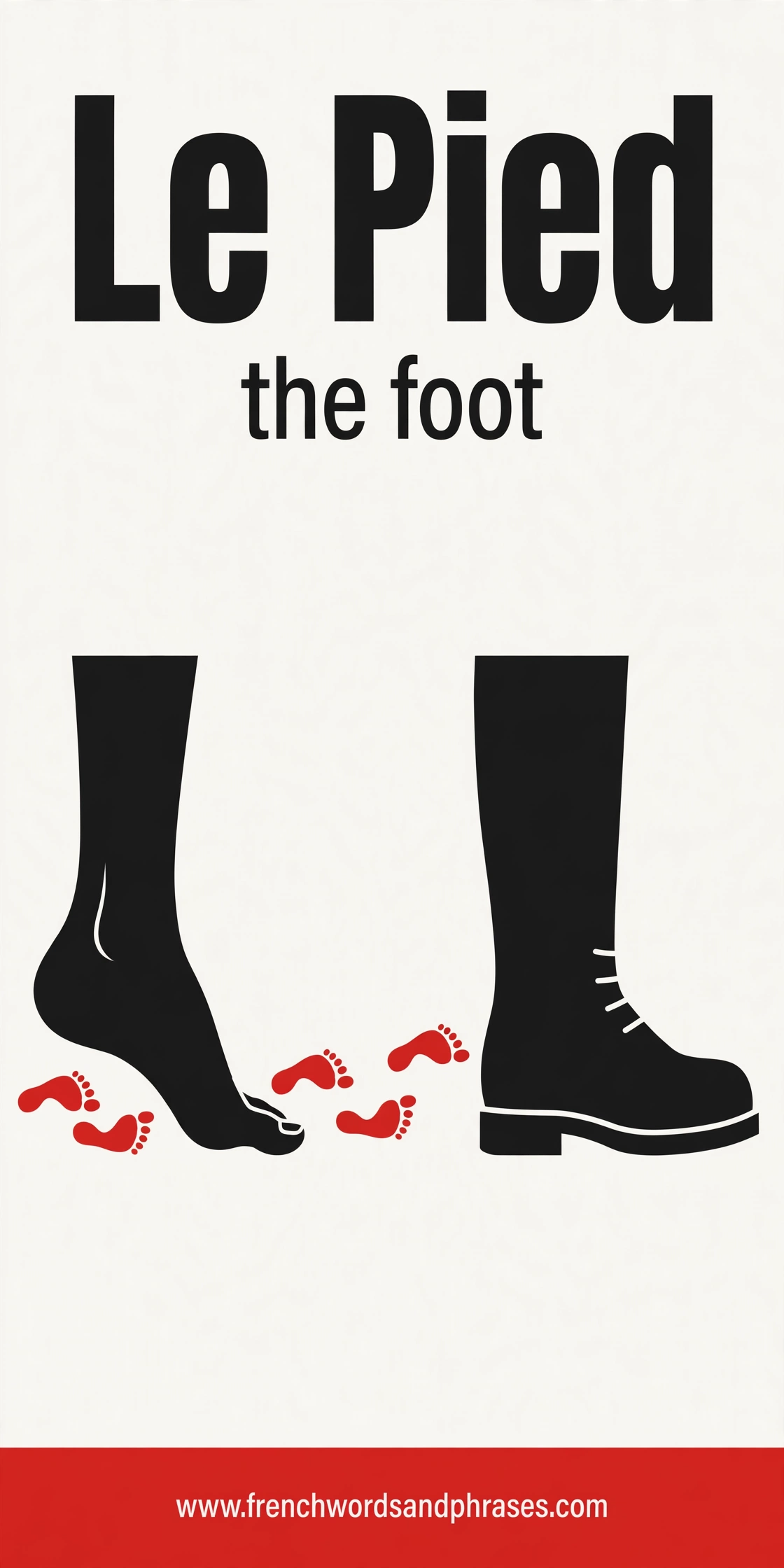
Le pied means the foot.
The hikers reach the summit path at dawn, boots laced, and the oldest of them laughs: « On y va à pied, comme toujours ! » Everything in the day ahead will be measured by one instrument — le pied, the foot.
In this guide, you’ll learn what pied means in English, how to use it with its articles, how to form its plural, and how it appears in everyday French. Explore French examples, English translations, and practice quizzes.
Understanding the French Noun Pied
Pied is a masculine French noun, learned with its article: le pied, un pied. The final -d is silent — the word is said /pje/ — and the plural simply adds an -s: les pieds. Beyond the body, un pied is also the foot of a mountain, of a table, of a page.
It means the foot — the end of the leg you stand and walk on, le pied droit and le pied gauche, right and left. French walks everywhere on this word: going à pied is going on foot, un coup de pied is a kick, and the foot of a thing — le pied de la montagne, le pied de la table — is its base, where it meets the ground.
Gender: Masculine — le pied, un pied
Plural: les pieds — the final -d stays silent
On foot: à pied — aller à pied, to go on foot
A kick: un coup de pied
The base: le pied de la montagne, le pied de la table
English equivalents: The foot; the base, the bottom
One usage detail: pied is the star of a celebrated blunder — mettre les pieds dans le plat, to put your feet in the dish, is to blurt out the awkward thing everyone was avoiding. Watch, too, for the trap of the silent -d: pied looks as if it should end in a hard sound, but it rhymes with léger, not with aide.
Experience the Word
Pied is how France was explored: before trains, before cars, the whole country was crossed à pied, village to village, market to market, pilgrims walking to Compostela one pied after the other.
Imagine the GR trails at first light: red-and-white marks on the trees, dew on the grass, and a line of walkers trusting the oldest vehicle there is — deux pieds, well shod, and a whole mountain ahead.
You have not just named the end of a leg. You have named the measure of every journey.
How to Use Pied in French: Complete Guide
Let’s explore how pied works in French, beginning with its articles — le for one foot, les for the pair that carries you.
Pied with the Definite Article (Le, Les)
The foot is masculine: le in the singular, les in the plural.
| Form | French |
|---|---|
| Masculine singular | le pied |
| Plural | les pieds |
Example
Le pied droit lui fait mal après la marche.
His right foot hurts after the walk.
Pied with the Indefinite Article (Un, Des)
Used for a foot in general — un pied, a foot; des pieds, feet.
| Form | French |
|---|---|
| Masculine singular | un pied |
| Plural | des pieds |
Example
Il a un pied plus grand que l’autre.
He has one foot bigger than the other.
Pied with the Partitive and Quantities (Des, Un coup de…)
Feet are counted in pairs and their actions in blows — a kick is a measured unit.
| Quantity | French |
|---|---|
| a kick | un coup de pied |
| a pair of feet | une paire de pieds |
| bare feet | les pieds nus |
| at the foot of the mountain | au pied de la montagne |
Example
Il donne un coup de pied dans le ballon.
He gives the ball a kick.
Quick Quiz 1
Complete the sentence:
Nous y allons ______ pied, c’est tout près. (on foot)
Reveal the answer
à
Nous y allons à pied, c’est tout près.
We’re going on foot, it’s very close — à pied, the fixed phrase for walking.
The Plural of Pied
Pied adds an -s in the plural — les pieds — and the -d remains silent, singular and plural alike.
| Number | French |
|---|---|
| Singular | le pied |
| Plural | les pieds |
Example
Les pieds des enfants pataugent dans la flaque.
The children’s feet splash in the puddle.
Pied with Possessive Adjectives (Mon, Ton, Son…)
Possessives agree with the noun — pied is masculine, so it takes mon, ton, son.
| Owner | French |
|---|---|
| my | mon pied |
| your (tu) | ton pied |
| his / her | son pied |
| our | notre pied |
| your (vous) | votre pied |
| their | leur pied |
Example
Mon pied a glissé sur une pierre mouillée.
My foot slipped on a wet stone.
Quick Quiz 2
Complete the sentence:
En disant cela, il a mis les ______ dans le plat !
Reveal the answer
pieds
En disant cela, il a mis les pieds dans le plat !
By saying that, he really put his foot in it — the classic blunder, feet first.
Pied with Demonstrative Adjectives (Ce, Ces)
Used to point: ce pied, this foot; ces pieds, these feet.
| Form | French |
|---|---|
| Masculine singular | ce pied |
| Plural | ces pieds |
Example
Ce pied de table est bancal.
This table leg is wobbly.
Pied with Adjectives
Adjectives agree with pied — masculine forms, and most follow the noun.
| Adjective | With Pied |
|---|---|
| nu (bare) | les pieds nus |
| plat (flat) | les pieds plats |
| petit (small) | un petit pied |
| fatigué (tired) | les pieds fatigués |
| droit (right) | le pied droit |
Example
Les enfants courent pieds nus sur le sable chaud.
The children run barefoot on the hot sand.
Quick Quiz 3
Complete the sentence:
Le randonneur a mal ______ pieds. (to the)
Reveal the answer
aux
Le randonneur a mal aux pieds.
The hiker’s feet hurt — avoir mal aux pieds, with aux for the plural.
Everyday Expressions with Pied
Kicks, blunders and grass cut from under you — the pied phrases of daily life.
| Expression | In English |
|---|---|
| à pied | on foot |
| un coup de pied | a kick |
| mettre les pieds dans le plat | to put your foot in it |
| couper l’herbe sous le pied de quelqu’un | to cut the ground from under someone |
| pieds nus | barefoot |
| ne pas savoir sur quel pied danser | not to know which way to turn |
Example
Elle lui a coupé l’herbe sous le pied en annonçant la nouvelle avant lui.
She cut the ground from under him by announcing the news before he could.
Words from the Same Family as Pied
Pedestrians, pedals and standing firm — the words that travel with pied.
| French | In English |
|---|---|
| le piéton | the pedestrian |
| la pédale | the pedal |
| piétiner | to stamp, to trample; to mark time |
| le pied-à-terre | a small flat, a base in town |
| à pied | on foot |
| le repose-pieds | the footrest |
Example
Les piétons traversent au passage clouté.
The pedestrians cross at the zebra crossing.
Quick Quiz 4
What does mettre les pieds dans le plat mean?
Reveal the answer
To put your foot in it — to say the awkward thing out loud, feet first into the dish.
En parlant du retard devant le directeur, il a mis les pieds dans le plat.
By mentioning the delay in front of the director, he really put his foot in it.
Pied in Everyday French: Real-Life Examples
Now that you know the word, let’s see how pied appears in everyday French.
Example 1 — Going to school
Les enfants vont à l’école à pied.
The children walk to school.
Example 2 — After a hike
Après vingt kilomètres, j’ai mal aux pieds.
After twenty kilometres, my feet hurt.
Example 3 — At the beach
Elle marche pieds nus au bord de l’eau.
She walks barefoot at the water’s edge.
Example 4 — A blunder
Il a mis les pieds dans le plat dès la première phrase.
He put his foot in it from the very first sentence.
Example 5 — Football
Un coup de pied précis, et le ballon est au fond des filets.
A precise kick, and the ball is in the back of the net.
Example 6 — At home
Le chat dort au pied du lit.
The cat sleeps at the foot of the bed.
Beyond Translation: The Meaning of Pied
Few words carry as much of France as pied. The great pilgrim and hiking routes are measured in pieds; the Republic’s soldiers marched on them; and the language keeps the foot as its unit of honesty — mettre les pieds dans le plat for the blunder, couper l’herbe sous le pied for the rival beaten to the punch, sur pied for anything set back on its feet and standing.
To say pied is to stand on the ground truth of things.
It evokes dusty trails and nursery rhymes, football and first steps — and the quiet pride of a country that still walks, à pied, whenever it can.
How to Remember the French Noun Pied
Remember it this way: Pied is the foot — masculine, le pied — the word for walking, kicking, and landing in the dish when you blunder.
- You walk with it — le pied, aller à pied.
- You kick with it — un coup de pied.
- You blunder with both — mettre les pieds dans le plat.
The key idea is le pied — the foot that walks, kicks and blunders.
Test Your Knowledge of Pied
Let’s see how much you’ve learned. Try answering these questions before revealing the answers.
Question 1
Is pied masculine or feminine?
Reveal the answer
Masculine — le pied, un pied.
Question 2
How do you say ‘on foot’ in French?
Reveal the answer
À pied — nous y allons à pied, we’re going on foot.
Question 3
Translate: My feet hurt.
Reveal the answer
J’ai mal aux pieds.
Question 4
What is un coup de pied?
Reveal the answer
A kick — literally, a blow of the foot.
Question 5
Complete the sentence:
Les enfants marchent ______ nus sur la plage.
Reveal the answer
pieds
Les enfants marchent pieds nus sur la plage.
The children walk barefoot on the beach.
Your Final Challenge
Can You Use It?
How would you say this in French?
“The children walk to school on foot every morning.”
Reveal the answer
Les enfants vont à l’école à pied tous les matins.
The children walk to school on foot every morning.
A little French. A little curiosity. A richer everyday life.
LEARN FRENCH ONE WORD AT A TIME