A French Word to Live By
Translate Petit to English
/pə.ti/
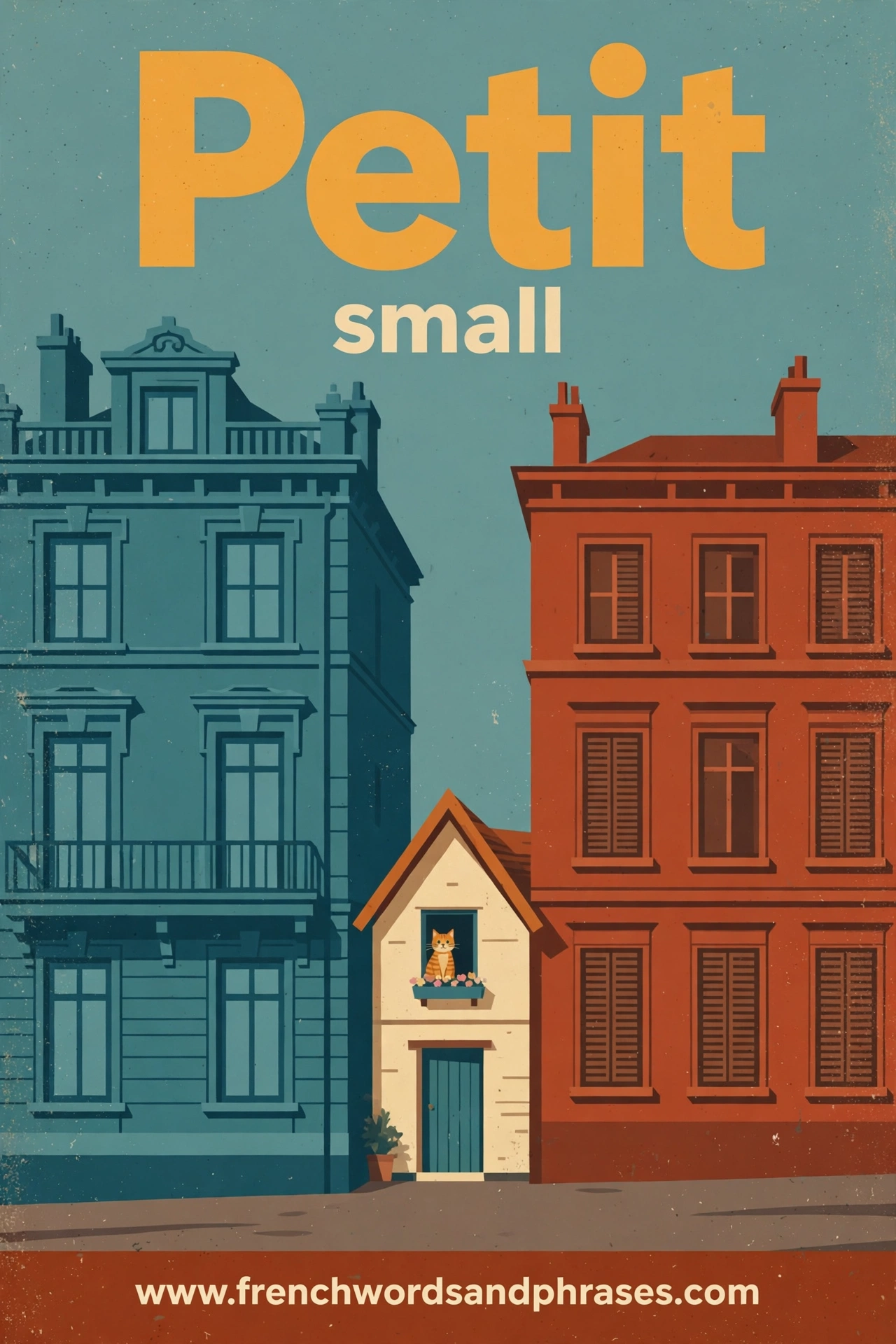
Petit means small.
The smallest café in Paris — four tables, a counter for two, a dog asleep in the doorway taking up most of it — and somehow the whole neighbourhood squeezes in every morning, because everything here is done with care. Big is easy. Petit is an art.
In this guide, you’ll learn what petit means in English, its four forms, why it stands in front of the noun, and how this little word came to name everything French holds dear — from le petit déjeuner to the Petit Prince. Explore French examples, English translations, and practice quizzes.
Understanding the French Adjective Petit
Petit is a French adjective of quality — the adjective of size, and one of the most loved words in the language. It agrees with its noun and stands before it, and it carries a warmth that English ‘small’ rarely manages: petit often means dear, cosy, beloved, as much as little.
It means small — little: une petite maison, a small house; un petit village, a small village. For people it can describe height — un homme petit, a short man — but in front of the noun it is usually pure affection: mon petit frère, my little brother, whatever his age or size.
Type: Adjective of quality — size
Answers the question: How big? — small, little
Changes form: Yes — petit, petite, petits, petites
English equivalents: Small; little; short (for people).
One important usage detail: petit stands BEFORE the noun — une petite maison. After the noun, for a person, it talks strictly about height: un homme petit is a short man. Before it, he is simply dear: mon petit frère measures love, not centimetres.
Experience the Word
Petit is the adjective of affection disguised as measurement — the small café, the little garden, the tiny cup of coffee that is somehow exactly enough.
Imagine a grandmother setting the table for a grandson who is now taller than the doorframe. She still calls across the kitchen, as she has for twenty years: « mon petit, à table ! » He ducks under the door, laughing. Some words refuse to update.
You have not just said small. You have said: this one is mine, and I love it.
How to Use Petit in French: Complete Guide
Let’s explore how petit works in French, beginning with the whole word on one card.
Petit at a Glance
Before the details, here is the whole word on one card.
The Whole Word on One Card
Meaning, type, position and forms — petit in four lines.
| Point | Petit |
|---|---|
| Meaning | small |
| Type | adjective of quality — size |
| Usual position | before the noun — une petite maison |
| Form | petit / petite / petits / petites |
Example
C’est une petite maison près de la rivière.
It’s a small house near the river.
The Four Forms of Petit
Petit agrees with the noun it describes: masculine or feminine, singular or plural. The feminine doubles the t before adding -e — petite.
| Form | Petit | Example |
|---|---|---|
| Masculine singular | petit | un petit village — a small village |
| Feminine singular | petite | une petite maison — a small house |
| Masculine plural | petits | de petits villages — small villages |
| Feminine plural | petites | de petites maisons — small houses |
Example
De petites maisons entourent la place du village.
Small houses surround the village square.
Quick Quiz 1
Which form of petit goes with maison (feminine)?
Reveal the answer
petite
Une petite maison.
A small house.
Forming the Feminine: petit → petite
Petit doubles its t and adds -e for the feminine — and the hidden t, silent at the end of petit, speaks clearly in petite.
| Step | Example |
|---|---|
| Masculine | petit — un petit jardin |
| Double the t, add -e | petite — une petite cour |
| The t wakes up | petite ends with a clear t sound |
| Plurals | petits / petites — de petits jardins, de petites cours |
Example
Elle a une petite cour pleine de fleurs.
She has a small courtyard full of flowers.
Where Petit Goes: In Front of the Noun
Petit leads its noun, like beau, bon and grand. Behind a person, it changes jobs and measures height instead — one of the neat little position stories of French.
| Pattern | Example |
|---|---|
| petit + noun | une petite maison — a small house |
| With an adverb | une très petite chambre — a very small room |
| Before the noun (a person) | mon petit frère — my little brother (affection, not size) |
| After the noun (a person) | un homme petit — a short man |
Example
Mon petit frère habite une petite maison à la campagne.
My little brother lives in a small house in the countryside.
Quick Quiz 2
Where does petit stand — before or after the noun?
Reveal the answer
Before
Un petit village, une petite maison.
A small village, a small house.
Smaller and Smallest: Comparing with Petit
Petit compares the regular way, with plus, moins and aussi — and its superlative is one of the most charming phrases in French: le plus petit, la plus petite.
| Degree | Example |
|---|---|
| As small as | aussi petit que — as small as |
| Smaller | plus petit — smaller |
| Less small | moins petit — less small |
| The smallest (masc.) | le plus petit — le plus petit des deux |
| The smallest (fem.) | la plus petite — la plus petite des deux |
Example
C’est la plus petite maison de la rue, et la plus jolie.
It’s the smallest house on the street, and the prettiest.
Everyday Expressions with Petit
Petit names the first meal of the day, the grandchildren, and the kindest way of making progress — few adjectives live in more French homes than this one.
| Expression | In English |
|---|---|
| le petit déjeuner | breakfast — literally, the little lunch |
| petit à petit | little by little |
| un petit café | a small coffee — and the cosy little place that serves it |
| mon petit | my little one — a term of endearment |
| les petits-enfants | the grandchildren |
| un petit mot | a short note — je te laisse un petit mot, I’ll leave you a little note |
Example
Petit à petit, son français devient excellent.
Little by little, her French is becoming excellent.
Quick Quiz 3
What does petit à petit mean?
Reveal the answer
Little by little
Petit à petit, on apprend.
Little by little, you learn.
Petit and Its Neighbours
Around petit gathers the whole vocabulary of size, from the enormous to the minuscule — with grand, its inseparable opposite, at the top of the scale.
| French | In English |
|---|---|
| grand | big, tall — the opposite |
| énorme | enormous — the far opposite |
| moyen | medium, average |
| court | short — for length and time |
| mini | mini — un mini-jardin, a mini garden |
| minuscule | tiny, minuscule |
Example
Ce n’est pas un grand jardin, mais il n’est pas minuscule non plus.
It’s not a big garden, but it isn’t tiny either.
Watch Out: The Traps Around Petit
A breakfast that is not small, a grandson who is not a small son, and a measurement of love that ignores the tape measure — petit is full of affectionate traps.
| Trap | The truth |
|---|---|
| breakfast | le petit déjeuner is a full breakfast, not a small meal to skip |
| petit-fils | means grandson, not ‘small son’ — petit builds the grandchildren generation |
| short people | for height, petit goes after the noun: un homme petit, a short man |
| affection | mon petit can be said to someone very tall — it measures love, not centimetres |
Example
Mon petit-fils est un homme grand, mais pour moi, c’est toujours mon petit.
My grandson is a tall man, but to me he’s still my little one.
Quick Quiz 4
What does le petit déjeuner mean?
Reveal the answer
Breakfast
Literally ‘the little lunch’ — the first, full meal of the French day.
Le petit déjeuner est servi à huit heures. — Breakfast is served at eight o’clock.
Petit in Everyday French: Real-Life Examples
Now that you know the word, let’s see how petit appears in everyday French.
Example 1 — Breakfast
Le petit déjeuner est servi à huit heures, avec du pain frais.
Breakfast is served at eight o’clock, with fresh bread.
Example 2 — A house
Ils ont acheté une petite maison avec un grand jardin.
They bought a small house with a big garden.
Example 3 — Little by little
Petit à petit, le village change et se modernise.
Little by little, the village is changing and modernising.
Example 4 — Family
Mes petits-enfants adorent les petites histoires du soir.
My grandchildren love the little bedtime stories.
Example 5 — A note
Je t’ai laissé un petit mot sur la table de la cuisine.
I left you a little note on the kitchen table.
Example 6 — The smallest
C’est le plus petit café de Paris, et le plus charmant.
It’s the smallest café in Paris, and the most charming.
Beyond Translation: The Meaning of Petit
English says small for the meaning of petit — but where English measures, French often caresses. Petit is the adjective of the beloved scale of things: the little café that knows your name, the little garden behind the house, the little brother who is forty.
To call something petit is often to claim it as your own.
France even built its most famous breakfast and its most famous prince out of the word — le petit déjeuner, le Petit Prince — proof that in French, small is not a size. It is a tenderness.
How to Remember the French Adjective Petit
Remember it this way: Petit is the little word with the big heart — in front of the noun, doubling its t for her, and measuring affection as often as size.
- You see the café with four tables — un petit café, une petite place.
- You double the t for her — petite, where the quiet t of petit starts to speak.
- You keep it in front — mon petit frère, le petit déjeuner.
The key idea is petit stands before the noun; petite for her; small in size, dear in feeling.
Test Your Knowledge of Petit
Let’s see how much you’ve learned. Try answering these questions before revealing the answers.
Question 1
What does petit mean?
Reveal the answer
Small, little — and short, for a person’s height.
Question 2
What are the forms of petit?
Reveal the answer
petit, petite, petits, petites.
Question 3
Translate: a small house.
Reveal the answer
Une petite maison.
Question 4
What is le petit déjeuner?
Reveal the answer
Breakfast — literally, the little lunch.
Question 5
Complete the sentence:
______ à ______, on apprend le français.
Reveal the answer
petit à petit
Petit à petit, on apprend le français.
Little by little, you learn French.
Your Final Challenge
Can You Use It?
How would you say this in French?
“Little by little, the small café became the heart of the village.”
Reveal the answer
Petit à petit, le petit café est devenu le cœur du village.
Little by little, the small café became the heart of the village.
A little French. A little curiosity. A richer everyday life.
LEARN FRENCH ONE WORD AT A TIME