How to Conjugate Pasteuriser in French
/pas.tø.ʁi.ze/
Pasteuriser means to pasteurize — to heat milk, wine or juice just enough to kill its germs and keep it safe.
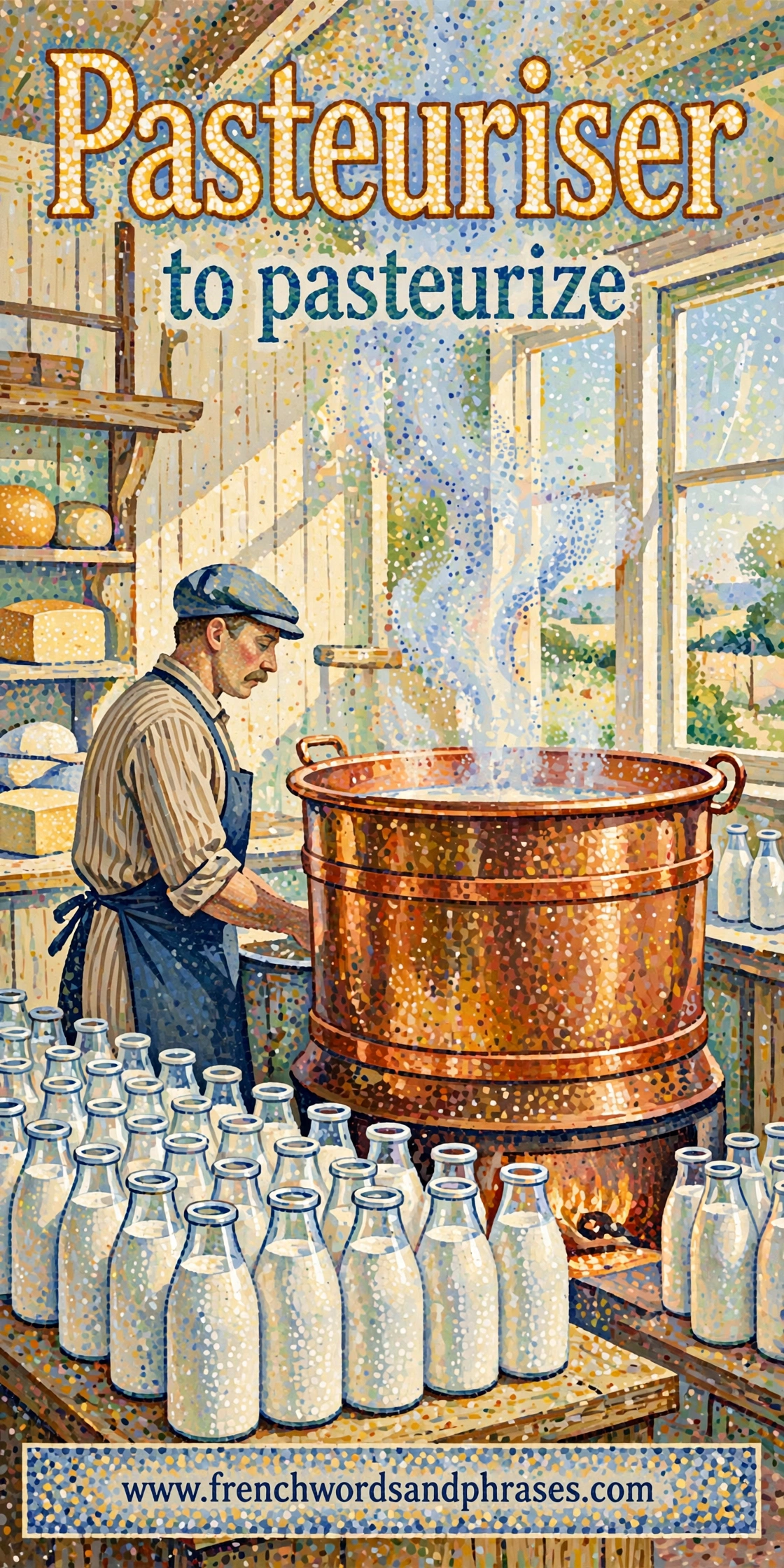
In a dairy at dawn, rivers of milk slide through steel pipes, are warmed for a few seconds, cooled again, and sealed into bottles that will keep for weeks. Pasteuriser is the verb of that life-saving warmth — the treatment Louis Pasteur invented, and the reason the milk in your fridge is safe.
In this guide, you’ll learn how to conjugate pasteuriser in all the major French tenses and moods. Explore complete conjugation tables, French examples, English translations, and practice quizzes.
Understanding the French Verb Pasteuriser
Pasteuriser is a regular French verb belonging to the first group of verbs, those ending in -er.
It means to pasteurize. It belongs to the dairy, the brewery and the juice plant: milk, cream, wine, beer, cider and fruit juices are pasteurisés every day, and the adjective is printed on a billion cartons. The modern flash method has its own label — upériser, UHT — but pasteuriser remains the generic word for making a liquid safe by heat.
Verb classification: First group (-er)
Auxiliary verb: Avoir
Past participle: pasteurisé
Present participle: pasteurisant
English equivalents: To pasteurize; pasteuriser le lait — to pasteurize milk; du lait pasteurisé — pasteurized milk; pasteuriser le vin, la bière, les jus — to pasteurize wine, beer, juices; la pasteurisation — pasteurization.
One important detail: pasteuriser is a man’s name turned into a verb — Louis Pasteur, who showed in the 1860s that gentle heat kills the microbes that sour wine and milk. The capital letter falls away in the verb: Pasteur the man, pasteuriser the process, le lait pasteurisé the result. The verb is a regular -er with no traps: je pasteurise, nous pasteurisons, ils pasteurisent, past participle pasteurisé.
Experience the Word
Pasteuriser is the verb of the helpful heat — warm enough to kill germs, gentle enough to spare the milk.
Imagine a small creamery in Normandy in 1880. The farmer’s wife has lost too many cheeses to invisible souring; now the milk is warmed, slowly, the Pasteur way — on pasteurise, on refroidit, et le lait se garde — and for the first time, the week’s milk reaches the town still sweet.
Nothing was added, nothing boiled away. The milk has been pasteurized — pasteurisé — and time itself has slowed down for it.
How to Conjugate Pasteuriser: Complete French Conjugation Guide
Let’s explore every major conjugation of pasteuriser, beginning with the indicative mood.
How to Conjugate Pasteuriser in the Indicative Mood
The indicative mood is used to express facts, observations, actions, and events.
How to Conjugate Pasteuriser in the Present Tense (Présent)
Used for actions happening now, habitual actions, and general truths.
| Subject | Conjugation |
|---|---|
| je | pasteurise |
| tu | pasteurises |
| il / elle | pasteurise |
| nous | pasteurisons |
| vous | pasteurisez |
| ils / elles | pasteurisent |
La laiterie pasteurise le lait chaque matin.
The dairy pasteurizes the milk every morning.
Complete the sentence:
Nous ______ le cidre chaque automne.
Reveal the answer
pasteurisons
Nous pasteurisons le cidre chaque automne.
We pasteurize the cider every autumn.
How to Conjugate Pasteuriser in the Passé Composé
Used for completed actions in the past. Pasteuriser takes the auxiliary verb avoir.
| Subject | Conjugation |
|---|---|
| j’ | ai pasteurisé |
| tu | as pasteurisé |
| il / elle | a pasteurisé |
| nous | avons pasteurisé |
| vous | avez pasteurisé |
| ils / elles | ont pasteurisé |
Ils ont pasteurisé le jus avant la mise en bouteille.
They pasteurized the juice before bottling.
How to Conjugate Pasteuriser in the Imparfait (Imperfect Tense)
Used for habitual past actions, descriptions, and ongoing situations in the past.
| Subject | Conjugation |
|---|---|
| je | pasteurisais |
| tu | pasteurisais |
| il / elle | pasteurisait |
| nous | pasteurisions |
| vous | pasteurisiez |
| ils / elles | pasteurisaient |
Autrefois, on ne pasteurisait pas le lait des fermes.
In the old days, farm milk was not pasteurized.
Choose the correct form:
They pasteurized the juice.
Ils ______ le jus. (ont pasteurisé / sont pasteurisés)
Reveal the answer
ont pasteurisé
Ils ont pasteurisé le jus.
Pasteuriser takes avoir.
How to Conjugate Pasteuriser in the Plus-que-parfait
Used to describe an action that had already been completed before another past event.
| Subject | Conjugation |
|---|---|
| j’ | avais pasteurisé |
| tu | avais pasteurisé |
| il / elle | avait pasteurisé |
| nous | avions pasteurisé |
| vous | aviez pasteurisé |
| ils / elles | avaient pasteurisé |
Elle avait pasteurisé la crème avant de faire le beurre.
She had pasteurized the cream before making the butter.
How to Conjugate Pasteuriser in the Passé Simple
Primarily used in formal writing, literature, and historical narratives. It is rarely used in everyday conversation.
| Subject | Conjugation |
|---|---|
| je | pasteurisai |
| tu | pasteurisas |
| il / elle | pasteurisa |
| nous | pasteurisâmes |
| vous | pasteurisâtes |
| ils / elles | pasteurisèrent |
Pasteur pasteurisa le vin pour sauver la récolte.
Pasteur pasteurized the wine to save the harvest.
How to Conjugate Pasteuriser in the Passé Antérieur
A literary tense used to express an action completed immediately before another past action, generally in the passé simple.
| Subject | Conjugation |
|---|---|
| j’ | eus pasteurisé |
| tu | eus pasteurisé |
| il / elle | eut pasteurisé |
| nous | eûmes pasteurisé |
| vous | eûtes pasteurisé |
| ils / elles | eurent pasteurisé |
Quand on eut pasteurisé le lait, on le mit en bouteilles.
When the milk had been pasteurized, it was bottled.
How to Conjugate Pasteuriser in the Future Tense (Futur Simple)
Used to describe actions that will take place in the future.
| Subject | Conjugation |
|---|---|
| je | pasteuriserai |
| tu | pasteuriseras |
| il / elle | pasteurisera |
| nous | pasteuriserons |
| vous | pasteuriserez |
| ils / elles | pasteuriseront |
Nous pasteuriserons le cidre cette semaine.
We will pasteurize the cider this week.
How to Conjugate Pasteuriser in the Futur Antérieur (Future Perfect)
Used for an action that will have been completed before a particular point in the future.
| Subject | Conjugation |
|---|---|
| j’ | aurai pasteurisé |
| tu | auras pasteurisé |
| il / elle | aura pasteurisé |
| nous | aurons pasteurisé |
| vous | aurez pasteurisé |
| ils / elles | auront pasteurisé |
À huit heures, ils auront pasteurisé mille litres de lait.
By eight o’clock, they will have pasteurized a thousand litres of milk.
How to Conjugate Pasteuriser in the Near Future (Futur Proche)
Used to describe something that is going to happen soon. Formed with aller + infinitive.
| Subject | Conjugation |
|---|---|
| je | vais pasteuriser |
| tu | vas pasteuriser |
| il / elle | va pasteuriser |
| nous | allons pasteuriser |
| vous | allez pasteuriser |
| ils / elles | vont pasteuriser |
L’usine va pasteuriser une nouvelle cuvée de jus.
The factory is going to pasteurize a new batch of juice.
How to Conjugate Pasteuriser in the Conditional Mood
The conditional mood expresses what would happen under certain circumstances. It is also frequently used to make polite requests or express wishes.
How to Conjugate Pasteuriser in the Present Conditional
| Subject | Conjugation |
|---|---|
| je | pasteuriserais |
| tu | pasteuriserais |
| il / elle | pasteuriserait |
| nous | pasteuriserions |
| vous | pasteuriseriez |
| ils / elles | pasteuriseraient |
Ce procédé pasteuriserait le lait sans changer son goût.
This process would pasteurize the milk without changing its taste.
How to Conjugate Pasteuriser in the Past Conditional
| Subject | Conjugation |
|---|---|
| j’ | aurais pasteurisé |
| tu | aurais pasteurisé |
| il / elle | aurait pasteurisé |
| nous | aurions pasteurisé |
| vous | auriez pasteurisé |
| ils / elles | auraient pasteurisé |
On aurait pasteurisé le vin si l’appareil avait fonctionné.
The wine would have been pasteurized if the machine had worked.
Pasteuriser in the Literary Past Conditional Form
This less common literary form uses the imperfect subjunctive of avoir.
| Subject | Conjugation |
|---|---|
| j’ | eusse pasteurisé |
| tu | eusses pasteurisé |
| il / elle | eût pasteurisé |
| nous | eussions pasteurisé |
| vous | eussiez pasteurisé |
| ils / elles | eussent pasteurisé |
Le vigneron eût pasteurisé sa récolte entière pour la sauver.
The winegrower would have pasteurized his entire harvest to save it.
How to Conjugate Pasteuriser in the Subjunctive Mood
The subjunctive is used to express wishes, emotions, doubts, necessity, and uncertainty. It frequently follows expressions such as il faut que (it is necessary that) or bien que (although).
How to Conjugate Pasteuriser in the Present Subjunctive
| Subject | Conjugation |
|---|---|
| que je | pasteurise |
| que tu | pasteurises |
| qu’il / qu’elle | pasteurise |
| que nous | pasteurisions |
| que vous | pasteurisiez |
| qu’ils / qu’elles | pasteurisent |
La loi exige que l’on pasteurise le lait vendu en ville.
The law requires milk sold in town to be pasteurized.
Complete the sentence using the subjunctive:
Il faut que vous ______ le lait avant la vente.
Reveal the answer
pasteurisiez
Il faut que vous pasteurisiez le lait avant la vente.
You must pasteurize the milk before it is sold.
How to Conjugate Pasteuriser in the Imperfect Subjunctive
A literary tense, rarely encountered in modern spoken French.
| Subject | Conjugation |
|---|---|
| que je | pasteurisasse |
| que tu | pasteurisasses |
| qu’il / qu’elle | pasteurisât |
| que nous | pasteurisassions |
| que vous | pasteurisassiez |
| qu’ils / qu’elles | pasteurisassent |
Le préfet ordonna que les laiteries pasteurisassent leur lait.
The prefect ordered the dairies to pasteurize their milk.
How to Conjugate Pasteuriser in the Pluperfect Subjunctive
A literary construction used to express an action completed before another past action.
| Subject | Conjugation |
|---|---|
| que j’ | eusse pasteurisé |
| que tu | eusses pasteurisé |
| qu’il / qu’elle | eût pasteurisé |
| que nous | eussions pasteurisé |
| que vous | eussiez pasteurisé |
| qu’ils / qu’elles | eussent pasteurisé |
On vérifia que l’usine eût pasteurisé chaque cuvée.
They checked that the factory had pasteurized every batch.
How to Conjugate Pasteuriser in the Past Subjunctive
| Subject | Conjugation |
|---|---|
| que j’ | aie pasteurisé |
| que tu | aies pasteurisé |
| qu’il / qu’elle | ait pasteurisé |
| que nous | ayons pasteurisé |
| que vous | ayez pasteurisé |
| qu’ils / qu’elles | aient pasteurisé |
Je suis content que la ferme ait pasteurisé sa crème.
I am glad the farm pasteurized its cream.
How to Conjugate Pasteuriser in the Imperative
The imperative is used to give commands, instructions, invitations, or suggestions. Subject pronouns are omitted.
How to Conjugate Pasteuriser in the Present Imperative
| Person | Conjugation |
|---|---|
| (tu) | pasteurise |
| (nous) | pasteurisons |
| (vous) | pasteurisez |
Pasteurisez le lait avant de le vendre !
Pasteurize the milk before selling it!
How would you say Pasteurize the milk (tu form)?
Reveal the answer
Pasteurise le lait !
French Participles of Pasteuriser
Participles are verb forms that can be used in compound tenses and other grammatical constructions.
Present Participle of Pasteuriser
pasteurisant
En pasteurisant le jus, on prolonge sa conservation.
By pasteurizing the juice, you extend its shelf life.
Past Participle of Pasteuriser
pasteurisé
Pasteurisé à basse température, le lait garde son goût de ferme.
Pasteurized at a low temperature, the milk keeps its farm taste.
Pasteuriser in Everyday French: Real-Life Examples
Now that you know the conjugations, let’s see how pasteuriser appears in everyday French.
La laiterie pasteurise le lait chaque matin.
The dairy pasteurizes the milk every morning.
Ils ont pasteurisé le jus de pommes.
They pasteurized the apple juice.
On ne pasteurisait pas le lait autrefois.
Milk was not pasteurized in the old days.
Nous pasteuriserons le cidre cette semaine.
We will pasteurize the cider this week.
Ce procédé pasteuriserait le lait sans changer son goût.
This process would pasteurize the milk without changing its taste.
Pasteurise le lait avant de le vendre !
Pasteurize the milk before selling it!
Beyond Translation: The Meaning of Pasteuriser
Few verbs carry a biography: pasteuriser is Louis Pasteur’s name at work, long after the man.
He invented it to save wine, and it ended up saving milk — and millions of children.
Heated gently, never boiled, the liquid keeps its taste and loses its dangers. Every carton marked lait pasteurisé in every French supermarket is a small monument to the chemist of Arbois.
How to Remember the French Verb Pasteuriser
Remember it this way: Pasteuriser is about Pasteur warming the milk just enough to save it.
- A man’s name became a verb: Pasteur the scientist, pasteuriser the process — no capital letter on the verb.
- Gentle heat, never boiling: pasteuriser kills the germs and spares the taste.
- Regular -er: je pasteurise, nous pasteurisons, past participle pasteurisé.
The key idea is Pasteur warming the milk just enough to save it.
Test Your Knowledge of Pasteuriser
Let’s see how much you’ve learned. Try answering these questions before revealing the answers.
Who gave his name to pasteuriser?
Reveal the answer
Louis Pasteur — the chemist who showed that gentle heat kills the germs in wine and milk.
How do you say The dairy pasteurizes the milk in French?
Reveal the answer
La laiterie pasteurise le lait.
Translate: They pasteurized the apple juice.
Reveal the answer
Ils ont pasteurisé le jus de pommes.
What is the past participle of pasteuriser?
Reveal the answer
Pasteurisé.
Complete the sentence:
La loi exige que l’on ______ le lait vendu en ville.
Reveal the answer
pasteurise
La loi exige que l’on pasteurise le lait vendu en ville.
The law requires milk sold in town to be pasteurized.
Can You Use It?
How would you say this in French?
The dairy pasteurizes the milk at dawn, and the whole village drinks without fear.
Reveal the answer
La laiterie pasteurise le lait à l’aube, et tout le village boit sans crainte.
The dairy pasteurizes the milk at dawn, and the whole village drinks without fear.
LEARN FRENCH ONE WORD AT A TIME