How to Conjugate Pasteller in French
/pas.tɛ.le/
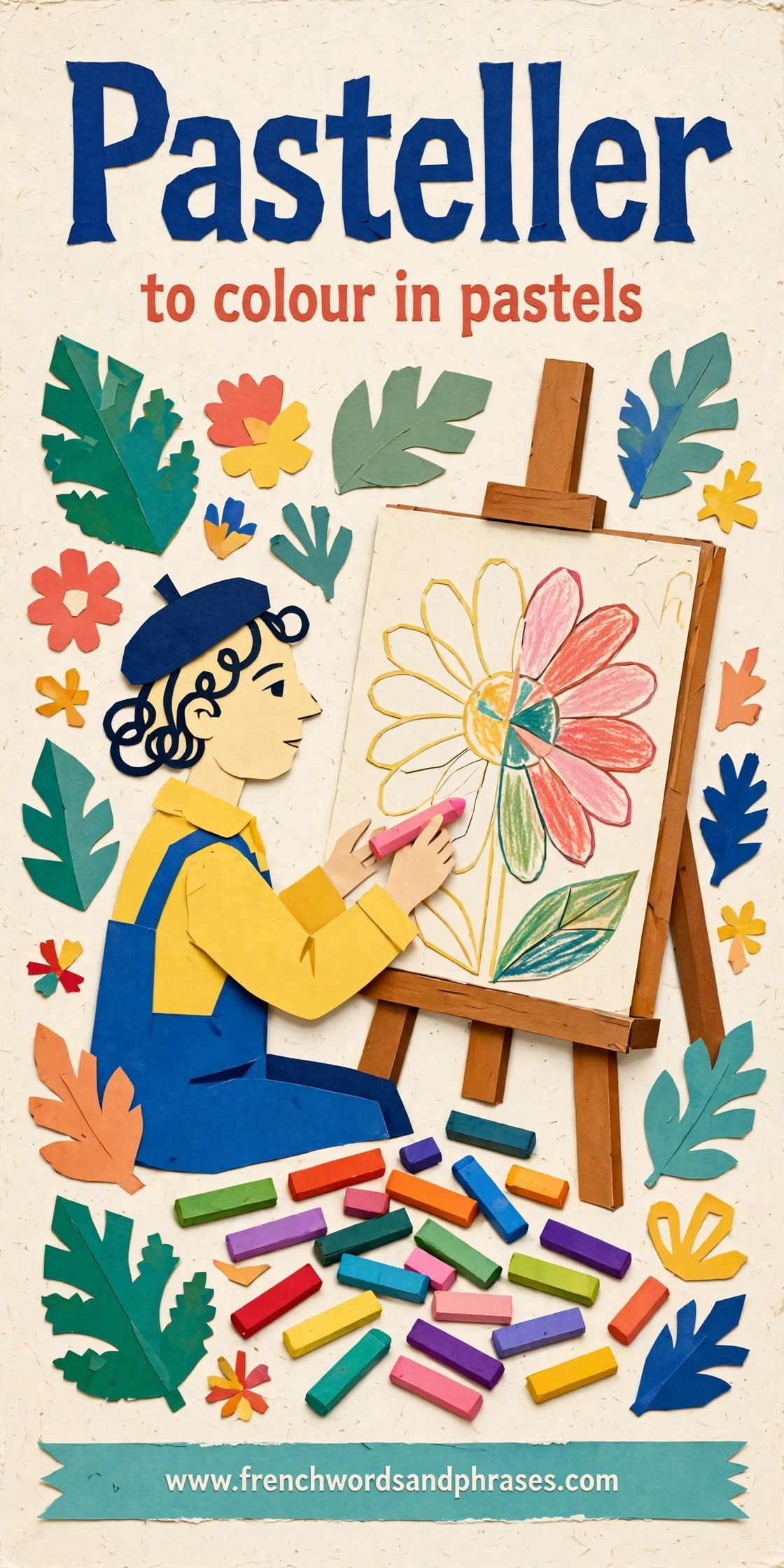
Pasteller means to colour in pastels — to draw and tint a picture with soft sticks of powdered colour.
In a quiet studio, an artist opens a wooden box of pastel sticks — rose, ash blue, ochre — and begins to rub colour straight onto the paper with her fingertips. Pasteller is the painter’s gentle verb: to work in pastel, building a picture out of pure pigment and dust.
In this guide, you’ll learn how to conjugate pasteller in all the major French tenses and moods. Explore complete conjugation tables, French examples, English translations, and practice quizzes.
Understanding the French Verb Pasteller
Pasteller is a regular French verb belonging to the first group of verbs, those ending in -er.
It means to colour in pastels. It is a quiet, specialised verb of art classes and studios: one pastelle a portrait, a landscape, a still life. It is intransitive as often as transitive — les enfants pastellent à l’école — and it always suggests softness: pastel has no hard edges and neither does the verb.
Verb classification: First group (-er)
Auxiliary verb: Avoir
Past participle: pastellé
Present participle: pastellant
English equivalents: To colour in pastels, to work in pastel; pasteller un portrait — to do a portrait in pastels; pasteller un paysage — to colour a landscape in pastels; un pastel — a pastel (stick, drawing or soft shade); des tons pastellés — pastel-tinted shades.
One important detail: pasteller is the verb of the noun un pastel, and it keeps the noun’s double l everywhere: je pastelle, nous pastellons, ils pastellent, past participle pastellé — the ll never drops, because it belongs to the stem, not to any doubling rule. The family is bigger than the studio: des couleurs pastel are the soft shades themselves, and the adjective pastellé describes anything tinted with them, from a portrait to a spring dress.
Experience the Word
Pasteller is the verb of colour without liquid — pigment laid on paper by hand, soft as powder.
Imagine a portrait class on a winter afternoon. Twenty students rub and blend in silence; the teacher walks between the easels, correcting a cheek here, a shadow there — tout le monde pastelle, and the room smells faintly of chalk and paper.
No brushes, no water, no noise. They are colouring in pastels — ils pastellent — and the portraits are emerging from the dust.
How to Conjugate Pasteller: Complete French Conjugation Guide
Let’s explore every major conjugation of pasteller, beginning with the indicative mood.
How to Conjugate Pasteller in the Indicative Mood
The indicative mood is used to express facts, observations, actions, and events.
How to Conjugate Pasteller in the Present Tense (Présent)
Used for actions happening now, habitual actions, and general truths.
| Subject | Conjugation |
|---|---|
| je | pastelle |
| tu | pastelles |
| il / elle | pastelle |
| nous | pastellons |
| vous | pastellez |
| ils / elles | pastellent |
Elle pastelle un portrait de sa fille.
She is doing a portrait of her daughter in pastels.
Complete the sentence:
Nous ______ un paysage de montagne.
Reveal the answer
pastellons
Nous pastellons un paysage de montagne.
We are colouring a mountain landscape in pastels.
How to Conjugate Pasteller in the Passé Composé
Used for completed actions in the past. Pasteller takes the auxiliary verb avoir.
| Subject | Conjugation |
|---|---|
| j’ | ai pastellé |
| tu | as pastellé |
| il / elle | a pastellé |
| nous | avons pastellé |
| vous | avez pastellé |
| ils / elles | ont pastellé |
Les enfants ont pastellé des paysages toute la matinée.
The children coloured landscapes in pastels all morning.
How to Conjugate Pasteller in the Imparfait (Imperfect Tense)
Used for habitual past actions, descriptions, and ongoing situations in the past.
| Subject | Conjugation |
|---|---|
| je | pastellais |
| tu | pastellais |
| il / elle | pastellait |
| nous | pastellions |
| vous | pastelliez |
| ils / elles | pastellaient |
Degas pastellait ses danseuses dans son atelier parisien.
Degas used to pastel his dancers in his Paris studio.
Choose the correct form:
The children coloured landscapes in pastels.
Les enfants ______ des paysages. (ont pastellé / sont pastellés)
Reveal the answer
ont pastellé
Les enfants ont pastellé des paysages.
Pasteller takes avoir.
How to Conjugate Pasteller in the Plus-que-parfait
Used to describe an action that had already been completed before another past event.
| Subject | Conjugation |
|---|---|
| j’ | avais pastellé |
| tu | avais pastellé |
| il / elle | avait pastellé |
| nous | avions pastellé |
| vous | aviez pastellé |
| ils / elles | avaient pastellé |
Elle avait pastellé le même modèle trois fois.
She had done the same model in pastels three times.
How to Conjugate Pasteller in the Passé Simple
Primarily used in formal writing, literature, and historical narratives. It is rarely used in everyday conversation.
| Subject | Conjugation |
|---|---|
| je | pastellai |
| tu | pastellas |
| il / elle | pastella |
| nous | pastellâmes |
| vous | pastellâtes |
| ils / elles | pastellèrent |
Le peintre pastella la vallée au crépuscule.
The painter coloured the valley in pastels at dusk.
How to Conjugate Pasteller in the Passé Antérieur
A literary tense used to express an action completed immediately before another past action, generally in the passé simple.
| Subject | Conjugation |
|---|---|
| j’ | eus pastellé |
| tu | eus pastellé |
| il / elle | eut pastellé |
| nous | eûmes pastellé |
| vous | eûtes pastellé |
| ils / elles | eurent pastellé |
Quand elle eut pastellé le fond, elle attaqua le visage.
When she had pastelled the background, she started on the face.
How to Conjugate Pasteller in the Future Tense (Futur Simple)
Used to describe actions that will take place in the future.
| Subject | Conjugation |
|---|---|
| je | pastellerai |
| tu | pastelleras |
| il / elle | pastellera |
| nous | pastellerons |
| vous | pastellerez |
| ils / elles | pastelleront |
Demain, nous pastellerons des natures mortes.
Tomorrow, we will do still lifes in pastels.
How to Conjugate Pasteller in the Futur Antérieur (Future Perfect)
Used for an action that will have been completed before a particular point in the future.
| Subject | Conjugation |
|---|---|
| j’ | aurai pastellé |
| tu | auras pastellé |
| il / elle | aura pastellé |
| nous | aurons pastellé |
| vous | aurez pastellé |
| ils / elles | auront pastellé |
À la fin du cours, vous aurez pastellé chacun un portrait.
By the end of the class, you will each have done a portrait in pastels.
How to Conjugate Pasteller in the Near Future (Futur Proche)
Used to describe something that is going to happen soon. Formed with aller + infinitive.
| Subject | Conjugation |
|---|---|
| je | vais pasteller |
| tu | vas pasteller |
| il / elle | va pasteller |
| nous | allons pasteller |
| vous | allez pasteller |
| ils / elles | vont pasteller |
Je vais pasteller ce paysage avant la nuit.
I am going to colour this landscape in pastels before nightfall.
How to Conjugate Pasteller in the Conditional Mood
The conditional mood expresses what would happen under certain circumstances. It is also frequently used to make polite requests or express wishes.
How to Conjugate Pasteller in the Present Conditional
| Subject | Conjugation |
|---|---|
| je | pastellerais |
| tu | pastellerais |
| il / elle | pastellerait |
| nous | pastellerions |
| vous | pastelleriez |
| ils / elles | pastelleraient |
Avec de meilleurs pastels, elle pastellerait plus finement.
With better pastels, she would colour more finely.
How to Conjugate Pasteller in the Past Conditional
| Subject | Conjugation |
|---|---|
| j’ | aurais pastellé |
| tu | aurais pastellé |
| il / elle | aurait pastellé |
| nous | aurions pastellé |
| vous | auriez pastellé |
| ils / elles | auraient pastellé |
Il aurait pastellé le portrait si la lumière avait tenu.
He would have done the portrait in pastels if the light had held.
Pasteller in the Literary Past Conditional Form
This less common literary form uses the imperfect subjunctive of avoir.
| Subject | Conjugation |
|---|---|
| j’ | eusse pastellé |
| tu | eusses pastellé |
| il / elle | eût pastellé |
| nous | eussions pastellé |
| vous | eussiez pastellé |
| ils / elles | eussent pastellé |
L’artiste eût pastellé la vallée entière avant l’hiver.
The artist would have pastelled the whole valley before winter.
How to Conjugate Pasteller in the Subjunctive Mood
The subjunctive is used to express wishes, emotions, doubts, necessity, and uncertainty. It frequently follows expressions such as il faut que (it is necessary that) or bien que (although).
How to Conjugate Pasteller in the Present Subjunctive
| Subject | Conjugation |
|---|---|
| que je | pastelle |
| que tu | pastelles |
| qu’il / qu’elle | pastelle |
| que nous | pastellions |
| que vous | pastelliez |
| qu’ils / qu’elles | pastellent |
Il faut que tu pastelles le ciel en douceur.
You must pastel the sky softly.
Complete the sentence using the subjunctive:
Il faut que vous ______ sans appuyer trop fort.
Reveal the answer
pastelliez
Il faut que vous pastelliez sans appuyer trop fort.
You must pastel without pressing too hard.
How to Conjugate Pasteller in the Imperfect Subjunctive
A literary tense, rarely encountered in modern spoken French.
| Subject | Conjugation |
|---|---|
| que je | pastellasse |
| que tu | pastellasses |
| qu’il / qu’elle | pastellât |
| que nous | pastellassions |
| que vous | pastellassiez |
| qu’ils / qu’elles | pastellassent |
Le professeur souhaitait que les élèves pastellassent sans appuyer.
The teacher wanted the pupils to pastel without pressing.
How to Conjugate Pasteller in the Pluperfect Subjunctive
A literary construction used to express an action completed before another past action.
| Subject | Conjugation |
|---|---|
| que j’ | eusse pastellé |
| que tu | eusses pastellé |
| qu’il / qu’elle | eût pastellé |
| que nous | eussions pastellé |
| que vous | eussiez pastellé |
| qu’ils / qu’elles | eussent pastellé |
On admirait qu’elle eût pastellé ce visage en une heure.
People admired that she had done that face in pastels in one hour.
How to Conjugate Pasteller in the Past Subjunctive
| Subject | Conjugation |
|---|---|
| que j’ | aie pastellé |
| que tu | aies pastellé |
| qu’il / qu’elle | ait pastellé |
| que nous | ayons pastellé |
| que vous | ayez pastellé |
| qu’ils / qu’elles | aient pastellé |
Je suis ravi que vous ayez pastellé ce paysage.
I am delighted that you coloured this landscape in pastels.
How to Conjugate Pasteller in the Imperative
The imperative is used to give commands, instructions, invitations, or suggestions. Subject pronouns are omitted.
How to Conjugate Pasteller in the Present Imperative
| Person | Conjugation |
|---|---|
| (tu) | pastelle |
| (nous) | pastellons |
| (vous) | pastellez |
Pastelle le fond d’abord, le visage ensuite !
Pastel the background first, the face afterwards!
How would you say Pastel the sky softly (tu form)?
Reveal the answer
Pastelle le ciel en douceur !
French Participles of Pasteller
Participles are verb forms that can be used in compound tenses and other grammatical constructions.
Present Participle of Pasteller
pastellant
En pastellant, elle souffle la poussière de couleur.
While pastelling, she blows away the coloured dust.
Past Participle of Pasteller
pastellé
Pastellé en tons doux, le portrait semble rêver.
Done in pastels in soft tones, the portrait seems to dream.
Pasteller in Everyday French: Real-Life Examples
Now that you know the conjugations, let’s see how pasteller appears in everyday French.
Elle pastelle un portrait de sa fille.
She is doing a portrait of her daughter in pastels.
Les enfants ont pastellé des paysages.
The children coloured landscapes in pastels.
Degas pastellait ses danseuses.
Degas used to pastel his dancers.
Nous pastellerons des natures mortes.
We will do still lifes in pastels.
Elle pastellerait plus finement avec de meilleurs pastels.
She would colour more finely with better pastels.
Pastelle le ciel en douceur !
Pastel the sky softly!
Beyond Translation: The Meaning of Pasteller
Pastel came to French from Italian pastello, a little paste — because the sticks are pigment kneaded into a paste and dried.
It is drawing and painting at once.
Degas and Mary Cassatt made the medium famous, and the verb pasteller still belongs to their world: no brush, no palette, just coloured dust coaxed onto paper by fingertips — and the soft shades it leaves behind gave French the everyday phrase des tons pastel.
How to Remember the French Verb Pasteller
Remember it this way: Pasteller is about fingertips rubbing soft colour straight onto the paper.
- The double l is in the stem and never drops: je pastelle, nous pastellons, pastellé.
- Picture the box of pastel sticks: pasteller is simply working with them — colouring in pastels.
- Regular -er: je pastelle, nous pastellons, past participle pastellé.
The key idea is fingertips rubbing soft colour straight onto the paper.
Test Your Knowledge of Pasteller
Let’s see how much you’ve learned. Try answering these questions before revealing the answers.
What is un pastel?
Reveal the answer
A stick of powdered colour — and the drawing made with it; pasteller is working in that medium.
How do you say She is doing a portrait in pastels in French?
Reveal the answer
Elle pastelle un portrait.
Translate: The children coloured landscapes in pastels.
Reveal the answer
Les enfants ont pastellé des paysages.
What is the past participle of pasteller?
Reveal the answer
Pastellé.
Complete the sentence:
Il faut que tu ______ le ciel en douceur.
Reveal the answer
pastelles
Il faut que tu pastelles le ciel en douceur.
You must pastel the sky softly.
Can You Use It?
How would you say this in French?
She colours the valley in pastels at dusk, and the coloured dust holds on to the light of day.
Reveal the answer
Elle pastelle la vallée au crépuscule, et la poussière de couleur retient la lumière du jour.
She colours the valley in pastels at dusk, and the coloured dust holds on to the light of day.
LEARN FRENCH ONE WORD AT A TIME