How to Conjugate Pasticher in French
/pas.ti.ʃe/
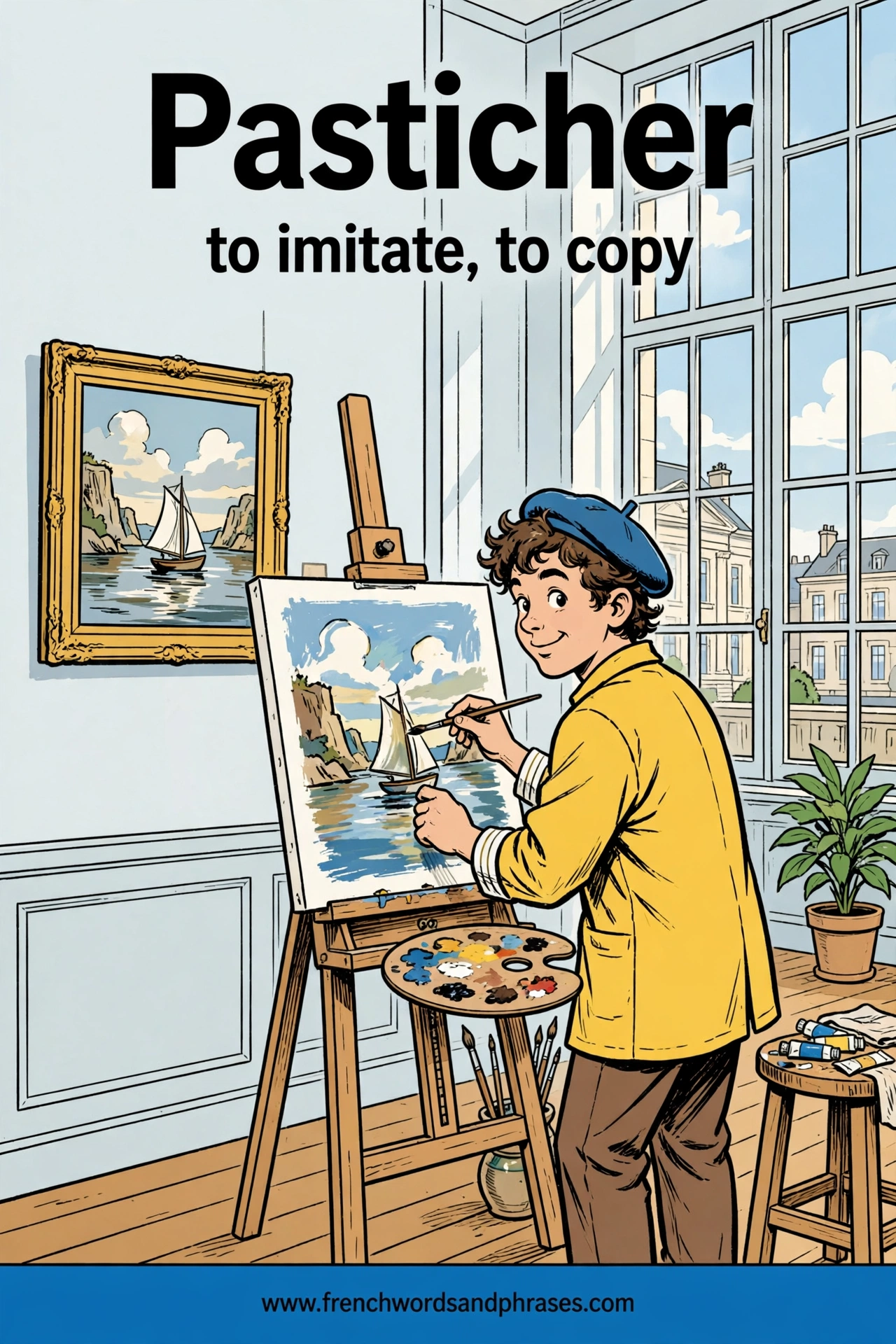
Pasticher means to imitate, to copy — to reproduce a writer’s or painter’s style so closely that the copy could pass for the original.
A student at a writing desk produces a flawless page of Victor Hugo — the rolling sentences, the thunder, the pity — and not one word of it is Hugo’s. Pasticher is the artist’s double-edged verb: to imitate a master’s style, in homage, in practice, or in gentle mockery.
In this guide, you’ll learn how to conjugate pasticher in all the major French tenses and moods. Explore complete conjugation tables, French examples, English translations, and practice quizzes.
Understanding the French Verb Pasticher
Pasticher is a regular French verb belonging to the first group of verbs, those ending in -er.
It means to imitate, to copy. It lives in literature, painting and music criticism: students pastichent to learn, humorists pastichent to tease, and forgers — the dark end of the scale — pastichent to deceive. Context decides whether the word is praise or accusation; the technique is the same.
Verb classification: First group (-er)
Auxiliary verb: Avoir
Past participle: pastiché
Present participle: pastichant
English equivalents: To imitate, to copy, to pastiche; pasticher un écrivain — to imitate a writer’s style; pasticher un tableau — to copy a painting; un pastiche — a pastiche, a work in another’s style; pasticher le style de Proust — to write in the manner of Proust.
One important detail: pasticher is not copier and not plagier. A pastiche copies a style, openly and often lovingly — the pastiches of Proust imitating Balzac or Flaubert are literature in their own right — while plagiarism steals the work itself and hides the theft. The verb is a regular -er: je pastiche, nous pastichons, ils pastichent, past participle pastiché. It comes from Italian pasticcio, a pie of mixed ingredients — a medley, which is exactly what a good pastiche is.
Experience the Word
Pasticher is the verb of the borrowed voice — writing like Hugo, painting like Monet, until the style itself becomes the subject.
Imagine a young novelist set an exercise by her teacher: tell this morning’s breakfast à la manière de Proust. Three pages later, a madeleine of toast has unfolded into childhood, memory and time itself — elle a pastiché Proust, and in copying him, she has learned how he works from the inside.
Not a word is Proust’s. It has been imitated — pastiché — and the imitation teaches more than a chapter of theory.
How to Conjugate Pasticher: Complete French Conjugation Guide
Let’s explore every major conjugation of pasticher, beginning with the indicative mood.
How to Conjugate Pasticher in the Indicative Mood
The indicative mood is used to express facts, observations, actions, and events.
How to Conjugate Pasticher in the Present Tense (Présent)
Used for actions happening now, habitual actions, and general truths.
| Subject | Conjugation |
|---|---|
| je | pastiche |
| tu | pastiches |
| il / elle | pastiche |
| nous | pastichons |
| vous | pastichez |
| ils / elles | pastichent |
Cet élève pastiche Hugo avec un talent fou.
This pupil imitates Hugo with mad talent.
Complete the sentence:
Nous ______ un conte de Maupassant.
Reveal the answer
pastichons
Nous pastichons un conte de Maupassant.
We are imitating a short story by Maupassant.
How to Conjugate Pasticher in the Passé Composé
Used for completed actions in the past. Pasticher takes the auxiliary verb avoir.
| Subject | Conjugation |
|---|---|
| j’ | ai pastiché |
| tu | as pastiché |
| il / elle | a pastiché |
| nous | avons pastiché |
| vous | avez pastiché |
| ils / elles | ont pastiché |
Proust a pastiché Balzac dans un exercice célèbre.
Proust imitated Balzac in a famous exercise.
How to Conjugate Pasticher in the Imparfait (Imperfect Tense)
Used for habitual past actions, descriptions, and ongoing situations in the past.
| Subject | Conjugation |
|---|---|
| je | pastichais |
| tu | pastichais |
| il / elle | pastichait |
| nous | pastichions |
| vous | pastichiez |
| ils / elles | pastichaient |
Les élèves pastichaient les grands auteurs pour s’entraîner.
The pupils used to imitate the great authors to train themselves.
Choose the correct form:
She imitated Monet.
Elle ______ Monet. (a pastiché / est pastichée)
Reveal the answer
a pastiché
Elle a pastiché Monet.
Pasticher takes avoir.
How to Conjugate Pasticher in the Plus-que-parfait
Used to describe an action that had already been completed before another past event.
| Subject | Conjugation |
|---|---|
| j’ | avais pastiché |
| tu | avais pastiché |
| il / elle | avait pastiché |
| nous | avions pastiché |
| vous | aviez pastiché |
| ils / elles | avaient pastiché |
Elle avait pastiché Monet avant de trouver son style.
She had imitated Monet before finding her own style.
How to Conjugate Pasticher in the Passé Simple
Primarily used in formal writing, literature, and historical narratives. It is rarely used in everyday conversation.
| Subject | Conjugation |
|---|---|
| je | pastichai |
| tu | pastichas |
| il / elle | pasticha |
| nous | pastichâmes |
| vous | pastichâtes |
| ils / elles | pastichèrent |
Le faussaire pasticha Vermeer pendant des années.
The forger copied Vermeer for years.
How to Conjugate Pasticher in the Passé Antérieur
A literary tense used to express an action completed immediately before another past action, generally in the passé simple.
| Subject | Conjugation |
|---|---|
| j’ | eus pastiché |
| tu | eus pastiché |
| il / elle | eut pastiché |
| nous | eûmes pastiché |
| vous | eûtes pastiché |
| ils / elles | eurent pastiché |
Quand il eut pastiché trois maîtres, il se mit à peindre pour lui-même.
When he had imitated three masters, he began painting for himself.
How to Conjugate Pasticher in the Future Tense (Futur Simple)
Used to describe actions that will take place in the future.
| Subject | Conjugation |
|---|---|
| je | pasticherai |
| tu | pasticheras |
| il / elle | pastichera |
| nous | pasticherons |
| vous | pasticherez |
| ils / elles | pasticheront |
Demain, nous pasticherons un conte de Maupassant.
Tomorrow, we will imitate a short story by Maupassant.
How to Conjugate Pasticher in the Futur Antérieur (Future Perfect)
Used for an action that will have been completed before a particular point in the future.
| Subject | Conjugation |
|---|---|
| j’ | aurai pastiché |
| tu | auras pastiché |
| il / elle | aura pastiché |
| nous | aurons pastiché |
| vous | aurez pastiché |
| ils / elles | auront pastiché |
À la fin du trimestre, ils auront pastiché cinq écrivains différents.
By the end of term, they will have imitated five different writers.
How to Conjugate Pasticher in the Near Future (Futur Proche)
Used to describe something that is going to happen soon. Formed with aller + infinitive.
| Subject | Conjugation |
|---|---|
| je | vais pasticher |
| tu | vas pasticher |
| il / elle | va pasticher |
| nous | allons pasticher |
| vous | allez pasticher |
| ils / elles | vont pasticher |
Tu vas pasticher quel auteur, cette fois ?
Which author are you going to imitate this time?
How to Conjugate Pasticher in the Conditional Mood
The conditional mood expresses what would happen under certain circumstances. It is also frequently used to make polite requests or express wishes.
How to Conjugate Pasticher in the Present Conditional
| Subject | Conjugation |
|---|---|
| je | pasticherais |
| tu | pasticherais |
| il / elle | pasticherait |
| nous | pasticherions |
| vous | pasticheriez |
| ils / elles | pasticheraient |
Un bon humoriste pasticherait ce discours en deux minutes.
A good humorist would pastiche this speech in two minutes.
How to Conjugate Pasticher in the Past Conditional
| Subject | Conjugation |
|---|---|
| j’ | aurais pastiché |
| tu | aurais pastiché |
| il / elle | aurait pastiché |
| nous | aurions pastiché |
| vous | auriez pastiché |
| ils / elles | auraient pastiché |
Elle aurait pastiché Flaubert si le délai avait été plus long.
She would have imitated Flaubert if the deadline had been longer.
Pasticher in the Literary Past Conditional Form
This less common literary form uses the imperfect subjunctive of avoir.
| Subject | Conjugation |
|---|---|
| j’ | eusse pastiché |
| tu | eusses pastiché |
| il / elle | eût pastiché |
| nous | eussions pastiché |
| vous | eussiez pastiché |
| ils / elles | eussent pastiché |
Le jeune auteur eût pastiché Hugo avec délices.
The young author would have imitated Hugo with delight.
How to Conjugate Pasticher in the Subjunctive Mood
The subjunctive is used to express wishes, emotions, doubts, necessity, and uncertainty. It frequently follows expressions such as il faut que (it is necessary that) or bien que (although).
How to Conjugate Pasticher in the Present Subjunctive
| Subject | Conjugation |
|---|---|
| que je | pastiche |
| que tu | pastiches |
| qu’il / qu’elle | pastiche |
| que nous | pastichions |
| que vous | pastichiez |
| qu’ils / qu’elles | pastichent |
Il est amusant que tu pastiches si bien les classiques.
It is amusing that you imitate the classics so well.
Complete the sentence using the subjunctive:
Le professeur veut que vous ______ un auteur du siècle.
Reveal the answer
pastichiez
Le professeur veut que vous pastichiez un auteur du siècle.
The teacher wants you to imitate an author of the century.
How to Conjugate Pasticher in the Imperfect Subjunctive
A literary tense, rarely encountered in modern spoken French.
| Subject | Conjugation |
|---|---|
| que je | pastichasse |
| que tu | pastichasses |
| qu’il / qu’elle | pastichât |
| que nous | pastichassions |
| que vous | pastichassiez |
| qu’ils / qu’elles | pastichassent |
Le professeur voulait que nous pastichassions un auteur du siècle.
The teacher wanted us to imitate an author of the century.
How to Conjugate Pasticher in the Pluperfect Subjunctive
A literary construction used to express an action completed before another past action.
| Subject | Conjugation |
|---|---|
| que j’ | eusse pastiché |
| que tu | eusses pastiché |
| qu’il / qu’elle | eût pastiché |
| que nous | eussions pastiché |
| que vous | eussiez pastiché |
| qu’ils / qu’elles | eussent pastiché |
On admirait qu’il eût pastiché Vermeer sans une faute.
People admired that he had copied Vermeer without a single mistake.
How to Conjugate Pasticher in the Past Subjunctive
| Subject | Conjugation |
|---|---|
| que j’ | aie pastiché |
| que tu | aies pastiché |
| qu’il / qu’elle | ait pastiché |
| que nous | ayons pastiché |
| que vous | ayez pastiché |
| qu’ils / qu’elles | aient pastiché |
Je suis étonné qu’elle ait pastiché Proust en une soirée.
I am amazed she imitated Proust in one evening.
How to Conjugate Pasticher in the Imperative
The imperative is used to give commands, instructions, invitations, or suggestions. Subject pronouns are omitted.
How to Conjugate Pasticher in the Present Imperative
| Person | Conjugation |
|---|---|
| (tu) | pastiche |
| (nous) | pastichons |
| (vous) | pastichez |
Pastichez un grand auteur, vous apprendrez son secret !
Imitate a great author, you will learn his secret!
How would you say Imitate a great author (tu form)?
Reveal the answer
Pastiche un grand auteur !
French Participles of Pasticher
Participles are verb forms that can be used in compound tenses and other grammatical constructions.
Present Participle of Pasticher
pastichant
En pastichant les maîtres, on apprend leur métier.
By imitating the masters, you learn their craft.
Past Participle of Pasticher
pastiché
Pastiché avec amour, le style de Hugo revit sous sa plume.
Imitated with love, Hugo’s style lives again under his pen.
Pasticher in Everyday French: Real-Life Examples
Now that you know the conjugations, let’s see how pasticher appears in everyday French.
Cet élève pastiche Hugo avec talent.
This pupil imitates Hugo with talent.
Proust a pastiché Balzac.
Proust imitated Balzac.
Les élèves pastichaient les grands auteurs.
The pupils used to imitate the great authors.
Nous pasticherons un conte de Maupassant.
We will imitate a short story by Maupassant.
Un humoriste pasticherait ce discours en deux minutes.
A humorist would pastiche this speech in two minutes.
Pastiche un grand auteur pour t’entraîner !
Imitate a great author to practise!
Beyond Translation: The Meaning of Pasticher
The word travelled from an Italian kitchen: pasticcio is a pie of many ingredients mixed together, and a literary pastiche is the same dish — many borrowed flavours in one crust.
Between homage and mockery, the pastiche walks a fine line.
Proust’s famous pastiches were acts of love and exorcism at once: by writing like Balzac, Flaubert and Saint-Simon, he cleared their voices out of his own. When a French critic says c’est un pastiche, listen for the smile — it is rarely an insult.
How to Remember the French Verb Pasticher
Remember it this way: Pasticher is about the student writing breakfast in the style of Proust.
- Pasticher copies a style, openly — copier copies a thing, plagier steals it. The pastiche is the honest imitation.
- Think of the Italian pasticcio, the mixed pie: many borrowed flavours, one dish.
- Regular -er: je pastiche, nous pastichons, past participle pastiché.
The key idea is the student writing breakfast in the style of Proust.
Test Your Knowledge of Pasticher
Let’s see how much you’ve learned. Try answering these questions before revealing the answers.
How does pasticher differ from plagier?
Reveal the answer
Pasticher imitates a style openly, often in homage; plagier steals the work itself and hides it.
How do you say Proust imitated Balzac in French?
Reveal the answer
Proust a pastiché Balzac.
Translate: This pupil imitates Hugo with talent.
Reveal the answer
Cet élève pastiche Hugo avec talent.
What is the past participle of pasticher?
Reveal the answer
Pastiché.
Complete the sentence:
Il est amusant que tu ______ si bien les classiques.
Reveal the answer
pastiches
Il est amusant que tu pastiches si bien les classiques.
It is amusing that you imitate the classics so well.
Can You Use It?
How would you say this in French?
She imitates Proust in the morning, and by evening her own voice is finally beginning to speak.
Reveal the answer
Elle pastiche Proust le matin, et le soir, sa propre voix commence enfin à parler.
She imitates Proust in the morning, and by evening her own voice is finally beginning to speak.
LEARN FRENCH ONE WORD AT A TIME