A French Word to Live By
Translate Passé to English
/pa.se/
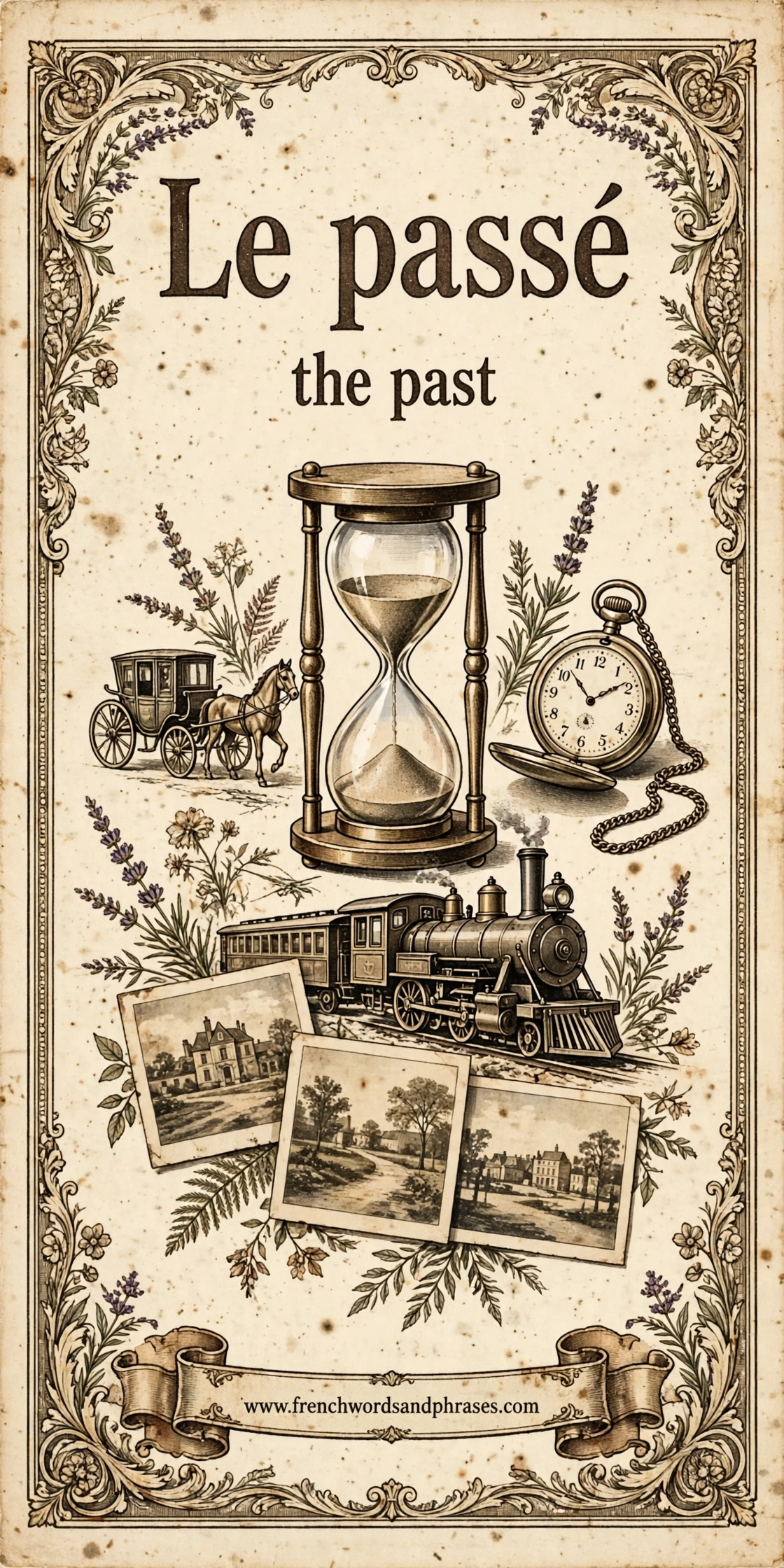
Le passé means the past.
Old photographs in a shoebox, a street that no longer exists, the grammar tense you learned at school: le passé, the past — everything that has been, and that French grammar spends half its life conjugating.
In this guide, you’ll learn what passé means in English, how to use it with its articles, how to form its plural, and how it appears in everyday French. Explore French examples, English translations, and practice quizzes.
Understanding the French Noun Passé
Passé is a masculine French noun, learned with its article: le passé, un passé. It is the past participle of passer turned into a noun: the time behind us, a person’s history — un passé glorieux, a glorious past — and, in grammar, the past tenses themselves: le passé composé, le passé simple.
It means the past: dans le passé, in the past; par le passé, in times gone by. Of a person, un passé is their history, for better or worse: un passé douloureux, a painful past, oublier le passé, to forget the past. And for every learner of French, le passé is also the great family of past tenses that tell what happened: passé composé, imparfait, passé simple.
Gender: Masculine — le passé
Definite article: le — le passé (the past)
Indefinite article: un — un passé (a past)
Plural: les passés — rare; usually singular
Grammar lives: le passé composé, le passé simple — the past tenses
Key phrases: dans le passé (in the past), par le passé (formerly)
English equivalents: The past.
Two small phrases carry the word through daily life: dans le passé for things situated in past time, and par le passé for how things used to be done — par le passé, on écrivait des lettres, in the old days, people wrote letters.
Experience the Word
Passé is the country behind us: everyone lives there part of the time, in photographs, in grammar, in stories that begin il était une fois.
Imagine the attic box: a wedding photograph, a ration card, a school report from 1962 — open it, and le passé sits down beside you like an old relative.
You have not just named dead time. You have named the storehouse of everything we were — le passé, the past.
How to Use Passé in French: Complete Guide
Let’s explore how passé works in French, beginning with its articles — le passé, un passé, dans le passé.
Passé with the Definite Article (Le, Les)
Used for the past itself — the time behind us, shared by everyone.
| Form | French |
|---|---|
| Masculine singular | le passé |
| Plural | les passés |
Example
Le passé ne revient jamais.
The past never comes back.
Passé with the Indefinite Article (Un, Des)
Used for one person’s past — a history among others.
| Form | French |
|---|---|
| Masculine singular | un passé |
| Plural | des passés |
Example
Elle a un passé de musicienne.
She has a past as a musician.
Passé with Quantities and Kinds (Récent, Lointain, Glorieux…)
The past comes in kinds — recent or distant, glorious or painful.
| Kind | French |
|---|---|
| the recent past | le passé récent |
| the distant past | le passé lointain |
| a glorious past | un passé glorieux |
| a painful past | un passé douloureux |
| in the past | dans le passé |
Example
Dans le passé, le village était plus petit.
In the past, the village was smaller.
Quick Quiz 1
Complete the sentence:
______ passé composé raconte ce qui s’est passé. (the)
Reveal the answer
Le
Le passé composé raconte ce qui s’est passé.
The passé composé tells what happened — passé is masculine, so le.
The Plural of Passé
Passé is usually singular — we each have one past — but the plural exists for histories and grammar books.
| Number | French |
|---|---|
| Singular | le passé |
| Plural | les passés |
Example
Les passés de ces deux familles se ressemblent.
The pasts of these two families resemble each other.
Passé with Possessive Adjectives (Mon, Ton, Son…)
Possessives agree with the noun: passé is masculine, so mon, ton, son in the singular.
| Owner | French |
|---|---|
| my | mon passé |
| your (tu) | ton passé |
| his / her | son passé |
| our | notre passé |
| your (vous) | votre passé |
| their | leur passé |
Example
Il ne parle jamais de son passé.
He never talks about his past.
Quick Quiz 2
Complete the sentence:
Elle a oublié ______ passé et commence une vie nouvelle. (her)
Reveal the answer
son
Elle a oublié son passé et commence une vie nouvelle.
She has forgotten her past and is starting a new life — son agrees with passé, masculine.
Passé with Demonstrative Adjectives (Ce, Ces)
Used to point: ce passé, that past — usually the one under discussion.
| Form | French |
|---|---|
| Masculine singular | ce passé |
| Plural | ces passés |
Example
Ce passé glorieux inspire encore la ville.
That glorious past still inspires the town.
Passé with Adjectives
Adjectives agree with passé — masculine singular.
| Adjective | With Passé |
|---|---|
| récent (recent) | le passé récent |
| lointain (distant) | le passé lointain |
| glorieux (glorious) | un passé glorieux |
| douloureux (painful) | un passé douloureux |
| composé (compound — grammar) | le passé composé |
Example
Le passé récent du quartier est bien documenté.
The recent past of the district is well documented.
Quick Quiz 3
Complete the sentence:
C’est un passé ______, plein de victoires. (glorious)
Reveal the answer
glorieux
C’est un passé glorieux, plein de victoires.
It is a glorious past, full of victories — glorieux, masculine, to agree with passé.
Everyday Expressions with Passé
Memory, history and grammar class — the passé phrases of daily life.
| Expression | In English |
|---|---|
| dans le passé | in the past |
| par le passé | in the past, formerly |
| oublier le passé | to forget the past |
| le passé composé | the passé composé (past tense) |
| un homme au passé chargé | a man with a heavy past |
Example
Par le passé, on voyageait en bateau.
In the old days, people travelled by boat.
Words from the Same Family as Passé
Time’s other rooms — the words that travel with passé.
| French | In English |
|---|---|
| passer | to pass, to go by (the verb) |
| le présent | the present |
| l’avenir | the future |
| autrefois | in the old days, formerly |
| jadis | long ago, in days of old |
Example
Le présent compte plus que le passé.
The present matters more than the past.
Quick Quiz 4
What does par le passé mean?
Reveal the answer
In the past, formerly — how things used to be done.
Par le passé, ce magasin était une boulangerie.
In the past, this shop was a bakery.
Passé in Everyday French: Real-Life Examples
Now that you know the word, let’s see how passé appears in everyday French.
Example 1 — Long ago
Dans le passé, tout était différent.
In the past, everything was different.
Example 2 — History
Cette ville a un passé glorieux.
This town has a glorious past.
Example 3 — Letting go
Il faut oublier le passé.
We must forget the past.
Example 4 — Grammar
Le passé composé utilise être ou avoir.
The passé composé uses être or avoir.
Example 5 — Personal
Elle ne parle pas de son passé.
She does not talk about her past.
Example 6 — Formerly
Par le passé, on écrivait des lettres.
In the old days, people wrote letters.
Beyond Translation: The Meaning of Passé
Every French learner meets le passé twice: first as the country of memory, then as the battlefield of grammar — passé composé, imparfait, passé simple, plus-que-parfait, a whole parliament of tenses for saying what happened. English manages with fewer; French insists that the past has textures: finished or ongoing, near or literary.
Le passé is not one time but several, layered like the streets of an old town.
To master its tenses is to be able to walk those streets.
How to Remember the French Noun Passé
Remember it this way: Passé is the past — time behind us and the grammar tenses that tell it: masculine, le passé.
- Always masculine — le passé, un passé, son passé.
- Two doorway phrases — dans le passé, in the past; par le passé, formerly.
- Grammar lives here — le passé composé and le passé simple are named with this word.
The key idea is le passé — the past, masculine; dans le passé = in the past.
Test Your Knowledge of Passé
Let’s see how much you’ve learned. Try answering these questions before revealing the answers.
Question 1
Is passé masculine or feminine?
Reveal the answer
Masculine — le passé, un passé.
Question 2
How do you say in the past in French?
Reveal the answer
Dans le passé — or par le passé for formerly.
Question 3
Translate: He never talks about his past.
Reveal the answer
Il ne parle jamais de son passé.
Question 4
What is le passé composé?
Reveal the answer
The main French past tense — formed with être or avoir plus the past participle.
Question 5
Complete the sentence:
______ passé ne revient jamais. (the)
Reveal the answer
Le
Le passé ne revient jamais.
The past never comes back.
Your Final Challenge
Can You Use It?
How would you say this in French?
“In the past, this shop was a bakery.”
Reveal the answer
Par le passé, ce magasin était une boulangerie.
In the past, this shop was a bakery.
A little French. A little curiosity. A richer everyday life.
LEARN FRENCH ONE WORD AT A TIME