
A French Word to Live By
Translate Doux to English
/du/
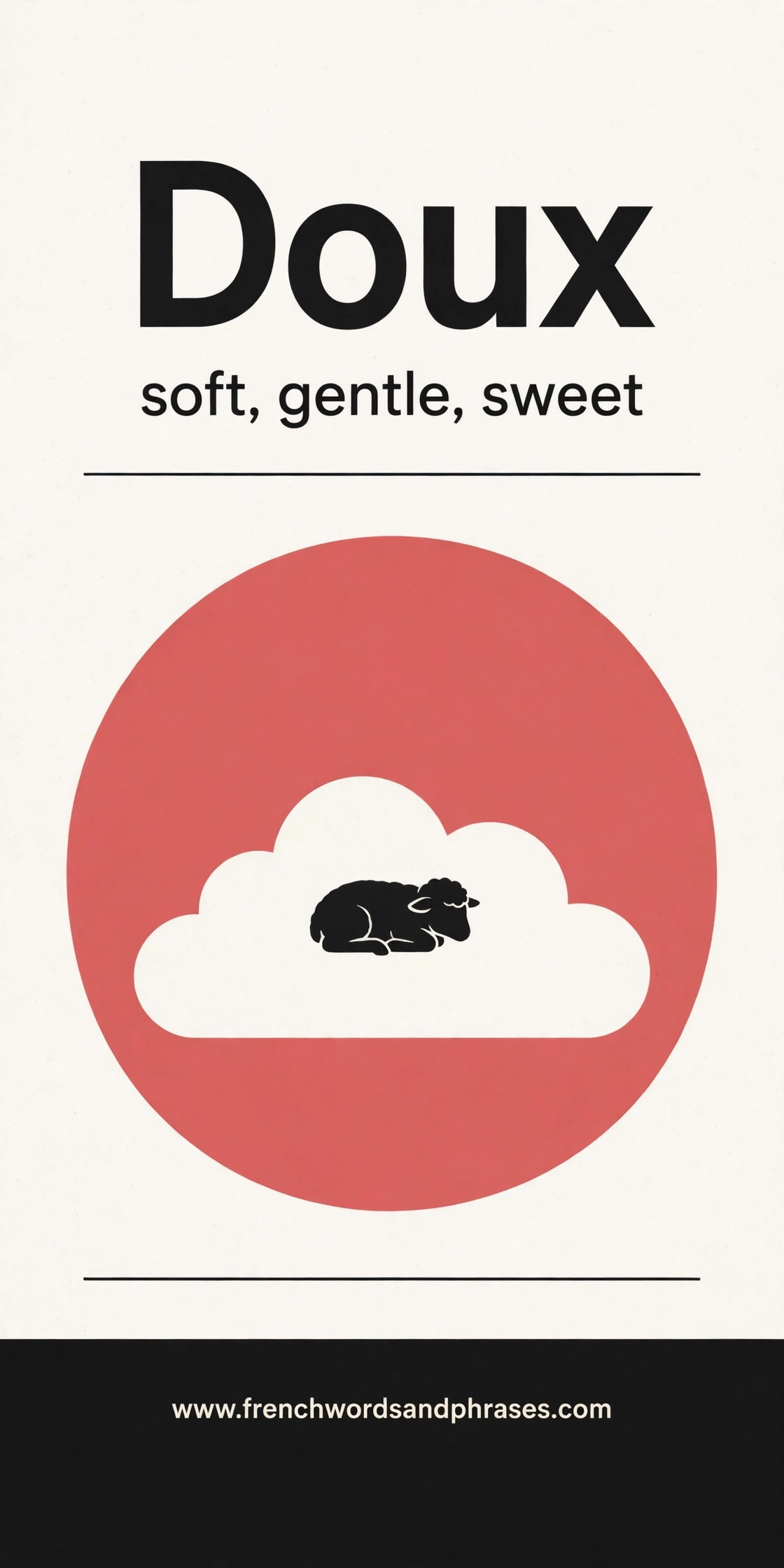
Doux means soft, gentle, sweet.
A hand on a child’s forehead, a voice that calms, honey on warm bread: doux is the adjective of everything that does not hurt — soft to the touch, gentle in manner, sweet on the tongue.
In this guide, you’ll learn what doux means in English, how its feminine douce is formed, where it stands in the sentence, and how one word covers soft blankets, gentle people and sweet tastes. Explore French examples, English translations, and practice quizzes.
Understanding the French Adjective Doux
Doux is a French adjective of sensation and character. Its feminine is douce — the x of the masculine softens into a c — and its family is one of the gentlest in French: la douceur, gentleness, doucement, gently, softly, slowly.
It means soft, gentle and sweet, moving between the senses: une peau douce, soft skin; un tissu doux, a soft fabric; une voix douce, a gentle voice; un goût doux, a sweet, mild taste. Of people it is kindness itself: un homme doux, a gentle man. And of weather, un temps doux is mild weather — neither hot nor cold.
Type: Adjective of sensation and character — softness in every sense
Answers the question: What is it like? — soft, gentle, sweet, mild
Changes form: Feminine douce (the x becomes c); plurals doux / douces
English equivalents: Soft; gentle; sweet; mild (of weather).
One important usage detail: doux follows its noun for things — une lumière douce, a soft light — and its adverb doucement does triple duty: gently, softly, and slowly — doucement ! is what you say to someone going too fast or too rough: easy does it!
Experience the Word
Doux is the adjective the hand learns before the ear: the blanket, the cheek, the evening air after a hot day.
Imagine the house at nightfall: a lamp lit, a voice reading aloud, un temps doux at the open window — everything sharp in the world has been politely asked to leave.
You have not just named a texture. You have named kindness in physical form — doux, soft, gentle, sweet.
How to Use Doux in French: Complete Guide
Let’s explore how doux works in French, beginning with its forms — doux, douce, and the family of douceur.
Doux at a Glance
Before the details, here is the whole word on one card.
The Whole Word on One Card
Doux in four lines — meaning, type, position, form.
| Point | Doux |
|---|---|
| Meaning | soft, gentle, sweet — what does not hurt |
| Type | adjective of sensation and character |
| Usual position | after the noun — une voix douce |
| Form | doux / douce; plurals doux / douces |
Example
Elle parle d’une voix douce.
She speaks in a gentle voice.
The Four Forms of Doux
The masculine ends in -x and does not change in the plural; the feminine is douce, douces.
| Form | Doux | Example |
|---|---|---|
| Masculine singular | doux | un tissu doux — a soft fabric |
| Feminine singular | douce | une peau douce — soft skin |
| Masculine plural | doux | des mots doux — gentle words |
| Feminine plural | douces | des mains douces — gentle hands |
Example
Des mains douces ont fermé la porte sans bruit.
Gentle hands closed the door without a sound.
Quick Quiz 1
Complete the sentence:
Elle a une voix ______ . (gentle)
Reveal the answer
douce
Elle a une voix douce.
She has a gentle voice — douce, the feminine of doux.
The Feminine of Doux: Douce
The -x of the masculine becomes -ce in the feminine: doux, douce.
| Situation | Example |
|---|---|
| Masculine | un regard doux — a gentle look |
| Feminine | une lumière douce — a soft light |
| Why | adjectives in -x often make their feminine in -ce: doux/douce, faux/fausse is the cousin in -sse |
| The plural | douces — des paroles douces, gentle words |
Example
Une lumière douce entre par la fenêtre.
A soft light comes through the window.
Where Doux Goes: After the Noun
Doux follows the noun it describes in almost all its uses.
| Pattern | Example |
|---|---|
| After the noun | un temps doux — mild weather |
| After être | elle est douce — she is gentle |
| Before the noun | de doux mots — literary only; everyday French keeps doux after |
| In set phrases | à feu doux — on a low heat (cooking) |
Example
Faites cuire à feu doux pendant une heure.
Cook on a low heat for an hour.
Quick Quiz 2
Choose the correct sentence:
(a) une douce voix (b) une voix douce — in everyday French
Reveal the answer
(b) une voix douce
Doux normally follows its noun: une voix douce, a gentle voice.
More Doux: Comparing with Doux
Comparisons work as usual — plus, moins, aussi before the adjective.
| Degree | Example |
|---|---|
| As gentle as | aussi doux que — as gentle as |
| Gentler | plus doux — softer, gentler |
| Less gentle | moins doux — less gentle |
| The gentlest (masc.) | le plus doux — le plus doux des frères |
| The gentlest (fem.) | la plus douce — la plus douce des voix |
Example
Ce tissu est plus doux que l’autre.
This fabric is softer than the other.
Everyday Expressions with Doux
Kitchens, weather and lullabies — where doux lives in daily French.
| Expression | In English |
|---|---|
| à feu doux | on a low heat |
| un temps doux | mild weather |
| des mots doux | sweet words, sweet nothings |
| une eau douce | fresh water (not salt) |
| la douceur de vivre | the sweetness of living |
| doucement | gently; softly; slowly — easy does it! |
Example
La douceur de vivre attire les visiteurs.
The sweetness of living attracts visitors.
Quick Quiz 3
What does à feu doux mean in a recipe?
Reveal the answer
On a low heat.
Laissez mijoter à feu doux.
Leave to simmer on a low heat.
Doux and Its Neighbours
Near words, from rough to tender.
| French | In English |
|---|---|
| mou | soft (squashy, limp) — a near neighbour, less kind |
| tendre | tender |
| gentil | kind, nice (of people) |
| sucré | sweetened, sugary — the taste neighbour |
| dur | hard — the opposite |
| rude | rough, harsh — the opposite |
Example
Ce fromage est doux, pas fort.
This cheese is mild, not strong.
Watch Out: The Traps Around Doux
Four things learners get wrong with doux.
| Trap | The truth |
|---|---|
| The feminine | douce, not douxe — the x becomes c |
| The masculine plural | des mots doux — no extra s: doux already ends in x |
| Sweet taste | doux = sweet and mild by nature; sucré = sweetened with sugar |
| Doucement | the adverb also means slowly: doucement ! = slow down, easy does it |
Example
Doucement, tu vas tout casser !
Easy does it, you’ll break everything!
Quick Quiz 4
Complete the sentence:
Elle berce l’enfant avec des paroles ______ . (gentle)
Reveal the answer
douces
Elle berce l’enfant avec des paroles douces.
She rocks the child with gentle words — douces, feminine plural.
Doux in Everyday French: Real-Life Examples
Now that you know the word, let’s see how doux appears in everyday French.
Example 1 — Touch
Ce tissu est très doux.
This fabric is very soft.
Example 2 — Voice
Elle parle d’une voix douce.
She speaks in a gentle voice.
Example 3 — Weather
Quel temps doux pour un mois de novembre !
What mild weather for November!
Example 4 — Cooking
Faites cuire à feu doux.
Cook on a low heat.
Example 5 — Character
C’est un homme doux et patient.
He is a gentle, patient man.
Example 6 — Slowly
Doucement, le bébé dort.
Gently — the baby is sleeping.
Beyond Translation: The Meaning of Doux
Doux is one of French’s load-bearing words: la douceur de vivre — the sweetness of living — is practically the national promise, and it is built on this adjective. The hand knows it (une peau douce), the ear knows it (une voix douce), the tongue knows it (un goût doux), and the climate borrows it (un temps doux). No other French adjective covers so many senses with one soft syllable.
Doux is the sound of the world lowering its voice.
And its warning form, doucement, is the first word every French child learns to obey.
How to Remember the French Adjective Doux
Remember it this way: Doux is soft, gentle, sweet — feminine douce, and its adverb doucement also means slowly: easy does it.
- The feminine changes — doux becomes douce; the masculine plural stays doux.
- After the noun — une voix douce, un temps doux (mild weather).
- The kitchen phrase — à feu doux, on a low heat.
The key idea is doux means soft, gentle, sweet; feminine douce, plural doux/douces.
Test Your Knowledge of Doux
Let’s see how much you’ve learned. Try answering these questions before revealing the answers.
Question 1
What is the feminine of doux?
Reveal the answer
Douce — the x becomes c: une voix douce.
Question 2
How do you say mild weather in French?
Reveal the answer
Un temps doux.
Question 3
Translate: She speaks in a gentle voice.
Reveal the answer
Elle parle d’une voix douce.
Question 4
What does doucement ! mean as an order?
Reveal the answer
Easy does it! Slow down! — doucement means gently, softly and slowly.
Question 5
Complete the sentence:
Des mains ______ ont fermé la porte. (gentle)
Reveal the answer
douces
Des mains douces ont fermé la porte.
Gentle hands closed the door.
Your Final Challenge
Can You Use It?
How would you say this in French?
“Cook on a low heat for an hour.”
Reveal the answer
Faites cuire à feu doux pendant une heure.
Cook on a low heat for an hour.
A little French. A little curiosity. A richer everyday life.
LEARN FRENCH ONE WORD AT A TIME




