A French Word to Live By
Translate Partout to English
/paʁ.tu/
Partout means everywhere.
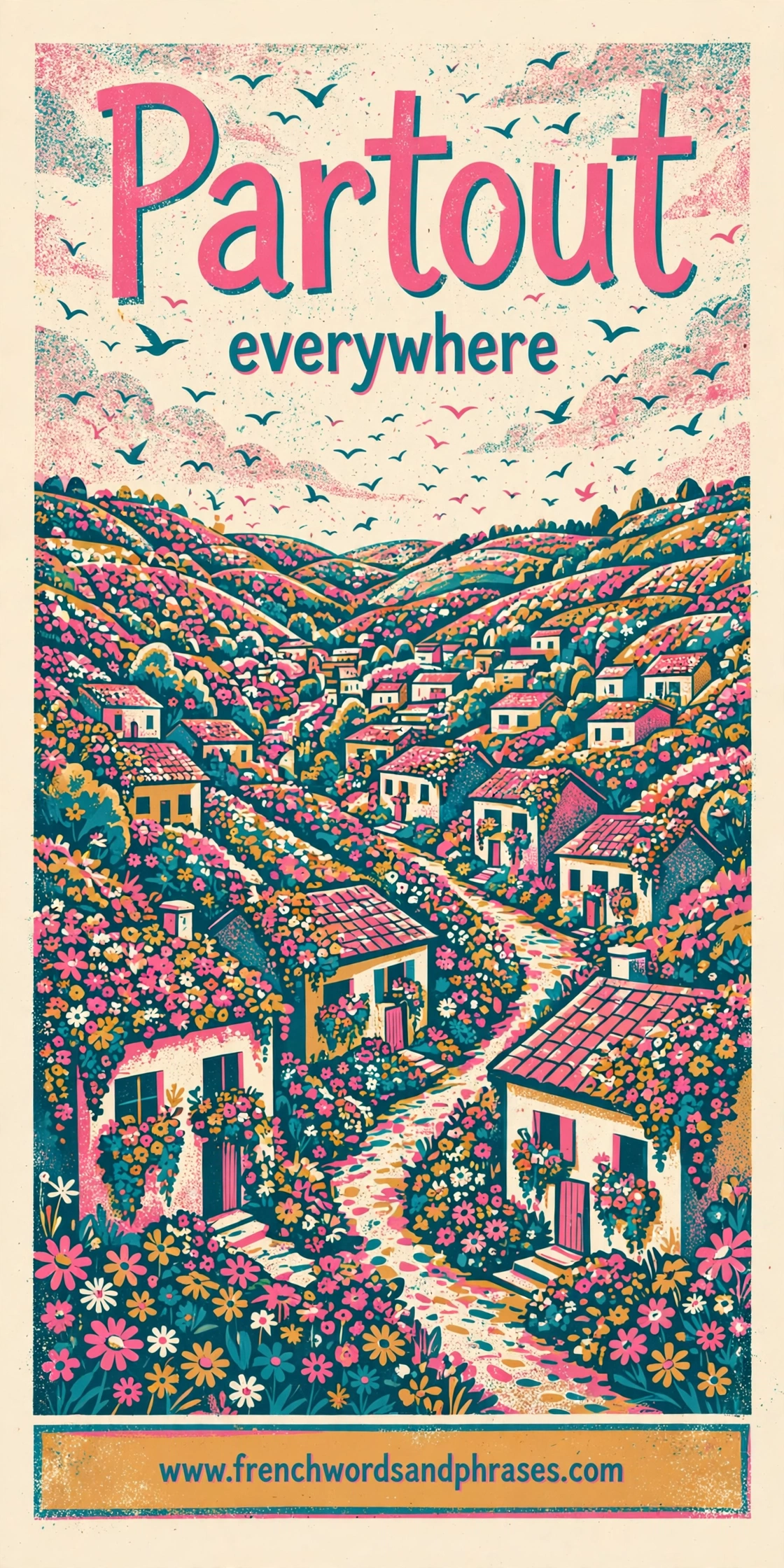
Spring in the valley: poppies in the wheat, poppies along the road, poppies in every crack of the old stone wall. The child turns in a slow circle, arms wide — « Il y en a partout ! » Partout: everywhere the eye can reach.
In this guide, you’ll learn what partout means in English, how it spreads an action over every place, where it stands in a French sentence, and the expressions built on it. Explore French examples, English translations, and practice quizzes.
Understanding the French Adverb Partout
Partout is a French adverb of place — the widest of them all. It is par (through) plus tout (all) fused into one word: through-all, everywhere. It never changes form, and it often travels with its partners: partout où, n’importe où, de partout.
It means everywhere. Il y a des fleurs partout — there are flowers everywhere. Partout stretches a fact over the whole map: not just here, not just there, but in every place you could look. With a negative it flips completely: nulle part is its opposite twin, nowhere.
Type: Adverb of place — every place
Answers the question: Where? — everywhere
Changes form: Never — partout is invariable
English equivalents: Everywhere; all over; (partout où) wherever.
One important usage detail: partout needs no help from a preposition — French says je l’ai cherché partout, I looked for it everywhere, never « en partout ». And when everywhere meets a clause, partout takes où with it: partout où je vais, everywhere I go.
Experience the Word
Partout is the adverb of abundance and of searching. It is the word for the rumour that reached every village, the sand after the beach holiday, the cat hair on every cushion in the house.
Imagine the market square on festival day: music from the bandstand, music from the café, bunting over every street — la fête est partout, and nobody can say where it begins or ends.
You have not just said in many places. You have covered the whole map with one word.
How to Use Partout in French: Complete Guide
Let’s explore how partout works in French, beginning with the whole word on one card.
Partout at a Glance
Before the details, here is the whole word on one card.
The Whole Word on One Card
Meaning, type, position and form — partout in four lines.
| Point | Partout |
|---|---|
| Meaning | everywhere |
| Type | adverb of place — every place |
| Usual position | after the verb, often at the end of the sentence |
| Form | invariable — never changes |
Example
Il y a des touristes partout en été.
There are tourists everywhere in summer.
Where Partout Goes in the Sentence
Partout usually closes the sentence, spreading the fact over the whole scene as it lands.
| Situation | Pattern |
|---|---|
| Simple sentence | verb + partout — je le cherche partout |
| Head of the sentence | Partout, + sentence — Partout, les gens dansaient |
| With a clause | partout où + clause — partout où je vais |
| From everywhere | de partout — ils arrivent de partout |
Example
Partout où il passe, les enfants le suivent.
Everywhere he goes, the children follow him.
Quick Quiz 1
True or false: partout needs a preposition, as in « en partout ».
Reveal the answer
False
Partout stands alone: je l’ai cherché partout — I looked for it everywhere.
Partout with Everyday Verbs
Partout spreads the verbs of being, searching, finding and going over the whole map.
| Situation | Example |
|---|---|
| Being | En août, il y a du monde partout. |
| Searching | J’ai cherché mes clés partout. |
| Finding | On trouve ce fromage partout en France. |
| Going | Il emporte son appareil photo partout. |
| Seeing | Des affiches partout annoncent la fête. |
Example
Elle laisse ses affaires partout dans la maison.
She leaves her things everywhere in the house.
Everyday Expressions with Partout
Partout builds phrases for searching, spreading and following.
| Expression | In English |
|---|---|
| partout où | wherever, everywhere that |
| de partout | from everywhere, from all sides |
| un peu partout | more or less everywhere, all over the place |
| partout dans le monde | all over the world |
| chercher partout | to look everywhere, to search high and low |
Example
Les invités arrivent de partout pour le mariage.
The guests are arriving from everywhere for the wedding.
Quick Quiz 2
Complete the sentence:
J’ai cherché mon passeport ______. (everywhere)
Reveal the answer
partout
J’ai cherché mon passeport partout.
I looked for my passport everywhere.
Partout and Its Neighbours
The place family, from one spot to the whole map — and the negative twin that empties it.
| French | In English |
|---|---|
| partout | everywhere |
| nulle part | nowhere — the negative twin |
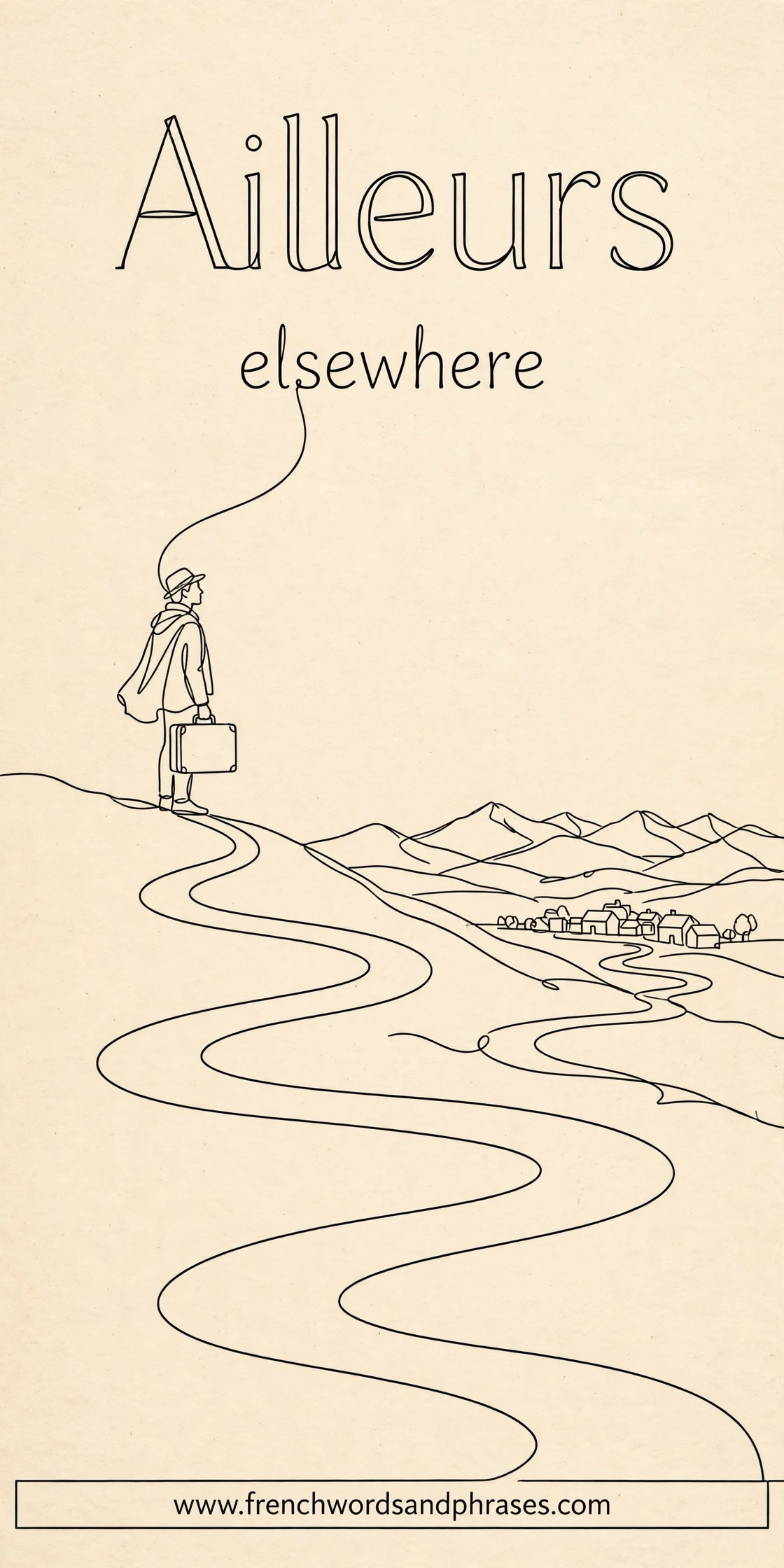
| ailleurs | elsewhere (one other place) |
| quelque part | somewhere |
Example
Je le cherche partout, mais je ne le trouve nulle part.
I am looking for it everywhere, but I cannot find it anywhere (nowhere).
Partout or Nulle Part?
French negatives move in pairs: ne… partout does not exist; the negative of partout is nulle part, riding with ne.
| Aspect | The Difference |
|---|---|
| Affirmative | Il y en a partout. — There are some everywhere. |
| Negative | Il n’y en a nulle part. — There are none anywhere. |
| The pair | ne + verb + nulle part |
| A safe rule | Everywhere affirms with partout; deny with ne… nulle part |
Example
On ne trouve ce pain nulle part ailleurs.
You cannot find this bread anywhere else.
Quick Quiz 3
What does de partout mean?
Reveal the answer
From everywhere
Les lettres arrivent de partout.
The letters are arriving from everywhere.
Partout Où: Everywhere That
When a clause follows, partout joins où — and the pair means wherever, everywhere that.
| Pattern | Example |
|---|---|
| partout où + present | Partout où je vais, je prends le train. |
| partout où + past | Partout où il a vécu, il a laissé des amis. |
| Shortened in speech | Partout où tu iras, écris-moi. |
| Contrast with n’importe où | n’importe où = anywhere at all (choice, not spread) |
Example
Partout où elle passe, les fleurs semblent plus belles.
Everywhere she goes, the flowers seem more beautiful.
Watch Out: Everywhere Is Not Tout le Monde
English everywhere is about place; learners sometimes reach for tout (all) and land on people instead.
| Mistake | Correct French |
|---|---|
| « tout le monde » used for everywhere | partout — tout le monde means everybody |
| « en partout » | partout alone |
| « partout les places » word-for-word | dans tous les endroits / partout |
| « je le trouve ne partout » for the negative | je ne le trouve nulle part |
Example
Tout le monde était là, et il y avait des fleurs partout.
Everybody was there, and there were flowers everywhere.
Quick Quiz 4
Translate: I looked for it everywhere, but I found it nowhere.
Reveal the answer
Je l’ai cherché partout, mais je ne l’ai trouvé nulle part.
Partout affirms; nulle part denies — the two twins of French place.
Partout in Everyday French: Real-Life Examples
Now that you know the word, let’s see how partout appears in everyday French.
Example 1 — At home
Il y a des livres partout dans son appartement.
There are books everywhere in his flat.
Example 2 — Travel
Partout où je vais en France, les gens sont accueillants.
Everywhere I go in France, people are welcoming.
Example 3 — Searching
Nous avons cherché le chat partout dans le quartier.
We looked for the cat everywhere in the neighbourhood.
Example 4 — Nature
Au printemps, il y a des fleurs partout.
In spring, there are flowers everywhere.
Example 5 — At work
Elle laisse des notes partout sur son bureau.
She leaves notes everywhere on her desk.
Example 6 — Weather
La neige a fondu partout dans la vallée.
The snow has melted everywhere in the valley.
Beyond Translation: The Meaning of Partout
Some words point, and some words pour. Partout pours: par tout, through all, it spreads whatever it touches — flowers, rumours, tourists, sand — over the whole surface of the world.
To say partout is to refuse to leave a single corner out.
It is the adverb of the festival and the lost key alike: total coverage, in two syllables, with its dark twin nulle part waiting for the negative.
How to Remember the French Adverb Partout
Remember it this way: Partout means everywhere — par tout, through all — and its negative twin is nulle part, nowhere.
- You spread the scene — il y a des fleurs partout au printemps.
- You search in vain — je l’ai cherché partout, trouvé nulle part.
- You add the clause — partout où je vais, je prends le train.
The key idea is everywhere — no preposition needed; negative twin nulle part.
Test Your Knowledge of Partout
Let’s see how much you’ve learned. Try answering these questions before revealing the answers.
Question 1
What does partout mean?
Reveal the answer
Everywhere — in every place.
Question 2
What is the negative of partout?
Reveal the answer
Nulle part — nowhere, used with ne: je ne le trouve nulle part.
Question 3
Translate: There are tourists everywhere in summer.
Reveal the answer
Il y a des touristes partout en été.
Question 4
What does partout où mean?
Reveal the answer
Wherever, everywhere that — partout où je vais, everywhere I go.
Question 5
Complete the sentence:
Les invités arrivent de ______. (everywhere)
Reveal the answer
partout
Les invités arrivent de partout.
The guests are arriving from everywhere.
Your Final Challenge
Can You Use It?
How would you say this in French?
“In spring, there are flowers everywhere.”
Reveal the answer
Au printemps, il y a des fleurs partout.
In spring, there are flowers everywhere.
A little French. A little curiosity. A richer everyday life.
LEARN FRENCH ONE WORD AT A TIME