A French Word to Live By
Translate Pantalon to English
/pɑ̃.ta.lɔ̃/
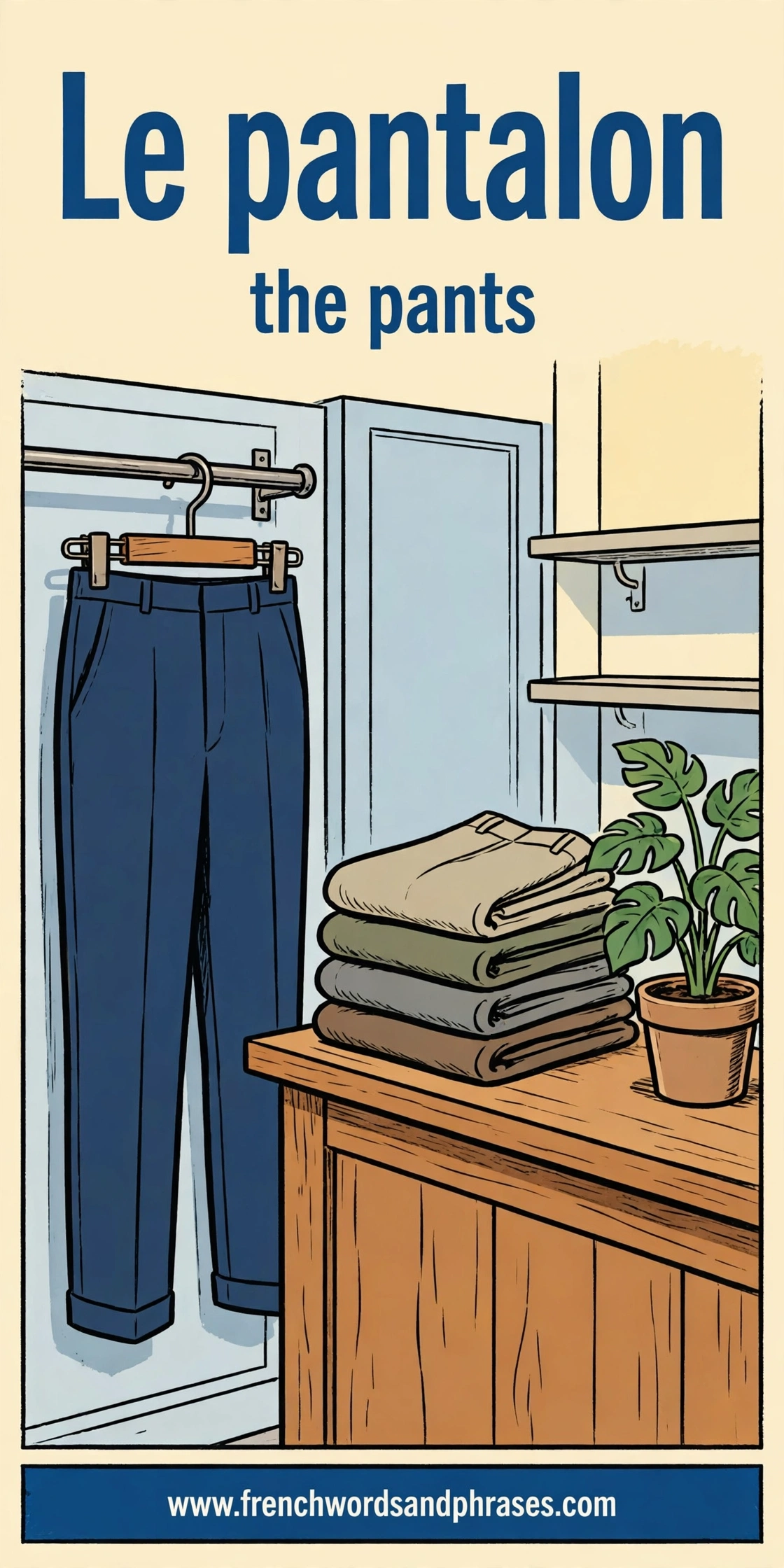
Le pantalon means the pants.
Two legs, a belt, and the whole day ahead: le pantalon, the pants — the garment that conquered the world from a Venetian stage, and in French, once again, a singular word for the pair: un pantalon.
In this guide, you’ll learn what pantalon means in English, how to use it with its articles, how to form its plural, and how it appears in everyday French. Explore French examples, English translations, and practice quizzes.
Understanding the French Noun Pantalon
Pantalon is a masculine French noun, learned with its article: le pantalon, un pantalon. The word is a character’s name: Pantalone, the old Venetian of the Italian comedy, wore the long trousers that took his name across Europe. In French the garment is grammatically singular — un pantalon is one pair of pants, with a singular verb — where English insists on a plural pair.
It means pants, trousers — the garment covering both legs, from waist to ankle: un pantalon noir, black pants, un pantalon de costume, suit trousers, un pantalon large, wide-leg trousers. The family is sorted by cloth and occasion: un pantalon en jean borders on le jean itself, un pantalon de sport is track pants, and the summer relations are le short and le bermuda. Its parts: la ceinture (the belt or waistband), les poches (the pockets), les jambes (the legs).
Gender: Masculine — le pantalon
Definite article: le — le pantalon (the pants)
Indefinite article: un — un pantalon (one pair of pants)
Plural: les pantalons — several pairs
Spelling note: named for Pantalone, the Venetian of the Italian comedy stage
The counting rule: one pair is singular: un pantalon, with a singular verb
English equivalents: The pants, the trousers.
The learner’s trap is agreement: mon pantalon est trop long — singular, always, for one pair. Describe by colour, cloth and cut: large (wide), serré (tight), à pinces (pleated). And French keeps an old figurative corner for the word: porter le pantalon, to wear the trousers — to be the one who decides, in the household of the idiom.
Experience the Word
Pantalon is the garment of getting things done: legs covered, pockets loaded, ready for the workshop, the office or the road.
Imagine the tailor’s shop in the morning — a rail of pantalons in grey, navy and black, each waiting for its hem, its belt, and its working life to begin.
You have not just named clothing. You have named the everyday uniform — le pantalon, the pants, singular and serious.
How to Use Pantalon in French: Complete Guide
Let’s explore how pantalon works in French, beginning with its articles — le pantalon, un pantalon, un pantalon de costume.
Pantalon with the Definite Article (Le, Les)
Used for a specific pantalon — the black one, the one for the interview.
| Form | French |
|---|---|
| Masculine singular | le pantalon |
| Plural | les pantalons |
Example
Le pantalon noir va avec la veste grise.
The black pants go with the grey jacket.
Pantalon with the Indefinite Article (Un, Des)
Used for a pantalon in general — one pair, counted as one garment.
| Form | French |
|---|---|
| Masculine singular | un pantalon |
| Plural | des pantalons |
Example
Il cherche un pantalon pour le mariage.
He is looking for pants for the wedding.
Kinds of Pantalon (De costume, de sport, large…)
Pants are named by occasion and by cut — the kinds in every wardrobe.
| Kind | French |
|---|---|
| suit trousers | un pantalon de costume |
| track pants | un pantalon de sport |
| wide-leg pants | un pantalon large |
| denim pants | un pantalon en jean |
| pleated pants | un pantalon à pinces |
Example
Pour courir, il met un pantalon de sport léger.
For running, he wears light track pants.
Quick Quiz 1
Complete the sentence:
______ pantalon est trop long, il faut le raccourcir. (the)
Reveal the answer
Le
Le pantalon est trop long, il faut le raccourcir.
The pants are too long, they need shortening — pantalon is masculine and singular, so le.
The Plural of Pantalon
Pantalon takes a regular plural in -s — the plural counts pairs in the wardrobe.
| Number | French |
|---|---|
| Singular | le pantalon (one pair) |
| Plural | les pantalons (several pairs) |
Example
Les pantalons sont rangés dans la penderie.
The pants are put away in the wardrobe.
Pantalon with Possessive Adjectives (Mon, Ton, Son…)
Possessives agree with the noun: pantalon is masculine, so mon, ton, son in the singular.
| Owner | French |
|---|---|
| my | mon pantalon |
| your (tu) | ton pantalon |
| his / her | son pantalon |
| our | notre pantalon |
| your (vous) | votre pantalon |
| their | leur pantalon |
Example
Mon pantalon a une tache, je vais changer.
My pants have a stain, I’ll change.
Quick Quiz 2
Complete the sentence:
Elle a mis ______ pantalon neuf pour l’entretien. (her)
Reveal the answer
son
Elle a mis son pantalon neuf pour l’entretien.
She wore her new pants for the interview — son, because pantalon is masculine.
Pantalon with Demonstrative Adjectives (Ce, Ces)
Used to point: ce pantalon, these pants — the one on the rail, the one in the mirror.
| Form | French |
|---|---|
| Masculine singular | ce pantalon |
| Plural | ces pantalons |
Example
Ce pantalon te va mieux que l’autre.
These pants suit you better than the other pair.
Pantalon with Adjectives
Adjectives agree with pantalon — masculine singular: un pantalon élégant, un pantalon serré.
| Adjective | With Pantalon |
|---|---|
| élégant (elegant) | un pantalon élégant |
| large (wide) | un pantalon large |
| serré (tight) | un pantalon serré |
| long (long) | un pantalon long |
| propre (clean) | un pantalon propre |
Example
Un pantalon élégant et une chemise, et le tour est joué.
Elegant pants and a shirt, and you’re done.
Quick Quiz 3
Complete the sentence:
C’est un pantalon ______, il me serre trop. (tight)
Reveal the answer
serré
C’est un pantalon serré, il me serre trop.
These pants are tight, they’re squeezing me — serré, masculine, to agree with pantalon.
Everyday Expressions with Pantalon
Interviews, tailors and one old idiom — the pantalon phrases of daily life.
| Expression | In English |
|---|---|
| un pantalon de costume | suit trousers |
| porter le pantalon | to wear the trousers — to be the boss (idiom) |
| la ceinture | the belt — the pantalon’s partner |
| les poches | the pockets |
| un pantalon à pinces | pleated pants |
Example
Dans cette maison, c’est elle qui porte le pantalon.
In this house, she’s the one who wears the trousers.
Words from the Same Family as Pantalon
Legs and wardrobes — the words that travel with pantalon.
| French | In English |
|---|---|
| le jean | the jeans — the denim branch |
| le short | the shorts — the summer cut |
| la ceinture | the belt |
| la jambe | the leg — of the body and of the trousers |
| la poche | the pocket |
Example
Le jean est un pantalon, mais tout pantalon n’est pas un jean.
Jeans are pants, but not all pants are jeans.
Quick Quiz 4
What does porter le pantalon mean, as an idiom?
Reveal the answer
To wear the trousers — to be the one who decides, the boss of the house.
Chez eux, c’est la grand-mère qui porte le pantalon.
In their house, it’s the grandmother who wears the trousers.
Pantalon in Everyday French: Real-Life Examples
Now that you know the word, let’s see how pantalon appears in everyday French.
Example 1 — Shopping
Je cherche un pantalon noir, taille quarante.
I’m looking for black pants, size forty.
Example 2 — Too long
Ton pantalon est trop long, il traîne.
Your pants are too long, they’re dragging.
Example 3 — The suit
Un pantalon de costume et une chemise blanche.
Suit trousers and a white shirt.
Example 4 — Sport
Pour le footing, il met un pantalon de sport.
For jogging, he wears track pants.
Example 5 — The stain
Mon pantalon a une tache de café.
My pants have a coffee stain.
Example 6 — Summer cut
En été, le pantalon devient un short.
In summer, the pants become shorts.
Beyond Translation: The Meaning of Pantalon
Pantalon began as a joke on a stage: Pantalone, the lean old Venetian merchant of the commedia dell’arte, in his long trousers and slippers, counting his coins. The character faded; the trousers conquered the world. French grammar gave the garment its final twist — singular, one thing, un pantalon — against English’s eternal pair. And the idiom porter le pantalon preserves the centuries when trousers meant authority itself: to wear them was to rule the house. A comedy costume that became the uniform of half of humanity.
To say pantalon is to dress a Venetian actor for modern life.
It evokes the tailor’s rail, the morning choice and the hem in the mirror — the serious garment, singular.
How to Remember the French Noun Pantalon
Remember it this way: Pantalon is the pants — masculine: le pantalon. One pair is un pantalon, singular, with a singular verb.
- Always masculine — le pantalon, un pantalon, mon pantalon.
- One pair, one word — mon pantalon est trop long, never « sont ».
- The name — from Pantalone, the Venetian of the Italian stage.
The key idea is le pantalon — the pants, masculine; one pair = un pantalon (singular).
Test Your Knowledge of Pantalon
Let’s see how much you’ve learned. Try answering these questions before revealing the answers.
Question 1
Is pantalon masculine or feminine?
Reveal the answer
Masculine — le pantalon, un pantalon.
Question 2
How do you say suit trousers?
Reveal the answer
Un pantalon de costume.
Question 3
Translate: My pants are too long.
Reveal the answer
Mon pantalon est trop long.
Question 4
Where does the word pantalon come from?
Reveal the answer
Pantalone — the Venetian character of the Italian comedy, whose trousers took his name.
Question 5
Complete the sentence:
______ pantalons sont dans la penderie. (the)
Reveal the answer
Les
Les pantalons sont dans la penderie.
The pants are in the wardrobe.
Your Final Challenge
Can You Use It?
How would you say this in French?
“My pants are too long, they need shortening.”
Reveal the answer
Mon pantalon est trop long, il faut le raccourcir.
My pants are too long, they need shortening.
A little French. A little curiosity. A richer everyday life.
LEARN FRENCH ONE WORD AT A TIME