A French Word to Live By
Translate Lycée to English
/li.se/
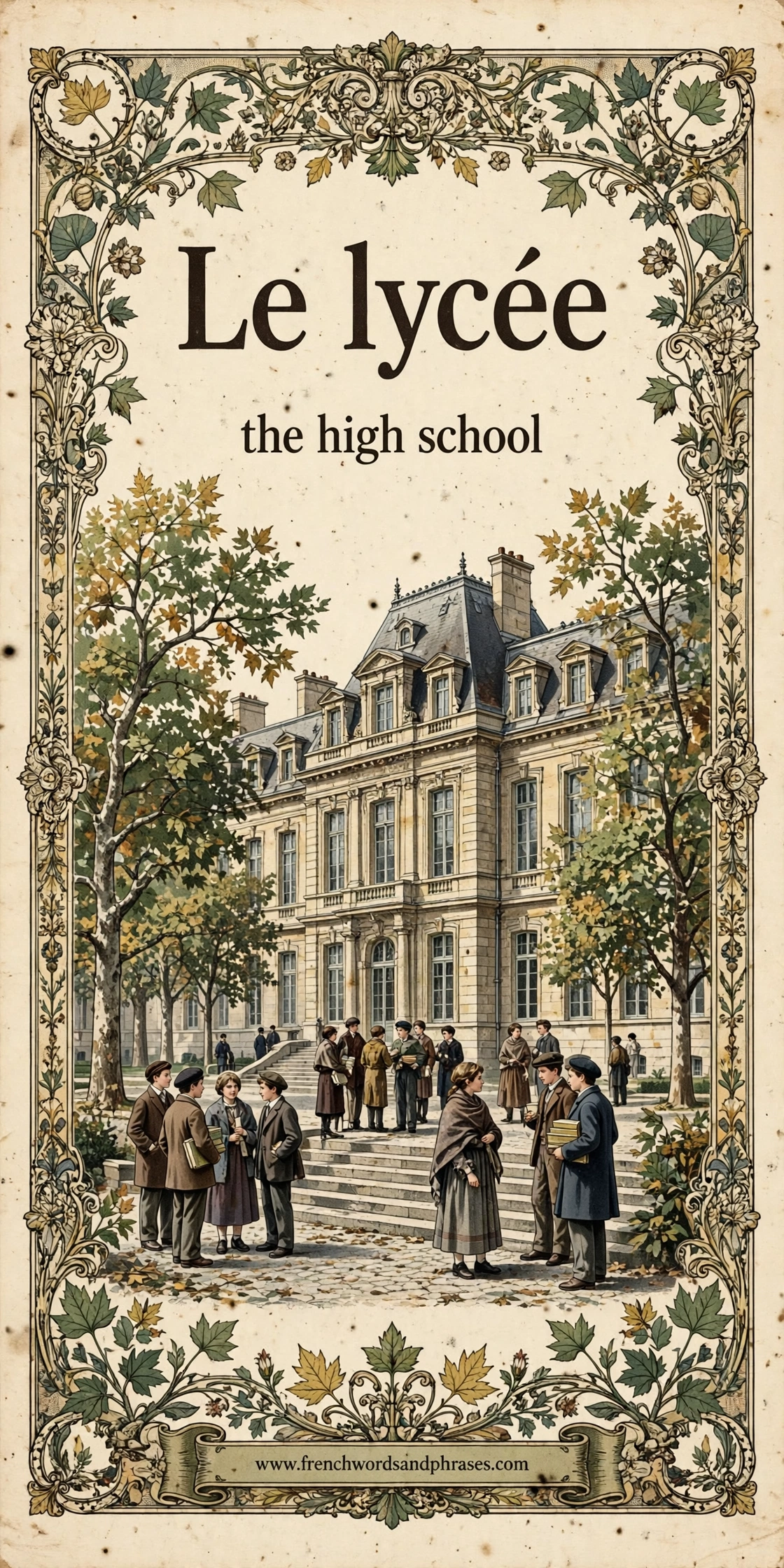
Le lycée means the high school.
Bigger gates, heavier books, and the whole future suddenly visible at the end of the corridor: le lycée, the high school — the last three years of French school, and the road to the famous baccalauréat.
In this guide, you’ll learn what lycée means in English, how to use it with its articles, how to form its plural, and how it appears in everyday French. Explore French examples, English translations, and practice quizzes.
Understanding the French Noun Lycée
Lycée is a masculine French noun, learned with its article: le lycée, un lycée. The word is ancient and travelled: it names the garden in Athens where Aristotle taught, the Lyceum, and Napoleon revived it for the schools he founded to form the nation’s elite. A pupil of the lycée is un lycéen, une lycéenne — the word changes the student as much as the school. After the lycée comes l’université — if the bac allows.
It means high school — the school for pupils aged fifteen to eighteen, after le collège: entrer au lycée, to start high school, un lycée parisien, a Parisian high school. Its three years climb like a countdown: la seconde, la première, la terminale — the final year, entirely aimed at le baccalauréat, le bac, the examination that ends French schooling and opens the university. A lycée can be général, technologique or professionnel, by the road it prepares.
Gender: Masculine — le lycée
Definite article: le — le lycée (the high school)
Indefinite article: un — un lycée (a high school)
Plural: les lycées — regular, with a simple -s
Spelling note: from the Lyceum of Athens, Aristotle’s school — revived by Napoleon
The three years: seconde, première, terminale — ages fifteen to eighteen
English equivalents: The high school.
Learn the pupil with the school: un lycéen, une lycéenne. The goal of the whole building is one word: le bac — passer le bac in terminale, avoir son bac in July, results day being a national event. And the staircase is now complete: maternelle, primaire, collège, lycée — say the four and you have mapped a French childhood.
Experience the Word
Lycée is the school’s last long corridor: behind you, childhood’s classrooms; ahead, one examination, and then the whole adult world.
Imagine the June morning of the bac — a thousand lycéens at the gates with pens and lucky charms, philosophy first, four hours, and the summer of their lives on the other side.
You have not just named a school. You have named the threshold — le lycée, the high school, where pupils become candidates.
How to Use Lycée in French: Complete Guide
Let’s explore how lycée works in French, beginning with its articles — le lycée, un lycée, de la seconde à la terminale.
Lycée with the Definite Article (Le, Les)
Used for a specific lycée — yours, the famous one across the river.
| Form | French |
|---|---|
| Masculine singular | le lycée |
| Plural | les lycées |
Example
Le lycée de ma fille est au centre-ville.
My daughter’s high school is in the town centre.
Lycée with the Indefinite Article (Un, Des)
Used for a lycée in general — one of the nation’s great schoolhouses.
| Form | French |
|---|---|
| Masculine singular | un lycée |
| Plural | des lycées |
Example
C’est un lycée ancien, fondé il y a deux siècles.
It’s an old high school, founded two centuries ago.
The Years of Lycée (Seconde, première, terminale)
Three years counted backwards towards the bac — the countdown every lycéen knows.
| Year | French |
|---|---|
| first year (age 15) | la seconde |
| second year (age 16) | la première |
| final year (age 17) | la terminale |
| the school-leaving exam | le baccalauréat — le bac |
| a high school pupil | un lycéen, une lycéenne |
Example
En terminale, tout le monde pense au bac.
In the final year, everyone thinks about the bac.
Quick Quiz 1
Complete the sentence:
______ lycée ouvre ses portes à sept heures et demie. (the)
Reveal the answer
Le
Le lycée ouvre ses portes à sept heures et demie.
The high school opens its doors at half past seven — lycée is masculine, so le.
The Plural of Lycée
Lycée takes a regular plural in -s — the great schools of a whole city.
| Number | French |
|---|---|
| Singular | le lycée |
| Plural | les lycées |
Example
Les lycées de la ville organisent une journée portes ouvertes.
The town’s high schools are holding an open day.
Lycée with Possessive Adjectives (Mon, Ton, Son…)
Possessives agree with the noun: lycée is masculine, so mon, ton, son in the singular.
| Owner | French |
|---|---|
| my | mon lycée |
| your (tu) | ton lycée |
| his / her | son lycée |
| our | notre lycée |
| your (vous) | votre lycée |
| their | leur lycée |
Example
Mon lycée avait une cour immense et de vieux marronniers.
My high school had a huge courtyard and old chestnut trees.
Quick Quiz 2
Complete the sentence:
Elle a retrouvé ______ lycée après vingt ans. (her)
Reveal the answer
son
Elle a retrouvé son lycée après vingt ans.
She found her old high school again after twenty years — son, because lycée is masculine.
Lycée with Demonstrative Adjectives (Ce, Ces)
Used to point: ce lycée, this high school — the one of the bac and the long June mornings.
| Form | French |
|---|---|
| Masculine singular | ce lycée |
| Plural | ces lycées |
Example
Ce lycée est connu pour ses résultats au bac.
This high school is known for its bac results.
Lycée with Adjectives
Adjectives agree with lycée — masculine singular: un lycée parisien, un grand lycée.
| Adjective | With Lycée |
|---|---|
| parisien (Parisian) | un lycée parisien |
| grand (big) | un grand lycée |
| ancien (old) | un lycée ancien |
| professionnel (vocational) | un lycée professionnel |
| célèbre (famous) | un lycée célèbre |
Example
Un lycée professionnel prépare à un métier précis.
A vocational high school prepares you for a specific trade.
Quick Quiz 3
Complete the sentence:
C’est un lycée ______, fondé sous Napoléon. (old)
Reveal the answer
ancien
C’est un lycée ancien, fondé sous Napoléon.
It’s an old high school, founded under Napoleon — ancien, masculine, to agree with lycée.
Everyday Expressions with Lycée
Countdowns, examinations and results day — the lycée phrases of daily life.
| Expression | In English |
|---|---|
| entrer au lycée | to start high school |
| passer le bac | to sit the baccalauréat |
| avoir son bac | to pass the bac — to graduate |
| la terminale | the final year |
| un lycéen, une lycéenne | a high school pupil |
Example
Elle a eu son bac avec mention, toute la famille est fière.
She passed her bac with honours, the whole family is proud.
Words from the Same Family as Lycée
The top of the school staircase — the words that travel with lycée.
| French | In English |
|---|---|
| le collège | the middle school — the step before |
| l’université | the university — the step after |
| le baccalauréat | the school-leaving examination |
| la terminale | the final year |
| un lycéen | a high school pupil |
Example
Après le lycée et le bac, l’université commence.
After high school and the bac, university begins.
Quick Quiz 4
What is le bac?
Reveal the answer
The baccalauréat — the great examination at the end of the lycée, in terminale.
Il passe son bac en juin.
He is sitting his bac in June.
Lycée in Everyday French: Real-Life Examples
Now that you know the word, let’s see how lycée appears in everyday French.
Example 1 — Starting
Mon fils entre au lycée en septembre.
My son starts high school in September.
Example 2 — The pupil
Les lycéens manifestent pour le climat.
The high school pupils are demonstrating for the climate.
Example 3 — The countdown
En terminale, le bac approche vite.
In the final year, the bac comes quickly.
Example 4 — Results day
Elle a eu son bac, nous fêtons ça ce soir.
She passed her bac, we’re celebrating tonight.
Example 5 — Memory
Mon lycée était un vieux bâtiment magnifique.
My high school was a magnificent old building.
Example 6 — The road on
Après le lycée, il veut étudier la médecine.
After high school, he wants to study medicine.
Beyond Translation: The Meaning of Lycée
Lycée is a word with two birthdays: born in Athens, where Aristotle walked and taught in the Lyceum, and reborn in 1802, when Napoleon founded the lycées to forge the administrators and officers of his empire — boarding, uniforms, drums at dawn. The military shine faded; the ambition remained. The lycée became the republic’s ladder, free and demanding, ending in the baccalauréat, the one examination a whole nation sits, discusses and remembers together. To have been a lycéen is a permanent French identity, carried long after the gates close behind you.
To say lycée is to stand at the top of the school staircase, looking out.
It evokes the June gates, the philosophy essay and the results sheet on the wall — youth, examined and released.
How to Remember the French Noun Lycée
Remember it this way: Lycée is the high school — masculine: le lycée, un lycée. Three years — seconde, première, terminale — and then le bac.
- Always masculine — le lycée, un lycée, mon lycée.
- The pupil — un lycéen, une lycéenne; the goal — le baccalauréat.
- The staircase complete — maternelle, primaire, collège, lycée, université.
The key idea is le lycée — the high school, masculine; seconde, première, terminale, then le bac.
Test Your Knowledge of Lycée
Let’s see how much you’ve learned. Try answering these questions before revealing the answers.
Question 1
Is lycée masculine or feminine?
Reveal the answer
Masculine — le lycée, un lycée.
Question 2
How do you say a high school pupil?
Reveal the answer
Un lycéen, une lycéenne.
Question 3
Translate: My daughter’s high school is in the town centre.
Reveal the answer
Le lycée de ma fille est au centre-ville.
Question 4
What are the three years of the lycée?
Reveal the answer
Seconde, première, terminale — counted down towards the baccalauréat.
Question 5
Complete the sentence:
______ lycées de la ville sont fermés en août. (the)
Reveal the answer
Les
Les lycées de la ville sont fermés en août.
The town’s high schools are closed in August.
Your Final Challenge
Can You Use It?
How would you say this in French?
“She passed her bac, we’re celebrating tonight.”
Reveal the answer
Elle a eu son bac, nous fêtons ça ce soir.
She passed her bac, we’re celebrating tonight.
A little French. A little curiosity. A richer everyday life.
LEARN FRENCH ONE WORD AT A TIME