How to Conjugate Palpiter in French
/pal.pi.te/
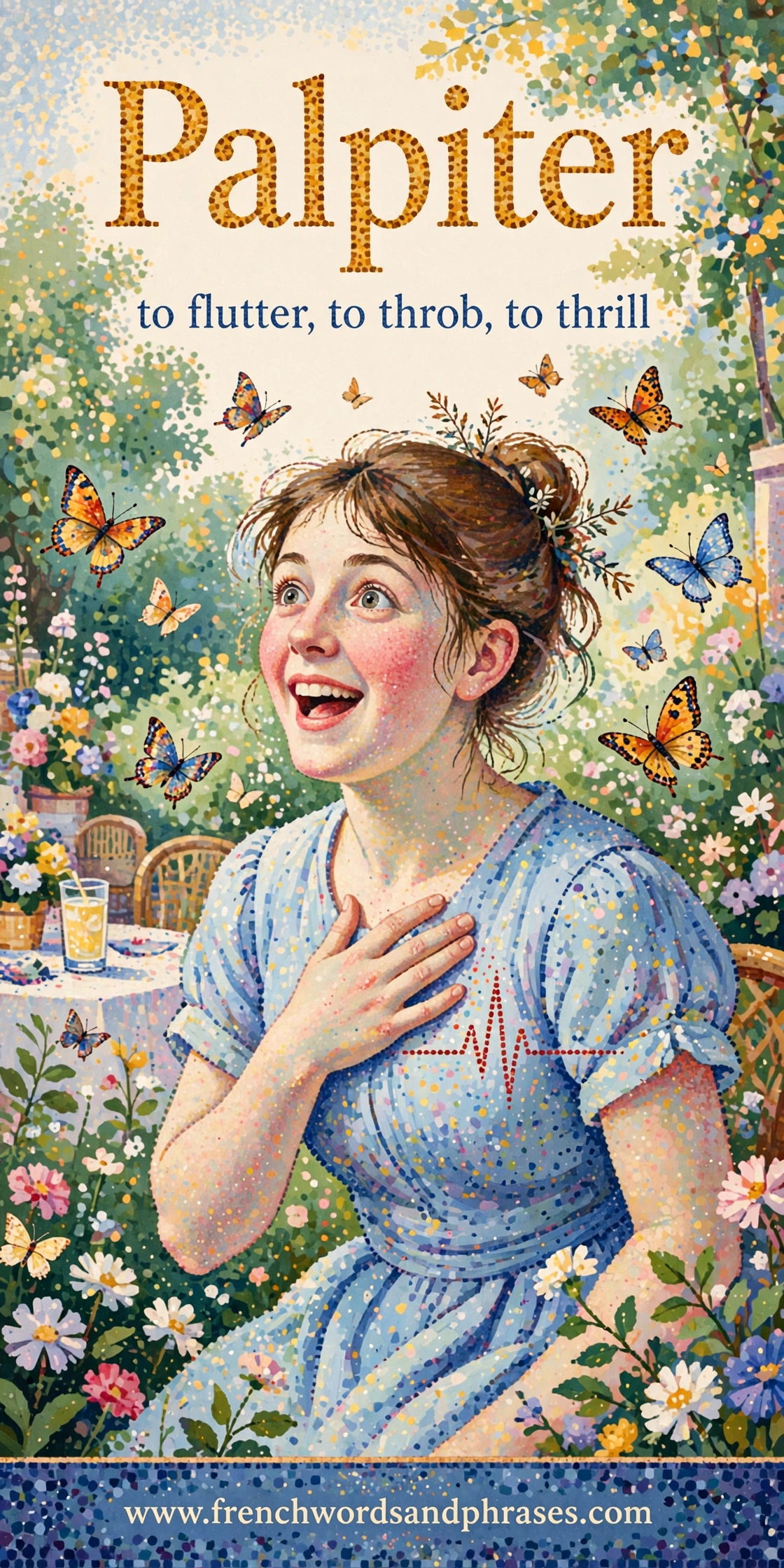
Palpiter means to flutter, to throb, to thrill — the quick, uneven beating of a heart in love or fear, of eyelids, of wings, of a whole body trembling with feeling.
A heart knocking against the ribs before a first kiss. Eyelids fluttering over tired eyes. A wounded bird’s wing beating weakly against the grass. Palpiter is the verb of the quick, irregular tremor of life: hearts throb with it, crowds thrill with it, and everything fragile and alive palpite before it settles or stops.
In this guide, you’ll learn how to conjugate palpiter in all the major French tenses and moods. Explore complete conjugation tables, French examples, English translations, and practice quizzes.
Understanding the French Verb Palpiter
Palpiter is a regular French verb belonging to the first group of verbs, those ending in -er.
It means to flutter, to throb, to thrill. It is used for hearts beating fast and unevenly, for eyelids and wings fluttering, for bodies quivering with emotion — and figuratively for anything trembling with life or excitement: a flag in the wind, a crowd before a result, a voice on the edge of tears. Palpiter d’impatience, de joie, d’angoisse: the de phrase names the feeling doing the shaking.
Verb classification: First group (-er)
Auxiliary verb: Avoir
Past participle: palpité
Present participle: palpitant
English equivalents: To flutter, to throb, to thrill, to quiver; le cœur lui palpite — her heart is pounding; palpiter d’émotion — to thrill with emotion; palpiter de peur — to tremble with fear; les paupières lui palpitent — his eyelids are fluttering; un cœur palpitant — a throbbing, thrilling heart.
One important detail: palpiter is the frequentative cousin of palper — Latin palpitare means to throb and flutter again and again, and the French verb keeps that repeated, uneven rhythm: it is never one clean beat, always a flutter of small ones. Its favourite subject by far is le cœur: mon cœur palpite. The conjugation is a gift — perfectly regular -er: je palpite, nous palpitons, past participle palpité, auxiliary avoir even when the subject is a heart: son cœur a palpité.
Experience the Word
Palpiter is the verb of the heart out of rhythm — love, fear and joy all make the same delicious disorder.
Imagine a young woman at a station barrier in 1960, watching the Paris train draw in. Somewhere in the third carriage is a soldier coming home after two years. Her hands are still, her face is composed, but her heart palpite so loudly she is sure the whole platform can hear it.
She has not moved a step. Inside, everything is fluttering — tout palpite — with hope.
How to Conjugate Palpiter: Complete French Conjugation Guide
Let’s explore every major conjugation of palpiter, beginning with the indicative mood.
How to Conjugate Palpiter in the Indicative Mood
The indicative mood is used to express facts, observations, actions, and events.
How to Conjugate Palpiter in the Present Tense (Présent)
Used for actions happening now, habitual actions, and general truths.
| Subject | Conjugation |
|---|---|
| je | palpite |
| tu | palpites |
| il / elle | palpite |
| nous | palpitons |
| vous | palpitez |
| ils / elles | palpitent |
Son cœur palpite chaque fois qu’elle le voit.
Her heart throbs every time she sees him.
Complete the sentence:
Nos cœurs ______ d’impatience.
Reveal the answer
palpitons
Nos cœurs palpitons d’impatience.
Our hearts are throbbing with impatience.
How to Conjugate Palpiter in the Passé Composé
Used for completed actions in the past. Palpiter takes the auxiliary verb avoir.
| Subject | Conjugation |
|---|---|
| j’ | ai palpité |
| tu | as palpité |
| il / elle | a palpité |
| nous | avons palpité |
| vous | avez palpité |
| ils / elles | ont palpité |
Mon cœur a palpité pendant tout le discours.
My heart pounded throughout the whole speech.
How to Conjugate Palpiter in the Imparfait (Imperfect Tense)
Used for habitual past actions, descriptions, and ongoing situations in the past.
| Subject | Conjugation |
|---|---|
| je | palpitais |
| tu | palpitais |
| il / elle | palpitait |
| nous | palpitions |
| vous | palpitiez |
| ils / elles | palpitaient |
Ses paupières palpitaient de fatigue.
His eyelids were fluttering with tiredness.
Choose the correct form:
His eyelids were fluttering.
Ses paupières ______. (palpitaient / palpitait)
Reveal the answer
palpitaient
Ses paupières palpitaient.
Paupières is plural, so the verb takes -aient.
How to Conjugate Palpiter in the Plus-que-parfait
Used to describe an action that had already been completed before another past event.
| Subject | Conjugation |
|---|---|
| j’ | avais palpité |
| tu | avais palpité |
| il / elle | avait palpité |
| nous | avions palpité |
| vous | aviez palpité |
| ils / elles | avaient palpité |
Son cœur avait palpité si fort qu’elle avait dû s’asseoir.
Her heart had throbbed so hard that she had had to sit down.
How to Conjugate Palpiter in the Passé Simple
Primarily used in formal writing, literature, and historical narratives. It is rarely used in everyday conversation.
| Subject | Conjugation |
|---|---|
| je | palpitai |
| tu | palpitas |
| il / elle | palpita |
| nous | palpitâmes |
| vous | palpitâtes |
| ils / elles | palpitèrent |
À son entrée, tous les cœurs palpitèrent.
When she entered, every heart thrilled.
How to Conjugate Palpiter in the Passé Antérieur
A literary tense used to express an action completed immediately before another past action, generally in the passé simple.
| Subject | Conjugation |
|---|---|
| j’ | eus palpité |
| tu | eus palpité |
| il / elle | eut palpité |
| nous | eûmes palpité |
| vous | eûtes palpité |
| ils / elles | eurent palpité |
Dès que le rideau se fut levé, la salle palpita d’impatience.
As soon as the curtain had risen, the hall thrilled with impatience.
How to Conjugate Palpiter in the Future Tense (Futur Simple)
Used to describe actions that will take place in the future.
| Subject | Conjugation |
|---|---|
| je | palpiterai |
| tu | palpiteras |
| il / elle | palpitera |
| nous | palpiterons |
| vous | palpiterez |
| ils / elles | palpiteront |
Ton cœur palpitera quand tu entendras son nom.
Your heart will throb when you hear his name.
How to Conjugate Palpiter in the Futur Antérieur (Future Perfect)
Used for an action that will have been completed before a particular point in the future.
| Subject | Conjugation |
|---|---|
| j’ | aurai palpité |
| tu | auras palpité |
| il / elle | aura palpité |
| nous | aurons palpité |
| vous | aurez palpité |
| ils / elles | auront palpité |
À la fin du concert, nos cœurs auront palpité cent fois.
By the end of the concert, our hearts will have thrilled a hundred times.
How to Conjugate Palpiter in the Near Future (Futur Proche)
Used to describe something that is going to happen soon. Formed with aller + infinitive.
| Subject | Conjugation |
|---|---|
| je | vais palpiter |
| tu | vas palpiter |
| il / elle | va palpiter |
| nous | allons palpiter |
| vous | allez palpiter |
| ils / elles | vont palpiter |
Je sens que mon cœur va palpiter très fort.
I feel my heart is going to pound very hard.
How to Conjugate Palpiter in the Conditional Mood
The conditional mood expresses what would happen under certain circumstances. It is also frequently used to make polite requests or express wishes.
How to Conjugate Palpiter in the Present Conditional
| Subject | Conjugation |
|---|---|
| je | palpiterais |
| tu | palpiterais |
| il / elle | palpiterait |
| nous | palpiterions |
| vous | palpiteriez |
| ils / elles | palpiteraient |
Sans ce café, mon cœur palpiterait moins vite.
Without this coffee, my heart would beat less wildly.
How to Conjugate Palpiter in the Past Conditional
| Subject | Conjugation |
|---|---|
| j’ | aurais palpité |
| tu | aurais palpité |
| il / elle | aurait palpité |
| nous | aurions palpité |
| vous | auriez palpité |
| ils / elles | auraient palpité |
Elle aurait palpité de joie en voyant la surprise.
She would have thrilled with joy on seeing the surprise.
Palpiter in the Literary Past Conditional Form
This less common literary form uses the imperfect subjunctive of avoir.
| Subject | Conjugation |
|---|---|
| j’ | eusse palpité |
| tu | eusses palpité |
| il / elle | eût palpité |
| nous | eussions palpité |
| vous | eussiez palpité |
| ils / elles | eussent palpité |
Son cœur eût palpité à cette vue sans les années d’attente.
His heart would have throbbed at that sight, but for the years of waiting.
How to Conjugate Palpiter in the Subjunctive Mood
The subjunctive is used to express wishes, emotions, doubts, necessity, and uncertainty. It frequently follows expressions such as il faut que (it is necessary that) or bien que (although).
How to Conjugate Palpiter in the Present Subjunctive
| Subject | Conjugation |
|---|---|
| que je | palpite |
| que tu | palpites |
| qu’il / qu’elle | palpite |
| que nous | palpitions |
| que vous | palpitiez |
| qu’ils / qu’elles | palpitent |
Il est normal que ton cœur palpite avant l’examen.
It is normal for your heart to pound before the exam.
Complete the sentence using the subjunctive:
Il est normal que vous ______ avant le spectacle.
Reveal the answer
palpitiez
Il est normal que vous palpitiez avant le spectacle.
It is normal for you to be thrilled before the show.
How to Conjugate Palpiter in the Imperfect Subjunctive
A literary tense, rarely encountered in modern spoken French.
| Subject | Conjugation |
|---|---|
| que je | palpitasse |
| que tu | palpitasses |
| qu’il / qu’elle | palpitât |
| que nous | palpitassions |
| que vous | palpitassiez |
| qu’ils / qu’elles | palpitassent |
On sentait que la foule palpitât d’une même émotion.
You could feel the crowd throbbing with a single emotion.
How to Conjugate Palpiter in the Pluperfect Subjunctive
A literary construction used to express an action completed before another past action.
| Subject | Conjugation |
|---|---|
| que j’ | eusse palpité |
| que tu | eusses palpité |
| qu’il / qu’elle | eût palpité |
| que nous | eussions palpité |
| que vous | eussiez palpité |
| qu’ils / qu’elles | eussent palpité |
Elle raconta que son cœur eût palpité toute la soirée.
She said her heart had thrilled all evening.
How to Conjugate Palpiter in the Past Subjunctive
| Subject | Conjugation |
|---|---|
| que j’ | aie palpité |
| que tu | aies palpité |
| qu’il / qu’elle | ait palpité |
| que nous | ayons palpité |
| que vous | ayez palpité |
| qu’ils / qu’elles | aient palpité |
Je suis ému que vos cœurs aient palpité à l’unisson.
I am moved that your hearts throbbed as one.
How to Conjugate Palpiter in the Imperative
The imperative is used to give commands, instructions, invitations, or suggestions. Subject pronouns are omitted.
How to Conjugate Palpiter in the Present Imperative
| Person | Conjugation |
|---|---|
| (tu) | palpite |
| (nous) | palpitons |
| (vous) | palpitez |
Palpite, mon cœur, la vie est courte !
Throb, my heart, life is short!
How would you say Throb, my heart (tu form)?
Reveal the answer
Palpite, mon cœur !
French Participles of Palpiter
Participles are verb forms that can be used in compound tenses and other grammatical constructions.
Present Participle of Palpiter
palpitant
En palpitant ainsi, son cœur l’avertissait du danger.
By throbbing like that, her heart was warning her of the danger.
Past Participle of Palpiter
palpité
Après avoir palpité d’angoisse, la foule s’est calmée.
After throbbing with anxiety, the crowd calmed down.
Palpiter in Everyday French: Real-Life Examples
Now that you know the conjugations, let’s see how palpiter appears in everyday French.
Son cœur palpite d’émotion.
Her heart is throbbing with emotion.
Mon cœur a palpité pendant le discours.
My heart pounded during the speech.
Ses paupières palpitaient de fatigue.
His eyelids were fluttering with tiredness.
Ton cœur palpitera en entendant son nom.
Your heart will throb when you hear his name.
Elle palpiterait de joie en voyant la surprise.
She would thrill with joy on seeing the surprise.
Palpite, mon cœur, c’est la fête !
Throb, my heart, it is a celebration!
Beyond Translation: The Meaning of Palpiter
English palpitate survives mostly in the doctor’s plural — heart palpitations — while French palpiter kept the poetry.
A French heart does not merely beat; it palpite.
Un roman palpitant is a thrilling novel, un récit palpitant a gripping tale: the word family runs from the cardiologist’s office to the bookshelf, and everywhere it means life moving fast and unevenly, exactly as it should.
How to Remember the French Verb Palpiter
Remember it this way: Palpiter is about a heart fluttering out of rhythm at the station barrier.
- Le cœur is the star subject: mon cœur palpite — my heart is pounding, fluttering, thrilling.
- The feeling follows with de: palpiter de joie, de peur, d’impatience.
- Regular -er, avoir even for hearts: son cœur a palpité.
The key idea is a heart fluttering out of rhythm at the station barrier.
Test Your Knowledge of Palpiter
Let’s see how much you’ve learned. Try answering these questions before revealing the answers.
Which body part is the classic subject of palpiter?
Reveal the answer
Le cœur — mon cœur palpite, my heart is pounding or thrilling.
How do you say Her heart is throbbing with emotion in French?
Reveal the answer
Son cœur palpite d’émotion.
Translate: My heart pounded during the speech.
Reveal the answer
Mon cœur a palpité pendant le discours.
What is the past participle of palpiter?
Reveal the answer
Palpité.
Complete the sentence:
Il est normal que ton cœur ______ avant l’examen.
Reveal the answer
palpite
Il est normal que ton cœur palpite avant l’examen.
It is normal for your heart to pound before the exam.
Can You Use It?
How would you say this in French?
Her heart is throbbing at the station barrier, and the train is not yet in sight.
Reveal the answer
Son cœur palpite à la barrière de la gare, et le train n’est pas encore en vue.
Her heart is throbbing at the station barrier, and the train is not yet in sight.
LEARN FRENCH ONE WORD AT A TIME