How to Conjugate Palper in French
/pal.pe/
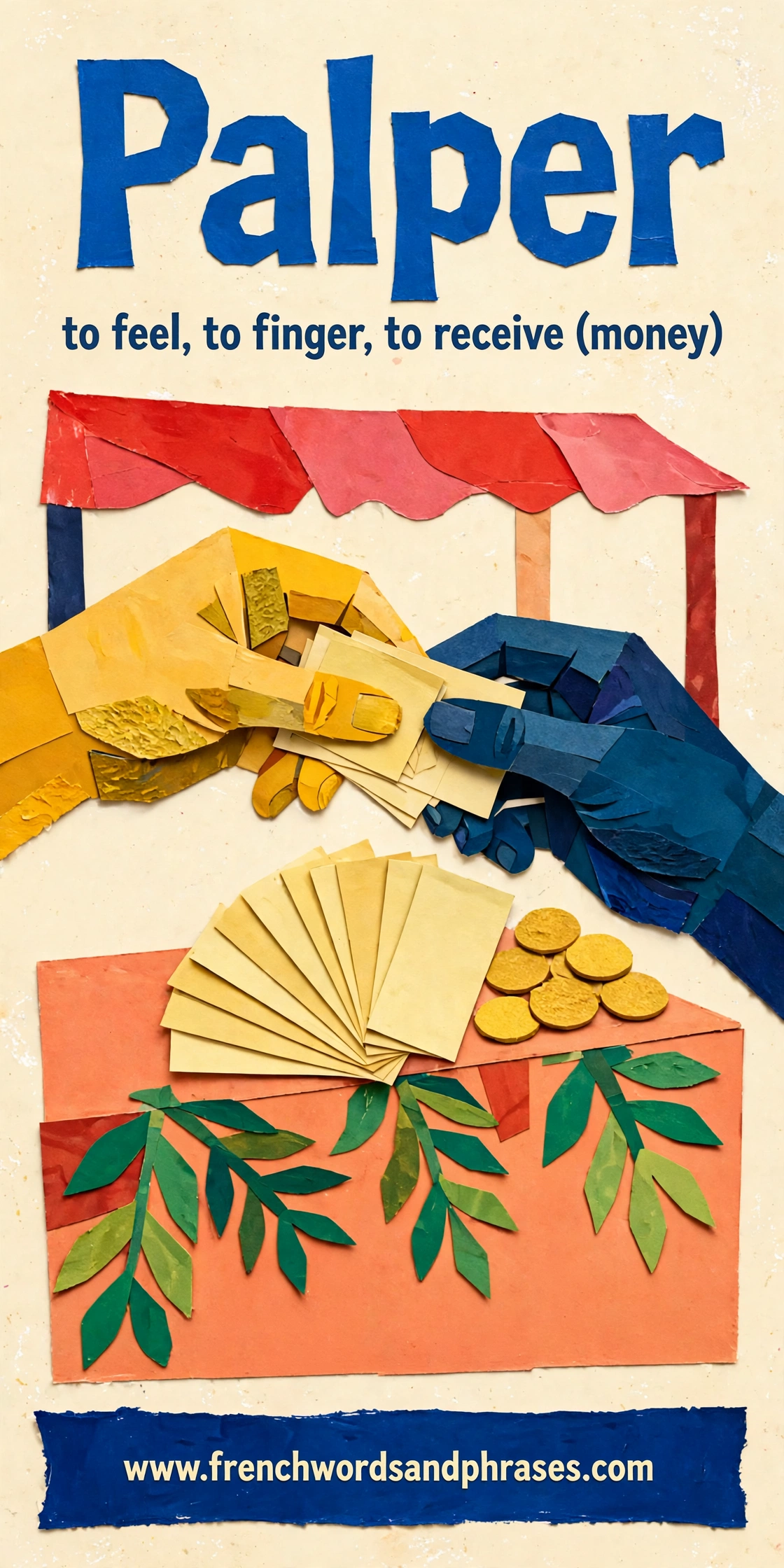
Palper means to feel, to finger, to receive (money) — a doctor’s hands reading a body by touch, a shopper squeezing a melon, and, in the slang of paydays, cash landing gratefully in the hand.
Three scenes, one verb. A doctor’s fingertips travel slowly over a patient’s abdomen, reading what eyes cannot see. A woman at a market stall presses a melon, judging ripeness by touch alone. And on Friday night a workman counts his wages with a grin — il a palpé. Palper is the verb of knowing by touch, and of money you can feel.
In this guide, you’ll learn how to conjugate palper in all the major French tenses and moods. Explore complete conjugation tables, French examples, English translations, and practice quizzes.
Understanding the French Verb Palper
Palper is a regular French verb belonging to the first group of verbs, those ending in -er.
It means to feel, to finger, to receive (money). Doctors palpate abdomens, throats and pulses; cooks and shoppers feel fruit, dough and fabric; customs officers frisk travellers (se faire palper). And in the familiar register, palper is pure payday joy — wages, winnings, bribes and bonuses are all palpés when the cash actually reaches the hand.
Verb classification: First group (-er)
Auxiliary verb: Avoir
Past participle: palpé
Present participle: palpant
English equivalents: To feel, to finger, to palpate; (money) to receive, to rake in; palper un fruit — to feel a fruit for ripeness; palper le pouls — to feel the pulse; se faire palper à la douane — to be frisked at customs; palper une belle somme — to pocket a tidy sum; il a palpé — he got paid, he raked it in.
One important detail: palper leads a double life, and the dictionary’s three glosses are the map. In the surgery and at the market it is the careful verb of touch — le médecin palpe le ventre du malade — but in familiar French, with money as its object, it means to receive, to pocket, to rake in: il a palpé une belle prime, he pocketed a handsome bonus. The conjugation never changes — regular -er, je palpe, nous palpons, past participle palpé — only the object tells you whether hands are examining or wages are landing.
Experience the Word
Palper is the verb of the knowing hand — it examines, it judges, and on payday, it collects.
Imagine a village doctor in 1950, before scanners and screens. A farmer complains of a pain; the old man washes his hands, warms them, and palpe — slowly, gently, fingertip by fingertip — until his hands have read the whole story the farmer’s words could not tell.
No machine has spoken. The diagnosis was felt — palpé — through the fingertips.
How to Conjugate Palper: Complete French Conjugation Guide
Let’s explore every major conjugation of palper, beginning with the indicative mood.
How to Conjugate Palper in the Indicative Mood
The indicative mood is used to express facts, observations, actions, and events.
How to Conjugate Palper in the Present Tense (Présent)
Used for actions happening now, habitual actions, and general truths.
| Subject | Conjugation |
|---|---|
| je | palpe |
| tu | palpes |
| il / elle | palpe |
| nous | palpons |
| vous | palpez |
| ils / elles | palpent |
Le médecin palpe le ventre du patient avec douceur.
The doctor is feeling the patient’s abdomen gently.
Complete the sentence:
Nous ______ chaque fruit avant de le mettre au panier.
Reveal the answer
palpons
Nous palpons chaque fruit avant de le mettre au panier.
We feel each fruit before putting it in the basket.
How to Conjugate Palper in the Passé Composé
Used for completed actions in the past. Palper takes the auxiliary verb avoir.
| Subject | Conjugation |
|---|---|
| j’ | ai palpé |
| tu | as palpé |
| il / elle | a palpé |
| nous | avons palpé |
| vous | avez palpé |
| ils / elles | ont palpé |
Elle a palpé le melon avant de l’acheter.
She felt the melon before buying it.
How to Conjugate Palper in the Imparfait (Imperfect Tense)
Used for habitual past actions, descriptions, and ongoing situations in the past.
| Subject | Conjugation |
|---|---|
| je | palpais |
| tu | palpais |
| il / elle | palpait |
| nous | palpions |
| vous | palpiez |
| ils / elles | palpaient |
Le boulanger palpait chaque pâte pour juger la levée.
The baker used to feel each dough to judge the rising.
Choose the correct form:
He pocketed a tidy sum.
Il ______ une belle somme. (a palpé / est palpé)
Reveal the answer
a palpé
Il a palpé une belle somme.
Palper takes avoir.
How to Conjugate Palper in the Plus-que-parfait
Used to describe an action that had already been completed before another past event.
| Subject | Conjugation |
|---|---|
| j’ | avais palpé |
| tu | avais palpé |
| il / elle | avait palpé |
| nous | avions palpé |
| vous | aviez palpé |
| ils / elles | avaient palpé |
Il avait palpé une belle somme à la fin du chantier.
He had pocketed a tidy sum at the end of the building job.
How to Conjugate Palper in the Passé Simple
Primarily used in formal writing, literature, and historical narratives. It is rarely used in everyday conversation.
| Subject | Conjugation |
|---|---|
| je | palpai |
| tu | palpas |
| il / elle | palpa |
| nous | palpâmes |
| vous | palpâtes |
| ils / elles | palpèrent |
Le chirurgien palpa la gorge de l’enfant sans le réveiller.
The surgeon felt the child’s throat without waking him.
How to Conjugate Palper in the Passé Antérieur
A literary tense used to express an action completed immediately before another past action, generally in the passé simple.
| Subject | Conjugation |
|---|---|
| j’ | eus palpé |
| tu | eus palpé |
| il / elle | eut palpé |
| nous | eûmes palpé |
| vous | eûtes palpé |
| ils / elles | eurent palpé |
Quand elle eut palpé tous les avocats, elle choisit le plus mûr.
When she had felt all the avocados, she chose the ripest.
How to Conjugate Palper in the Future Tense (Futur Simple)
Used to describe actions that will take place in the future.
| Subject | Conjugation |
|---|---|
| je | palperai |
| tu | palperas |
| il / elle | palpera |
| nous | palperons |
| vous | palperez |
| ils / elles | palperont |
Demain, le contrôleur palpera les bagages suspects.
Tomorrow, the inspector will frisk the suspicious luggage.
How to Conjugate Palper in the Futur Antérieur (Future Perfect)
Used for an action that will have been completed before a particular point in the future.
| Subject | Conjugation |
|---|---|
| j’ | aurai palpé |
| tu | auras palpé |
| il / elle | aura palpé |
| nous | aurons palpé |
| vous | aurez palpé |
| ils / elles | auront palpé |
À la fin du mois, ils auront palpé leur première paye.
By the end of the month, they will have received their first wages.
How to Conjugate Palper in the Near Future (Futur Proche)
Used to describe something that is going to happen soon. Formed with aller + infinitive.
| Subject | Conjugation |
|---|---|
| je | vais palper |
| tu | vas palper |
| il / elle | va palper |
| nous | allons palper |
| vous | allez palper |
| ils / elles | vont palper |
Le médecin va palper ton genou, ne bouge pas.
The doctor is going to feel your knee, do not move.
How to Conjugate Palper in the Conditional Mood
The conditional mood expresses what would happen under certain circumstances. It is also frequently used to make polite requests or express wishes.
How to Conjugate Palper in the Present Conditional
| Subject | Conjugation |
|---|---|
| je | palperais |
| tu | palperais |
| il / elle | palperait |
| nous | palperions |
| vous | palperiez |
| ils / elles | palperaient |
Avec des mains expertes, on palperait la tumeur sans peine.
With expert hands, one would feel the tumour without difficulty.
How to Conjugate Palper in the Past Conditional
| Subject | Conjugation |
|---|---|
| j’ | aurais palpé |
| tu | aurais palpé |
| il / elle | aurait palpé |
| nous | aurions palpé |
| vous | auriez palpé |
| ils / elles | auraient palpé |
Il aurait palpé le double avec les heures supplémentaires.
He would have pocketed double with the overtime.
Palper in the Literary Past Conditional Form
This less common literary form uses the imperfect subjunctive of avoir.
| Subject | Conjugation |
|---|---|
| j’ | eusse palpé |
| tu | eusses palpé |
| il / elle | eût palpé |
| nous | eussions palpé |
| vous | eussiez palpé |
| ils / elles | eussent palpé |
Le médecin eût palpé le pouls avant tout remède.
The doctor would have felt the pulse before any remedy.
How to Conjugate Palper in the Subjunctive Mood
The subjunctive is used to express wishes, emotions, doubts, necessity, and uncertainty. It frequently follows expressions such as il faut que (it is necessary that) or bien que (although).
How to Conjugate Palper in the Present Subjunctive
| Subject | Conjugation |
|---|---|
| que je | palpe |
| que tu | palpes |
| qu’il / qu’elle | palpe |
| que nous | palpions |
| que vous | palpiez |
| qu’ils / qu’elles | palpent |
Il faut que le médecin palpe l’abdomen du malade.
The doctor must feel the patient’s abdomen.
Complete the sentence using the subjunctive:
Il faut que vous ______ le pouls du blessé.
Reveal the answer
palpiez
Il faut que vous palpiez le pouls du blessé.
You must feel the injured man’s pulse.
How to Conjugate Palper in the Imperfect Subjunctive
A literary tense, rarely encountered in modern spoken French.
| Subject | Conjugation |
|---|---|
| que je | palpasse |
| que tu | palpasses |
| qu’il / qu’elle | palpât |
| que nous | palpassions |
| que vous | palpassiez |
| qu’ils / qu’elles | palpassent |
On voulait que le douanier palpât chaque valise.
They wanted the customs officer to frisk every suitcase.
How to Conjugate Palper in the Pluperfect Subjunctive
A literary construction used to express an action completed before another past action.
| Subject | Conjugation |
|---|---|
| que j’ | eusse palpé |
| que tu | eusses palpé |
| qu’il / qu’elle | eût palpé |
| que nous | eussions palpé |
| que vous | eussiez palpé |
| qu’ils / qu’elles | eussent palpé |
On racontait qu’il eût palpé des millions dans cette affaire.
It was said he had raked in millions in that business.
How to Conjugate Palper in the Past Subjunctive
| Subject | Conjugation |
|---|---|
| que j’ | aie palpé |
| que tu | aies palpé |
| qu’il / qu’elle | ait palpé |
| que nous | ayons palpé |
| que vous | ayez palpé |
| qu’ils / qu’elles | aient palpé |
Je suis content que tu aies palpé ta prime avant Noël.
I am glad you received your bonus before Christmas.
How to Conjugate Palper in the Imperative
The imperative is used to give commands, instructions, invitations, or suggestions. Subject pronouns are omitted.
How to Conjugate Palper in the Present Imperative
| Person | Conjugation |
|---|---|
| (tu) | palpe |
| (nous) | palpons |
| (vous) | palpez |
Palpe ce tissu, tu verras comme il est doux !
Feel this fabric, you will see how soft it is!
How would you say Feel this fabric (tu form)?
Reveal the answer
Palpe ce tissu !
French Participles of Palper
Participles are verb forms that can be used in compound tenses and other grammatical constructions.
Present Participle of Palper
palpant
En palpant le fruit, elle juge sa maturité.
By feeling the fruit, she judges its ripeness.
Past Participle of Palper
palpé
Palpé par des mains expertes, le melon fut déclaré mûr.
Felt by expert hands, the melon was declared ripe.
Palper in Everyday French: Real-Life Examples
Now that you know the conjugations, let’s see how palper appears in everyday French.
Le médecin palpe le ventre du patient.
The doctor is feeling the patient’s abdomen.
Elle a palpé le melon avant de l’acheter.
She felt the melon before buying it.
Le boulanger palpait chaque pâte.
The baker used to feel each dough.
Tu palperas ta paye vendredi.
You will receive your wages on Friday.
Il palperait le double avec les heures supplémentaires.
He would pocket double with the overtime.
Palpe ce tissu, il est très doux !
Feel this fabric, it is very soft!
Beyond Translation: The Meaning of Palper
English doctors palpate — the same Latin root, palpare, to touch gently — but English kept only the surgery.
French kept the payday too.
Because real money can be felt, counted and weighed in the hand, palper became the familiar verb of cash actually received: il a palpé cent mille euros is not an examination, it is a celebration.
How to Remember the French Verb Palper
Remember it this way: Palper is about the doctor’s fingertips — and the workman counting his wages.
- Hands first: palper is to feel with the fingertips — a pulse, a melon, a fabric.
- With money as the object, it flips to payday slang: il a palpé — he got the cash.
- Regular -er: je palpe, nous palpons, past participle palpé.
The key idea is the doctor’s fingertips — and the workman counting his wages.
Test Your Knowledge of Palper
Let’s see how much you’ve learned. Try answering these questions before revealing the answers.
What are the two lives of palper?
Reveal the answer
Touch and cash — to feel or examine by touch, and, familiarly, to receive money: il a palpé sa paye.
How do you say The doctor is feeling the patient’s abdomen in French?
Reveal the answer
Le médecin palpe le ventre du patient.
Translate: She felt the melon before buying it.
Reveal the answer
Elle a palpé le melon avant de l’acheter.
What is the past participle of palper?
Reveal the answer
Palpé.
Complete the sentence:
Il faut que le médecin ______ l’abdomen du malade.
Reveal the answer
palpe
Il faut que le médecin palpe l’abdomen du malade.
The doctor must feel the patient’s abdomen.
Can You Use It?
How would you say this in French?
The old doctor feels, listens, and understands the body better than a machine.
Reveal the answer
Le vieux médecin palpe, écoute, et comprend le corps mieux qu’une machine.
The old doctor feels, listens, and understands the body better than a machine.
LEARN FRENCH ONE WORD AT A TIME