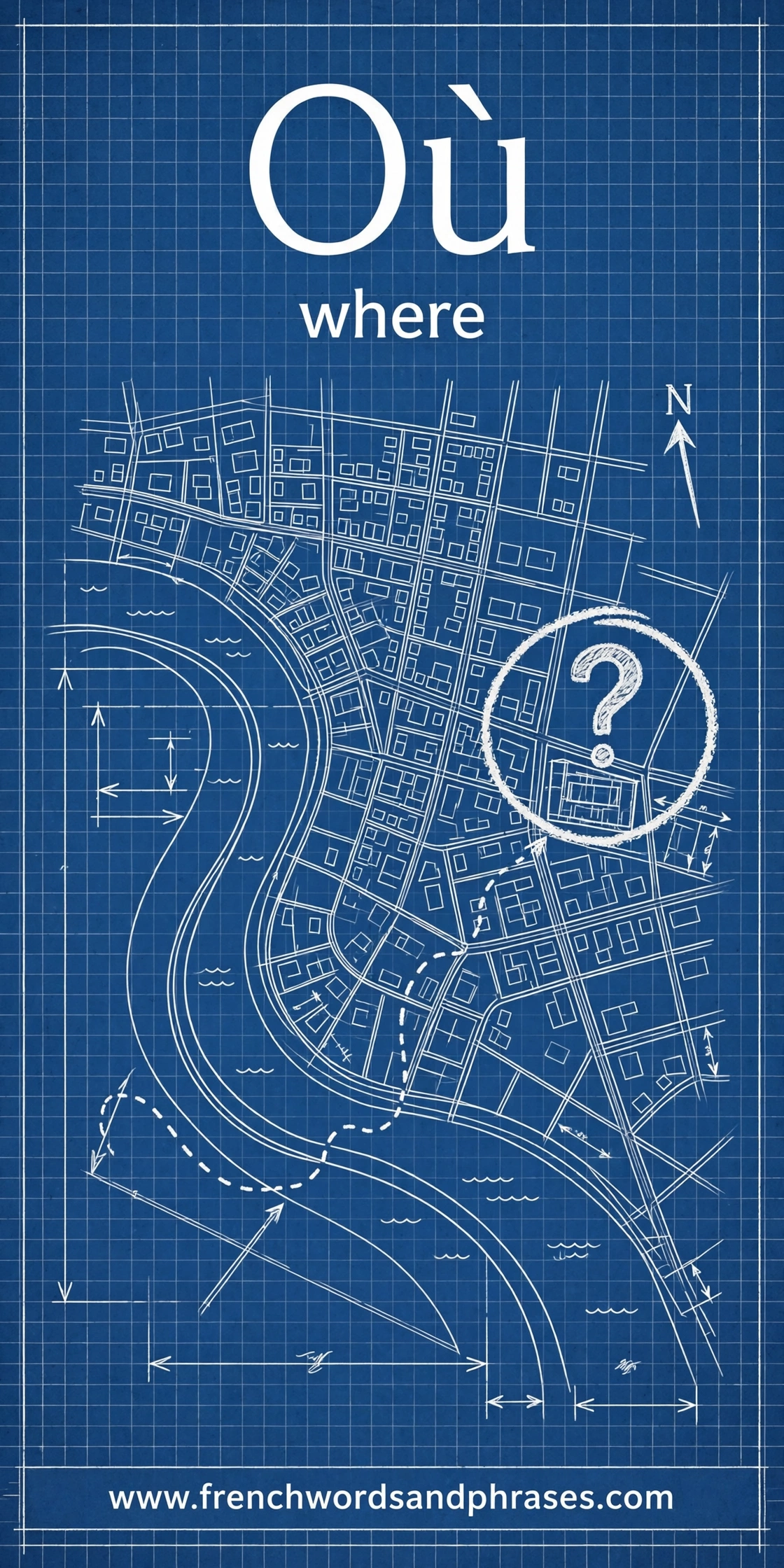
A French Word to Live By
Translate Où to English
/u/
Où means where.
A traveller steps off the train in a town he has never seen, suitcase in hand, and turns slowly on the platform. « Pardon, où est la sortie ? » — Excuse me, where is the exit? Où is the French word for asking about place: where is it, where are we going, where did you leave it — the question that asks the world to give up its address.
Let’s explore how où works in French, beginning with the whole word on one card.
Understanding the French Pronoun Où
Où is a French interrogative pronoun — the question word for place. It asks where something is, where someone is going, or where something happened, and it never changes form: one small word carries every place-question in the language.
It means where. The picture it paints is a finger hovering over a map, looking for the right street: où est la gare ? — where is the station? But où has a second life too: inside a sentence it links a place or a moment to what belongs there — la ville où je suis né (the town where I was born), le jour où tout a changé (the day when everything changed).
Type: Interrogative pronoun — place
Answers the question: It asks the question: Où ? — Where?
What follows it: A verb, very often être or aller: où est la gare, où sont les clés, où vas-tu
Watch the pair: où (where) vs ou (or) — one grave accent changes everything: où vas-tu ? = where are you going?; un thé ou un café ? = tea or coffee?
One important usage detail: où never drops its accent and never changes before a vowel — où est-il ? (where is he?) keeps the ù intact, and the words simply run together in speech. The accent is not decoration: it is the whole visible difference between ‘where’ and ‘or’.
Experience the Word
Où is the question of the lost traveller and the searching hand — the word you reach for when something, or somewhere, is missing.
Imagine a grandmother hunting through the kitchen drawers while the soup waits: où sont les cuillères ? où ai-je mis le sel ? — where are the spoons? where did I put the salt? Half of daily life is looking for things, and où leads every search.
You have not just asked a question. You have asked the world to point — and somewhere, an answer is already turning towards you.
How to Use Où in French: Complete Guide
Let’s explore how où works in French, beginning with the whole word on one card.
Où at a Glance
The Whole Word on One Card
Meaning, job, pattern and pair — où in four lines.
| Point | Où |
|---|---|
| Meaning | where |
| Job | interrogative pronoun — asks about place |
| What it asks about | a location, a destination, or the place where something happened |
| Its famous twin | ou — ‘or’, spelled without the accent: the pair this page untangles |
Example
Où est la gare, s’il vous plaît ?
Where is the station, please?
The Pattern in Action: Asking About Place
Où connects a question to a missing place — the station, the keys, the town someone lives in.
| Pattern | Example |
|---|---|
| où + être, one thing | où est la gare ? — where is the station? |
| où + être, several things | où sont les clés ? — where are the keys? |
| où + a verb, asking someone | où habites-tu ? — where do you live? |
| où + aller, destination | où allez-vous ce soir ? — where are you going this evening? |
Example
Où sont les enfants ? Ils jouent dans le jardin.
Where are the children? They are playing in the garden.
Quick Quiz 1
Does où ask about a person, a thing, or a place?
Reveal the answer
A place — people take qui, things take que or quoi, places take où.
Où est le musée ?
Where is the museum?
The Tricky Bit: Où vs Ou — One Accent, Two Worlds
Où has the most famous spelling trap in French: a single grave accent separates ‘where’ from ‘or’.
| The word | How it works |
|---|---|
| où, with the grave accent | means WHERE — it asks about place: où habites-tu ? (where do you live?) |
| ou, without the accent | means OR — it offers a choice: un thé ou un café ? (tea or coffee?) |
| they sound identical | où and ou are pronounced exactly the same — only the spelling tells them apart |
| the memory hook | the accent on ù is a little roof, and a roof means a place: the word with the roof is the one asking where |
Example
Où veux-tu aller : au cinéma ou au théâtre ?
Where do you want to go: to the cinema or to the theatre?
Where It Goes: At the Head of the Question
Où leads the question — then comes the verb, with est-ce que for everyday speech or inversion for the neater pattern.
| Position / pattern | Example |
|---|---|
| with est-ce que, everyday | où est-ce que tu habites ? — where do you live? (the relaxed spoken pattern) |
| with inversion, neater | où habites-tu ? — where do you live? (subject and verb swap places) |
| with être, the subject follows | où est la poste ? où sont mes lunettes ? — the thing you are looking for comes after est / sont |
| où stays whole before vowels | où est-il ? où est-elle ? — no elision, no change: où never shortens |
Example
Où est-ce que vous avez garé la voiture ?
Where did you park the car?
Quick Quiz 2
« Un thé ______ un café ? » — do you write ou or où?
Reveal the answer
ou — the sentence offers a choice, and a choice takes ou, without the accent.
Un thé ou un café ?
Tea or coffee?
Everyday Expressions with Où
Où turns up in stations, streets and kitchens all over France.
| Expression | In English |
|---|---|
| où ça ? | where? (lit. where that? — the surprised, everyday way to ask) |
| n’importe où | anywhere — assieds-toi n’importe où, sit anywhere |
| par où ? | which way? — par où passe le bus ? (which way does the bus go?) |
| où en sommes-nous ? | where are we up to? — the question that restarts a task |
Example
On se retrouve où, devant la gare ou au café ?
Where shall we meet, in front of the station or at the café?
Close Cousins: Où, Ou, D’où, Quand
Four neighbours that share sounds or jobs — here is who does what.
| Word | The difference |
|---|---|
| ou | or — offers a choice and wears no accent: tu viens ou tu restes ? |
| d’où | from where — asks about origin: d’où viens-tu ? (where do you come from?) — it has its own page |
| quand | when — asks about time, the partner of où the place-word: quand pars-tu, et où vas-tu ? |
| où | where — asks about place, and links places and moments inside sentences |
Example
D’où viens-tu, et où vas-tu maintenant ?
Where do you come from, and where are you going now?
Quick Quiz 3
Which cousin asks about origin — ‘where from’?
Reveal the answer
d’où — de + où asks where a person or a thing comes from.
D’où vient ce train ?
Where does this train come from?
Où and Its Neighbours: The Second Life of Où
Où has a quiet second job: after a place or a time word, it links the scene to what happens there — no question involved.
| French | In English |
|---|---|
| la ville où… | the town where…: la ville où je suis né (the town where I was born) |
| la maison où… | the house where…: la maison où j’ai grandi (the house where I grew up) |
| le jour où… | the day when…: le jour où nous sommes arrivés (the day we arrived) |
| le moment où… | the moment when…: au moment où il est entré (at the moment he came in) |
Example
C’est le village où mes grands-parents se sont rencontrés.
It is the village where my grandparents met.
Watch Out: The Traps Around Où
The traps: the missing accent, où used for people, and que where a place needs où.
| Trap | The truth |
|---|---|
| writing ou for où | ou = or, où = where — ‘ou vas-tu’ without the accent tries to say ‘or are you going’, which means nothing |
| dropping the accent before a vowel | où est-il keeps its ù — the accent never disappears, even where où runs into est |
| using où for a person or a thing | people take qui and things take que: qui est là ? que cherches-tu ? — où is for places only |
| using que after a place | after a place or time word the link is où, not que: la ville où je vis (the town where I live) |
Example
Où est le livre que je lisais hier ?
Where is the book that I was reading yesterday?
Quick Quiz 4
Complete: ______ est la pharmacie ? (Where is the pharmacy?)
Reveal the answer
Où — with the grave accent: the question asks about a place.
Où est la pharmacie ?
Where is the pharmacy?
Où in Everyday French: Real-Life Examples
Now that you know the word, let’s see how où appears in everyday French.
Example Example 1 — Directions
Excusez-moi, où sont les toilettes, s’il vous plaît ?
Excuse me, where are the toilets, please?
Example Example 2 — At home
Où as-tu mis les ciseaux ? Je ne les trouve pas.
Where did you put the scissors? I cannot find them.
Example Example 3 — Travel
Où est-ce que ce train s’arrête ensuite ?
Where does this train stop next?
Example Example 4 — Meeting friends
Où déjeune-t-on demain, chez toi ou au restaurant ?
Where are we having lunch tomorrow, at your place or at the restaurant?
Example Example 5 — Childhood
Le quartier où j’ai grandi a beaucoup changé.
The neighbourhood where I grew up has changed a lot.
Example Example 6 — Evening plans
Tu sais où elle a garé la voiture ?
Do you know where she parked the car?
Beyond Translation: The Meaning of Où
English ‘where’ asks its question and then goes home. French où works a double shift: it opens questions — où est la gare ? — and it stitches places into sentences — la ville où je suis né, le jour où tout a changé.
To say où is to believe every place holds a story, and every story happened somewhere.
And its little accent is a lesson in French spelling: où and ou sound exactly alike, so the grave accent exists purely for the eye — a tiny roof drawn over the word that asks about places, so a choice can never be mistaken for an address.
How to Remember the French Pronoun Où
Remember it this way: Remember it this way: Où is the place-question — its grave accent is a little roof, and a roof means somewhere: if the sentence is about a place, où keeps its hat on.
- You picture the roof — où with its accent asks where; bare ou only ever means ‘or’.
- You ask it three ways — où est la gare ? où est-ce que tu vas ? où habites-tu ?
- You reuse it to link — la ville où je suis né, le jour où tout a changé.
The key idea is où means where and always keeps its grave accent — ou without the accent means or, and où also links places and moments inside a sentence.
Test Your Knowledge of Où
Let’s see how much you’ve learned. Try answering these questions before revealing the answers.
Question 1
What does où mean?
Reveal the answer
Where — the interrogative pronoun that asks about place.
Question 2
What is the difference between où and ou?
Reveal the answer
The accent — and everything it carries: où, with the grave accent, means where; ou, without it, means or. The two sound exactly the same.
Question 3
Translate: Where are the keys?
Reveal the answer
Où sont les clés ?
Question 4
In ‘le jour où nous sommes partis’, is où asking a question?
Reveal the answer
No — there où is a relative word meaning ‘when’: it links the day to what happened on it (the day when we left).
Question 5
Complete the sentence:
______ habitez-vous ? (Where do you live?)
Reveal the answer
Où
Où habitez-vous ?
Where do you live?
Your Final Challenge
Can You Use It?
How would you say this in French?
“How would you say this in French?”
Reveal the answer
Où se trouve la plus belle place du village ?
Where is the most beautiful square in the village?
A little French. A little curiosity. A richer everyday life.
LEARN FRENCH ONE WORD AT A TIME