A French Word to Live By
How to Conjugate Oblitérer in French
/ɔ.bli.te.ʁe/
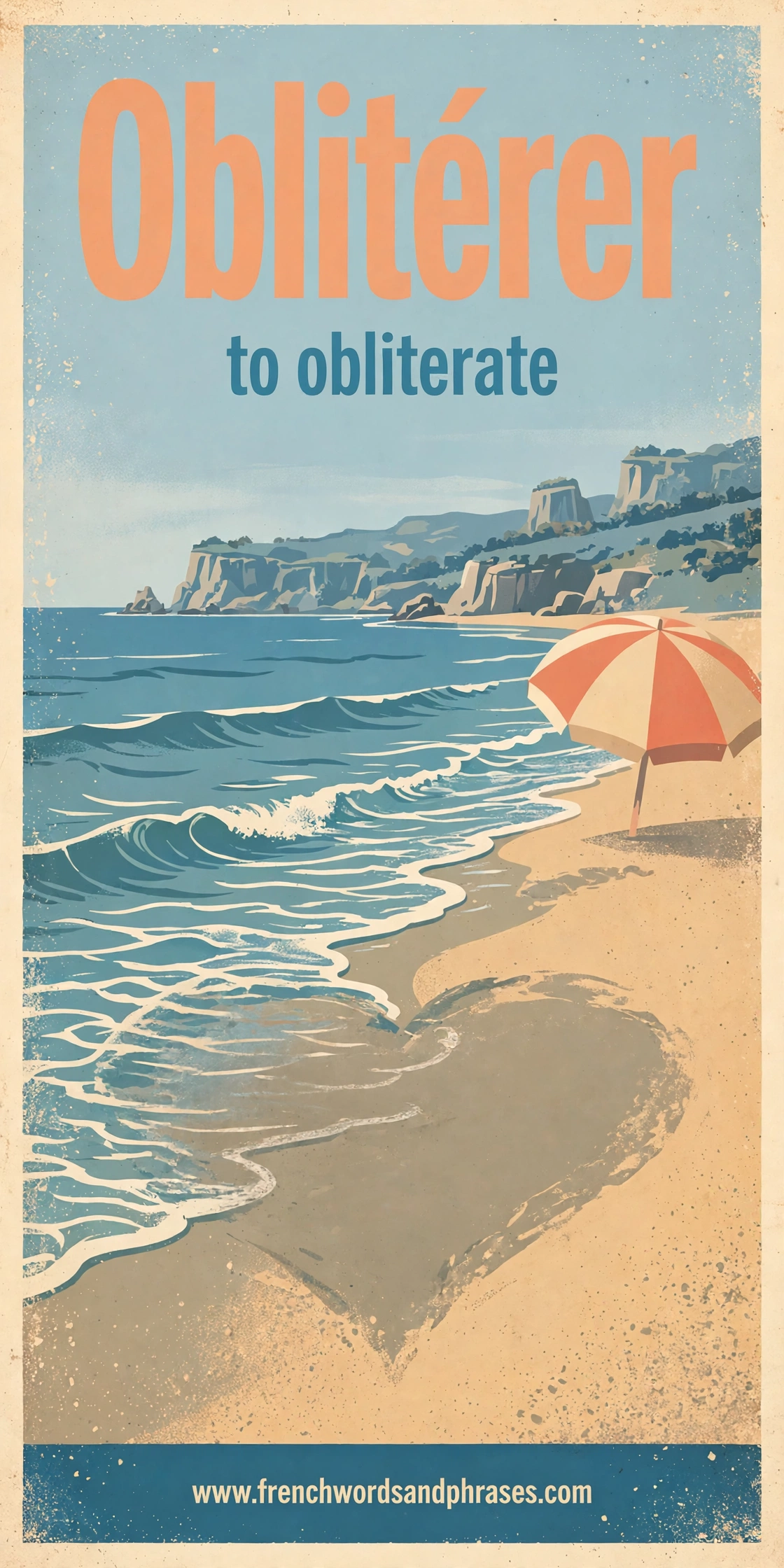
Oblitérer means to obliterate — to wipe something out so completely that no trace remains.
On a harbour wall in Brittany, the names of sailors carved a century ago have faded letter by letter until only smooth stone remains — oblitérer is the verb of that total erasure, of a trace wiped out so thoroughly that nothing is left to read.
In this guide, you’ll learn how to conjugate oblitérer in all the major French tenses and moods. Explore complete conjugation tables, French examples, English translations, and practice quizzes.
Understanding the French Verb Oblitérer
Oblitérer is a regular French verb belonging to the first group of verbs, those ending in -er.
It means to obliterate. It is commonly used for traces, inscriptions and memories erased without remainder, for names wiped off stone and towns wiped off the map, and at the post office for cancelling stamps with the postmark.
Verb classification: First group (-er)
Auxiliary verb: Avoir
Past participle: oblitéré
Present participle: oblitérant
English equivalents: To obliterate, to wipe out, to efface; oblitérer un timbre — to cancel a stamp with a postmark; un cachet d’oblitération — a postmark.
One important detail: oblitérer is a céder-type verb — the é of the stem becomes è wherever the next syllable is mute: j’oblitère, tu oblitères, ils oblitèrent, but nous oblitérons, vous oblitérez with the é kept. The future follows the same music: j’oblitèrerai. And the verb has a second, official life at the post office: oblitérer un timbre is to cancel a stamp with the round postmark so it can never be used again.
Experience the Word
Oblitérer is stronger than effacer: to efface leaves a smudge; to oblitérer leaves nothing at all.
Imagine a clerk at an old Paris post office in 1900. Every letter gets its stamp struck hard with the round cachet — oblitéré — so that nobody can peel it off and use it again. Erasure as a daily, official gesture, performed with a wooden stamp and a steady hand.
Nothing of the mark survives. It has been oblitéré — struck out of existence.
How to Conjugate Oblitérer: Complete French Conjugation Guide
Let’s explore every major conjugation of oblitérer, beginning with the indicative mood.
How to Conjugate Oblitérer in the Indicative Mood
The indicative mood is used to express facts, observations, actions, and events.
How to Conjugate Oblitérer in the Present Tense (Présent)
Used for actions happening now, habitual actions, and general truths.
| Subject | Conjugation |
|---|---|
| je | oblitère |
| tu | oblitères |
| il / elle | oblitère |
| nous | oblitérons |
| vous | oblitérez |
| ils / elles | oblitèrent |
Example
Le temps oblitère les inscriptions sur les vieilles tombes.
Time obliterates the inscriptions on the old graves.
Quick Quiz 1
Complete the sentence:
Nous ______ les timbres à la poste.
Reveal the answer
oblitérons
Nous oblitérons les timbres à la poste.
We cancel the stamps at the post office.
How to Conjugate Oblitérer in the Passé Composé
Used for completed actions in the past. Oblitérer takes the auxiliary verb avoir.
| Subject | Conjugation |
|---|---|
| j’ | ai oblitéré |
| tu | as oblitéré |
| il / elle | a oblitéré |
| nous | avons oblitéré |
| vous | avez oblitéré |
| ils / elles | ont oblitéré |
Example
Le postier a oblitéré le timbre d’un coup de tampon.
The postal worker cancelled the stamp with one strike of the postmark.
How to Conjugate Oblitérer in the Imparfait (Imperfect Tense)
Used for habitual past actions, descriptions, and ongoing situations in the past.
| Subject | Conjugation |
|---|---|
| je | oblitérais |
| tu | oblitérais |
| il / elle | oblitérait |
| nous | oblitérions |
| vous | oblitériez |
| ils / elles | oblitéraient |
Example
À l’époque, nous oblitérions les cachets à la main, un par un.
In those days, we used to cancel the postmarks by hand, one by one.
Quick Quiz 2
Choose the correct form:
The wave obliterated the castle.
La vague ______ le château. (a oblitéré / est oblitérée)
Reveal the answer
a oblitéré
La vague a oblitéré le château.
Oblitérer takes avoir.
How to Conjugate Oblitérer in the Plus-que-parfait
Used to describe an action that had already been completed before another past event.
| Subject | Conjugation |
|---|---|
| j’ | avais oblitéré |
| tu | avais oblitéré |
| il / elle | avait oblitéré |
| nous | avions oblitéré |
| vous | aviez oblitéré |
| ils / elles | avaient oblitéré |
Example
La pluie avait oblitéré les marques sur le chemin.
The rain had obliterated the marks along the path.
How to Conjugate Oblitérer in the Passé Simple
Primarily used in formal writing, literature, and historical narratives. It is rarely used in everyday conversation.
| Subject | Conjugation |
|---|---|
| je | oblitérai |
| tu | oblitéras |
| il / elle | oblitéra |
| nous | oblitérâmes |
| vous | oblitérâtes |
| ils / elles | oblitérèrent |
Example
D’un geste sec, le censeur oblitéra tout le paragraphe.
With one dry gesture, the censor obliterated the whole paragraph.
How to Conjugate Oblitérer in the Passé Antérieur
A literary tense used to express an action completed immediately before another past action, generally in the passé simple.
| Subject | Conjugation |
|---|---|
| j’ | eus oblitéré |
| tu | eus oblitéré |
| il / elle | eut oblitéré |
| nous | eûmes oblitéré |
| vous | eûtes oblitéré |
| ils / elles | eurent oblitéré |
Example
Quand le vent eut oblitéré les traces, ils renoncèrent à suivre la piste.
When the wind had obliterated the tracks, they gave up following the trail.
How to Conjugate Oblitérer in the Future Tense (Futur Simple)
Used to describe actions that will take place in the future.
| Subject | Conjugation |
|---|---|
| je | oblitèrerai |
| tu | oblitèreras |
| il / elle | oblitèrera |
| nous | oblitèrerons |
| vous | oblitèrerez |
| ils / elles | oblitèreront |
Example
Un jour, la mer oblitèrera les noms gravés sur la digue.
One day, the sea will obliterate the names carved on the seawall.
How to Conjugate Oblitérer in the Futur Antérieur (Future Perfect)
Used for an action that will have been completed before a particular point in the future.
| Subject | Conjugation |
|---|---|
| j’ | aurai oblitéré |
| tu | auras oblitéré |
| il / elle | aura oblitéré |
| nous | aurons oblitéré |
| vous | aurez oblitéré |
| ils / elles | auront oblitéré |
Example
Dans cent ans, le sel aura oblitéré toutes les lettres.
In a hundred years, the salt will have obliterated all the letters.
How to Conjugate Oblitérer in the Near Future (Futur Proche)
Used to describe something that is going to happen soon. Formed with aller + infinitive.
| Subject | Conjugation |
|---|---|
| je | vais oblitérer |
| tu | vas oblitérer |
| il / elle | va oblitérer |
| nous | allons oblitérer |
| vous | allez oblitérer |
| ils / elles | vont oblitérer |
Example
Attention, ce produit va oblitérer les couleurs du tissu.
Careful, this product is going to obliterate the colours of the fabric.
How to Conjugate Oblitérer in the Conditional Mood
The conditional mood expresses what would happen under certain circumstances. It is also frequently used to make polite requests or express wishes.
How to Conjugate Oblitérer in the Present Conditional
| Subject | Conjugation |
|---|---|
| je | oblitèrerais |
| tu | oblitèrerais |
| il / elle | oblitèrerait |
| nous | oblitèrerions |
| vous | oblitèreriez |
| ils / elles | oblitèreraient |
Example
Sans protection, la lumière oblitèrerait les teintes en un été.
Without protection, the light would obliterate the colours in one summer.
How to Conjugate Oblitérer in the Past Conditional
| Subject | Conjugation |
|---|---|
| j’ | aurais oblitéré |
| tu | aurais oblitéré |
| il / elle | aurait oblitéré |
| nous | aurions oblitéré |
| vous | auriez oblitéré |
| ils / elles | auraient oblitéré |
Example
Il aurait oblitéré le message si le chef ne l’avait pas arrêté.
He would have obliterated the message if the boss had not stopped him.
Oblitérer in the Literary Past Conditional Form
This less common literary form uses the imperfect subjunctive of avoir.
| Subject | Conjugation |
|---|---|
| j’ | eusse oblitéré |
| tu | eusses oblitéré |
| il / elle | eût oblitéré |
| nous | eussions oblitéré |
| vous | eussiez oblitéré |
| ils / elles | eussent oblitéré |
Example
Le brouillard eût oblitéré le port en une nuit.
The fog would have obliterated the harbour in one night.
How to Conjugate Oblitérer in the Subjunctive Mood
The subjunctive is used to express wishes, emotions, doubts, necessity, and uncertainty. It frequently follows expressions such as il faut que (it is necessary that) or bien que (although).
How to Conjugate Oblitérer in the Present Subjunctive
| Subject | Conjugation |
|---|---|
| que je | oblitère |
| que tu | oblitères |
| qu’il / qu’elle | oblitère |
| que nous | oblitérions |
| que vous | oblitériez |
| qu’ils / qu’elles | oblitèrent |
Example
Il faut que tu oblitères ce cachet avant d’envoyer la lettre.
You must cancel this postmark before sending the letter.
Quick Quiz 3
Complete the sentence using the subjunctive:
Il faut qu’il ______ les anciennes marques.
Reveal the answer
oblitère
Il faut qu’il oblitère les anciennes marques.
He must obliterate the old markings.
How to Conjugate Oblitérer in the Imperfect Subjunctive
A literary tense, rarely encountered in modern spoken French.
| Subject | Conjugation |
|---|---|
| que je | oblitérasse |
| que tu | oblitérasses |
| qu’il / qu’elle | oblitérât |
| que nous | oblitérassions |
| que vous | oblitérassiez |
| qu’ils / qu’elles | oblitérassent |
Example
On craignait que la crue n’oblitérât le chemin.
People feared the flood would obliterate the path.
How to Conjugate Oblitérer in the Pluperfect Subjunctive
A literary construction used to express an action completed before another past action.
| Subject | Conjugation |
|---|---|
| que j’ | eusse oblitéré |
| que tu | eusses oblitéré |
| qu’il / qu’elle | eût oblitéré |
| que nous | eussions oblitéré |
| que vous | eussiez oblitéré |
| qu’ils / qu’elles | eussent oblitéré |
Example
Il regrettait que le temps eût oblitéré leurs noms.
He regretted that time had obliterated their names.
How to Conjugate Oblitérer in the Past Subjunctive
| Subject | Conjugation |
|---|---|
| que j’ | aie oblitéré |
| que tu | aies oblitéré |
| qu’il / qu’elle | ait oblitéré |
| que nous | ayons oblitéré |
| que vous | ayez oblitéré |
| qu’ils / qu’elles | aient oblitéré |
Example
Je suis triste que la mer ait oblitéré le château de sable.
I am sad that the sea has obliterated the sandcastle.
How to Conjugate Oblitérer in the Imperative
The imperative is used to give commands, instructions, invitations, or suggestions. Subject pronouns are omitted.
How to Conjugate Oblitérer in the Present Imperative
| Person | Conjugation |
|---|---|
| (tu) | oblitère |
| (nous) | oblitérons |
| (vous) | oblitérez |
Example
Oblitère ce timbre, il ne doit pas resservir !
Cancel this stamp, it must not be used again!
Quick Quiz 4
How would you say Cancel this stamp (tu form)?
Reveal the answer
Oblitère ce timbre !
French Participles of Oblitérer
Participles are verb forms that can be used in compound tenses and other grammatical constructions.
Present Participle of Oblitérer
oblitérant
En oblitérant les anciennes marques, on prépare la nouvelle signalisation.
By obliterating the old markings, they prepare the new signs.
Past Participle of Oblitérer
oblitéré
Oblitérées par le sel, les lettres sont devenues illisibles.
Obliterated by the salt, the letters became illegible.
Oblitérer in Everyday French: Real-Life Examples
Now that you know the conjugations, let’s see how oblitérer appears in everyday French.
Example 1 — Present
Le temps oblitère les inscriptions anciennes.
Time obliterates the old inscriptions.
Example 2 — Passé composé
La vague a oblitéré notre château de sable.
The wave obliterated our sandcastle.
Example 3 — Imparfait
Nous oblitérions les cachets à la main.
We used to cancel the postmarks by hand.
Example 4 — Future
La mer oblitèrera ces noms un jour.
The sea will obliterate these names one day.
Example 5 — Conditional
Ce produit oblitèrerait les couleurs.
This product would obliterate the colours.
Example 6 — Imperative
Oblitère ce timbre !
Cancel this stamp!
Beyond Translation: The Meaning of Oblitérer
English obliterate and French oblitérer are the same Latin word wearing two coats: ob-, against, plus littera, a letter — to strike the letters out.
It began as an attack on writing itself.
That is why the verb still feels total: whatever it touches — a name, a town, a memory — is not damaged but deleted, letter by letter, until the page is blank.
How to Remember the French Verb Oblitérer
Remember it this way: Oblitérer is about no trace left — even the letters struck out.
- É becomes è before a mute syllable: j’oblitère, ils oblitèrent — but nous oblitérons.
- Oblitérer un timbre — to cancel a stamp; the postmark is un cachet d’oblitération.
- Stronger than effacer: oblitérer leaves no trace at all.
The key idea is no trace left — even the letters struck out.
Test Your Knowledge of Oblitérer
Let’s see how much you’ve learned. Try answering these questions before revealing the answers.
Question 1
How do you say to cancel a stamp in French?
Reveal the answer
Oblitérer un timbre.
Question 2
How do you say Time obliterates the inscriptions in French?
Reveal the answer
Le temps oblitère les inscriptions.
Question 3
Translate: The wave obliterated our sandcastle.
Reveal the answer
La vague a oblitéré notre château de sable.
Question 4
What is the past participle of oblitérer?
Reveal the answer
Oblitéré.
Question 5
Complete the sentence:
Il faut que tu ______ ce cachet.
Reveal the answer
oblitères
Il faut que tu oblitères ce cachet.
You must cancel this postmark.
Your Final Challenge
Can You Use It?
How would you say this in French?
The tide comes in, obliterates the footprints on the sand, and the beach becomes a blank page again.
Reveal the answer
La marée monte, oblitère les pas sur le sable, et la plage redevient une page blanche.
The tide comes in, obliterates the footprints on the sand, and the beach becomes a blank page again.
A little French. A little curiosity. A richer everyday life.
LEARN FRENCH ONE WORD AT A TIME