A French Word to Live By
How to Conjugate Obliquer in French
/ɔ.bli.ke/
Obliquer means to edge towards — to leave the straight line and move off at an angle, towards the right, the left or a new direction.
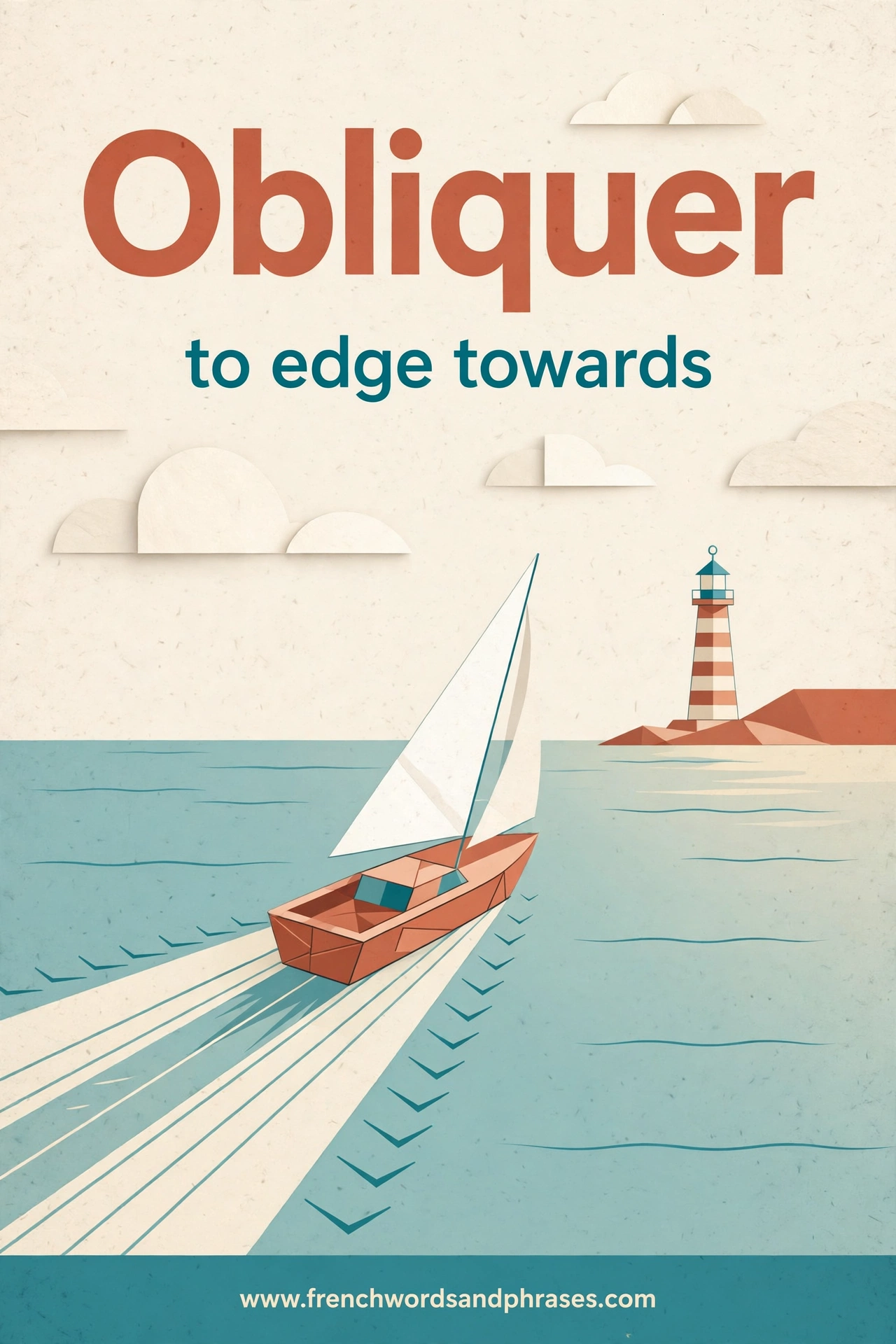
A hiker leaving the straight path to angle across a meadow, a small boat edging towards the harbour light, a glance sliding sideways — obliquer is the verb of the diagonal, of quietly changing direction without ever turning round.
In this guide, you’ll learn how to conjugate obliquer in all the major French tenses and moods. Explore complete conjugation tables, French examples, English translations, and practice quizzes.
Understanding the French Verb Obliquer
Obliquer is a regular French verb belonging to the first group of verbs, those ending in -er.
It means to edge towards. It is commonly used of roads, paths, boats, troops and glances that leave the straight line and angle away — in walking directions, sailing, military movement and descriptions of eyes sliding sideways.
Verb classification: First group (-er)
Auxiliary verb: Avoir
Past participle: obliqué
Present participle: obliquant
English equivalents: To slant, to edge, to turn aside; obliquer vers la gauche — to edge to the left; obliquer sur la droite — to bear right; la route oblique vers la rivière — the road angles down towards the river.
One important detail: obliquer keeps its -qu- spelling through the whole conjugation — nous obliquons, en obliquant, j’obliquai — like appliquer and expliquer. It starts with a vowel sound, so je becomes j’: j’oblique, j’ai obliqué. It almost always travels with a direction: obliquer vers la gauche, obliquer sur la droite — the verb of the diagonal, cousin of the adjective oblique.
Experience the Word
Obliquer is the verb of the diagonal — never straight ahead, never a full turn, always the quiet angle between.
Imagine a small sailing boat crossing a grey estuary. The wind pushes from the side, the harbour light blinks ahead, and the helmsman obliqué doucement vers la gauche — edges gently left, correcting the drift without a single sharp movement.
No turn, no drama. The boat has edged over — a obliqué — and the light grows nearer.
How to Conjugate Obliquer: Complete French Conjugation Guide
Let’s explore every major conjugation of obliquer, beginning with the indicative mood.
How to Conjugate Obliquer in the Indicative Mood
The indicative mood is used to express facts, observations, actions, and events.
How to Conjugate Obliquer in the Present Tense (Présent)
Used for actions happening now, habitual actions, and general truths.
| Subject | Conjugation |
|---|---|
| je | oblique |
| tu | obliques |
| il / elle | oblique |
| nous | obliquons |
| vous | obliquez |
| ils / elles | obliquent |
Example
Le sentier oblique vers la rivière.
The path edges towards the river.
Quick Quiz 1
Complete the sentence:
Nous ______ vers le port avant la nuit.
Reveal the answer
obliquons
Nous obliquons vers le port avant la nuit.
We edge towards the harbour before nightfall.
How to Conjugate Obliquer in the Passé Composé
Used for completed actions in the past. Obliquer takes the auxiliary verb avoir.
| Subject | Conjugation |
|---|---|
| j’ | ai obliqué |
| tu | as obliqué |
| il / elle | a obliqué |
| nous | avons obliqué |
| vous | avez obliqué |
| ils / elles | ont obliqué |
Example
Le bateau a obliqué vers le port avant la nuit.
The boat edged towards the harbour before nightfall.
How to Conjugate Obliquer in the Imparfait (Imperfect Tense)
Used for habitual past actions, descriptions, and ongoing situations in the past.
| Subject | Conjugation |
|---|---|
| je | obliquais |
| tu | obliquais |
| il / elle | obliquait |
| nous | obliquions |
| vous | obliquiez |
| ils / elles | obliquaient |
Example
Après le pont, la route obliquait sur la droite.
After the bridge, the road used to bear to the right.
Quick Quiz 2
Choose the correct form:
The boat edged towards the harbour.
Le bateau ______ vers le port. (a obliqué / est obliqué)
Reveal the answer
a obliqué
Le bateau a obliqué vers le port.
Obliquer takes avoir.
How to Conjugate Obliquer in the Plus-que-parfait
Used to describe an action that had already been completed before another past event.
| Subject | Conjugation |
|---|---|
| j’ | avais obliqué |
| tu | avais obliqué |
| il / elle | avait obliqué |
| nous | avions obliqué |
| vous | aviez obliqué |
| ils / elles | avaient obliqué |
Example
Les soldats avaient obliqué vers la colline avant l’aube.
The soldiers had edged towards the hill before dawn.
How to Conjugate Obliquer in the Passé Simple
Primarily used in formal writing, literature, and historical narratives. It is rarely used in everyday conversation.
| Subject | Conjugation |
|---|---|
| je | obliquai |
| tu | obliquas |
| il / elle | obliqua |
| nous | obliquâmes |
| vous | obliquâtes |
| ils / elles | obliquèrent |
Example
Le cavalier obliqua vers la gauche et disparut.
The horseman edged to the left and disappeared.
How to Conjugate Obliquer in the Passé Antérieur
A literary tense used to express an action completed immediately before another past action, generally in the passé simple.
| Subject | Conjugation |
|---|---|
| j’ | eus obliqué |
| tu | eus obliqué |
| il / elle | eut obliqué |
| nous | eûmes obliqué |
| vous | eûtes obliqué |
| ils / elles | eurent obliqué |
Example
Quand le bateau eut obliqué vers le phare, le vent tomba.
When the boat had edged towards the lighthouse, the wind dropped.
How to Conjugate Obliquer in the Future Tense (Futur Simple)
Used to describe actions that will take place in the future.
| Subject | Conjugation |
|---|---|
| je | obliquerai |
| tu | obliqueras |
| il / elle | obliquera |
| nous | obliquerons |
| vous | obliquerez |
| ils / elles | obliqueront |
Example
Après le village, le chemin obliquera vers la forêt.
After the village, the path will angle towards the forest.
How to Conjugate Obliquer in the Futur Antérieur (Future Perfect)
Used for an action that will have been completed before a particular point in the future.
| Subject | Conjugation |
|---|---|
| j’ | aurai obliqué |
| tu | auras obliqué |
| il / elle | aura obliqué |
| nous | aurons obliqué |
| vous | aurez obliqué |
| ils / elles | auront obliqué |
Example
À marée basse, le bateau aura obliqué vers le chenal.
At low tide, the boat will have edged towards the channel.
How to Conjugate Obliquer in the Near Future (Futur Proche)
Used to describe something that is going to happen soon. Formed with aller + infinitive.
| Subject | Conjugation |
|---|---|
| je | vais obliquer |
| tu | vas obliquer |
| il / elle | va obliquer |
| nous | allons obliquer |
| vous | allez obliquer |
| ils / elles | vont obliquer |
Example
Je vais obliquer vers la sortie pour éviter la foule.
I am going to edge towards the exit to avoid the crowd.
How to Conjugate Obliquer in the Conditional Mood
The conditional mood expresses what would happen under certain circumstances. It is also frequently used to make polite requests or express wishes.
How to Conjugate Obliquer in the Present Conditional
| Subject | Conjugation |
|---|---|
| je | obliquerais |
| tu | obliquerais |
| il / elle | obliquerait |
| nous | obliquerions |
| vous | obliqueriez |
| ils / elles | obliqueraient |
Example
Sans ce vent, le bateau obliquerait droit vers le port.
Without this wind, the boat would edge straight towards the harbour.
How to Conjugate Obliquer in the Past Conditional
| Subject | Conjugation |
|---|---|
| j’ | aurais obliqué |
| tu | aurais obliqué |
| il / elle | aurait obliqué |
| nous | aurions obliqué |
| vous | auriez obliqué |
| ils / elles | auraient obliqué |
Example
Il aurait obliqué plus tôt si le brouillard s’était levé.
He would have edged over earlier if the fog had lifted.
Obliquer in the Literary Past Conditional Form
This less common literary form uses the imperfect subjunctive of avoir.
| Subject | Conjugation |
|---|---|
| j’ | eusse obliqué |
| tu | eusses obliqué |
| il / elle | eût obliqué |
| nous | eussions obliqué |
| vous | eussiez obliqué |
| ils / elles | eussent obliqué |
Example
Le cavalier eût obliqué vers la colline au coucher du soleil.
The horseman would have edged towards the hill at sunset.
How to Conjugate Obliquer in the Subjunctive Mood
The subjunctive is used to express wishes, emotions, doubts, necessity, and uncertainty. It frequently follows expressions such as il faut que (it is necessary that) or bien que (although).
How to Conjugate Obliquer in the Present Subjunctive
| Subject | Conjugation |
|---|---|
| que je | oblique |
| que tu | obliques |
| qu’il / qu’elle | oblique |
| que nous | obliquions |
| que vous | obliquiez |
| qu’ils / qu’elles | obliquent |
Example
Il faut que tu obliques vers la droite après le pont.
You must bear right after the bridge.
Quick Quiz 3
Complete the sentence using the subjunctive:
Il faut que tu ______ vers la droite.
Reveal the answer
obliques
Il faut que tu obliques vers la droite.
You must bear right.
How to Conjugate Obliquer in the Imperfect Subjunctive
A literary tense, rarely encountered in modern spoken French.
| Subject | Conjugation |
|---|---|
| que je | obliquasse |
| que tu | obliquasses |
| qu’il / qu’elle | obliquât |
| que nous | obliquassions |
| que vous | obliquassiez |
| qu’ils / qu’elles | obliquassent |
Example
Le capitaine ne voulait pas que le navire obliquât vers les récifs.
The captain did not want the ship to edge towards the reefs.
How to Conjugate Obliquer in the Pluperfect Subjunctive
A literary construction used to express an action completed before another past action.
| Subject | Conjugation |
|---|---|
| que j’ | eusse obliqué |
| que tu | eusses obliqué |
| qu’il / qu’elle | eût obliqué |
| que nous | eussions obliqué |
| que vous | eussiez obliqué |
| qu’ils / qu’elles | eussent obliqué |
Example
On raconta que les troupes eussent obliqué vers la rivière pendant la nuit.
It was told that the troops had edged towards the river during the night.
How to Conjugate Obliquer in the Past Subjunctive
| Subject | Conjugation |
|---|---|
| que j’ | aie obliqué |
| que tu | aies obliqué |
| qu’il / qu’elle | ait obliqué |
| que nous | ayons obliqué |
| que vous | ayez obliqué |
| qu’ils / qu’elles | aient obliqué |
Example
Je suis content que le sentier ait obliqué vers le village.
I am glad the path angled towards the village.
How to Conjugate Obliquer in the Imperative
The imperative is used to give commands, instructions, invitations, or suggestions. Subject pronouns are omitted.
How to Conjugate Obliquer in the Present Imperative
| Person | Conjugation |
|---|---|
| (tu) | oblique |
| (nous) | obliquons |
| (vous) | obliquez |
Example
Obliquez vers la gauche au prochain carrefour !
Bear left at the next crossroads!
Quick Quiz 4
How would you say Bear left at the crossroads (vous form)?
Reveal the answer
Obliquez vers la gauche au carrefour !
French Participles of Obliquer
Participles are verb forms that can be used in compound tenses and other grammatical constructions.
Present Participle of Obliquer
obliquant
En obliquant vers la sortie, elle a évité la foule.
By edging towards the exit, she avoided the crowd.
Past Participle of Obliquer
obliqué
Le regard, obliqué vers la fenêtre, trahissait son impatience.
His gaze, angled towards the window, betrayed his impatience.
Obliquer in Everyday French: Real-Life Examples
Now that you know the conjugations, let’s see how obliquer appears in everyday French.
Example 1 — Present
Le sentier oblique vers la rivière.
The path edges towards the river.
Example 2 — Passé composé
Le bateau a obliqué vers le port.
The boat edged towards the harbour.
Example 3 — Imparfait
La route obliquait sur la droite après le pont.
The road used to bear right after the bridge.
Example 4 — Future
Le chemin obliquera vers la forêt.
The path will angle towards the forest.
Example 5 — Conditional
Sans le vent, le bateau obliquerait vers le port.
Without the wind, the boat would edge towards the harbour.
Example 6 — Imperative
Oblique vers la gauche au carrefour !
Bear left at the crossroads!
Beyond Translation: The Meaning of Obliquer
English oblique is mostly an adjective, a slanting line or an indirect remark; French obliquer puts that slant into motion.
It is the diagonal as a decision.
Roads, boats, soldiers and glances all obliquer when they leave the straight course without fully turning — a small verb for every quiet change of direction in French prose.
How to Remember the French Verb Obliquer
Remember it this way: Obliquer is about the quiet diagonal — edging off the straight line.
- Obliquer vers / obliquer sur — to edge towards, to bear towards a direction.
- The -qu- never changes: nous obliquons, en obliquant, j’ai obliqué.
- Cousin of the adjective oblique — slanting, indirect: un regard oblique, a sidelong glance.
The key idea is the quiet diagonal — edging off the straight line.
Test Your Knowledge of Obliquer
Let’s see how much you’ve learned. Try answering these questions before revealing the answers.
Question 1
How do you say to edge to the left in French?
Reveal the answer
Obliquer vers la gauche.
Question 2
Translate: The path edges towards the river.
Reveal the answer
Le sentier oblique vers la rivière.
Question 3
What is the past participle of obliquer?
Reveal the answer
Obliqué.
Question 4
Complete the sentence:
Il faut que tu ______ vers la droite après le pont.
Reveal the answer
obliques
Il faut que tu obliques vers la droite après le pont.
You must bear right after the bridge.
Question 5
How do you say a sidelong glance in French, using the cousin adjective?
Reveal the answer
Un regard oblique.
Your Final Challenge
Can You Use It?
How would you say this in French?
The path edges towards the river, and the walkers follow its quiet angle.
Reveal the answer
Le sentier oblique vers la rivière, et les marcheurs suivent son angle tranquille.
The path edges towards the river, and the walkers follow its quiet angle.
A little French. A little curiosity. A richer everyday life.
LEARN FRENCH ONE WORD AT A TIME