A French Word to Live By
Translate Objet to English
/ɔb.ʒɛ/
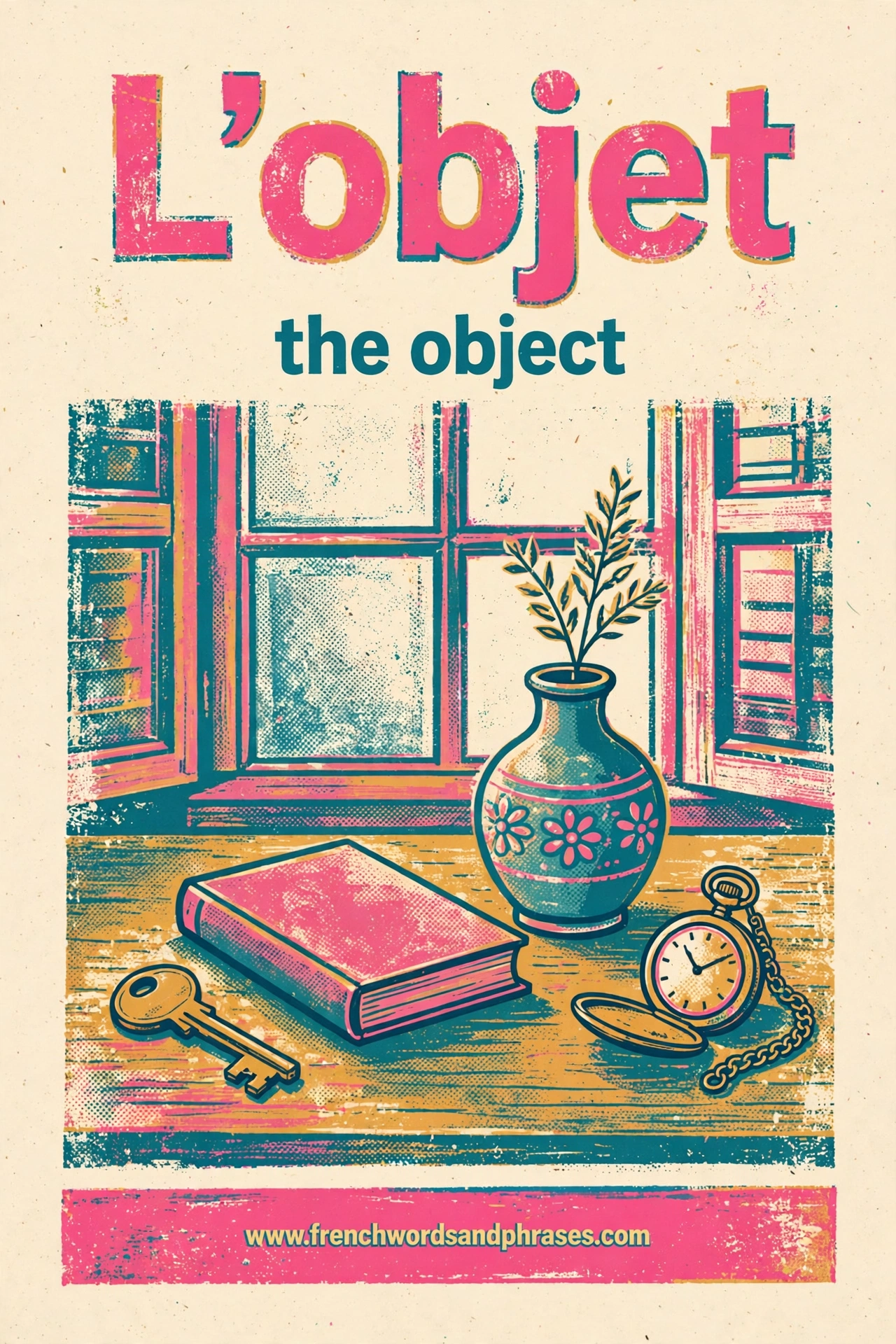
L’objet means the object.
At the lost property office, the clerk opens a drawer of umbrellas, gloves and one mysterious brass key. « Vous cherchez quel objet, exactement ? » she asks, pen ready.
In this guide, you’ll learn what objet means in English, how to use it with its articles, how to form its plural, and how it appears in everyday French. Explore French examples, English translations, and practice quizzes.
Understanding the French Noun Objet
Objet is a masculine French noun. It begins with a vowel, so the article shrinks: l’objet, never « le objet ». The indefinite article keeps its full shape: un objet. Remember the vowel — it will change your possessives and demonstratives too: mon objet, cet objet.
It means the object — any physical thing you can point at, pick up or lose: a key, a stone, a strange brass instrument. But objet also means the purpose or subject of something abstract: l’objet de la réunion is what the meeting is about, and in an email, l’objet is the subject line. At school, grammar gives it a third life: le complément d’objet is the object of the verb in a sentence.
Gender: Masculine
Definite article: l’ — l’objet (the object)
Indefinite article: un — un objet (an object)
Partitive article: de l’ — as in l’objet de la réunion, the subject of the meeting
Plural: les objets
English equivalents: The object; the item; (of a meeting or email) the subject.
One important usage detail: because objet begins with a vowel, the possessives stay masculine and smooth — mon objet, ton objet, son objet — and the demonstrative is cet objet, with a -t, not « ce objet ». French simply refuses to let two vowels collide.
Experience the Word
Objet is more than a thing. It is the most philosophical word on the lost-property shelf: every objet was once chosen, carried, loved — and then left on a train.
Imagine the brocante on a Sunday morning: tables of old lamps, keys without locks, photographs of strangers. Each objet waits for a new hand, a new pocket, a new story.
You have not just picked up a thing. You have rescued a story — un objet, a small survivor of everyday life.
How to Use Objet in French: Complete Guide
Let’s explore how objet works in French, beginning with its articles — and watch the vowel change everything: l’objet, cet objet, mon objet.
Objet with the Definite Article (L’, Les)
Objet begins with a vowel, so le shrinks to l’ — l’objet, the object in question.
| Form | French |
|---|---|
| Singular | l’objet |
| Plural | les objets |
Example
L’objet sur la table est un vieux compas en laiton.
The object on the table is an old brass compass.
Objet with the Indefinite Article (Un, Des)
Used for an object in general — an unknown object, some curious objects.
| Form | French |
|---|---|
| Singular | un objet |
| Plural | des objets |
Example
Il trouve un objet bizarre dans le grenier.
He finds a strange object in the attic.
Objets du Quotidien: Everyday Objects in French
Keys, phones and wallets — the objects that fill our pockets and bags.
| French | In English |
|---|---|
| les clés | the keys |
| le téléphone | the phone |
| le portefeuille | the wallet |
| le sac | the bag |
| la bouteille | the bottle |
| le livre | the book |
Example
Ses objets personnels sont dans le tiroir du bureau.
His personal objects are in the desk drawer.
Quick Quiz 1
Complete the sentence:
______ objet en métal est très lourd. (This)
Reveal the answer
Cet
Cet objet en métal est très lourd.
This metal object is very heavy — cet, with a -t, because objet begins with a vowel.
The Plural of Objet
Objet adds an -s in the plural — les objets, from pocketfuls to museum collections.
| Number | French |
|---|---|
| Singular | l’objet |
| Plural | les objets |
Example
Les objets anciens se vendent bien à la brocante.
Old objects sell well at the flea market.
Objet with Possessive Adjectives (Mon, Ton, Son…)
Objet is masculine and begins with a vowel, so the possessives are mon, ton, son — smooth and simple.
| Owner | French |
|---|---|
| my | mon objet |
| your (tu) | ton objet |
| his / her | son objet |
| our | notre objet |
| your (vous) | votre objet |
| their | leur objet |
Example
Ne touche pas à mon objet, il est fragile.
Don’t touch my object, it’s fragile.
Quick Quiz 2
In an email, what is l’objet?
Reveal the answer
The subject line — what the message is about.
N’oublie pas d’écrire l’objet du message.
Don’t forget to write the subject of the message.
Objet with Demonstrative Adjectives (Cet, Ces)
Used to point: cet objet (with -t, for the vowel), ces objets.
| Form | French |
|---|---|
| Singular | cet objet |
| Plural | ces objets |
Example
Ces objets appartiennent au musée de la ville.
These objects belong to the town museum.
Objet with Adjectives
Adjectives agree with objet: lourd, ancien and fragile take their masculine forms.
| Adjective | With Objet |
|---|---|
| lourd (heavy) | un objet lourd |
| ancien (old, antique) | un objet ancien |
| fragile (fragile) | un objet fragile |
| précieux (precious) | un objet précieux |
| inutile (useless) | un objet inutile |
Example
Elle garde un objet précieux de sa grand-mère.
She keeps a precious object from her grandmother.
Quick Quiz 3
Complete the sentence:
Les ______ trouvés sont gardés à la gare. (lost property — literally, the found objects)
Reveal the answer
objets
Les objets trouvés sont gardés à la gare.
Found objects are kept at the station — les objets trouvés is the lost property office itself.
Everyday Expressions with Objet
Lost property, meetings and emails — the objet phrases of daily life.
| Expression | In English |
|---|---|
| les objets trouvés | lost property (the found objects) |
| un objet perdu | a lost object |
| l’objet de la réunion | the subject (purpose) of the meeting |
| un objet de valeur | a valuable object |
| sans objet | pointless, no longer relevant |
| un objet fragile | a fragile object |
Example
Il dépose l’objet perdu aux objets trouvés.
He hands in the lost object at the lost property office.
Words from the Same Family as Objet
Aims, lenses and objections — the words that travel with objet.
| French | In English |
|---|---|
| l’objectif | the aim, the goal; the (camera) lens |
| objecter | to object, to raise an objection |
| la chose | the thing |
| le truc | the thing, the thingummy (informal) |
| le complément d’objet | the object (in grammar) |
| personnel (objets personnels) | personal belongings |
Example
L’objectif de la réunion est de choisir une date.
The aim of the meeting is to choose a date.
Quick Quiz 4
What is l’objectif?
Reveal the answer
The aim or goal — the big cousin of objet, and also a camera lens.
Notre objectif est de finir avant vendredi.
Our aim is to finish before Friday.
Objet in Everyday French: Real-Life Examples
Now that you know the word, let’s see how objet appears in everyday French.
Example 1 — At lost property
J’ai perdu un objet dans le train de huit heures.
I lost an object on the eight o’clock train.
Example 2 — In the attic
Quel est cet objet bizarre, à ton avis ?
What is this strange object, in your opinion?
Example 3 — Writing an email
Écris l’objet du message en quelques mots.
Write the subject of the message in a few words.
Example 4 — At the market
Ces objets anciens sont très beaux.
These old objects are very beautiful.
Example 5 — Being careful
Attention, cet objet est fragile !
Careful, this object is fragile!
Example 6 — At the meeting
L’objet de la réunion est le budget de l’année.
The subject of the meeting is the year’s budget.
Beyond Translation: The Meaning of Objet
French philosophy adores the objet: whole books have been written about the humble things on a kitchen table, and the French brocante — the flea market — is practically a national museum of rescued objets. The word also runs the country’s administration: every official letter and every email must state its objet, and a demand without one can be declared sans objet — without purpose, void.
To say objet is to give even the smallest thing a name and a dignity.
It evokes the lost property drawer, the subject line of a careful email, and the brass key that somebody, somewhere, is still looking for.
How to Remember the French Noun Objet
Remember it this way: Objet is the object — masculine, but the vowel swallows the article: l’objet, cet objet, mon objet.
- You point at a thing — l’objet, jamais « le objet ».
- You show it — cet objet, avec un -t pour la voyelle.
- You write an email — l’objet du message, the subject line.
The key idea is l’objet — the vowel takes l’, cet and mon.
Test Your Knowledge of Objet
Let’s see how much you’ve learned. Try answering these questions before revealing the answers.
Question 1
Why do we say l’objet and not le objet?
Reveal the answer
Because objet begins with a vowel — le shrinks to l’ before a vowel sound.
Question 2
Translate: This object is very heavy.
Reveal the answer
Cet objet est très lourd.
Question 3
What are les objets trouvés?
Reveal the answer
Lost property — literally « the found objects », and the office that keeps them.
Question 4
How do you say a valuable object?
Reveal the answer
Un objet de valeur.
Question 5
Complete the sentence:
______ objet de la réunion est le nouveau projet.
Reveal the answer
L’
L’objet de la réunion est le nouveau projet.
The subject of the meeting is the new project.
Your Final Challenge
Can You Use It?
How would you say this in French?
“She finds a strange object in the attic.”
Reveal the answer
Elle trouve un objet bizarre dans le grenier.
She finds a strange object in the attic.
A little French. A little curiosity. A richer everyday life.
LEARN FRENCH ONE WORD AT A TIME