A French Word to Live By
Translate Mollet to English
/mɔ.lɛ/
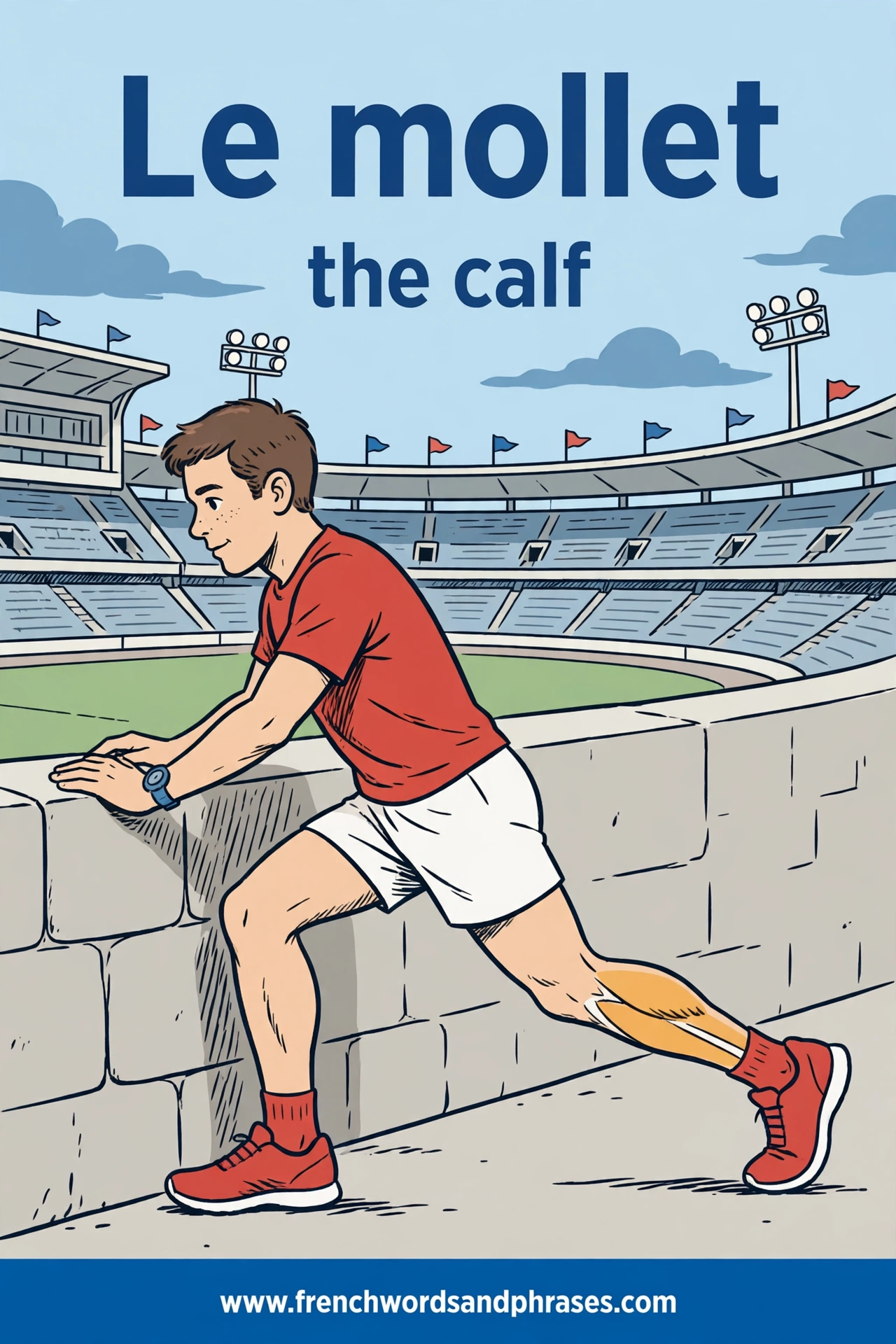
Le mollet means the calf.
The cyclist crests the hill, legs burning, and the crowd on the barrier can see every muscle working. A spectator nods with respect: « Regarde ses mollets ! »
In this guide, you’ll learn what mollet means in English, how to use it with its articles, how to form its plural, and how it appears in everyday French. Explore French examples, English translations, and practice quizzes.
Understanding the French Noun Mollet
Mollet is a masculine French noun. It is learned together with its article: le mollet, un mollet. Here it means the calf of the leg — not the baby cow, which French calls le veau. Same English word, two completely different French words.
It means the calf — the round muscle at the back of your lower leg, between le genou (the knee) and la cheville (the ankle). Runners, cyclists and dancers live by their mollets; everyone else notices theirs on the stairs, or when une crampe au mollet strikes at three in the morning. And in the kitchen, the same word hides in un œuf mollet — a soft-boiled egg, cooked just until the white sets and the yolk stays runny.
Gender: Masculine
Definite article: le — le mollet (the calf)
Indefinite article: un — un mollet (a calf)
Partitive article: du — du mollet appears in recipes: un œuf mollet, never *du mollet for the leg
Plural: les mollets
English equivalents: The calf (of the leg); un œuf mollet = a soft-boiled egg.
One important trap: English « calf » covers two French words. The animal is le veau; the muscle is le mollet. Ask a farmer about his mollets and he will check his legs. And in a restaurant, un œuf mollet is a soft-boiled egg — nothing to do with legs at all, except that both are tender.
Experience the Word
Mollet is more than an anatomy word. It is the engine room of every walk, every dance, every sprint for the bus — the muscle that pushes you up the stairs of life, one step at a time.
Imagine the Tour de France on a mountain stage: a hundred riders, and the cameras zooming in on the famous mollets des coureurs, hard as carved wood, turning the pedals at ninety beats a minute.
You have not just named a muscle. You have named your own spring — le mollet, the body’s little catapult.
How to Use Mollet in French: Complete Guide
Let’s explore how mollet works in French, beginning with its articles — le mollet, un mollet, des mollets.
Mollet with the Definite Article (Le, Les)
Used for the calf everyone is talking about — the aching one, the strong one.
| Form | French |
|---|---|
| Singular | le mollet |
| Plural | les mollets |
Example
Le mollet droit du coureur est très musclé.
The runner’s right calf is very muscular.
Mollet with the Indefinite Article (Un, Des)
Used for a calf in general — a cramp in a calf, strong calves.
| Form | French |
|---|---|
| Singular | un mollet |
| Plural | des mollets |
Example
Les danseurs ont des mollets puissants.
Dancers have powerful calves.
The Leg in French: Words around Mollet
Knees, ankles and thighs — the mollet’s neighbours on the leg.
| French | In English |
|---|---|
| le genou | the knee |
| la cheville | the ankle |
| la cuisse | the thigh |
| le tibia | the shin |
| le pied | the foot |
| le talon | the heel |
Example
Le mollet se trouve entre le genou et la cheville.
The calf is located between the knee and the ankle.
Quick Quiz 1
Complete the sentence:
Après la course, j’ai une crampe ______ mollet. (in the)
Reveal the answer
au
Après la course, j’ai une crampe au mollet.
After the race, I have a cramp in my calf — au, à + le.
The Plural of Mollet
Mollet adds an -s in the plural — and legs, like laces, come in pairs: les mollets.
| Number | French |
|---|---|
| Singular | le mollet |
| Plural | les mollets |
Example
Ses mollets sont durs après l’entraînement.
His calves are firm after training.
Mollet with Possessive Adjectives (Mon, Ton, Son…)
Possessives agree with the noun: mollet is masculine, so it takes mon, ton, son.
| Owner | French |
|---|---|
| my | mon mollet |
| your (tu) | ton mollet |
| his / her | son mollet |
| our | notre mollet |
| your (vous) | votre mollet |
| their | leur mollet |
Example
Mon mollet me fait mal depuis la randonnée.
My calf has been hurting since the hike.
Quick Quiz 2
At the restaurant, you order un œuf mollet. What arrives?
Reveal the answer
A soft-boiled egg — white set, yolk runny, perfect for dipping toast.
Un œuf mollet avec des mouillettes, s’il vous plaît.
A soft-boiled egg with soldiers, please.
Mollet with Demonstrative Adjectives (Ce, Ces)
Used to point: ce mollet, this calf; ces mollets, these calves.
| Form | French |
|---|---|
| Singular | ce mollet |
| Plural | ces mollets |
Example
Ces mollets musclés sont ceux d’un danseur.
These muscular calves are a dancer’s.
Mollet with Adjectives
Adjectives agree with mollet: musclé, dur and fin all take their masculine forms.
| Adjective | With Mollet |
|---|---|
| musclé (muscular) | un mollet musclé |
| dur (firm, hard) | un mollet dur |
| fin (slim) | un mollet fin |
| douloureux (painful) | un mollet douloureux |
| fort (strong) | un mollet fort |
Example
Le cycliste a des mollets durs comme du bois.
The cyclist has calves as hard as wood.
Quick Quiz 3
A baby cow is not un mollet. What is it?
Reveal the answer
Un veau — English « calf » splits in two: le veau for the animal, le mollet for the muscle.
Le veau boit le lait de sa mère.
The calf drinks its mother’s milk.
Everyday Expressions with Mollet
Stairs, cramps and soft-boiled eggs — the mollet phrases of daily life.
| Expression | In English |
|---|---|
| avoir mal aux mollets | to have aching calves |
| une crampe au mollet | a cramp in the calf |
| se muscler les mollets | to build up one’s calves |
| un œuf mollet | a soft-boiled egg |
| monter sur la pointe des pieds | to go up on tiptoe (working the calves) |
| des mollets de coureur | a runner’s calves |
Example
Après les escaliers, j’ai mal aux mollets.
After the stairs, my calves ache.
Words from the Same Family as Mollet
Legs, walking and running — the words that travel with mollet.
| French | In English |
|---|---|
| la jambe | the leg |
| le muscle | the muscle |
| marcher | to walk |
| courir | to run |
| la crampe | the cramp |
| le veau | the calf (the animal) |
Example
Courir muscle les jambes et surtout les mollets.
Running builds up the legs, and especially the calves.
Quick Quiz 4
Where exactly is le mollet?
Reveal the answer
At the back of the lower leg, between the knee and the ankle.
Le mollet est entre le genou et la cheville.
The calf is between the knee and the ankle.
Mollet in Everyday French: Real-Life Examples
Now that you know the word, let’s see how mollet appears in everyday French.
Example 1 — After the run
J’ai une crampe au mollet, je dois m’arrêter.
I have a cramp in my calf, I have to stop.
Example 2 — On the stairs
Ces escaliers ! Mes mollets sont en feu.
These stairs! My calves are on fire.
Example 3 — At the café
Pour moi, un œuf mollet et un café, merci.
For me, a soft-boiled egg and a coffee, thank you.
Example 4 — Admiring a dancer
Regarde ses mollets, quelle puissance !
Look at her calves, what power!
Example 5 — At training
Cet exercice muscle les mollets et les cuisses.
This exercise builds the calves and the thighs.
Example 6 — A complaint
Mon mollet gauche me fait mal depuis hier.
My left calf has been hurting since yesterday.
Beyond Translation: The Meaning of Mollet
The mollet has a proud place in French cycling culture: journalists write about les mollets des coureurs the way art critics write about brushwork, and a rider with weak calves simply does not survive the Alps. Then the same modest word slips into the kitchen and becomes un œuf mollet, the soft-boiled egg timed to the second in every French bistrot — six minutes, no more, so the yolk runs gold over the toast soldiers.
To say mollet is to name the muscle that carries you — and the egg that rewards you.
It evokes mountain stages and morning cramps, dancers at the barre, and breakfast trays with a perfect egg waiting in its shell.
How to Remember the French Noun Mollet
Remember it this way: Mollet is the calf of your leg — masculine, le mollet — while the baby cow is le veau.
- You climb stairs — les mollets travaillent, the calves work.
- You see a farm animal — c’est un veau, pas un mollet.
- You order breakfast — un œuf mollet, a soft-boiled egg.
The key idea is le mollet — the calf of the leg; le veau — the calf in the field.
Test Your Knowledge of Mollet
Let’s see how much you’ve learned. Try answering these questions before revealing the answers.
Question 1
Is mollet masculine or feminine?
Reveal the answer
Masculine — le mollet, un mollet.
Question 2
Translate: My calves ache after the hike.
Reveal the answer
Mes mollets me font mal après la randonnée. (Or: J’ai mal aux mollets après la randonnée.)
Question 3
What is un œuf mollet?
Reveal the answer
A soft-boiled egg — the white set, the yolk still runny.
Question 4
How do you say a cramp in the calf?
Reveal the answer
Une crampe au mollet — au, à + le mollet.
Question 5
Complete the sentence:
Le danseur a des ______ très musclés.
Reveal the answer
mollets
Le danseur a des mollets très musclés.
The dancer has very muscular calves.
Your Final Challenge
Can You Use It?
How would you say this in French?
“The runner has a cramp in his calf.”
Reveal the answer
Le coureur a une crampe au mollet.
The runner has a cramp in his calf.
A little French. A little curiosity. A richer everyday life.
LEARN FRENCH ONE WORD AT A TIME