A French Word to Live By
Translate Musclé to English
/myskle/
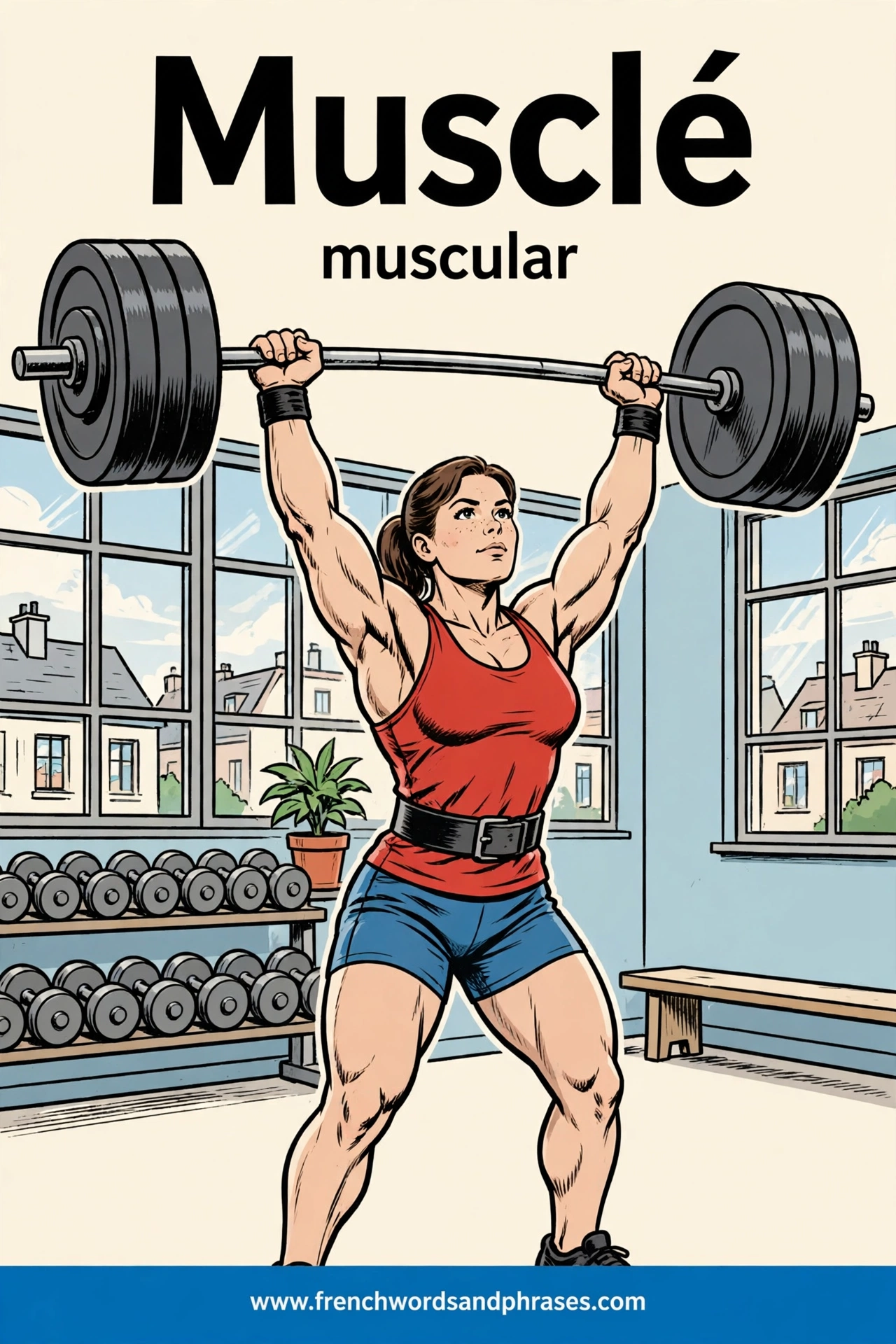
Musclé means muscular.
On the quay at dawn, two fishermen haul a net out of the harbour hand over hand, shoulders working, arms shining with seawater. Nobody in the little crowd mentions the fish. They are all looking at the arms — and French has the exact word for them: musclés.
In this guide, you’ll learn what musclé means in English, how its four regular forms are built, where it stands in the sentence, and the surprising second life it leads describing speeches and arguments. Explore French examples, English translations, and practice quizzes.
Understanding the French Adjective Musclé
Musclé is a French adjective of quality — the adjective of the trained body. It is built like a past participle and agrees in the most regular way: add an e for the feminine and an s for the plural — musclé, musclée, musclés, musclées.
It means muscular: des bras musclés, muscular arms; un corps musclé, a muscular body. French also uses it as a picture for force: un discours musclé is a forceful, hard-hitting speech, and une intervention musclée is a show of strength. Wherever power shows, musclé can describe it.
Type: Adjective of quality — the trained, powerful body
Answers the question: What is it like? — muscular
Changes form: Yes — musclé, musclée, musclés, musclées
English equivalents: Muscular; forceful, hard-hitting (of speeches and action).
One important usage detail: musclé stands AFTER the noun — des bras musclés, des épaules musclées. And do not confuse it with its medical cousin musculaire: une douleur musculaire is a muscle pain, but a muscular arm is un bras musclé.
Experience the Word
Musclé is the adjective of the harbour at dawn — of nets and oars, of bodies built by work rather than by mirrors.
Imagine the fisherman again at the end of the morning, rolling his sleeves down over arms that have pulled a living out of the sea for forty years. The muscles are not decoration. They are a biography.
You have not just described a body. You have described strength that was earned.
How to Use Musclé in French: Complete Guide
Let’s explore how musclé works in French, beginning with the whole word on one card.
Musclé at a Glance
Before the details, here is the whole word on one card.
The Whole Word on One Card
Meaning, type, position and forms — musclé in four lines.
| Point | Musclé |
|---|---|
| Meaning | muscular |
| Type | adjective of quality — the powerful body |
| Usual position | after the noun — des bras musclés |
| Form | musclé / musclée / musclés / musclées |
Example
Il a des bras musclés.
He has muscular arms.
The Four Forms of Musclé
Musclé agrees with the noun it describes, following the regular -é pattern: the feminine adds an e, the plurals add an s.
| Form | Musclé | Example |
|---|---|---|
| Masculine singular | musclé | un bras musclé — a muscular arm |
| Feminine singular | musclée | une épaule musclée — a muscular shoulder |
| Masculine plural | musclés | des bras musclés — muscular arms |
| Feminine plural | musclées | des épaules musclées — muscular shoulders |
Example
Le rameur a des bras musclés et des épaules musclées.
The rower has muscular arms and muscular shoulders.
Quick Quiz 1
Which form of musclé goes with épaules (feminine plural)?
Reveal the answer
musclées
Des épaules musclées.
Muscular shoulders.
Musclée: The Regular Feminine
No doubles, no accents added, no surprises: the feminine of musclé is formed by adding a single e. It changes the spelling only — musclé and musclée sound exactly alike.
| Situation | Example |
|---|---|
| The rule | just add -e — musclé → musclée |
| The sound | musclé and musclée sound exactly the same |
| Masculine plural | musclés — des bras musclés |
| Feminine plural | musclées — des jambes musclées |
Example
La gymnaste a des jambes musclées.
The gymnast has muscular legs.
Where Musclé Goes: After the Noun
Musclé follows the noun, like most adjectives of quality, and it sits naturally after être. In its figurative life it keeps the same place: the speech follows its muscle.
| Pattern | Example |
|---|---|
| After the noun | un corps musclé — a muscular body |
| After être | il est très musclé — he is very muscular |
| With an adverb | des bras très musclés — very muscular arms |
| Figurative | un discours musclé — a forceful speech |
Example
Après un an d’entraînement, il est bien musclé.
After a year of training, he is well built.
Quick Quiz 2
How do you say ‘muscular arms’ — des musclés bras or des bras musclés?
Reveal the answer
des bras musclés
Musclé stands after the noun.
Muscular arms.
More Muscular: Comparing with Musclé
Musclé compares the regular way, with plus, moins and aussi — and the superlative keeps the agreement: le plus musclé, la plus musclée.
| Degree | Example |
|---|---|
| As muscular as | aussi musclé que — as muscular as |
| More muscular | plus musclé — more muscular |
| Less muscular | moins musclé — less muscular |
| The most muscular (masc.) | le plus musclé — le plus musclé des rameurs |
| The most muscular (fem.) | la plus musclée — la plus musclée des gymnastes |
Example
Le pêcheur est plus musclé que son fils.
The fisherman is more muscular than his son.
Everyday Expressions with Musclé
Musclé spends its mornings in the harbour and the gym — and its evenings in the newspapers, where speeches and police operations borrow its strength.
| Expression | In English |
|---|---|
| des bras musclés | muscular arms |
| un corps bien musclé | a well-built, muscular body |
| un discours musclé | a forceful, hard-hitting speech |
| une intervention musclée | a show of force, a heavy-handed intervention |
| des épaules musclées | muscular shoulders |
| être musclé comme un athlète | to be built like an athlete |
Example
Le ministre a fait un discours musclé hier soir.
The minister gave a hard-hitting speech last night.
Quick Quiz 3
In un discours musclé, is anyone showing their arms?
Reveal the answer
No
The speech is forceful and hard-hitting.
Un discours musclé — a forceful speech.
Musclé and Its Neighbours
Musclé is about visible, trained strength; its neighbours divide the rest of the body’s qualities between power, shape and flexibility.
| French | In English |
|---|---|
| fort | strong — the general word for strength |
| sportif | athletic, sporty |
| athlétique | athletic in build |
| trapu | stocky, thickset |
| souple | supple, flexible — the opposite quality |
| maigre | skinny — at the other end of the harbour |
Example
Il est fort et musclé, mais aussi très souple.
He is strong and muscular, but also very supple.
Watch Out: The Traps Around Musclé
The traps here are a medical cousin, a noun that looks similar, and an accent that must never be dropped.
| Trap | The truth |
|---|---|
| musclé vs musculaire | musculaire is the medical word (une douleur musculaire, a muscle pain); musclé describes the visible build |
| le muscle | the noun is le muscle — ne dites pas ‘un musclé’ for the body part |
| Spelling | the é is part of the word — musclé, musclée, never ‘muscle’ with an agreement |
| Agreement | épaules is feminine plural: des épaules musclées |
Example
Après la course, il a une douleur musculaire à la jambe.
After the race, he has a muscle pain in his leg.
Quick Quiz 4
Which word describes a visible build — musclé or musculaire?
Reveal the answer
musclé
Des bras musclés.
Muscular arms.
Musclé in Everyday French: Real-Life Examples
Now that you know the word, let’s see how musclé appears in everyday French.
Example 1 — At the harbour
Les pêcheurs ont des bras musclés.
The fishermen have muscular arms.
Example 2 — At the gym
Après six mois, elle a des jambes musclées.
After six months, she has muscular legs.
Example 3 — Sport
Le joueur de rugby est grand et musclé.
The rugby player is tall and muscular.
Example 4 — In the news
Le discours du maire était musclé hier.
The mayor’s speech was hard-hitting yesterday.
Example 5 — At the beach
Le sauveteur est jeune et bien musclé.
The lifeguard is young and well built.
Example 6 — Work
Il faut des épaules musclées pour ce métier.
You need muscular shoulders for this job.
Beyond Translation: The Meaning of Musclé
English says muscular for the meaning of musclé — but French lets the word walk out of the gym and into the debating chamber. A speech can be musclé, an argument can be musclé, a reply can be musclée: force, in French, is a quality of language as much as of arms.
To call something musclé is to say it was built to carry weight.
The fisherman’s arms and the minister’s speech share one idea — nothing about them is accidental, and both took years to build.
How to Remember the French Adjective Musclé
Remember it this way: Musclé is the earned adjective — regular as a training plan, with an e for her, an s for the plural, and its place behind the noun.
- You see the family together — musclé, musclée, musclés, musclées — built by adding e and s.
- You put it after the noun — des bras musclés, des épaules musclées.
- You let it describe force anywhere — un discours musclé is a speech with muscle.
The key idea is musclé agrees the regular -é way and stands after the noun.
Test Your Knowledge of Musclé
Let’s see how much you’ve learned. Try answering these questions before revealing the answers.
Question 1
What does musclé mean?
Reveal the answer
Muscular — and, figuratively, forceful or hard-hitting.
Question 2
What is the feminine plural of musclé?
Reveal the answer
musclées — des épaules musclées.
Question 3
Translate: muscular arms.
Reveal the answer
Des bras musclés.
Question 4
What does un discours musclé describe?
Reveal the answer
A forceful speech — hard-hitting words, not arms.
Question 5
Complete the sentence:
La gymnaste a des jambes ______ .
Reveal the answer
musclées
La gymnaste a des jambes musclées.
The gymnast has muscular legs.
Your Final Challenge
Can You Use It?
How would you say this in French?
“Her brother has muscular arms.”
Reveal the answer
Son frère a des bras musclés.
Her brother has muscular arms.
A little French. A little curiosity. A richer everyday life.
LEARN FRENCH ONE WORD AT A TIME