A French Word to Live By
Translate Mignon to English
/miɲɔ̃/
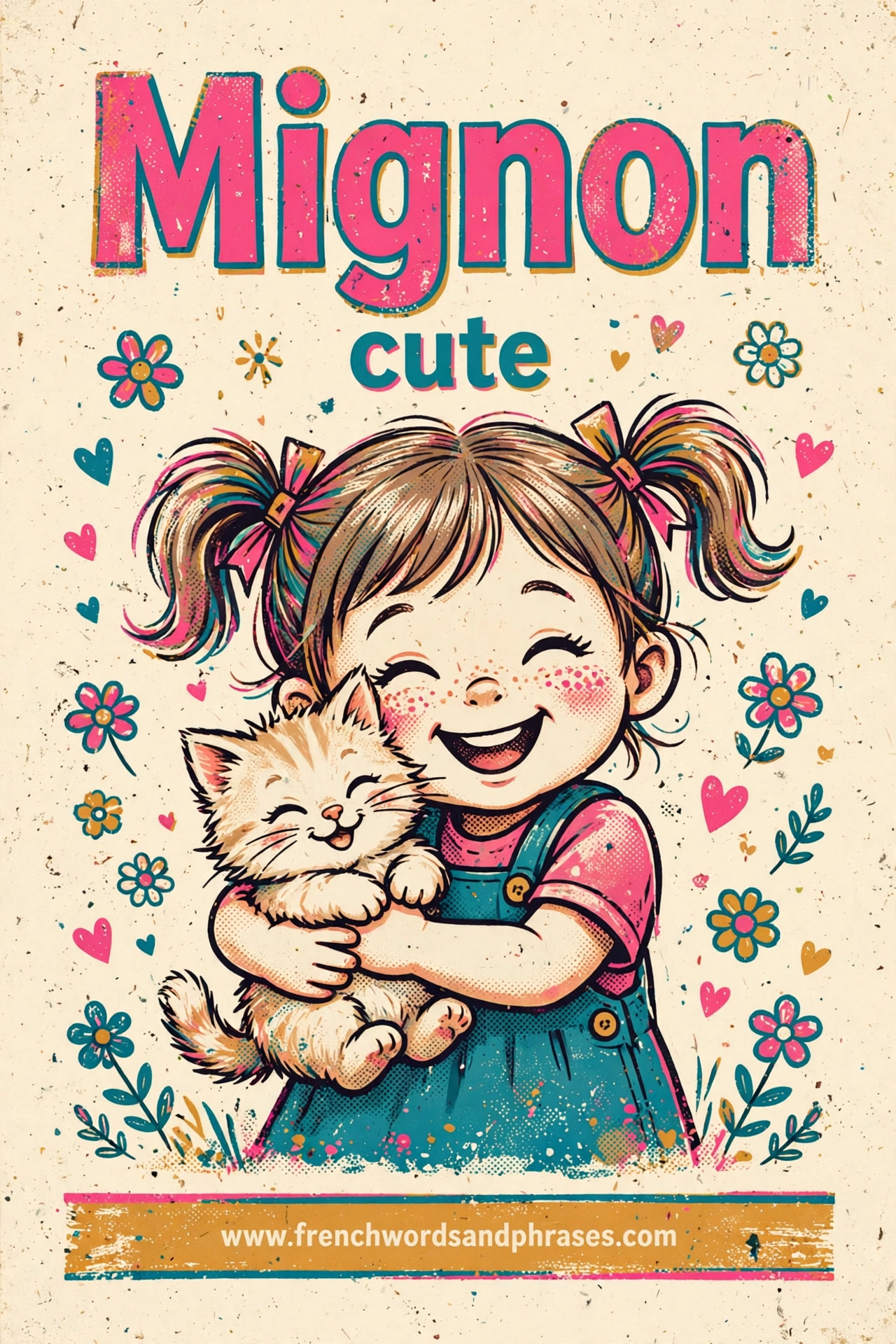
Mignon means cute.
At a country market, a cardboard box beside the vegetable stall holds four kittens, and a small crowd has gathered to do nothing but look at them. Nobody is buying vegetables any more. One word keeps rising out of the crowd like a sigh — mignon.
In this guide, you’ll learn what mignon means in English, why its feminine doubles the n, where it stands in the sentence, and why the French also use it to say that something was sweet of you. Explore French examples, English translations, and practice quizzes.
Understanding the French Adjective Mignon
Mignon is a French adjective of quality — the adjective of cuteness. Like every French adjective, it agrees with the noun it describes: mignon, mignonne, mignons, mignonnes. It is the word French reaches for in front of babies, kittens and tiny cottages.
It means cute — cute in the way of small, soft, charming things: un chaton mignon, a cute kitten; un bébé mignon, a cute baby; un village mignon, a cute little village. Said of a gesture, it means sweet: c’est mignon de ta part, that’s sweet of you. It praises charm, not grandeur.
Type: Adjective of quality — charm and cuteness
Answers the question: What is it like? — cute
Changes form: Yes — mignon, mignonne, mignons, mignonnes
English equivalents: Cute; sweet, darling.
One important usage detail: mignon stands AFTER the noun — un chaton mignon, une maison mignonne. And listen for its kindest use, with no noun at all: c’est mignon de ta part — that’s sweet of you.
Experience the Word
Mignon is the adjective of the market crowd around the kitten box — the word people say with their head tilted and their voice gone soft.
Imagine a grandmother opening a parcel to find a drawing her granddaughter made of her: a house, a sun, and a stick figure with enormous hair. The drawing is not good, exactly. It is something better. It is mignon, and it goes straight onto the fridge.
You have not just judged something pretty. You have been charmed, and admitted it.
How to Use Mignon in French: Complete Guide
Let’s explore how mignon works in French, beginning with the whole word on one card.
Mignon at a Glance
Before the details, here is the whole word on one card.
The Whole Word on One Card
Meaning, type, position and forms — mignon in four lines.
| Point | Mignon |
|---|---|
| Meaning | cute |
| Type | adjective of quality — charm and cuteness |
| Usual position | after the noun — un chaton mignon |
| Form | mignon / mignonne / mignons / mignonnes |
Example
Ce chaton est vraiment mignon.
This kitten is really cute.
The Four Forms of Mignon
Mignon agrees with the noun it describes. Watch the feminine: the n doubles, and suddenly you can hear it.
| Form | Mignon | Example |
|---|---|---|
| Masculine singular | mignon | un bébé mignon — a cute baby |
| Feminine singular | mignonne | une fille mignonne — a cute girl |
| Masculine plural | mignons | des chatons mignons — cute kittens |
| Feminine plural | mignonnes | des maisons mignonnes — cute houses |
Example
Les chatons sont mignons et les petites maisons sont mignonnes.
The kittens are cute and the little houses are cute.
Quick Quiz 1
Which form of mignon goes with maison (feminine)?
Reveal the answer
mignonne
Une maison mignonne.
A cute house.
Mignonne: The Feminine with a Double N
The feminine of mignon is not formed by simply adding an e. The n doubles — mignon becomes mignonne — and the sound changes with it: in mignonne, the n is fully pronounced and the vowel opens.
| Situation | Example |
|---|---|
| The rule | double the n and add e — mignon → mignonne |
| The sound | in mignonne you hear the n: /miɲɔn/ |
| Masculine plural | mignons — des bébés mignons |
| Feminine plural | mignonnes — des robes mignonnes |
Example
Quelle robe mignonne pour la fête !
What a cute dress for the party!
Where Mignon Goes: After the Noun
Mignon follows the noun it describes, like most adjectives of quality, and it is perfectly at home after être, where most compliments are delivered.
| Pattern | Example |
|---|---|
| After the noun | un chien mignon — a cute dog |
| After être | ce bébé est mignon — this baby is cute |
| With an adverb | un village très mignon — a very cute village |
| Before the noun | un mignon chaton — not in everyday French |
Example
Regarde ce petit café, il est très mignon.
Look at this little café, it’s very cute.
Quick Quiz 2
How do you say ‘a cute kitten’ — un mignon chaton or un chaton mignon?
Reveal the answer
un chaton mignon
Mignon stands after the noun.
A cute kitten.
Cuter Still: Comparing with Mignon
Mignon compares the regular way, with plus, moins and aussi — and the superlative keeps the agreement: le plus mignon, la plus mignonne.
| Degree | Example |
|---|---|
| As cute as | aussi mignon que — as cute as |
| Cuter | plus mignon — cuter |
| Less cute | moins mignon — less cute |
| The cutest (masc.) | le plus mignon — le plus mignon des chatons |
| The cutest (fem.) | la plus mignonne — la plus mignonne des maisons |
Example
Ce chiot est plus mignon que l’autre.
This puppy is cuter than the other one.
Everyday Expressions with Mignon
Mignon is the hardest-working compliment in French — it covers babies, villages and dresses, and doubles as the politest way to thank someone for a kind gesture.
| Expression | In English |
|---|---|
| trop mignon | so cute, adorable |
| mignon comme tout | cute as can be, cute as anything |
| c’est mignon de ta part | that’s sweet of you |
| un bébé mignon | a cute baby |
| un petit village mignon | a cute little village |
| mignon à croquer | cute enough to eat — utterly adorable |
Example
Merci pour les fleurs, c’est mignon de ta part.
Thank you for the flowers, that’s sweet of you.
Quick Quiz 3
What does c’est mignon de ta part mean?
Reveal the answer
That’s sweet of you
Tu m’as apporté un café, c’est mignon de ta part.
You brought me a coffee, that’s sweet of you.
Mignon and Its Neighbours
Mignon praises charm at small scale; its neighbours divide the rest of the compliments — and laid waits at the far end, saying the opposite.
| French | In English |
|---|---|
| joli | pretty — the everyday word for pleasing looks |
| adorable | adorable — stronger than mignon |
| craquant | adorable, irresistible (informal — literally, crunchy) |
| charmant | charming — of people and places |
| beau | beautiful, handsome — grander than mignon |
| laid | ugly — the opposite |
Example
Ce bébé est adorable, vraiment mignon.
This baby is adorable, really cute.
Watch Out: The Traps Around Mignon
The traps here are the double n, the gn sound, and a false friend hiding in the kitchen.
| Trap | The truth |
|---|---|
| Spelling | the feminine doubles the n — mignonne, mignonnes |
| The sound | gn is one sound, /ɲ/ — mignon rhymes with oignon (onion) |
| Not size | mignon means cute, not small — small is petit; a big dog can be mignon |
| At the table | un filet mignon is a cut of beef — the word’s famous second life on menus |
Example
Le filet mignon est le plat du jour.
The filet mignon is the dish of the day.
Quick Quiz 4
Does mignon mean small or cute?
Reveal the answer
Cute
Un gros chien peut être très mignon.
A big dog can be very cute.
Mignon in Everyday French: Real-Life Examples
Now that you know the word, let’s see how mignon appears in everyday French.
Example 1 — At the market
Regarde ces chatons, ils sont trop mignons !
Look at these kittens, they’re so cute!
Example 2 — Family
Ton bébé est mignon avec ce petit bonnet.
Your baby is cute in that little hat.
Example 3 — Travelling
Nous avons visité un village mignon en Provence.
We visited a cute village in Provence.
Example 4 — A thank-you
Tu m’as écrit une carte, c’est mignon de ta part.
You wrote me a card, that’s sweet of you.
Example 5 — Shopping
Cette robe mignonne est parfaite pour l’été.
This cute dress is perfect for summer.
Example 6 — At home
Le chiot dort dans un panier mignon.
The puppy sleeps in a cute basket.
Beyond Translation: The Meaning of Mignon
English says cute for the meaning of mignon — but mignon carries a warmth that cute sometimes lacks. It is the word of grandmothers and market crowds, of drawings kept on fridges for twenty years.
To call something mignon is to say it has disarmed you.
And French trusts the word so completely that it lends it to gratitude itself: c’est mignon de ta part — your kindness, too, can be small, soft and impossible to resist.
How to Remember the French Adjective Mignon
Remember it this way: Mignon is the disarming adjective — it follows the noun, doubles its n for her, and melts every heart it describes.
- You see the family together — mignon, mignonne, mignons, mignonnes — with a double n in the feminine.
- You put it after the noun — un chaton mignon, une robe mignonne.
- You hear the gn as one sound — mignon rhymes with oignon.
The key idea is mignon stands after the noun and doubles its n in mignonne.
Test Your Knowledge of Mignon
Let’s see how much you’ve learned. Try answering these questions before revealing the answers.
Question 1
What does mignon mean?
Reveal the answer
Cute — and sweet, when it describes a gesture.
Question 2
What are the forms of mignon?
Reveal the answer
mignon, mignonne, mignons, mignonnes — the feminine doubles the n.
Question 3
Translate: a cute kitten.
Reveal the answer
Un chaton mignon.
Question 4
What does c’est mignon de ta part mean?
Reveal the answer
That’s sweet of you.
Question 5
Complete the sentence:
Elle porte une robe très ______ .
Reveal the answer
mignonne
Elle porte une robe très mignonne.
She is wearing a very cute dress.
Your Final Challenge
Can You Use It?
How would you say this in French?
“The baby is cute in his little hat.”
Reveal the answer
Le bébé est mignon avec son petit chapeau.
The baby is cute in his little hat.
A little French. A little curiosity. A richer everyday life.
LEARN FRENCH ONE WORD AT A TIME