A French Word to Live By
Translate Mexique to English
/mɛk.sik/
Le Mexique means Mexico.
Colour, music and two thousand years of pyramids: le Mexique, Mexico — the great Spanish-speaking country south of the United States, and a famous exception in the French country rules.
In this guide, you’ll learn what Mexique means in English, how to use it with its articles, how to form its plural, and how it appears in everyday French. Explore French examples, English translations, and practice quizzes.
Understanding the French Noun Mexique
Mexique is a masculine proper noun, learned with its article: le Mexique. It is one of the celebrated exceptions: most countries ending in -e are feminine, but Mexique is masculine — like le Cambodge and le Zimbabwe — so it takes au for in/to and du for from: au Mexique, du Mexique. Its capital, Mexico City, is simply Mexico in French — the city and the country share the name.
It means Mexico — the large country of North America between the United States and Central America, homeland of the Aztecs and the Maya long before Spanish ships arrived. Its capital is Mexico, one of the largest cities in the world, built on the ruins of the Aztec capital. Its people are les Mexicains and les Mexicaines, its language l’espagnol — Mexico is the most populous Spanish-speaking country on Earth.
Gender: Masculine — le Mexique (an exception: -e but masculine)
Definite article: le — le Mexique (Mexico)
Saying in / to: au — au Mexique
Saying from: du — venir du Mexique
Capital: Mexico
The people: les Mexicains, les Mexicaines
English equivalents: Mexico.
Memorise Mexique with its exception flag: au Mexique, never “en Mexique”. The capital takes no article trick either: à Mexico, in Mexico City. French distinguishes the country and the city only by context — le Mexique with the article is the country; Mexico alone, after à or de, is usually the city.
Experience the Word
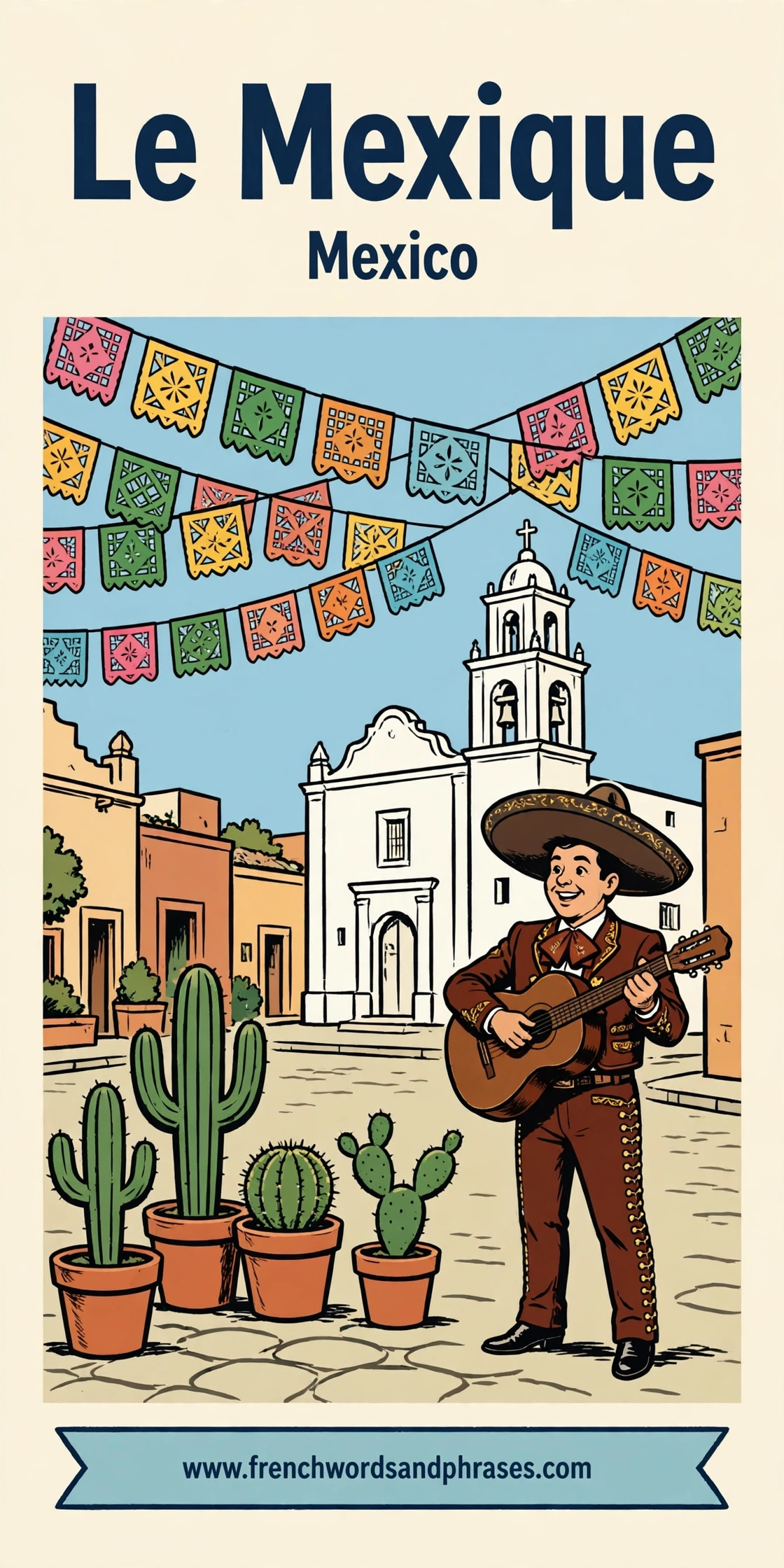
Mexique is colour you can hear: mariachi trumpets, market awnings, painted walls — a country that turns every festival into an art form.
Imagine the Day of the Dead in a Mexican town — candles in the cemetery, marigolds on the graves, families picnicking with their ancestors as if death were just another relative: le Mexique honouring its dead by feeding them.
You have not just named a country. You have named the land of the Aztecs — le Mexique, Mexico, the great exception.
How to Use Mexique in French: Complete Guide
Let’s explore how Mexique works in French, beginning with its article and prepositions — le Mexique, au Mexique, du Mexique.
Mexique with the Definite Article (Le)
As subject or object, Mexique keeps his article: le Mexique.
| Form | French |
|---|---|
| The country | le Mexique |
| The north of Mexico | le nord du Mexique |
| All of Mexico | tout le Mexique |
Example
Le Mexique est un grand pays d’Amérique.
Mexico is a large country in America.
Saying In, To and From: Au Mexique, Du Mexique
Masculine countries take au for in/to and du for from — Mexique is masculine despite its -e.
| Meaning | French |
|---|---|
| in Mexico, to Mexico | au Mexique |
| from Mexico | du Mexique |
| across Mexico | dans tout le Mexique |
| to the capital | à Mexico |
Example
Nous voyageons au Mexique en novembre.
We’re travelling to Mexico in November.
The People of Mexico: Les Mexicains
The inhabitants take a capital letter — and mexicain, small m, is the adjective.
| Person | French |
|---|---|
| a Mexican man | un Mexicain |
| a Mexican woman | une Mexicaine |
| Mexican men / the Mexicans | les Mexicains |
| Mexican women | les Mexicaines |
Example
Les Mexicains fêtent le Jour des Morts.
Mexicans celebrate the Day of the Dead.
Quick Quiz 1
Complete the sentence:
Nous voyageons ______ Mexique en novembre. (to)
Reveal the answer
au
Nous voyageons au Mexique en novembre.
We’re travelling to Mexico in November — Mexique is masculine, so au, despite the final -e.
The Language and the Adjective: Mexicain
Mexico speaks Spanish — the adjective mexicain carries the country’s own flavour.
| Use | French |
|---|---|
| the language | l’espagnol |
| masculine adjective | un chapeau mexicain |
| feminine adjective | une fête mexicaine |
| to speak Spanish | parler espagnol |
Example
L’espagnol du Mexique a ses propres expressions.
The Spanish of Mexico has its own expressions.
Mexique at a Glance
The facts every beginner meets first — capital, currency, language.
| Point | Mexique |
|---|---|
| Capital | Mexico |
| Currency | le peso |
| Language | l’espagnol |
| Ancient peoples | les Aztèques et les Mayas |
| Great festival | le Jour des Morts — the Day of the Dead |
Example
Mexico est la capitale du Mexique.
Mexico City is the capital of Mexico.
Quick Quiz 2
What is the capital of Mexico?
Reveal the answer
Mexico
Mexico est la capitale du Mexique.
Mexico City is the capital of Mexico.
Mexique and Its Neighbours
Mexico bridges North and Central America, between two oceans.
| Direction | French |
|---|---|
| to the north | les États-Unis |
| to the south | le Guatemala |
| to the east | le golfe du Mexique |
| to the west | l’océan Pacifique |
Example
Les États-Unis sont au nord du Mexique.
The United States is north of Mexico.
Mexique with Adjectives
Adjectives agree with Mexique — masculine singular: le Mexique entier, the whole of Mexico.
| Adjective | With Mexique |
|---|---|
| entier (whole) | le Mexique entier |
| beau (beautiful) | le beau Mexique |
| ancien (ancient) | le Mexique ancien des Aztèques |
| coloré (colourful) | le Mexique coloré |
Example
Le Mexique entier célèbre la fête nationale en septembre.
The whole of Mexico celebrates the national holiday in September.
Quick Quiz 3
Complete the sentence:
C’est une fête ______ très colorée. (Mexican)
Reveal the answer
mexicaine
C’est une fête mexicaine très colorée.
It’s a very colourful Mexican festival — mexicaine, feminine, to agree with fête.
Everyday Expressions with Mexique
Pyramids, festivals and sombreros — the Mexique phrases of daily life.
| Expression | In English |
|---|---|
| au Mexique | in Mexico |
| du Mexique | from Mexico; Mexican (of origin) |
| le Jour des Morts | the Day of the Dead |
| une pyramide | a pyramid — Aztec and Maya temples |
| la cuisine mexicaine | Mexican food |
Example
La cuisine mexicaine est célèbre dans le monde entier.
Mexican food is famous all over the world.
Words from the Same Family as Mexique
Mexicans and Mexico — the words that travel with Mexique.
| French | In English |
|---|---|
| mexicain | Mexican — the adjective |
| un Mexicain | a Mexican man |
| les Aztèques | the Aztecs |
| les Mayas | the Maya |
| hispanophone | Spanish-speaking |
Example
Les Aztèques ont construit de grandes pyramides au Mexique.
The Aztecs built great pyramids in Mexico.
Quick Quiz 4
What is le Jour des Morts?
Reveal the answer
The Day of the Dead — Mexico’s great festival honouring the dead with candles, flowers and food.
Le Jour des Morts est le 2 novembre au Mexique.
The Day of the Dead is on 2 November in Mexico.
Mexique in Everyday French: Real-Life Examples
Now that you know the word, let’s see how Mexique appears in everyday French.
Example 1 — Travel
Nous voyageons au Mexique en novembre.
We’re travelling to Mexico in November.
Example 2 — Language
Au Mexique, on parle espagnol.
In Mexico, people speak Spanish.
Example 3 — Geography
Le Mexique est au sud des États-Unis.
Mexico is south of the United States.
Example 4 — Food
La cuisine mexicaine est délicieuse.
Mexican food is delicious.
Example 5 — History
Les Aztèques vivaient au Mexique.
The Aztecs lived in Mexico.
Example 6 — Festivals
Le Jour des Morts est une grande fête au Mexique.
The Day of the Dead is a great festival in Mexico.
Beyond Translation: The Meaning of Mexique
Mexique is the exception every French teacher circles in red: a country in -e that insists on being masculine, au Mexique, du Mexique. Behind the grammar stands a double history — the high civilisations of the Aztecs and Maya, and the Spanish conquest that gave the country its language while keeping its name, from the Mexica people themselves. France’s own Mexican adventure ended badly in the 1860s, but the cultural exchange never stopped: French words season Mexican Spanish, and Mexican colour seasons French imaginations.
To say Mexique is to hear trumpets over a pyramid.
It evokes marigolds on graves, painted markets and ancient stones — Mexico, the exception with a festival for everything.
How to Remember the French Noun Mexique
Remember it this way: Mexique is masculine — the famous exception: le Mexique, au Mexique, du Mexique.
- Masculine despite the -e — le Mexique, one of the great exceptions.
- The prepositions — au Mexique (in, to), du Mexique (from), never “en Mexique”.
- City and country — Mexico alone is the capital; le Mexique is the country.
The key idea is le Mexique — Mexico, masculine (exception); au Mexique, du Mexique.
Test Your Knowledge of Mexique
Let’s see how much you’ve learned. Try answering these questions before revealing the answers.
Question 1
Is Mexique masculine or feminine in French?
Reveal the answer
Masculine — le Mexique, despite the final -e.
Question 2
How do you say in Mexico?
Reveal the answer
Au Mexique — masculine countries take au.
Question 3
Translate: We’re travelling to Mexico in November.
Reveal the answer
Nous voyageons au Mexique en novembre.
Question 4
What language is spoken in Mexico?
Reveal the answer
L’espagnol — Spanish; Mexico is the largest Spanish-speaking country.
Question 5
Complete the sentence:
______ Mexique est au sud des États-Unis. (the)
Reveal the answer
Le
Le Mexique est au sud des États-Unis.
Mexico is south of the United States.
Your Final Challenge
Can You Use It?
How would you say this in French?
“We’re travelling to Mexico in November.”
Reveal the answer
Nous voyageons au Mexique en novembre.
We’re travelling to Mexico in November.
A little French. A little curiosity. A richer everyday life.
LEARN FRENCH ONE WORD AT A TIME