A French Word to Live By
Translate Grèce to English
/ɡʁɛs/
La Grèce means Greece.
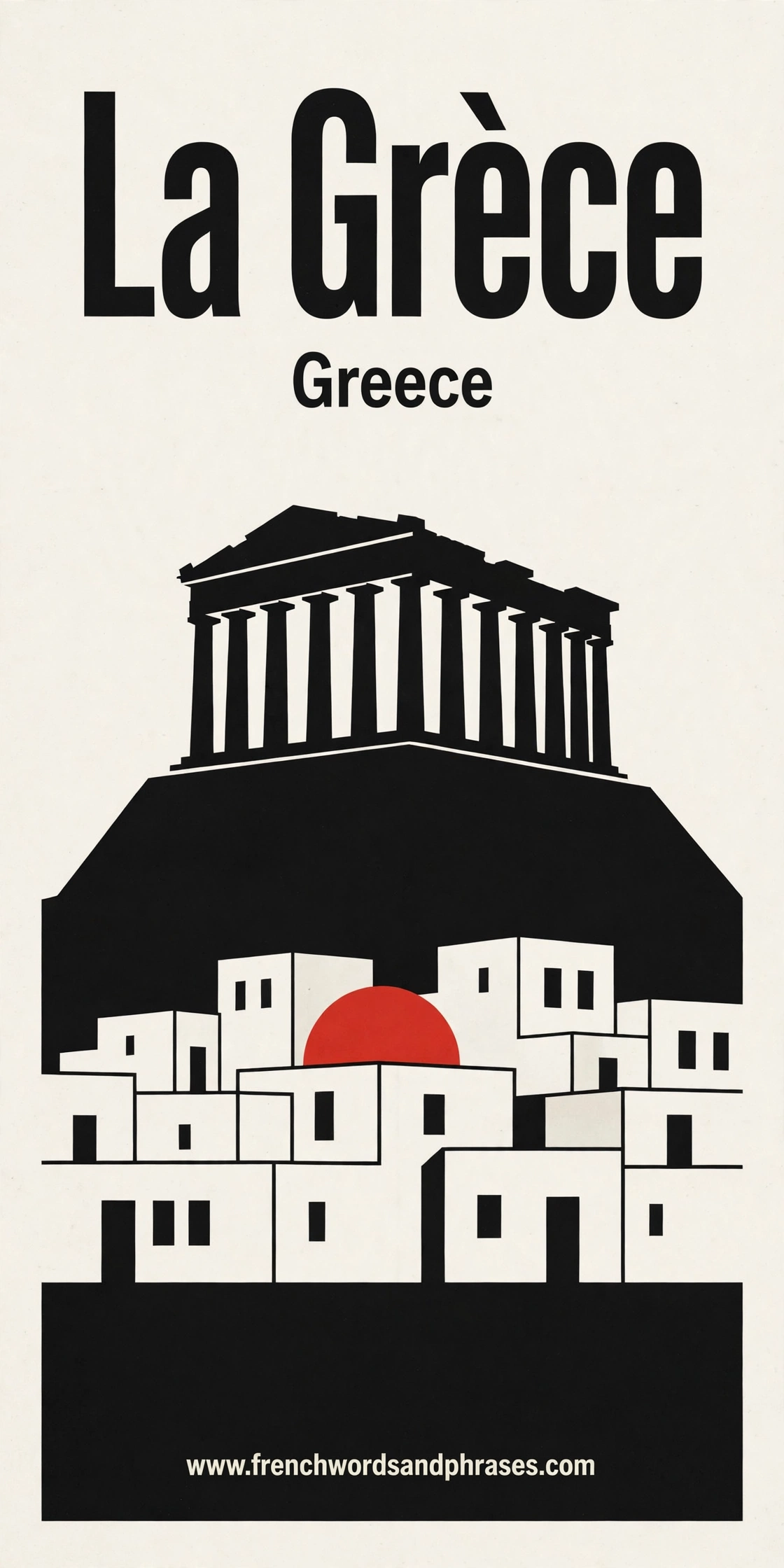
White villages, blue domes and the oldest words in Europe: la Grèce, Greece — the country that gave France its theatre, its democracy and half its dictionary, scattered across a sea of islands.
In this guide, you’ll learn what Grèce means in English, how to use it with its articles, how to form its plural, and how it appears in everyday French. Explore French examples, English translations, and practice quizzes.
Understanding the French Noun Grèce
Grèce is a feminine proper noun, learned with its article: la Grèce. Countries ending in -e are feminine, and Grèce follows the rule — en Grèce for in/to, de Grèce for from. The Greeks call their country Elláda; the French name comes from the Latin Graecia — and Greek itself, le grec, is the ancestor French borrows from more than any other language.
It means Greece — the mountainous peninsula and archipelago at the south-east of Europe, with Athènes, Athens, as its capital, the city of Socrates and the Parthenon. Its people are les Grecs and les Grecques, its language le grec. For a French learner, Greece is hiding inside the vocabulary: démocratie, théâtre, école, musique, téléphone — hundreds of everyday French words are Greek travellers in disguise.
Gender: Feminine — la Grèce
Definite article: la — la Grèce (Greece)
Saying in / to: en — en Grèce
Saying from: de — venir de Grèce
Capital: Athènes
The people: les Grecs, les Grecques
English equivalents: Greece.
Grèce behaves like France: en Grèce, de Grèce, and la Grèce as subject or object. Its islands take their own phrases: en Crète, in Crete, dans les îles grecques, in the Greek islands. The adjective and the people follow the stem: un Grec, une Grecque — note the feminine’s double spelling change, Grecque, pronounced like the masculine.
Experience the Word
Grèce is the grandmother of European words: every time a French speaker says démocratie or théâtre, Athens is speaking through them.
Imagine the ferry leaving Athens at sunset for the islands — the Acropolis shrinking gold behind you, the Aegean turning copper, and a hundred white villages waiting in the dark ahead: en Grèce, la mer est partout.
You have not just named a country. You have named the source — la Grèce, Greece, where Europe’s words were born.
How to Use Grèce in French: Complete Guide
Let’s explore how Grèce works in French, beginning with its article and prepositions — la Grèce, en Grèce, de Grèce.
Grèce with the Definite Article (La)
As subject or object, Grèce keeps her article: la Grèce.
| Form | French |
|---|---|
| The country | la Grèce |
| Ancient Greece | la Grèce antique |
| All of Greece | toute la Grèce |
Example
La Grèce est un pays du sud de l’Europe.
Greece is a country in southern Europe.
Saying In, To and From: En Grèce, De Grèce
Feminine countries take en for in/to and de for from — the article disappears after both.
| Meaning | French |
|---|---|
| in Greece, to Greece | en Grèce |
| from Greece | de Grèce |
| across Greece | dans toute la Grèce |
| to the capital | à Athènes |
Example
Ils passent l’été en Grèce.
They spend the summer in Greece.
The People of Greece: Les Grecs
The inhabitants take a capital letter — and grec, small g, is the language and the adjective.
| Person | French |
|---|---|
| a Greek man | un Grec |
| a Greek woman | une Grecque |
| Greek men / the Greeks | les Grecs |
| Greek women | les Grecques |
Example
Les Grecs aiment la mer et le soleil.
Greeks love the sea and the sun.
Quick Quiz 1
Complete the sentence:
Ils passent l’été ______ Grèce. (in)
Reveal the answer
en
Ils passent l’été en Grèce.
They spend the summer in Greece — feminine countries take en, with no article.
The Language and the Adjective: Grec
Grec is the ancestor language — and an adjective whose feminine, grecque, changes its spelling.
| Use | French |
|---|---|
| the language | le grec |
| masculine adjective | un temple grec |
| feminine adjective | une île grecque |
| to speak Greek | parler grec |
Example
Le grec ancien est la langue d’Homère.
Ancient Greek is the language of Homer.
Grèce at a Glance
The facts every beginner meets first — capital, currency, language.
| Point | Grèce |
|---|---|
| Capital | Athènes |
| Currency | l’euro |
| Language | le grec |
| Famous hill | l’Acropole |
| Islands | les îles grecques — hundreds of them |
Example
Athènes est la capitale de la Grèce.
Athens is the capital of Greece.
Quick Quiz 2
What is the capital of Greece?
Reveal the answer
Athènes
Athènes est la capitale de la Grèce.
Athens is the capital of Greece.
Grèce and Its Neighbours
Greece sits between Europe and Asia, with Turkey across the Aegean.
| Direction | French |
|---|---|
| to the east | la Turquie |
| to the north | l’Albanie et la Macédoine du Nord |
| to the south | la Crète, puis la mer |
| the sea | la mer Égée |
Example
La Turquie est à l’est de la Grèce.
Turkey is east of Greece.
Grèce with Adjectives
Adjectives agree with Grèce — feminine singular: la Grèce entière, the whole of Greece.
| Adjective | With Grèce |
|---|---|
| entière (whole) | la Grèce entière |
| antique (ancient) | la Grèce antique |
| belle (beautiful) | la belle Grèce |
| ensoleillée (sunny) | la Grèce ensoleillée |
Example
La Grèce antique a inventé la démocratie.
Ancient Greece invented democracy.
Quick Quiz 3
Complete the sentence:
C’est une île ______ très belle. (Greek)
Reveal the answer
grecque
C’est une île grecque très belle.
It’s a very beautiful Greek island — grecque, the feminine of grec.
Everyday Expressions with Grèce
Islands, temples and alphabets — the Grèce phrases of daily life.
| Expression | In English |
|---|---|
| en Grèce | in Greece |
| de Grèce | from Greece; Greek (of origin) |
| les îles grecques | the Greek islands |
| l’alphabet grec | the Greek alphabet |
| c’est du grec | it’s incomprehensible (rare — French usually blames Chinese!) |
Example
Les îles grecques sont magnifiques en été.
The Greek islands are magnificent in summer.
Words from the Same Family as Grèce
Greeks and Greek — the words that travel with Grèce.
| French | In English |
|---|---|
| grec | Greek — the language and the adjective |
| un Grec | a Greek man |
| la démocratie | democracy — a Greek gift |
| le théâtre | theatre — another Greek word |
| Athènes | Athens — the capital |
Example
La démocratie et le théâtre viennent de la Grèce antique.
Democracy and theatre come from ancient Greece.
Quick Quiz 4
What is l’Acropole?
Reveal the answer
The Acropolis — the ancient hill of Athens, crowned by the Parthenon.
L’Acropole domine la ville d’Athènes.
The Acropolis overlooks the city of Athens.
Grèce in Everyday French: Real-Life Examples
Now that you know the word, let’s see how Grèce appears in everyday French.
Example 1 — Holidays
Ils passent l’été en Grèce.
They spend the summer in Greece.
Example 2 — Islands
Les îles grecques sont magnifiques.
The Greek islands are magnificent.
Example 3 — Language
Elle apprend le grec moderne.
She is learning modern Greek.
Example 4 — History
La Grèce antique a inventé les Jeux olympiques.
Ancient Greece invented the Olympic Games.
Example 5 — Food
La salade grecque est célèbre.
Greek salad is famous.
Example 6 — Words
Le mot « démocratie » vient de Grèce.
The word “democracy” comes from Greece.
Beyond Translation: The Meaning of Grèce
Grèce is the one country a French learner has already half-visited without knowing it: the vocabulary is full of Greek — école from scholē, musique from mousikē, problème, théâtre, politique, alphabet itself. Athens and Paris have admired each other for two centuries, since French philhellènes sailed to fight for Greek independence and Lord Byron made it romantic. The modern country keeps the ancient one’s habits: ferries, islands, long evenings, and philosophy conducted at café tables.
To say Grèce is to thank the grandmother of European words.
It evokes white islands, marble temples and the Aegean at sunset — Greece, where French goes to find its own roots.
How to Remember the French Noun Grèce
Remember it this way: Grèce is feminine: la Grèce — en Grèce and de Grèce, with no article, for in and from.
- Feminine with her article — la Grèce as subject: la Grèce est belle.
- The prepositions — en Grèce (in, to), de Grèce (from).
- The woman — une Grecque: the feminine doubles the spelling, grec → grecque.
The key idea is la Grèce — Greece, feminine; en Grèce, de Grèce.
Test Your Knowledge of Grèce
Let’s see how much you’ve learned. Try answering these questions before revealing the answers.
Question 1
Is Grèce masculine or feminine in French?
Reveal the answer
Feminine — la Grèce.
Question 2
How do you say in Greece?
Reveal the answer
En Grèce — feminine countries take en, without the article.
Question 3
Translate: They spend the summer in Greece.
Reveal the answer
Ils passent l’été en Grèce.
Question 4
How do you say a Greek woman?
Reveal the answer
Une Grecque — the feminine of Grec is Grecque.
Question 5
Complete the sentence:
______ Grèce est le pays des îles. (the)
Reveal the answer
La
La Grèce est le pays des îles.
Greece is the country of islands.
Your Final Challenge
Can You Use It?
How would you say this in French?
“They spend the summer in Greece.”
Reveal the answer
Ils passent l’été en Grèce.
They spend the summer in Greece.
A little French. A little curiosity. A richer everyday life.
LEARN FRENCH ONE WORD AT A TIME