A French Word to Live By
Translate Portugal to English
/pɔʁ.ty.ɡal/
Le Portugal means Portugal.
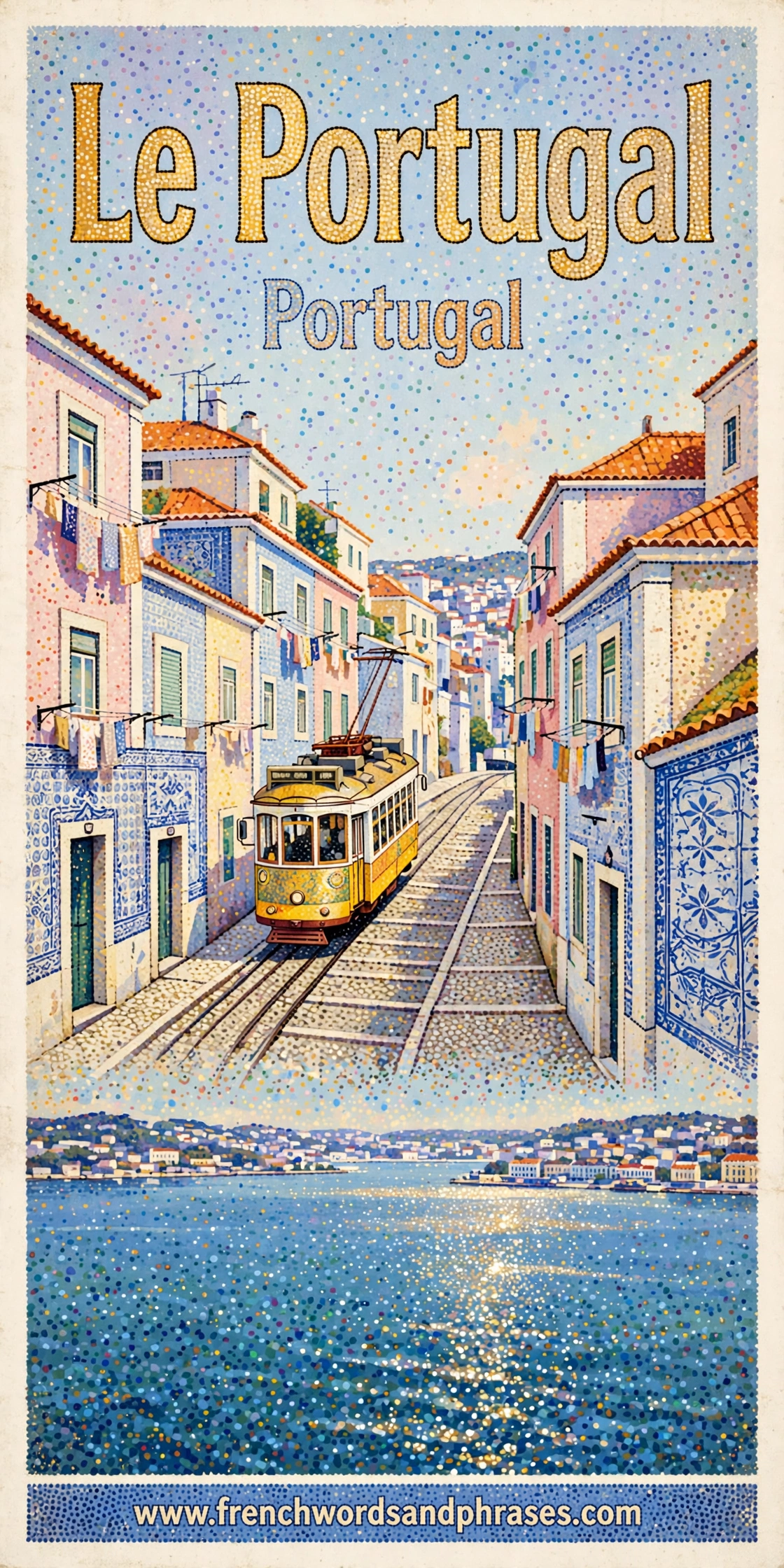
Tiles, trams and the Atlantic wind at the edge of Europe: le Portugal, Portugal — Spain’s western neighbour, a small country with a world-sized history of ships and discovery.
In this guide, you’ll learn what Portugal means in English, how to use it with its articles, how to form its plural, and how it appears in everyday French. Explore French examples, English translations, and practice quizzes.
Understanding the French Noun Portugal
Portugal is a masculine proper noun, learned with its article: le Portugal. Masculine countries take au for in/to and du for from: au Portugal, du Portugal. The name comes from Portus Cale, the Roman port at the mouth of the Douro — the city French calls Porto, which also gave its name to the famous wine, le porto.
It means Portugal — the long, narrow country on the Atlantic edge of the Iberian Peninsula, with Lisbonne, Lisbon, as its capital. Its people are les Portugais and les Portugaises, its language le portugais, carried by Portuguese sailors to Brazil, Africa and Asia. France knows Portugal well at home, too: the Portuguese are one of the largest communities in France, and many a French town has its boulangerie and its café portugais.
Gender: Masculine — le Portugal
Definite article: le — le Portugal (Portugal)
Saying in / to: au — au Portugal
Saying from: du — venir du Portugal
Capital: Lisbonne
The people: les Portugais, les Portugaises
English equivalents: Portugal.
Portugal behaves like Canada: au Portugal, du Portugal, and le Portugal as subject or object. Do not let the -al ending fool you into a feminine guess — the article is le, and the preposition is au. Its capital keeps its French name: Lisbon is Lisbonne, and its yellow trams climb streets as steep as any in Europe.
Experience the Word
Portugal is Europe’s Atlantic balcony: a country that spent centuries looking outward, over the ocean, and sent its language around the world.
Imagine Lisbon at golden hour — the tram rattling up to the castle, laundry over the alley, the Tagus glittering below, and the smell of grilled sardines rising from a courtyard: le Portugal in one evening.
You have not just named a country. You have named the sailors’ nation — le Portugal, Portugal, at the edge of the ocean.
How to Use Portugal in French: Complete Guide
Let’s explore how Portugal works in French, beginning with its article and prepositions — le Portugal, au Portugal, du Portugal.
Portugal with the Definite Article (Le)
As subject or object, Portugal keeps his article: le Portugal.
| Form | French |
|---|---|
| The country | le Portugal |
| The north of Portugal | le nord du Portugal |
| All of Portugal | tout le Portugal |
Example
Le Portugal est un pays d’Europe du Sud.
Portugal is a country in southern Europe.
Saying In, To and From: Au Portugal, Du Portugal
Masculine countries take au for in/to and du for from.
| Meaning | French |
|---|---|
| in Portugal, to Portugal | au Portugal |
| from Portugal | du Portugal |
| across Portugal | dans tout le Portugal |
| to the capital | à Lisbonne |
Example
Ils passent l’été au Portugal.
They spend the summer in Portugal.
The People of Portugal: Les Portugais
The inhabitants take a capital letter — and portugais, small p, is the language and the adjective.
| Person | French |
|---|---|
| a Portuguese man | un Portugais |
| a Portuguese woman | une Portugaise |
| Portuguese men / the Portuguese | les Portugais |
| Portuguese women | les Portugaises |
Example
Les Portugais aiment la mer et le poisson grillé.
The Portuguese love the sea and grilled fish.
Quick Quiz 1
Complete the sentence:
Ils passent l’été ______ Portugal. (in)
Reveal the answer
au
Ils passent l’été au Portugal.
They spend the summer in Portugal — masculine countries take au.
The Language and the Adjective: Portugais
Portugais is a world language thanks to Brazil — and an adjective that agrees like any other.
| Use | French |
|---|---|
| the language | le portugais |
| masculine adjective | un vin portugais |
| feminine adjective | une ville portugaise |
| to speak Portuguese | parler portugais |
Example
Le portugais est parlé au Brésil aussi.
Portuguese is spoken in Brazil too.
Portugal at a Glance
The facts every beginner meets first — capital, currency, language.
| Point | Portugal |
|---|---|
| Capital | Lisbonne |
| Currency | l’euro |
| Language | le portugais |
| Ocean | l’océan Atlantique |
| Famous wine | le porto — from Porto |
Example
Lisbonne est la capitale du Portugal.
Lisbon is the capital of Portugal.
Quick Quiz 2
What is the capital of Portugal?
Reveal the answer
Lisbonne
Lisbonne est la capitale du Portugal.
Lisbon is the capital of Portugal.
Portugal and Its Neighbour
Portugal has a single land neighbour — Spain, all along its eastern side.
| Direction | French |
|---|---|
| to the east | l’Espagne |
| to the west | l’océan Atlantique |
| to the north | la Galice (Espagne) |
| the islands | les Açores et Madère |
Example
L’Espagne est à l’est du Portugal.
Spain is east of Portugal.
Portugal with Adjectives
Adjectives agree with Portugal — masculine singular: le Portugal entier, the whole of Portugal.
| Adjective | With Portugal |
|---|---|
| entier (whole) | le Portugal entier |
| beau (beautiful) | le beau Portugal |
| ensoleillé (sunny) | le Portugal ensoleillé |
| ancien (old) | le vieux Portugal des marins |
Example
Le Portugal entier aime le football.
The whole of Portugal loves football.
Quick Quiz 3
Complete the sentence:
C’est une ville ______ au bord de la mer. (Portuguese)
Reveal the answer
portugaise
C’est une ville portugaise au bord de la mer.
It’s a Portuguese town by the sea — portugaise, feminine, to agree with ville.
Everyday Expressions with Portugal
Trams, tiles and sardines — the Portugal phrases of daily life.
| Expression | In English |
|---|---|
| au Portugal | in Portugal |
| du Portugal | from Portugal; Portuguese (of origin) |
| un tramway de Lisbonne | a Lisbon tram |
| les sardines grillées | grilled sardines — the summer dish |
| le porto | port wine, from the city of Porto |
Example
Un verre de porto vient du Portugal.
A glass of port comes from Portugal.
Words from the Same Family as Portugal
Portuguese and Portugal — the words that travel with Portugal.
| French | In English |
|---|---|
| portugais | Portuguese — the language and the adjective |
| un Portugais | a Portuguese man |
| Lisbonne | Lisbon — the capital |
| lusophone | Portuguese-speaking |
| le porto | port wine |
Example
Le Brésil est un pays lusophone immense.
Brazil is an immense Portuguese-speaking country.
Quick Quiz 4
What is le porto?
Reveal the answer
Port wine — the famous wine of Porto, the city that also named the country.
On sert le porto en apéritif ou en dessert.
Port is served as an aperitif or with dessert.
Portugal in Everyday French: Real-Life Examples
Now that you know the word, let’s see how Portugal appears in everyday French.
Example 1 — Holidays
Ils passent l’été au Portugal.
They spend the summer in Portugal.
Example 2 — Language
Elle parle portugais avec sa grand-mère.
She speaks Portuguese with her grandmother.
Example 3 — Geography
Le Portugal est à l’ouest de l’Espagne.
Portugal is west of Spain.
Example 4 — Food
Les sardines grillées sont un plat du Portugal.
Grilled sardines are a dish from Portugal.
Example 5 — Wine
Ce porto vient du Portugal.
This port comes from Portugal.
Example 6 — Travel
Le train pour Lisbonne traverse le Portugal.
The train to Lisbon crosses Portugal.
Beyond Translation: The Meaning of Portugal
Portugal is the small country that drew the first modern map of the world: from its Atlantic ports, caravels reached India, Brazil and Japan, and the Portuguese language settled on four continents. France meets Portugal twice — abroad, in Lisbon’s tiled streets, and at home, where the Portuguese community is one of the largest in the country, woven into French towns for two generations. Even the country’s name is a harbour: Portus Cale, the warm port.
To say Portugal is to stand on Europe’s Atlantic doorstep.
It evokes yellow trams, blue tiles and grilled sardines — Portugal, the sailors’ country at the continent’s edge.
How to Remember the French Noun Portugal
Remember it this way: Portugal is masculine: le Portugal — au Portugal for in/to, du Portugal for from.
- Masculine with his article — le Portugal as subject: le Portugal est petit mais célèbre.
- The prepositions — au Portugal (in, to), du Portugal (from).
- The capital’s French name — Lisbon is Lisbonne.
The key idea is le Portugal — Portugal, masculine; au Portugal, du Portugal.
Test Your Knowledge of Portugal
Let’s see how much you’ve learned. Try answering these questions before revealing the answers.
Question 1
Is Portugal masculine or feminine in French?
Reveal the answer
Masculine — le Portugal.
Question 2
How do you say in Portugal?
Reveal the answer
Au Portugal — masculine countries take au.
Question 3
Translate: They spend the summer in Portugal.
Reveal the answer
Ils passent l’été au Portugal.
Question 4
What is the French name of Lisbon?
Reveal the answer
Lisbonne.
Question 5
Complete the sentence:
______ Portugal est à l’ouest de l’Espagne. (the)
Reveal the answer
Le
Le Portugal est à l’ouest de l’Espagne.
Portugal is west of Spain.
Your Final Challenge
Can You Use It?
How would you say this in French?
“They spend the summer in Portugal.”
Reveal the answer
Ils passent l’été au Portugal.
They spend the summer in Portugal.
A little French. A little curiosity. A richer everyday life.
LEARN FRENCH ONE WORD AT A TIME