A French Word to Live By
Translate Mensonge to English
/mɑ̃.sɔ̃ʒ/
Le mensonge means a lie.
The broken vase swept under the rug, the homework eaten by an imaginary dog: le mensonge, the lie — the story told to hide the truth, and one of the first moral words every French child learns.
In this guide, you’ll learn what mensonge means in English, how to use it with its articles, how to form its plural, and how it appears in everyday French. Explore French examples, English translations, and practice quizzes.
Understanding the French Noun Mensonge
Mensonge is a masculine French noun, learned with its article: le mensonge, un mensonge. Its verb is mentir, to lie, and the person is un menteur, a liar. French grades its lies: un gros mensonge, a big lie, and the forgiven one, un pieux mensonge, a white lie — literally a pious lie.
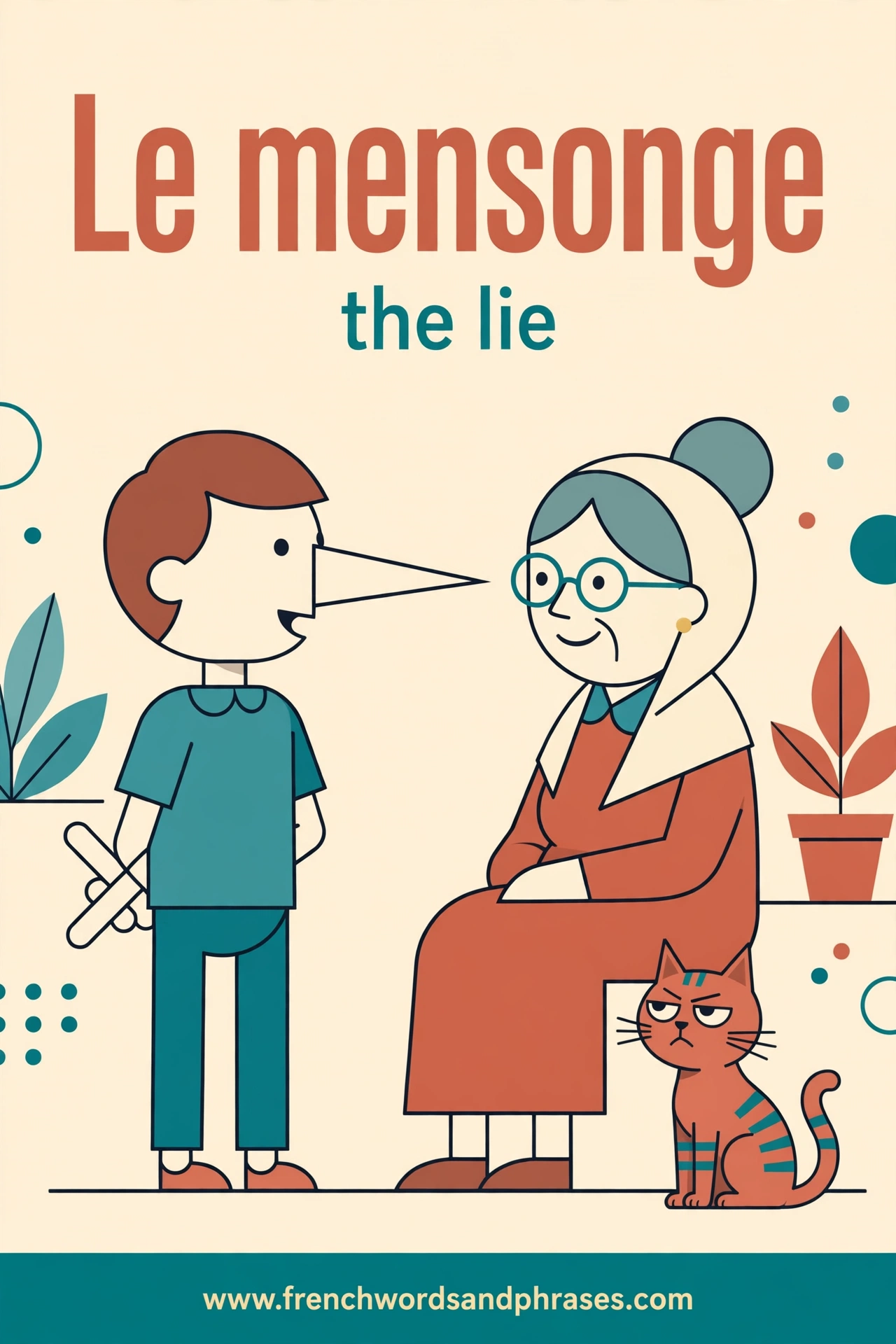
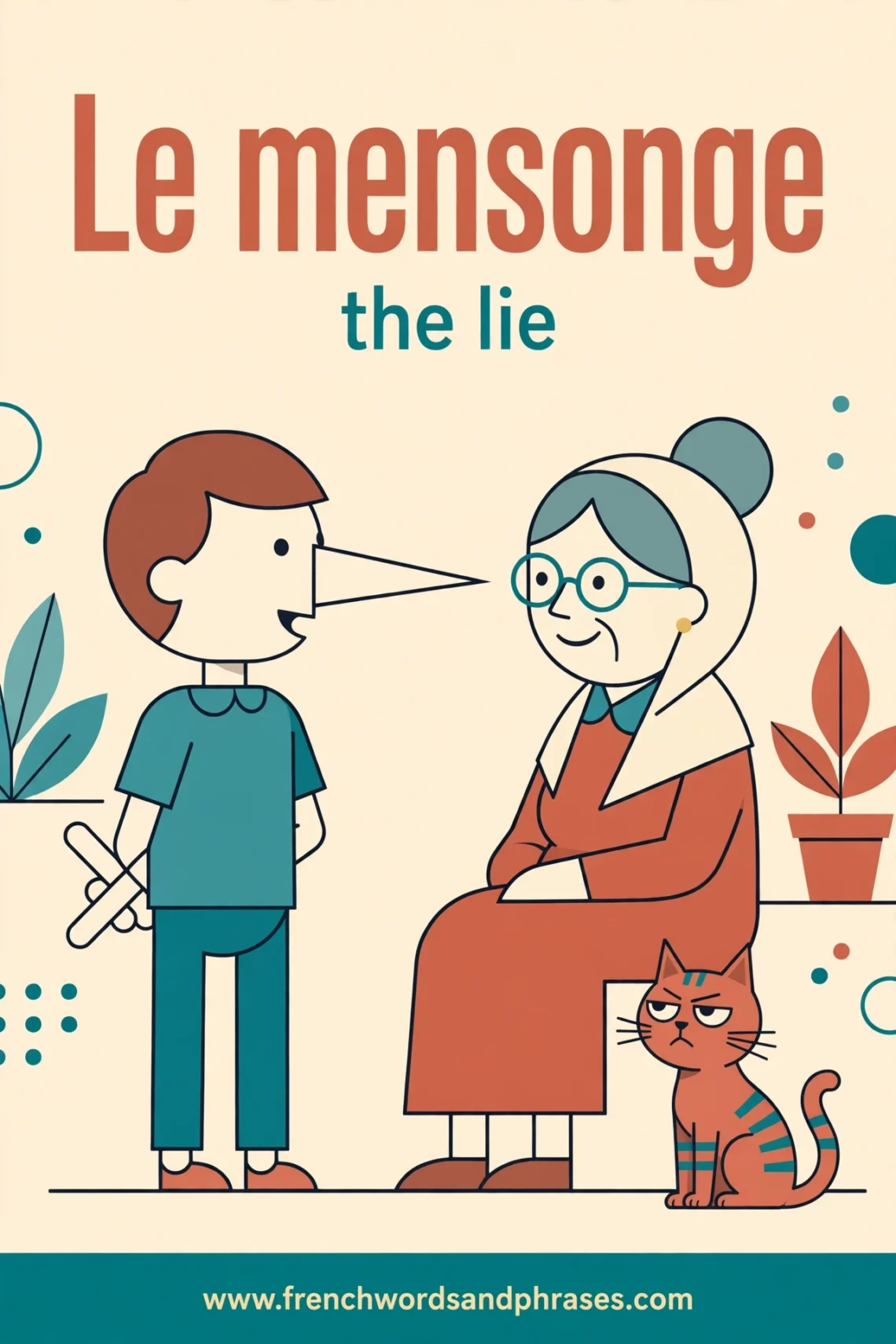
It means a lie — a statement made to deceive: dire un mensonge, to tell a lie, un mensonge éhonté, a barefaced lie, vivre dans le mensonge, to live a lie. Politics has le mensonge d’État, the state lie; children have the detector’s dream, and Pinocchio — whose nose, in French too, grows with every mensonge. The opposite is la vérité, the truth.
Gender: Masculine — le mensonge
Definite article: le — le mensonge (the lie)
Indefinite article: un — un mensonge (a lie)
Plural: les mensonges — regular, with a simple -s
Spelling note: the silent g softens the ending: mensonge rhymes with songe, a dream
The kind lie: un pieux mensonge — a white lie, literally a pious lie
English equivalents: A lie, an untruth.
The verb phrase is dire un mensonge — French tells a lie as English does. Size and shame are graded with adjectives: un petit mensonge, a small lie, un gros mensonge, a whopper, un mensonge éhonté, a barefaced lie. And the kind one has its own name: un pieux mensonge spares feelings — the compliment on the terrible hat.
Experience the Word
Mensonge is the truth’s shadow — a story built to stand exactly where the truth should be, and shaped exactly like it.
Imagine the classroom at nine o’clock: thirty children, one missing homework, and one story about a dog, a flood and a lost bag, all before breakfast. The teacher listens, eyebrows rising like theatre curtains: « Quel mensonge ! » The class giggles — everyone has told one; everyone knows the word.
You have not just named a falsehood. You have named the invention that replaces the truth — le mensonge, the lie, big, small or pious.
How to Use Mensonge in French: Complete Guide
Let’s explore how mensonge works in French, beginning with its articles — le mensonge, un mensonge, un pieux mensonge.
Mensonge with the Definite Article (Le, Les)
Used for a specific lie — the one discovered, the one repeated.
| Form | French |
|---|---|
| Masculine singular | le mensonge |
| Plural | les mensonges |
Example
Le mensonge a été découvert le lendemain.
The lie was discovered the next day.
Mensonge with the Indefinite Article (Un, Des)
Used for a lie in general — any invention told to deceive.
| Form | French |
|---|---|
| Masculine singular | un mensonge |
| Plural | des mensonges |
Example
C’est un mensonge, je n’ai jamais dit cela.
That’s a lie, I never said that.
Mensonge with Sizes and Kinds (Petit, Gros, Pieux…)
French grades its lies — by size, by shame, and by kindness.
| Kind | French |
|---|---|
| a small lie | un petit mensonge |
| a big lie | un gros mensonge |
| a white lie | un pieux mensonge |
| a barefaced lie | un mensonge éhonté |
| a web of lies | un tissu de mensonges |
Example
Elle lui a dit un pieux mensonge pour ne pas le blesser.
She told him a white lie so as not to hurt him.
Quick Quiz 1
Complete the sentence:
______ mensonge était facile à découvrir. (the)
Reveal the answer
Le
Le mensonge était facile à découvrir.
The lie was easy to uncover — mensonge is masculine, so le.
The Plural of Mensonge
Mensonge takes a regular plural in -s — lies, alas, multiply easily.
| Number | French |
|---|---|
| Singular | le mensonge |
| Plural | les mensonges |
Example
Ses mensonges ont fini par le perdre.
His lies ended up ruining him.
Mensonge with Possessive Adjectives (Mon, Ton, Son…)
Possessives agree with the noun: mensonge is masculine, so mon, ton, son in the singular.
| Owner | French |
|---|---|
| my | mon mensonge |
| your (tu) | ton mensonge |
| his / her | son mensonge |
| our | notre mensonge |
| your (vous) | votre mensonge |
| their | leur mensonge |
Example
Son mensonge n’a trompé personne.
His lie fooled nobody.
Quick Quiz 2
Complete the sentence:
Je regrette ______ mensonge de ce matin. (my)
Reveal the answer
mon
Je regrette mon mensonge de ce matin.
I regret my lie of this morning — mon, because mensonge is masculine.
Mensonge with Demonstrative Adjectives (Ce, Ces)
Used to point: ce mensonge, this lie — the one on the table, undeniable.
| Form | French |
|---|---|
| Masculine singular | ce mensonge |
| Plural | ces mensonges |
Example
Ce mensonge a brisé leur amitié.
This lie broke their friendship.
Mensonge with Adjectives
Adjectives agree with mensonge — masculine singular: un gros mensonge, un mensonge éhonté.
| Adjective | With Mensonge |
|---|---|
| gros (big) | un gros mensonge |
| petit (small) | un petit mensonge |
| pieux (white, pious) | un pieux mensonge |
| éhonté (barefaced) | un mensonge éhonté |
| énorme (enormous) | un énorme mensonge |
Example
Un mensonge éhonté, dit devant tout le monde !
A barefaced lie, told in front of everyone!
Quick Quiz 3
Complete the sentence:
C’était un ______ mensonge, personne ne l’a cru. (big)
Reveal the answer
gros
C’était un gros mensonge, personne ne l’a cru.
It was a big lie, nobody believed it — gros stands before the masculine noun.
Everyday Expressions with Mensonge
Playgrounds, politics and Pinocchio — the mensonge phrases of daily life.
| Expression | In English |
|---|---|
| dire un mensonge | to tell a lie |
| un pieux mensonge | a white lie |
| un tissu de mensonges | a web of lies |
| vivre dans le mensonge | to live a lie |
| le mensonge d’État | the state lie, official deception |
Example
Son histoire n’est qu’un tissu de mensonges.
His story is nothing but a web of lies.
Words from the Same Family as Mensonge
Truth and invention — the words that travel with mensonge.
| French | In English |
|---|---|
| mentir | to lie (the verb) |
| un menteur | a liar |
| la vérité | the truth — the opposite |
| un songe | a dream — the rhyming cousin |
| tromper | to deceive, to cheat |
Example
Il ment comme il respire, dit sa grand-mère.
He lies as he breathes, says his grandmother.
Quick Quiz 4
What is un pieux mensonge?
Reveal the answer
A white lie — literally a pious lie, told to spare someone’s feelings.
Elle lui a dit un pieux mensonge sur sa coiffure.
She told him a white lie about his haircut.
Mensonge in Everyday French: Real-Life Examples
Now that you know the word, let’s see how mensonge appears in everyday French.
Example 1 — The playground
C’est un mensonge, je l’ai vu de mes yeux !
That’s a lie, I saw it with my own eyes!
Example 2 — Kindness
Un pieux mensonge vaut mieux qu’une vérité qui blesse.
A white lie is better than a truth that wounds.
Example 3 — Politics
Les électeurs ne pardonnent pas le mensonge.
Voters do not forgive lying.
Example 4 — Family
Les enfants apprennent tôt que le mensonge se découvre toujours.
Children learn early that lies are always found out.
Example 5 — Regret
Il a avoué son mensonge et demandé pardon.
He confessed his lie and asked forgiveness.
Example 6 — Stories
Pinocchio voit son nez grandir à chaque mensonge.
Pinocchio sees his nose grow with every lie.
Beyond Translation: The Meaning of Mensonge
Mensonge is built from mentir, to lie, with an ending that makes it rhyme with songe, a dream — and the resemblance is a small philosophy: a lie is a dream told awake, a story that asks to be believed. French moral teaching seized the word early: the pieux mensonge, the pious white lie, has been debated by priests and philosophers for centuries — the one lie told for love.
To say mensonge is to judge a story, not just to describe it.
It evokes the growing nose, the crossed fingers and the caught-out child — falsehood, in its most human form.
How to Remember the French Noun Mensonge
Remember it this way: Mensonge is the lie — masculine: le mensonge, un mensonge. And the kind one is un pieux mensonge.
- Always masculine — le mensonge, un mensonge, mon mensonge.
- The phrase — dire un mensonge, to tell a lie; the verb is mentir.
- The kind lie — un pieux mensonge, a white lie.
The key idea is le mensonge — a lie, masculine; un pieux mensonge = a white lie.
Test Your Knowledge of Mensonge
Let’s see how much you’ve learned. Try answering these questions before revealing the answers.
Question 1
Is mensonge masculine or feminine?
Reveal the answer
Masculine — le mensonge, un mensonge.
Question 2
How do you say to tell a lie?
Reveal the answer
Dire un mensonge.
Question 3
Translate: That’s a big lie!
Reveal the answer
C’est un gros mensonge !
Question 4
What is the verb of the same family as mensonge?
Reveal the answer
Mentir — to lie; the person is un menteur, a liar.
Question 5
Complete the sentence:
______ mensonges finissent toujours par se découvrir. (the)
Reveal the answer
Les
Les mensonges finissent toujours par se découvrir.
Lies always end up being found out.
Your Final Challenge
Can You Use It?
How would you say this in French?
“A white lie is better than a truth that wounds.”
Reveal the answer
Un pieux mensonge vaut mieux qu’une vérité qui blesse.
A white lie is better than a truth that wounds.
A little French. A little curiosity. A richer everyday life.
LEARN FRENCH ONE WORD AT A TIME