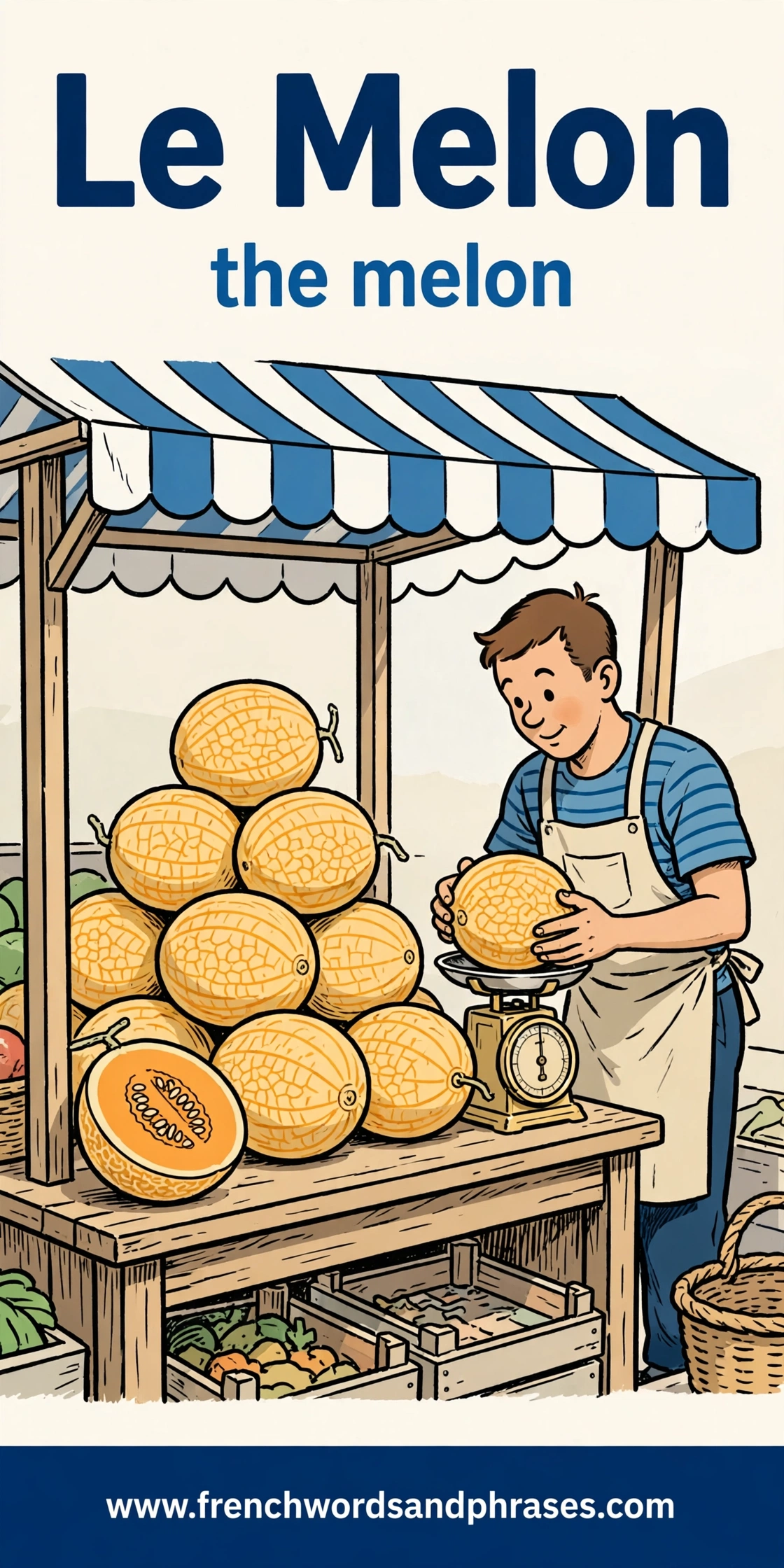
A French Word to Live By
Translate Melon to English
/mə.lɔ̃/
Le melon means the melon.
July on a market stall in Provence: the stallholder taps a green-striped melon, lifts it to his ear, sniffs the stalk end and announces, « Celui-ci est prêt ! » Everyone at the stall is waiting for the same verdict — is le melon ripe?
In this guide, you’ll learn what melon means in English, how to use it with its articles, how to form its plural, and how it appears in everyday French. Explore French examples, English translations, and practice quizzes.
Understanding the French Noun Melon
Melon is a masculine French noun, learned with its article: le melon, un melon. It names the round summer fruit with sweet orange or green flesh — and, in a second life, the bowler hat, because of its round shape.
It means the melon — the fruit you slice for a summer starter, often served with cured ham. The plural is completely regular: les melons. Watch for the second sense: un chapeau melon is a bowler hat, named after the fruit it resembles.
Gender: Masculine
Definite article: le — le melon (the melon)
Indefinite article: un — un melon (a melon)
Plural: les melons
Second sense: un chapeau melon — a bowler hat
Famous phrase: avoir le melon — to be big-headed, full of oneself
One important usage detail: to say a melon is ripe, French uses mûr or à point — ce melon est à point. And when someone has grown too proud of themselves, French says il a le melon — his head has swollen to melon size.
Experience the Word
Melon is the taste of a French summer. It opens the meal, cut in half and eaten with a spoon, or sliced thin beside le jambon cru (cured ham) — the sweet-and-salty pairing that every French family knows.
Choosing one is a small ceremony. The French tap it, weigh it in the hand — il doit être lourd, it must feel heavy — and smell the stalk end. A good melon from Cavaillon or Charentes carries its perfume before you ever cut it open.
And then the word escapes the fruit bowl. A bowler hat is un melon, and a swollen ego is le melon too: the round shape follows the word everywhere it goes.
How to Use Melon in French: Complete Guide
Let’s explore how melon works in French, beginning with its articles — the word itself never changes, only the little word in front of it.
Melon with the Definite Article (Le, Les)
The noun never changes; the article does the work.
| Form | French |
|---|---|
| Singular | le melon |
| Plural | les melons |
Example
Le melon est sur la table, prêt à être coupé.
The melon is on the table, ready to be cut.
Melon with the Indefinite Article (Un, Des)
Use un for one melon, des for melons in general.
| Form | French |
|---|---|
| Singular | un melon |
| Plural | des melons |
Example
Elle a acheté un melon au marché ce matin.
She bought a melon at the market this morning.
Melon in Quantities and Partitives
Melon takes the partitive du when you eat some of it, and de after quantities.
| Expression | French |
|---|---|
| some melon | du melon |
| a slice of melon | une tranche de melon |
| a lot of melons | beaucoup de melons |
| no melon | pas de melon |
Example
Tu veux du melon en entrée ?
Would you like some melon as a starter?
Quick Quiz 1
Complete the sentence:
Je voudrais ______ tranche de melon, s’il vous plaît. (a slice)
Reveal the answer
une
Je voudrais une tranche de melon, s’il vous plaît.
I would like a slice of melon, please — une, because tranche is feminine.
The Plural of Melon
Melon adds a simple -s in the plural.
| Number | French |
|---|---|
| Singular | le melon |
| Plural | les melons |
Example
Les melons de Cavaillon sont célèbres dans toute la France.
The melons of Cavaillon are famous throughout France.
Melon with Possessive Adjectives (Mon, Ton, Son…)
Melon is masculine, so the singular possessives are mon, ton, son.
| Owner | French |
|---|---|
| my | mon melon |
| your (tu) | ton melon |
| his / her | son melon |
| our | notre melon |
| your (vous) | votre melon |
| their | leur melon |
Example
Mon melon est mûr, on peut le manger ce soir.
My melon is ripe, we can eat it this evening.
Quick Quiz 2
Complete the sentence:
______ melon est trop vert, il faut attendre. (my)
Reveal the answer
Mon
Mon melon est trop vert, il faut attendre.
My melon is too unripe, we must wait — mon, because melon is masculine.
Melon with Demonstrative Adjectives (Ce, Ces)
Ce points to one melon, ces to several.
| Form | French |
|---|---|
| Singular | ce melon |
| Plural | ces melons |
Example
Ce melon sent très bon, prenons-le !
This melon smells wonderful, let’s take it!
Melon with Adjectives
Adjectives agree: masculine singular with melon, and most come after the noun.
| Adjective | With Melon |
|---|---|
| gros (big) | un gros melon |
| mûr (ripe) | un melon mûr |
| sucré (sweet) | un melon sucré |
| vert (unripe/green) | un melon vert |
Example
Un melon bien mûr parfume toute la cuisine.
A really ripe melon perfumes the whole kitchen.
Quick Quiz 3
True or false?
« Avoir le melon » means to be very thirsty on a hot day.
Reveal the answer
False
Avoir le melon means to be big-headed — to have a swollen opinion of yourself, as if your head were a melon.
Everyday Expressions with Melon
Melon appears in several lively everyday expressions.
| Expression | In English |
|---|---|
| avoir le melon | to be big-headed, full of oneself |
| un chapeau melon | a bowler hat |
| le melon de Cavaillon | the Cavaillon melon, a prized variety |
| un melon bien mûr | a perfectly ripe melon |
Example
Depuis sa promotion, il a un peu le melon.
Since his promotion, he has become a bit big-headed.
Words from the Same Family as Melon
Words that live in the same orchard as melon.
| French | In English |
|---|---|
| le cantaloup | the cantaloupe |
| la pastèque | the watermelon |
| la tranche | the slice |
Example
La pastèque est le fruit préféré des enfants en été.
Watermelon is the children’s favourite fruit in summer.
Quick Quiz 4
Complete the sentence:
Il porte un chapeau ______ pour aller au bureau. (bowler)
Reveal the answer
melon
Il porte un chapeau melon pour aller au bureau.
He wears a bowler hat to the office — the hat is named after the round fruit.
Melon in Everyday French: Real-Life Examples
Now that you know the word, let’s see how melon appears in everyday French.
Example 1 — At the market
Ce melon est-il bien mûr ?
Is this melon nice and ripe?
Example 2 — At lunch
On commence par du melon et du jambon cru.
We’re starting with melon and cured ham.
Example 3 — In the kitchen
Coupe le melon en deux et enlève les graines.
Cut the melon in half and remove the seeds.
Example 4 — At the greengrocer’s
Je voudrais un melon bien lourd, s’il vous plaît.
I would like a nice heavy melon, please.
Example 5 — Teasing a friend
Attention, tu vas attraper le melon !
Careful, you’re getting big-headed!
Example 6 — At dessert
Il reste une tranche de melon pour toi.
There is one slice of melon left for you.
Beyond Translation: The Meaning of Melon
The melon holds a proud place in French summer life: the melons of Cavaillon, in Provence, are so prized that the town celebrates them with a festival, and Alexandre Dumas — who adored them — is said to have exchanged his complete works with the town library for a yearly supply of melons. The word then slips off the plate: onto the head as a bowler hat, and into the character as a symbol of pride. Few fruits carry so much.
How to Remember the French Noun Melon
Remember it this way: Melon is the round summer fruit — and everything round or swollen borrows its name: the bowler hat, the big head of someone too proud.
- You see the fruit — le melon, sweet, orange and ripe.
- You see the hat — un chapeau melon, round like the fruit.
- You see the ego — il a le melon, his head has swollen like one.
The key idea is le melon — the fruit, the hat, the swollen head.
Test Your Knowledge of Melon
Let’s see how much you’ve learned. Try answering these questions before revealing the answers.
Question 1
Is melon masculine or feminine?
Reveal the answer
Masculine — le melon, un melon.
Question 2
How do you say ‘some melon’?
Reveal the answer
Du melon — the partitive for a portion of the fruit.
Question 3
What is the plural of melon?
Reveal the answer
Les melons — a simple added -s.
Question 4
What does « avoir le melon » mean?
Reveal the answer
To be big-headed — to think too much of yourself.
Question 5
What is « un chapeau melon »?
Reveal the answer
A bowler hat — named for its round, melon-like shape.
Your Final Challenge
Can You Use It?
How would you say this in French?
“The melon is ripe and sweet.”
Reveal the answer
Le melon est mûr et sucré.
The melon is ripe and sweet.
A little French. A little curiosity. A richer everyday life.
LEARN FRENCH ONE WORD AT A TIME