A French Word to Live By
Translate Artichaut to English
/aʁ.ti.ʃo/
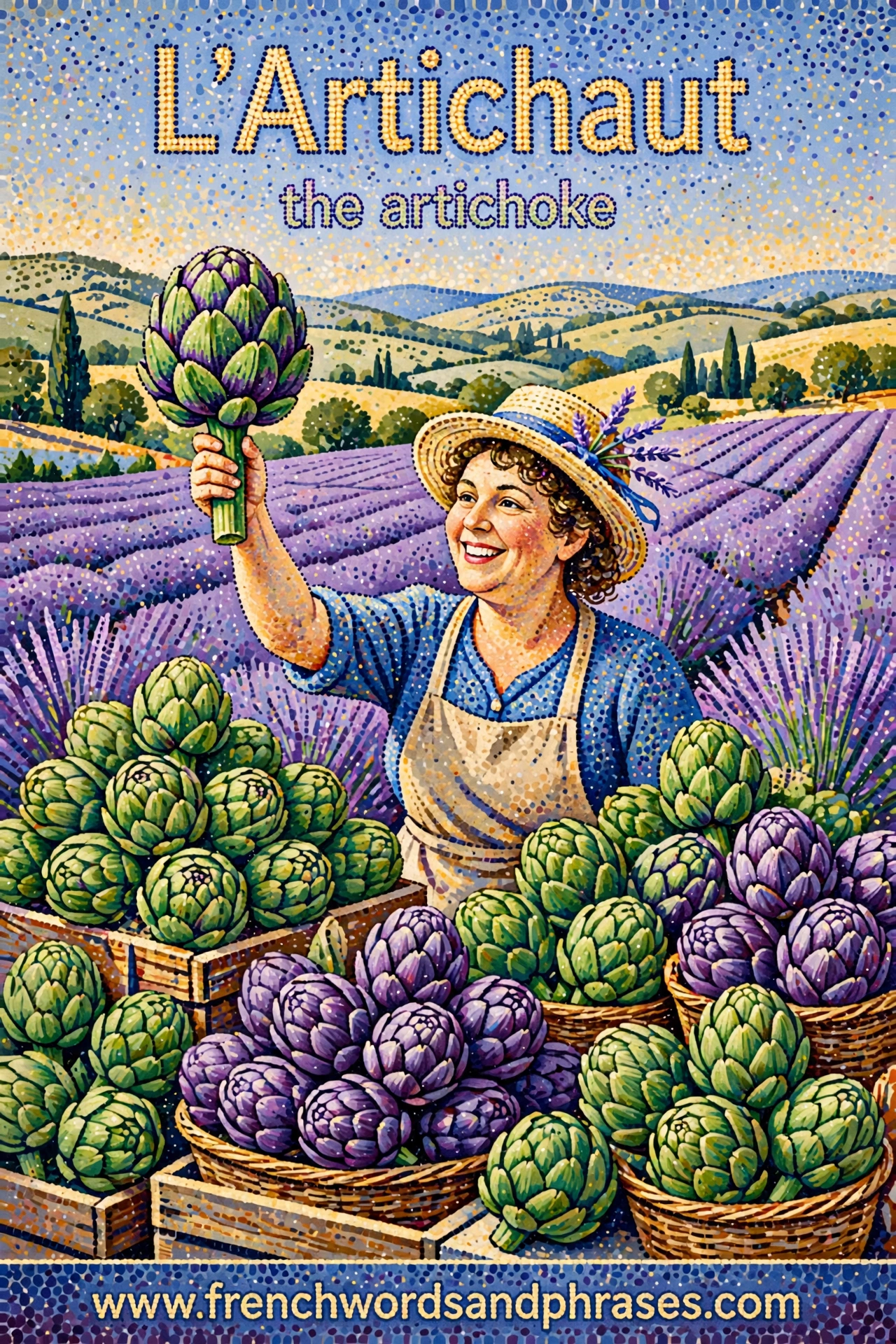
L’Artichaut means the artichoke.
At the market in Provence, the stall is a green fortress of artichokes — big Breton globes on one side, small violet ones on the other. The seller snaps a leaf, tastes, and nods: « Ils sont tendres aujourd’hui. » The king of patient vegetables: l’artichaut.
In this guide, you’ll learn what artichaut means in English, how to use it with its articles, how to form its plural, and how it appears in everyday French. Explore French examples, English translations, and practice quizzes.
Understanding the French Noun Artichaut
Artichaut is a masculine French noun, learned with its article: l’artichaut, un artichaut. It is the artichoke, the great green thistle-flower eaten leaf by leaf. Its heart gives French one of its most charming judgements: avoir un cœur d’artichaut — to have an artichoke heart — is to fall in love easily and often, handing out a leaf to everyone.
It means the artichoke — the vegetable you eat slowly: the base of each leaf, then the tender heart (le cœur, also called le fond) once the hairy choke (le foin, la barbe) is removed. Brittany grows the big globe artichauts; the small purple poivrades of the south are eaten raw with salt. Few vegetables take so long to eat, and French loves it for exactly that reason.
Gender: Masculine — l’artichaut, un artichaut
Definite article: l’ — l’artichaut (the artichoke)
Indefinite article: un — un artichaut (an artichoke)
Plural: les artichauts
Famous phrase: un cœur d’artichaut — a heart that falls in love easily
English equivalents: The artichoke
One important usage detail: the parts have names. The heart you prize is le cœur d’artichaut or le fond d’artichaut; the inedible hairy centre is le foin (the hay) or la barbe. And the topinambour, the Jerusalem artichoke, is not an artichoke at all — it is a sunflower tuber that borrowed the name.
Experience the Word
Artichaut is the vegetable of long lunches. Eating one cannot be hurried: leaf by leaf, dipped in vinaigrette, the conversation has time to happen before the heart appears — the reward at the centre. French patience, served on a plate.
And its heart became a metaphor of tenderness: un cœur d’artichaut loves quickly, generously, leaf after leaf — an insult so gentle it sounds like a compliment, usually said of a charming uncle or a romantic teenager.
You have not just learned a vegetable. You have learned the slowest pleasure of the French table — and its tenderest heart.
How to Use Artichaut in French: Complete Guide
Let’s explore how artichaut works in French, beginning with its articles — l’ before the vowel — then leaf by leaf to the heart.
Artichaut with the Definite Article (L’, Les)
Artichaut starts with a vowel, so the article becomes l’.
| Form | French |
|---|---|
| Singular | l’artichaut |
| Plural | les artichauts |
Example
L’artichaut se mange feuille par feuille.
The artichoke is eaten leaf by leaf.
Artichaut with the Indefinite Article (Un, Des)
One artichoke, or a pile of them at the market.
| Form | French |
|---|---|
| Singular | un artichaut |
| Plural | des artichauts |
Example
Je voudrais un artichaut bien gros, s’il vous plaît.
I would like one really big artichoke, please.
Artichauts at the Market: Quantities
Bought by the dozen, eaten by the leaf — how French counts artichokes.
| French | In English |
|---|---|
| un artichaut | one artichoke |
| une douzaine d’artichauts | a dozen artichokes |
| un kilo d’artichauts | a kilo of artichokes |
| un cœur d’artichaut | an artichoke heart |
| des fonds d’artichauts | artichoke hearts, artichoke bottoms |
| un artichaut poivrade | a small purple artichoke, eaten raw |
Example
Une douzaine d’artichauts pour le déjeuner de dimanche.
A dozen artichokes for Sunday lunch.
Quick Quiz 1
Complete the sentence:
Je voudrais ______ artichaut bien tendre. (an)
Reveal the answer
un
Je voudrais un artichaut bien tendre.
Artichaut is masculine: un artichaut — though its definite article hides the gender: l’artichaut.
The Plural of Artichaut
Regular: add -s — les artichauts.
| Number | French |
|---|---|
| Singular | l’artichaut |
| Plural | les artichauts |
Example
Les artichauts de Bretagne sont énormes.
The artichokes from Brittany are enormous.
Artichaut with Possessive Adjectives (Mon, Ton, Son…)
Before a vowel, the possessives use the masculine-looking forms mon, ton, son — even for a feminine owner.
| Owner | French |
|---|---|
| my | mon artichaut |
| your (tu) | ton artichaut |
| his / her | son artichaut |
| our | notre artichaut |
| your (vous) | votre artichaut |
| their | leur artichaut |
Example
Elle garde son artichaut pour la fin du repas.
She keeps her artichoke for the end of the meal.
Quick Quiz 2
« Mon cousin a un cœur d’artichaut. » What is your cousin like in love?
Reveal the answer
He falls in love easily and often.
Un cœur d’artichaut gives a leaf to everyone — the tender image of a fickle, generous heart.
Artichaut with Demonstrative Adjectives (Cet, Ces)
Before a masculine noun starting with a vowel, ce becomes cet.
| Form | French |
|---|---|
| Masculine singular | cet artichaut |
| Plural | ces artichauts |
Example
Cet artichaut-là est pour toi, il est le plus gros.
That artichoke is for you, it is the biggest.
Artichaut with Adjectives
Size, freshness and colour — the market adjectives.
| Adjective | With Artichaut |
|---|---|
| gros (big) | un gros artichaut |
| frais (fresh) | un artichaut frais |
| violet (purple) | un artichaut violet |
| tendre (tender) | un artichaut tendre |
Example
Un artichaut violet se mange cru, avec du sel.
A purple artichoke is eaten raw, with salt.
Quick Quiz 3
What do you call the prized centre of the artichoke?
Reveal the answer
Le cœur — or le fond.
Le cœur d’artichaut, the heart, is the tender base you reach after the leaves; the hairy le foin above it is thrown away.
Everyday Expressions with Artichaut
One great expression of the heart, and the phrases of the table.
| Expression | In English |
|---|---|
| avoir un cœur d’artichaut | to fall in love easily and often |
| un cœur d’artichaut | a fickle, tender heart |
| des fonds d’artichauts | artichoke hearts (in salads, tins) |
| un artichaut à la barigoule | a Provençal braised artichoke dish |
| manger un artichaut feuille à feuille | to eat an artichoke leaf by leaf |
| l’artichaut de Jérusalem | the Jerusalem artichoke (= le topinambour) |
Example
À seize ans, il avait un cœur d’artichaut : un amour par mois.
At sixteen, he had an artichoke heart: one love per month.
Words from the Same Family as Artichaut
The heart, the leaf, and the cousins on the stall.
| French | In English |
|---|---|
| le cœur | the heart |
| la feuille | the leaf |
| le topinambour | the Jerusalem artichoke |
| la poivrade | the small raw-eating purple artichoke |
| le cardon | the cardoon, its cousin |
Example
On jette le foin et on garde le cœur, le meilleur morceau.
You throw away the choke and keep the heart, the best part.
Quick Quiz 4
How are the small purple poivrade artichokes eaten?
Reveal the answer
Raw, with salt.
Un artichaut poivrade is tender enough to eat uncooked — a spring delicacy of the south.
Artichaut in Everyday French: Real-Life Examples
Now that you know the word, let’s see how artichaut appears in everyday French.
Example 1 — At the market
Douze artichauts, s’il vous plaît, bien fermes.
Twelve artichokes, please, nice and firm.
Example 2 — At lunch
On commence par un artichaut vinaigrette, comme autrefois.
We start with an artichoke in vinaigrette, like in the old days.
Example 3 — Teasing an uncle
Ton oncle a un cœur d’artichaut, il tombe amoureux chaque été.
Your uncle has an artichoke heart, he falls in love every summer.
Example 4 — Cooking
Retire le foin avant de servir les cœurs d’artichauts.
Remove the choke before serving the artichoke hearts.
Example 5 — In Brittany
Les gros artichauts bretons sont les meilleurs pour farcir.
The big Breton artichokes are the best for stuffing.
Example 6 — A salad
J’ajoute des fonds d’artichauts à la salade composée.
I add artichoke hearts to the mixed salad.
Beyond Translation: The Meaning of Artichaut
The artichoke arrived in France with Catherine de Médicis and never left the throne of vegetables. It is a flower that never opened — a thistle bud — and eating it is a ritual of patience that French children learn at the family table: the leaf, the dip, the scrape of teeth, the growing pile of leaves, and at last the heart. No wonder its cœur became the metaphor for a heart that loves in the same way: leaf after leaf, generously, to everyone who passes.
Un cœur d’artichaut is the gentlest teasing in French — a heart with too many leaves to give.
Take your time with both: the vegetable and the word reward slowness.
How to Remember the French Noun Artichaut
Remember it this way: Artichaut is the vegetable with a heart — and a heart that gives away a leaf to everyone is un cœur d’artichaut, the person who falls in love every week.
- You work leaf by leaf — l’artichaut teaches patience at the table.
- You reach the centre — le cœur d’artichaut, the prize at the end.
- You tease the romantic — un cœur d’artichaut, in love again by Friday.
The key idea is l’artichaut — the vegetable with a heart for everyone.
Test Your Knowledge of Artichaut
Let’s see how much you’ve learned. Try answering these questions before revealing the answers.
Question 1
What does artichaut mean?
Reveal the answer
The artichoke — the green thistle-flower eaten leaf by leaf.
Question 2
Is artichaut masculine or feminine?
Reveal the answer
Masculine — l’artichaut, un artichaut; the article hides it as l’ before the vowel.
Question 3
What does « avoir un cœur d’artichaut » mean?
Reveal the answer
To fall in love easily and often — to give a leaf of your heart to everyone.
Question 4
What is le foin of the artichoke?
Reveal the answer
The hairy choke — the inedible centre you remove to reach the heart.
Question 5
Translate: He falls in love every week: he has an artichoke heart.
Reveal the answer
Il tombe amoureux chaque semaine : il a un cœur d’artichaut.
Your Final Challenge
Can You Use It?
How would you say this in French?
“He falls in love every week: he has an artichoke heart.”
Reveal the answer
Il tombe amoureux chaque semaine : il a un cœur d’artichaut.
He falls in love every week: he has an artichoke heart.
A little French. A little curiosity. A richer everyday life.
LEARN FRENCH ONE WORD AT A TIME