
A French Word to Live By
How to Conjugate Marteler in French
/maʁ.tə.le/
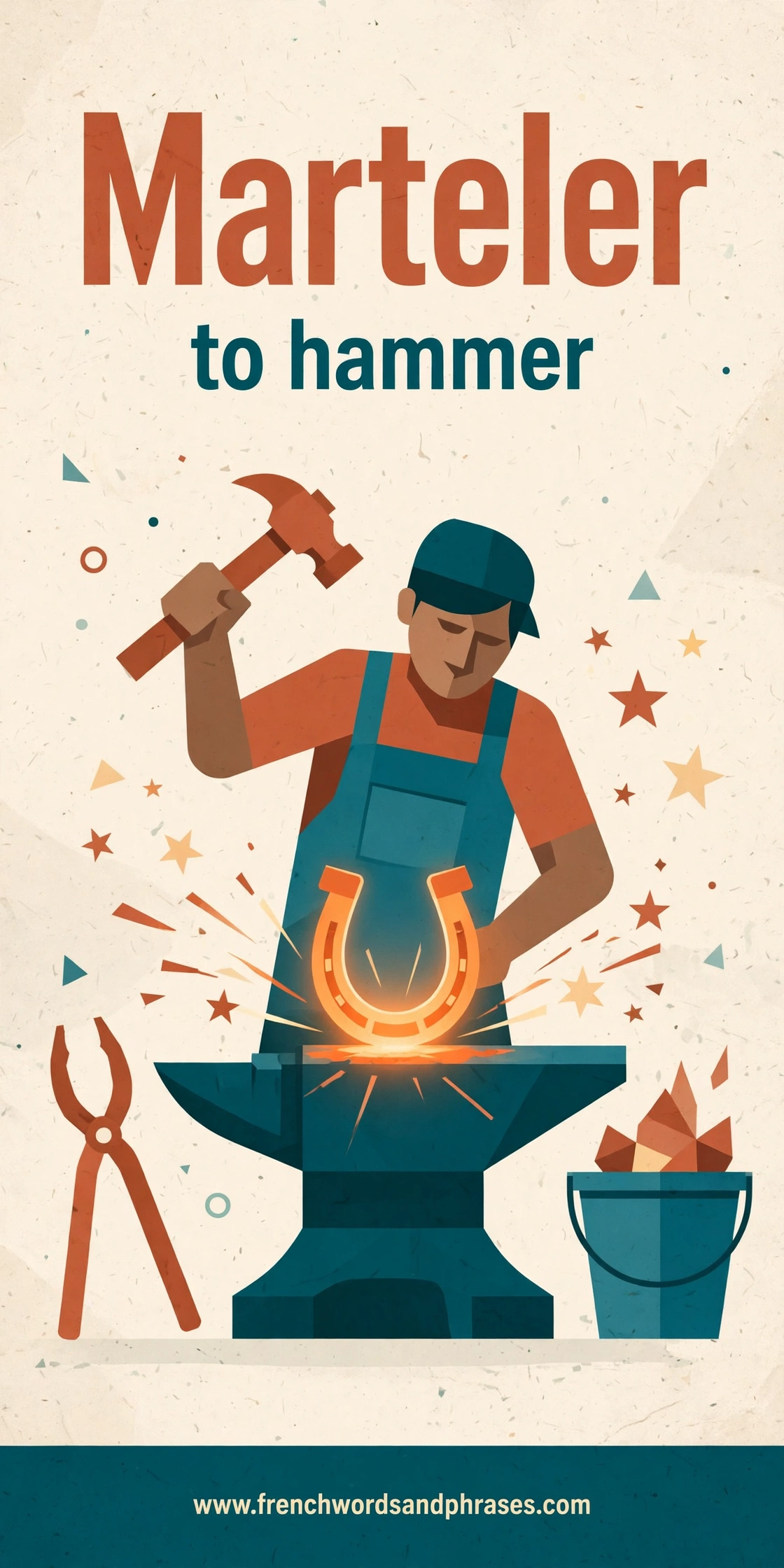
Marteler means to hammer.
A blacksmith’s arm rising and falling like a machine, a roofer fixing slates in the wind, a speaker drumming his message into a crowd — marteler is the verb of the repeated blow: hammering metal, roofs, and ideas alike.
In this guide, you’ll learn how to conjugate marteler in all the major French tenses and moods. Explore complete conjugation tables, French examples, English translations, and practice quizzes.
Understanding the French Verb Marteler
Marteler is a regular French verb belonging to the first group of verbs, those ending in -er.
It means to hammer. It is commonly used for smiths hammering iron and copper, for roofers and builders at work, for rain and hail hammering on roofs, and figuratively for speakers hammering home a word, a number or a slogan — marteler un message.
Verb classification: First group (-er)
Auxiliary verb: Avoir
Past participle: martelé
Present participle: martelant
English equivalents: To hammer, to pound; marteler un mot — to hammer home a word, stressing every syllable; marteler un slogan — to drum a message home.
One important detail: marteler is an -eler verb with the è stem change — je martèle, il martèle, ils martèlent, with a grave accent wherever the next syllable is mute, exactly like acheter. But where the ending is sounded, the plain e returns: nous martelons, vous martelez, en martelant. Its tool is le marteau, the hammer, and its past participle is martelé.
Experience the Word
Marteler is the verb of rhythm and repetition — one blow does nothing; a hundred blows shape the metal, and the message.
Imagine a forge at dawn. The iron glows orange, the hammer rises and falls without hurry, and each blow lands exactly where the last one did. That patience — blow after identical blow — is marteler.
Nothing was struck once. It has been hammered — shaped by repetition.
How to Conjugate Marteler: Complete French Conjugation Guide
Let’s explore every major conjugation of marteler, beginning with the indicative mood.
How to Conjugate Marteler in the Indicative Mood
The indicative mood is used to express facts, observations, actions, and events.
How to Conjugate Marteler in the Present Tense (Présent)
Used for actions happening now, habitual actions, and general truths.
| Subject | Conjugation |
|---|---|
| je | martèle |
| tu | marteles |
| il / elle | martèle |
| nous | martelons |
| vous | martelez |
| ils / elles | martèlent |
Example
Il martèle le fer rouge sur l’enclume.
He hammers the red-hot iron on the anvil.
Quick Quiz 1
Complete the sentence:
Nous ______ le fer chaud.
Reveal the answer
martelons
Nous martelons le fer chaud.
We hammer the hot iron. No accent here: the ending is sounded.
How to Conjugate Marteler in the Passé Composé
Used for completed actions in the past. Marteler takes the auxiliary verb avoir.
| Subject | Conjugation |
|---|---|
| j’ | ai martelé |
| tu | as martelé |
| il / elle | a martelé |
| nous | avons martelé |
| vous | avez martelé |
| ils / elles | ont martelé |
Example
Elle a martelé les clous un à un.
She hammered the nails one by one.
How to Conjugate Marteler in the Imparfait (Imperfect Tense)
Used for habitual past actions, descriptions, and ongoing situations in the past.
| Subject | Conjugation |
|---|---|
| je | martelais |
| tu | martelais |
| il / elle | martelait |
| nous | martelions |
| vous | marteliez |
| ils / elles | martelaient |
Example
Le forgeron martelait le cuivre du matin au soir.
The blacksmith used to hammer copper from morning to night.
Quick Quiz 2
Choose the correct form:
She hammered the nails.
Elle ______ les clous. (a martelé / est martelée)
Reveal the answer
a martelé
Elle a martelé les clous.
Marteler takes avoir.
How to Conjugate Marteler in the Plus-que-parfait
Used to describe an action that had already been completed before another past event.
| Subject | Conjugation |
|---|---|
| j’ | avais martelé |
| tu | avais martelé |
| il / elle | avait martelé |
| nous | avions martelé |
| vous | aviez martelé |
| ils / elles | avaient martelé |
Example
Nous avions martelé la plaque avant de la plier.
We had hammered the sheet before bending it.
How to Conjugate Marteler in the Passé Simple
Primarily used in formal writing, literature, and historical narratives. It is rarely used in everyday conversation.
| Subject | Conjugation |
|---|---|
| je | martelai |
| tu | martelas |
| il / elle | martela |
| nous | martelâmes |
| vous | martelâtes |
| ils / elles | martelèrent |
Example
Il martela l’enclume et le fer prit forme.
He hammered the anvil and the iron took shape.
How to Conjugate Marteler in the Passé Antérieur
A literary tense used to express an action completed immediately before another past action, generally in the passé simple.
| Subject | Conjugation |
|---|---|
| j’ | eus martelé |
| tu | eus martelé |
| il / elle | eut martelé |
| nous | eûmes martelé |
| vous | eûtes martelé |
| ils / elles | eurent martelé |
Example
Quand il eut martelé la barre, il la plongea dans l’eau.
When he had hammered the bar, he plunged it into water.
How to Conjugate Marteler in the Future Tense (Futur Simple)
Used to describe actions that will take place in the future.
| Subject | Conjugation |
|---|---|
| je | martèlerai |
| tu | martèleras |
| il / elle | martèlera |
| nous | martèlerons |
| vous | martèlerez |
| ils / elles | martèleront |
Example
Demain, je martèlerai la plaque de cuivre.
Tomorrow, I will hammer the copper sheet.
How to Conjugate Marteler in the Futur Antérieur (Future Perfect)
Used for an action that will have been completed before a particular point in the future.
| Subject | Conjugation |
|---|---|
| j’ | aurai martelé |
| tu | auras martelé |
| il / elle | aura martelé |
| nous | aurons martelé |
| vous | aurez martelé |
| ils / elles | auront martelé |
Example
À midi, ils auront martelé toutes les barres.
By noon, they will have hammered all the bars.
How to Conjugate Marteler in the Near Future (Futur Proche)
Used to describe something that is going to happen soon. Formed with aller + infinitive.
| Subject | Conjugation |
|---|---|
| je | vais marteler |
| tu | vas marteler |
| il / elle | va marteler |
| nous | allons marteler |
| vous | allez marteler |
| ils / elles | vont marteler |
Example
Je vais marteler ce clou, attention aux doigts.
I am going to hammer this nail, mind your fingers.
How to Conjugate Marteler in the Conditional Mood
The conditional mood expresses what would happen under certain circumstances. It is also frequently used to make polite requests or express wishes.
How to Conjugate Marteler in the Present Conditional
| Subject | Conjugation |
|---|---|
| je | martèlerais |
| tu | martèlerais |
| il / elle | martèlerait |
| nous | martèlerions |
| vous | martèleriez |
| ils / elles | martèleraient |
Example
Il martèlerait le fer toute la journée s’il le pouvait.
He would hammer iron all day if he could.
How to Conjugate Marteler in the Past Conditional
| Subject | Conjugation |
|---|---|
| j’ | aurais martelé |
| tu | aurais martelé |
| il / elle | aurait martelé |
| nous | aurions martelé |
| vous | auriez martelé |
| ils / elles | auraient martelé |
Example
Elle aurait martelé la plaque plus longtemps.
She would have hammered the sheet for longer.
Marteler in the Literary Past Conditional Form
This less common literary form uses the imperfect subjunctive of avoir.
| Subject | Conjugation |
|---|---|
| j’ | eusse martelé |
| tu | eusses martelé |
| il / elle | eût martelé |
| nous | eussions martelé |
| vous | eussiez martelé |
| ils / elles | eussent martelé |
Example
Il eût martelé le cuivre comme son père.
He would have hammered copper like his father.
How to Conjugate Marteler in the Subjunctive Mood
The subjunctive is used to express wishes, emotions, doubts, necessity, and uncertainty. It frequently follows expressions such as il faut que (it is necessary that) or bien que (although).
How to Conjugate Marteler in the Present Subjunctive
| Subject | Conjugation |
|---|---|
| que je | martèle |
| que tu | marteles |
| qu’il / qu’elle | martèle |
| que nous | martelions |
| que vous | marteliez |
| qu’ils / qu’elles | martèlent |
Example
Il faut que tu martèles le fer pendant qu’il est chaud.
You must hammer the iron while it is hot.
Quick Quiz 3
Complete the sentence using the subjunctive:
Il faut que vous ______ la plaque.
Reveal the answer
marteliez
Il faut que vous marteliez la plaque.
You must hammer the sheet.
How to Conjugate Marteler in the Imperfect Subjunctive
A literary tense, rarely encountered in modern spoken French.
| Subject | Conjugation |
|---|---|
| que je | martelasse |
| que tu | martelasses |
| qu’il / qu’elle | martelât |
| que nous | martelassions |
| que vous | martelassiez |
| qu’ils / qu’elles | martelassent |
Example
Je voulais qu’il martelât la plaque plus doucement.
I wanted him to hammer the sheet more gently.
How to Conjugate Marteler in the Pluperfect Subjunctive
A literary construction used to express an action completed before another past action.
| Subject | Conjugation |
|---|---|
| que j’ | eusse martelé |
| que tu | eusses martelé |
| qu’il / qu’elle | eût martelé |
| que nous | eussions martelé |
| que vous | eussiez martelé |
| qu’ils / qu’elles | eussent martelé |
Example
Il regrettait que nous eussions martelé si fort.
He regretted that we had hammered so hard.
How to Conjugate Marteler in the Past Subjunctive
| Subject | Conjugation |
|---|---|
| que j’ | aie martelé |
| que tu | aies martelé |
| qu’il / qu’elle | ait martelé |
| que nous | ayons martelé |
| que vous | ayez martelé |
| qu’ils / qu’elles | aient martelé |
Example
Je suis content que vous ayez martelé les clous.
I am glad you hammered the nails.
How to Conjugate Marteler in the Imperative
The imperative is used to give commands, instructions, invitations, or suggestions. Subject pronouns are omitted.
How to Conjugate Marteler in the Present Imperative
| Person | Conjugation |
|---|---|
| (tu) | martèle |
| (nous) | martelons |
| (vous) | martelez |
Example
Martèle le clou, mais vise juste !
Hammer the nail, but aim straight!
Quick Quiz 4
How would you say Hammer the nail (tu form)?
Reveal the answer
Martèle le clou !
French Participles of Marteler
Participles are verb forms that can be used in compound tenses and other grammatical constructions.
Present Participle of Marteler
martelant
En martelant le fer, il suivait le rythme de la forge.
While hammering the iron, he followed the rhythm of the forge.
Past Participle of Marteler
martelé
Martelé à la main, le cuivre garde la trace des coups.
Hammered by hand, the copper keeps the trace of the blows.
Marteler in Everyday French: Real-Life Examples
Now that you know the conjugations, let’s see how marteler appears in everyday French.
Example 1 — Present
La pluie martèle le toit de la grange.
The rain hammers on the barn roof.
Example 2 — Passé composé
Il a martelé son message pendant tout le discours.
He hammered his message home throughout the speech.
Example 3 — Imparfait
Le couvreur martelait les ardoises au petit matin.
The roofer used to hammer the slates in the early morning.
Example 4 — Future
Nous martèlerons les plaques demain.
We will hammer the sheets tomorrow.
Example 5 — Conditional
Tu martèlerais ce mot, toi ?
Would you stress that word like that?
Example 6 — Imperative
Martelez les clous jusqu’au bout !
Hammer the nails all the way in!
Beyond Translation: The Meaning of Marteler
English hammer stays mostly at the forge; French marteler walks straight into the speech hall.
To marteler a word is to strike it like iron.
A politician who martèle his slogan hits the same syllables again and again until the crowd carries them home. The blacksmith and the orator share one verb — and one faith in repetition.
How to Remember the French Verb Marteler
Remember it this way: Marteler is about the repeated blow — iron, roofs and slogans.
- Je martèle, nous martelons — the è appears where the next syllable is mute, like acheter.
- Le marteau is the hammer; marteler is what you do with it.
- Marteler un message — to hammer a message home, blow after blow.
The key idea is the repeated blow — iron, roofs and slogans.
Test Your Knowledge of Marteler
Let’s see how much you’ve learned. Try answering these questions before revealing the answers.
Question 1
What is le marteau?
Reveal the answer
The hammer — the tool that gives marteler its name and its rhythm.
Question 2
How do you say He hammers the red-hot iron in French?
Reveal the answer
Il martèle le fer rouge.
Question 3
Translate: The rain hammers on the roof.
Reveal the answer
La pluie martèle le toit.
Question 4
What is the past participle of marteler?
Reveal the answer
Martelé.
Question 5
Complete the sentence:
Il faut qu’il ______ le cuivre pendant qu’il est chaud.
Reveal the answer
martèle
Il faut qu’il martèle le cuivre pendant qu’il est chaud.
He must hammer the copper while it is hot.
Your Final Challenge
Can You Use It?
How would you say this in French?
He hammers the red-hot iron, and the sparks dance around the anvil.
Reveal the answer
Il martèle le fer rouge, et les étincelles dansent autour de l’enclume.
He hammers the red-hot iron, and the sparks dance around the anvil.
A little French. A little curiosity. A richer everyday life.
LEARN FRENCH ONE WORD AT A TIME




