A French Word to Live By
How to Conjugate Martiner in French
/maʁ.ti.ne/
Martiner means to hammer.
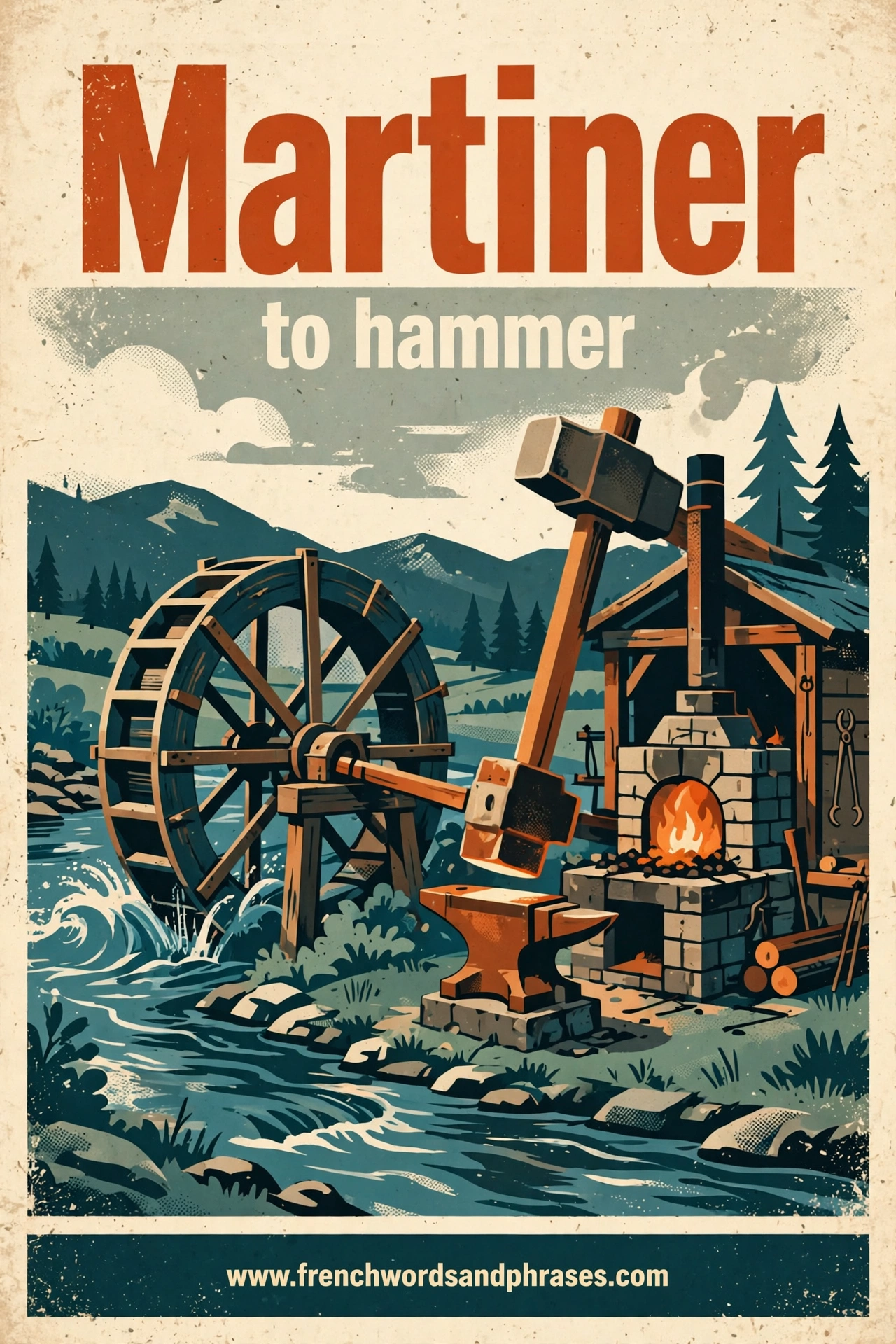
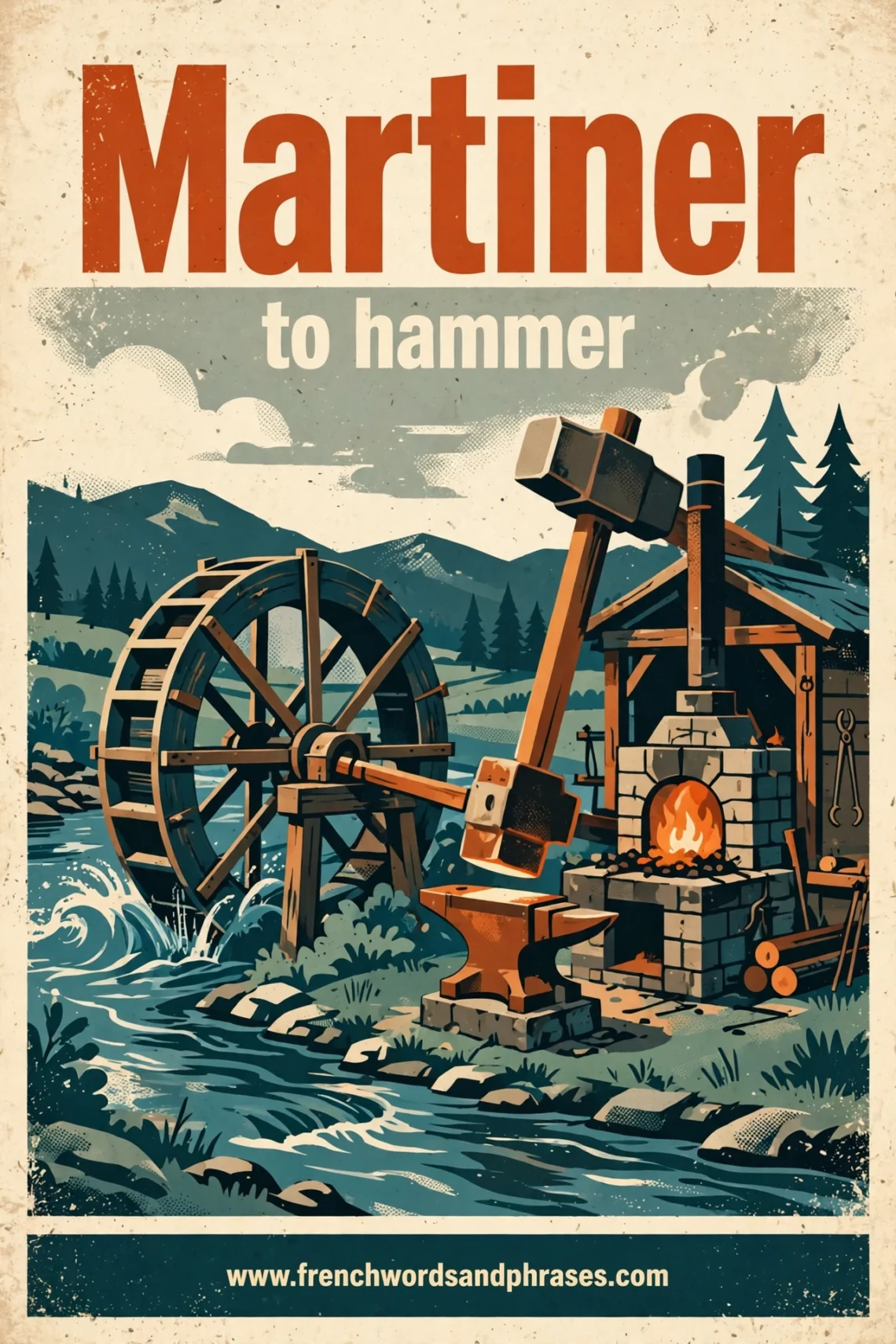
In the old forge, a great water-powered hammer rose and crashed down on sheets of copper, hour after hour, driven by the river itself. Martiner is that hammer’s verb: to flatten metal under the martinet, the tilt hammer of the old mills.
In this guide, you’ll learn how to conjugate martiner in all the major French tenses and moods. Explore complete conjugation tables, French examples, English translations, and practice quizzes.
Understanding the French Verb Martiner
Martiner is a regular French verb belonging to the first group of verbs, those ending in -er.
It means to hammer. It is commonly used in the history of metalwork for flattening copper, iron and steel sheets under the martinet, for the work of old hammer mills along rivers, and in museum descriptions of pre-industrial forges.
Verb classification: First group (-er)
Auxiliary verb: Avoir
Past participle: martiné
Present participle: martinant
English equivalents: To hammer metal flat under a martinet — a water-powered tilt hammer in an old forge or hammer mill.
One important detail: martiner is the specialist cousin of marteler. Marteler is any hammering, by hand, anywhere; martiner belongs to one machine — le martinet, the great tilt hammer of the old forges, lifted by a water wheel and dropped on the metal. Whole villages lived by it: the men who martinaient copper and iron were the martiniers. Its past participle is martiné.
Experience the Word
Martiner is the verb of the machine before machines — a river, a wheel, and a hammer that never tired.
Imagine a forge in a valley two centuries ago. The wheel turns in the stream, the great hammer lifts and falls, lifts and falls, and under it a bar of copper slowly widens into a sheet. The whole building breathes with the rhythm.
No arm could strike so evenly for so long. The river itself is hammering — martinant the metal flat.
How to Conjugate Martiner: Complete French Conjugation Guide
Let’s explore every major conjugation of martiner, beginning with the indicative mood.
How to Conjugate Martiner in the Indicative Mood
The indicative mood is used to express facts, observations, actions, and events.
How to Conjugate Martiner in the Present Tense (Présent)
Used for actions happening now, habitual actions, and general truths.
| Subject | Conjugation |
|---|---|
| je | martine |
| tu | martines |
| il / elle | martine |
| nous | martinons |
| vous | martinez |
| ils / elles | martinent |
Example
Au martinet, on martine le cuivre en feuilles fines.
At the hammer mill, copper is hammered into thin sheets.
Quick Quiz 1
Complete the sentence:
Nous ______ les plaques de cuivre.
Reveal the answer
martinons
Nous martinons les plaques de cuivre.
We hammer the copper sheets flat.
How to Conjugate Martiner in the Passé Composé
Used for completed actions in the past. Martiner takes the auxiliary verb avoir.
| Subject | Conjugation |
|---|---|
| j’ | ai martiné |
| tu | as martiné |
| il / elle | a martiné |
| nous | avons martiné |
| vous | avez martiné |
| ils / elles | ont martiné |
Example
Ils ont martiné la plaque avant de la découper.
They hammered the sheet flat before cutting it.
How to Conjugate Martiner in the Imparfait (Imperfect Tense)
Used for habitual past actions, descriptions, and ongoing situations in the past.
| Subject | Conjugation |
|---|---|
| je | martinais |
| tu | martinais |
| il / elle | martinait |
| nous | martinions |
| vous | martiniez |
| ils / elles | martinaient |
Example
Le martinet martinait le fer jour et nuit.
The tilt hammer used to pound the iron day and night.
Quick Quiz 2
Choose the correct form:
They hammered the sheet flat.
Ils ______ la plaque. (ont martiné / sont martinés)
Reveal the answer
ont martiné
Ils ont martiné la plaque.
Martiner takes avoir.
How to Conjugate Martiner in the Plus-que-parfait
Used to describe an action that had already been completed before another past event.
| Subject | Conjugation |
|---|---|
| j’ | avais martiné |
| tu | avais martiné |
| il / elle | avait martiné |
| nous | avions martiné |
| vous | aviez martiné |
| ils / elles | avaient martiné |
Example
Nous avions martiné toutes les barres avant midi.
We had hammered all the bars flat before noon.
How to Conjugate Martiner in the Passé Simple
Primarily used in formal writing, literature, and historical narratives. It is rarely used in everyday conversation.
| Subject | Conjugation |
|---|---|
| je | martinai |
| tu | martinas |
| il / elle | martina |
| nous | martinâmes |
| vous | martinâtes |
| ils / elles | martinèrent |
Example
Le forgeron martina la lame avec patience.
The smith hammered the blade flat with patience.
How to Conjugate Martiner in the Passé Antérieur
A literary tense used to express an action completed immediately before another past action, generally in the passé simple.
| Subject | Conjugation |
|---|---|
| j’ | eus martiné |
| tu | eus martiné |
| il / elle | eut martiné |
| nous | eûmes martiné |
| vous | eûtes martiné |
| ils / elles | eurent martiné |
Example
Quand il eut martiné le cuivre, il le laissa refroidir.
When he had hammered the copper flat, he let it cool.
How to Conjugate Martiner in the Future Tense (Futur Simple)
Used to describe actions that will take place in the future.
| Subject | Conjugation |
|---|---|
| je | martinerai |
| tu | martineras |
| il / elle | martinera |
| nous | martinerons |
| vous | martinerez |
| ils / elles | martineront |
Example
Demain, ils martineront les plaques pour les toits.
Tomorrow, they will hammer the sheets for the roofs.
How to Conjugate Martiner in the Futur Antérieur (Future Perfect)
Used for an action that will have been completed before a particular point in the future.
| Subject | Conjugation |
|---|---|
| j’ | aurai martiné |
| tu | auras martiné |
| il / elle | aura martiné |
| nous | aurons martiné |
| vous | aurez martiné |
| ils / elles | auront martiné |
Example
À la fin du mois, l’atelier aura martiné deux tonnes de cuivre.
By the end of the month, the workshop will have hammered two tons of copper flat.
How to Conjugate Martiner in the Near Future (Futur Proche)
Used to describe something that is going to happen soon. Formed with aller + infinitive.
| Subject | Conjugation |
|---|---|
| je | vais martiner |
| tu | vas martiner |
| il / elle | va martiner |
| nous | allons martiner |
| vous | allez martiner |
| ils / elles | vont martiner |
Example
Je vais martiner cette barre de fer.
I am going to hammer this iron bar flat.
How to Conjugate Martiner in the Conditional Mood
The conditional mood expresses what would happen under certain circumstances. It is also frequently used to make polite requests or express wishes.
How to Conjugate Martiner in the Present Conditional
| Subject | Conjugation |
|---|---|
| je | martinerais |
| tu | martinerais |
| il / elle | martinerait |
| nous | martinerions |
| vous | martineriez |
| ils / elles | martineraient |
Example
Avec un martinet neuf, on martinerait plus vite.
With a new tilt hammer, we would hammer faster.
How to Conjugate Martiner in the Past Conditional
| Subject | Conjugation |
|---|---|
| j’ | aurais martiné |
| tu | aurais martiné |
| il / elle | aurait martiné |
| nous | aurions martiné |
| vous | auriez martiné |
| ils / elles | auraient martiné |
Example
Elle aurait martiné la plaque si la machine avait marché.
She would have hammered the sheet if the machine had worked.
Martiner in the Literary Past Conditional Form
This less common literary form uses the imperfect subjunctive of avoir.
| Subject | Conjugation |
|---|---|
| j’ | eusse martiné |
| tu | eusses martiné |
| il / elle | eût martiné |
| nous | eussions martiné |
| vous | eussiez martiné |
| ils / elles | eussent martiné |
Example
Il eût martiné le fer comme ses ancêtres.
He would have hammered the iron flat like his ancestors.
How to Conjugate Martiner in the Subjunctive Mood
The subjunctive is used to express wishes, emotions, doubts, necessity, and uncertainty. It frequently follows expressions such as il faut que (it is necessary that) or bien que (although).
How to Conjugate Martiner in the Present Subjunctive
| Subject | Conjugation |
|---|---|
| que je | martine |
| que tu | martines |
| qu’il / qu’elle | martine |
| que nous | martinions |
| que vous | martiniez |
| qu’ils / qu’elles | martinent |
Example
Il faut que tu martines le cuivre avant de le plier.
You must hammer the copper flat before bending it.
Quick Quiz 3
Complete the sentence using the subjunctive:
Il faut que vous ______ le cuivre.
Reveal the answer
martiniez
Il faut que vous martiniez le cuivre.
You must hammer the copper flat.
How to Conjugate Martiner in the Imperfect Subjunctive
A literary tense, rarely encountered in modern spoken French.
| Subject | Conjugation |
|---|---|
| que je | martinasse |
| que tu | martinasses |
| qu’il / qu’elle | martinât |
| que nous | martinassions |
| que vous | martinassiez |
| qu’ils / qu’elles | martinassent |
Example
Je voulais qu’il martinât la lame plus finement.
I wanted him to hammer the blade flatter.
How to Conjugate Martiner in the Pluperfect Subjunctive
A literary construction used to express an action completed before another past action.
| Subject | Conjugation |
|---|---|
| que j’ | eusse martiné |
| que tu | eusses martiné |
| qu’il / qu’elle | eût martiné |
| que nous | eussions martiné |
| que vous | eussiez martiné |
| qu’ils / qu’elles | eussent martiné |
Example
Il regrettait que nous eussions martiné si tôt.
He regretted that we had done the hammering so early.
How to Conjugate Martiner in the Past Subjunctive
| Subject | Conjugation |
|---|---|
| que j’ | aie martiné |
| que tu | aies martiné |
| qu’il / qu’elle | ait martiné |
| que nous | ayons martiné |
| que vous | ayez martiné |
| qu’ils / qu’elles | aient martiné |
Example
Je suis content que vous ayez martiné les plaques.
I am glad you hammered the sheets flat.
How to Conjugate Martiner in the Imperative
The imperative is used to give commands, instructions, invitations, or suggestions. Subject pronouns are omitted.
How to Conjugate Martiner in the Present Imperative
| Person | Conjugation |
|---|---|
| (tu) | martine |
| (nous) | martinons |
| (vous) | martinez |
Example
Martine le cuivre, mais sans le casser !
Hammer the copper flat, but do not break it!
Quick Quiz 4
How would you say Hammer the copper flat (tu form)?
Reveal the answer
Martine le cuivre !
French Participles of Martiner
Participles are verb forms that can be used in compound tenses and other grammatical constructions.
Present Participle of Martiner
martinant
En martinant le fer, il suivait le rythme du martinet.
While hammering the iron, he followed the rhythm of the tilt hammer.
Past Participle of Martiner
martiné
Martiné au martinet, le cuivre devient une feuille fine.
Hammered under the tilt hammer, copper becomes a thin sheet.
Martiner in Everyday French: Real-Life Examples
Now that you know the conjugations, let’s see how martiner appears in everyday French.
Example 1 — Present
On martine le cuivre au martinet, dans cette vallée.
Copper is hammered under the tilt hammer in this valley.
Example 2 — Passé composé
L’atelier a martiné deux tonnes de fer cette année.
The workshop hammered two tons of iron this year.
Example 3 — Imparfait
Les martiniers martinaient les plaques dès l’aube.
The hammer-mill workers used to flatten the sheets from dawn.
Example 4 — Future
Nous martinerons les barres demain matin.
We will hammer the bars flat tomorrow morning.
Example 5 — Conditional
On martinerait plus vite avec deux martinets.
We would hammer faster with two tilt hammers.
Example 6 — Imperative
Martinez le fer pendant qu’il est chaud !
Hammer the iron while it is hot!
Beyond Translation: The Meaning of Martiner
English has no everyday verb for this: to hammer under a tilt hammer takes a whole clause. French martiner keeps the machine inside the word.
It is a fossil of the industrial dawn.
Before steam, rivers did the heavy work of Europe, and every valley forge had its martinet. The verb survives in museums and old trade names — a word that still smells of hot iron and river water.
How to Remember the French Verb Martiner
Remember it this way: Martiner is about the martinet’s hammer — metal flattened in the old forge.
- Le martinet is the machine — a water-powered tilt hammer; martiner is its work.
- Marteler is hammering by hand, anywhere; martiner is the martinet’s flattening, in the forge.
- Regular -er: je martine, nous martinons, past participle martiné.
The key idea is the martinet’s hammer — metal flattened in the old forge.
Test Your Knowledge of Martiner
Let’s see how much you’ve learned. Try answering these questions before revealing the answers.
Question 1
What is le martinet?
Reveal the answer
A water-powered tilt hammer — the great hammer of the old forges and hammer mills.
Question 2
How do you say We will hammer the bars flat tomorrow in French?
Reveal the answer
Nous martinerons les barres demain.
Question 3
Translate: They hammered the sheet flat before cutting it.
Reveal the answer
Ils ont martiné la plaque avant de la découper.
Question 4
What is the past participle of martiner?
Reveal the answer
Martiné.
Question 5
Complete the sentence:
Il faut que tu ______ le cuivre avant de le plier.
Reveal the answer
martines
Il faut que tu martines le cuivre avant de le plier.
You must hammer the copper flat before bending it.
Your Final Challenge
Can You Use It?
How would you say this in French?
The tilt hammer pounds the copper, and the sheet takes shape under the blows.
Reveal the answer
Le martinet martine le cuivre, et la feuille prend forme sous les coups.
The tilt hammer pounds the copper, and the sheet takes shape under the blows.
A little French. A little curiosity. A richer everyday life.
LEARN FRENCH ONE WORD AT A TIME