A French Word to Live By
How to Conjugate Marronner in French
/ma.ʁɔ.ne/
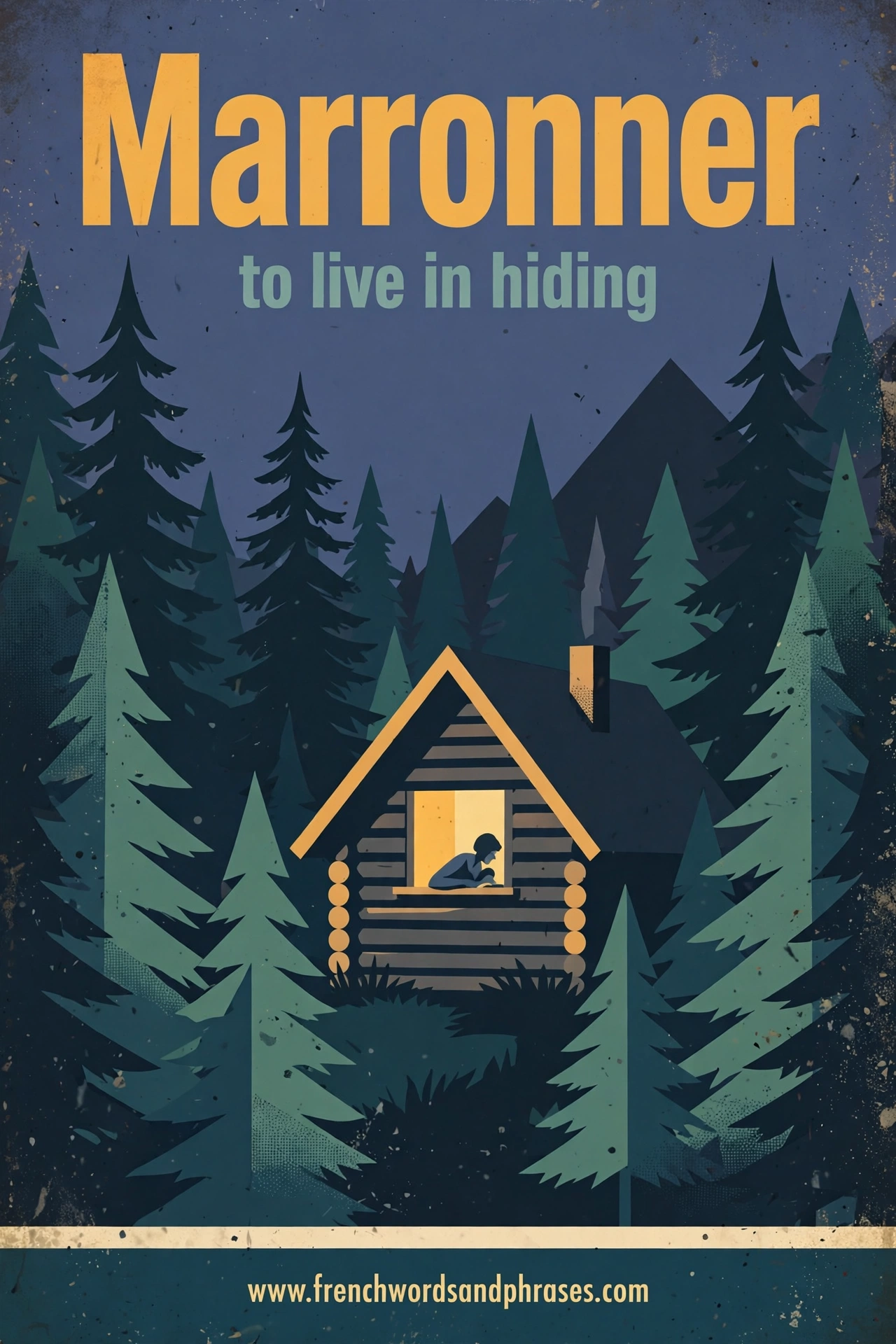
Marronner means to live in hiding.
A man sleeping in a barn, eating what the woods offer, watching the road from the trees — marronner is the verb of the runaway’s hidden life, born in the colonies and still carrying the smell of forest and fear.
In this guide, you’ll learn how to conjugate marronner in all the major French tenses and moods. Explore complete conjugation tables, French examples, English translations, and practice quizzes.
Understanding the French Verb Marronner
Marronner is a regular French verb belonging to the first group of verbs, those ending in -er.
It means to live in hiding. It is commonly used in history for runaway slaves and fugitives living hidden in forests and mountains, for anyone lying low until danger passes, and in its familiar modern sense for long, idle waits in stations, offices and waiting rooms.
Verb classification: First group (-er)
Auxiliary verb: Avoir
Past participle: marronné
Present participle: marronnant
English equivalents: To live in hiding, to lie low; (familiar) to hang around waiting, to cool one’s heels.
One important detail: marronner comes from un marron — a runaway slave who fled the plantation for the hills and forests, from the Spanish cimarrón, wild and untamed. To marronner is to live that hidden life. In relaxed modern speech the verb has softened: marronner dans une salle d’attente is simply to hang around waiting, with nothing to do but watch the clock.
Experience the Word
Marronner is the verb of the hidden life — days measured not by clocks but by danger, distance and hunger.
Imagine the forested hills above an old plantation. A man has built a shelter no path leads to; he knows every stream and every sound. He marronne — free, but at the price of never being seen.
He owns nothing and fears everything. But he is hidden — and hiding is his freedom.
How to Conjugate Marronner: Complete French Conjugation Guide
Let’s explore every major conjugation of marronner, beginning with the indicative mood.
How to Conjugate Marronner in the Indicative Mood
The indicative mood is used to express facts, observations, actions, and events.
How to Conjugate Marronner in the Present Tense (Présent)
Used for actions happening now, habitual actions, and general truths.
| Subject | Conjugation |
|---|---|
| je | marronne |
| tu | marronnes |
| il / elle | marronne |
| nous | marronnons |
| vous | marronnez |
| ils / elles | marronnent |
Example
Il marronne depuis des semaines, loin du village.
He has been living in hiding for weeks, far from the village.
Quick Quiz 1
Complete the sentence:
Nous ______ dans les collines depuis des jours.
Reveal the answer
marronnons
Nous marronnons dans les collines depuis des jours.
We have been living in hiding in the hills for days.
How to Conjugate Marronner in the Passé Composé
Used for completed actions in the past. Marronner takes the auxiliary verb avoir.
| Subject | Conjugation |
|---|---|
| j’ | ai marronné |
| tu | as marronné |
| il / elle | a marronné |
| nous | avons marronné |
| vous | avez marronné |
| ils / elles | ont marronné |
Example
Elle a marronné trois jours dans une grange.
She hid out for three days in a barn.
How to Conjugate Marronner in the Imparfait (Imperfect Tense)
Used for habitual past actions, descriptions, and ongoing situations in the past.
| Subject | Conjugation |
|---|---|
| je | marronnais |
| tu | marronnais |
| il / elle | marronnait |
| nous | marronnions |
| vous | marronniez |
| ils / elles | marronnaient |
Example
Les fugitifs marronnaient dans les bois.
The fugitives used to live in hiding in the woods.
Quick Quiz 2
Choose the correct form:
She hid out for three days.
Elle ______ trois jours. (a marronné / est marronnée)
Reveal the answer
a marronné
Elle a marronné trois jours.
Marronner takes avoir.
How to Conjugate Marronner in the Plus-que-parfait
Used to describe an action that had already been completed before another past event.
| Subject | Conjugation |
|---|---|
| j’ | avais marronné |
| tu | avais marronné |
| il / elle | avait marronné |
| nous | avions marronné |
| vous | aviez marronné |
| ils / elles | avaient marronné |
Example
Il avait marronné longtemps avant de se rendre.
He had lived in hiding for a long time before giving himself up.
How to Conjugate Marronner in the Passé Simple
Primarily used in formal writing, literature, and historical narratives. It is rarely used in everyday conversation.
| Subject | Conjugation |
|---|---|
| je | marronnai |
| tu | marronnas |
| il / elle | marronna |
| nous | marronnâmes |
| vous | marronnâtes |
| ils / elles | marronnèrent |
Example
Il marronna dans la forêt tout l’hiver.
He lived in hiding in the forest all winter.
How to Conjugate Marronner in the Passé Antérieur
A literary tense used to express an action completed immediately before another past action, generally in the passé simple.
| Subject | Conjugation |
|---|---|
| j’ | eus marronné |
| tu | eus marronné |
| il / elle | eut marronné |
| nous | eûmes marronné |
| vous | eûtes marronné |
| ils / elles | eurent marronné |
Example
Quand il eut marronné assez longtemps, il reparut au village.
When he had hidden long enough, he reappeared in the village.
How to Conjugate Marronner in the Future Tense (Futur Simple)
Used to describe actions that will take place in the future.
| Subject | Conjugation |
|---|---|
| je | marronnerai |
| tu | marronneras |
| il / elle | marronnera |
| nous | marronnerons |
| vous | marronnerez |
| ils / elles | marronneront |
Example
Ils marronneront jusqu’à la fin des recherches.
They will lie low until the search ends.
How to Conjugate Marronner in the Futur Antérieur (Future Perfect)
Used for an action that will have been completed before a particular point in the future.
| Subject | Conjugation |
|---|---|
| j’ | aurai marronné |
| tu | auras marronné |
| il / elle | aura marronné |
| nous | aurons marronné |
| vous | aurez marronné |
| ils / elles | auront marronné |
Example
À la nuit, il aura marronné dix heures dans la salle d’attente.
By nightfall, he will have been hanging around ten hours in the waiting room.
How to Conjugate Marronner in the Near Future (Futur Proche)
Used to describe something that is going to happen soon. Formed with aller + infinitive.
| Subject | Conjugation |
|---|---|
| je | vais marronner |
| tu | vas marronner |
| il / elle | va marronner |
| nous | allons marronner |
| vous | allez marronner |
| ils / elles | vont marronner |
Example
Je vais encore marronner une heure à la gare.
I am going to hang around another hour at the station.
How to Conjugate Marronner in the Conditional Mood
The conditional mood expresses what would happen under certain circumstances. It is also frequently used to make polite requests or express wishes.
How to Conjugate Marronner in the Present Conditional
| Subject | Conjugation |
|---|---|
| je | marronnerais |
| tu | marronnerais |
| il / elle | marronnerait |
| nous | marronnerions |
| vous | marronneriez |
| ils / elles | marronneraient |
Example
À sa place, je marronnerais loin de la ville.
In his place, I would lie low far from the town.
How to Conjugate Marronner in the Past Conditional
| Subject | Conjugation |
|---|---|
| j’ | aurais marronné |
| tu | aurais marronné |
| il / elle | aurait marronné |
| nous | aurions marronné |
| vous | auriez marronné |
| ils / elles | auraient marronné |
Example
Elle aurait marronné plus longtemps sans la faim.
She would have stayed hidden longer if not for hunger.
Marronner in the Literary Past Conditional Form
This less common literary form uses the imperfect subjunctive of avoir.
| Subject | Conjugation |
|---|---|
| j’ | eusse marronné |
| tu | eusses marronné |
| il / elle | eût marronné |
| nous | eussions marronné |
| vous | eussiez marronné |
| ils / elles | eussent marronné |
Example
Il eût marronné des mois dans les montagnes.
He would have lived in hiding for months in the mountains.
How to Conjugate Marronner in the Subjunctive Mood
The subjunctive is used to express wishes, emotions, doubts, necessity, and uncertainty. It frequently follows expressions such as il faut que (it is necessary that) or bien que (although).
How to Conjugate Marronner in the Present Subjunctive
| Subject | Conjugation |
|---|---|
| que je | marronne |
| que tu | marronnes |
| qu’il / qu’elle | marronne |
| que nous | marronnions |
| que vous | marronniez |
| qu’ils / qu’elles | marronnent |
Example
Il faut qu’il marronne jusqu’à ce que tout se calme.
He must lie low until everything calms down.
Quick Quiz 3
Complete the sentence using the subjunctive:
Il faut que vous ______ loin de la ville.
Reveal the answer
marronniez
Il faut que vous marronniez loin de la ville.
You must lie low far from the town.
How to Conjugate Marronner in the Imperfect Subjunctive
A literary tense, rarely encountered in modern spoken French.
| Subject | Conjugation |
|---|---|
| que je | marronnasse |
| que tu | marronnasses |
| qu’il / qu’elle | marronnât |
| que nous | marronnassions |
| que vous | marronnassiez |
| qu’ils / qu’elles | marronnassent |
Example
On craignait qu’il marronnât seul dans les bois.
They feared he might be hiding alone in the woods.
How to Conjugate Marronner in the Pluperfect Subjunctive
A literary construction used to express an action completed before another past action.
| Subject | Conjugation |
|---|---|
| que j’ | eusse marronné |
| que tu | eusses marronné |
| qu’il / qu’elle | eût marronné |
| que nous | eussions marronné |
| que vous | eussiez marronné |
| qu’ils / qu’elles | eussent marronné |
Example
Il semblait qu’ils eussent marronné des semaines.
It seemed they had lived in hiding for weeks.
How to Conjugate Marronner in the Past Subjunctive
| Subject | Conjugation |
|---|---|
| que j’ | aie marronné |
| que tu | aies marronné |
| qu’il / qu’elle | ait marronné |
| que nous | ayons marronné |
| que vous | ayez marronné |
| qu’ils / qu’elles | aient marronné |
Example
Je suis étonné qu’il ait marronné si longtemps.
I am surprised he stayed hidden so long.
How to Conjugate Marronner in the Imperative
The imperative is used to give commands, instructions, invitations, or suggestions. Subject pronouns are omitted.
How to Conjugate Marronner in the Present Imperative
| Person | Conjugation |
|---|---|
| (tu) | marronne |
| (nous) | marronnons |
| (vous) | marronnez |
Example
Marronne encore un peu, la voie sera libre bientôt.
Lie low a little longer, the way will soon be clear.
Quick Quiz 4
How would you say Lie low (tu form)?
Reveal the answer
Marronne !
French Participles of Marronner
Participles are verb forms that can be used in compound tenses and other grammatical constructions.
Present Participle of Marronner
marronnant
En marronnant, il a appris chaque sentier de la forêt.
While living in hiding, he learned every path in the forest.
Past Participle of Marronner
marronné
Marronné des semaines, il finit par reparaître au printemps.
Hidden away for weeks, he finally reappeared in spring.
Marronner in Everyday French: Real-Life Examples
Now that you know the conjugations, let’s see how marronner appears in everyday French.
Example 1 — Present
Il marronne chez un cousin, loin des regards.
He is lying low at a cousin’s, away from prying eyes.
Example 2 — Passé composé
J’ai marronné deux heures à la gare.
I hung around for two hours at the station.
Example 3 — Imparfait
Les marrons marronnaient dans les bois et les collines.
The runaways used to live in hiding in the woods and hills.
Example 4 — Future
Il marronnera jusqu’au printemps.
He will lie low until spring.
Example 5 — Conditional
Je marronnerais à ta place.
I would lie low in your place.
Example 6 — Imperative
Marronne ici, je reviens tout de suite !
Wait here, I will be right back!
Beyond Translation: The Meaning of Marronner
English lie low is a phrase; French marronner is a whole history in one verb — the marron, the runaway, is inside it.
And its second life is pure bathos.
The same verb that once meant surviving in the forest now describes waiting for a delayed train. Languages do this: the words of danger retire into everyday boredom, carrying their old shadows with them.
How to Remember the French Verb Marronner
Remember it this way: Marronner is about the runaway’s life — hidden in the woods.
- Un marron was a runaway slave — marronner is to live his hidden life.
- Modern familiar sense: to hang around waiting, as in a station or a waiting room.
- Regular -er: je marronne, nous marronnons, past participle marronné — note the double n.
The key idea is the runaway’s life — hidden in the woods.
Test Your Knowledge of Marronner
Let’s see how much you’ve learned. Try answering these questions before revealing the answers.
Question 1
Who was un marron?
Reveal the answer
A runaway slave — one who fled to the hills and forests to live free and hidden.
Question 2
How do you say I hung around for two hours at the station in French?
Reveal the answer
J’ai marronné deux heures à la gare.
Question 3
Translate: He lived in hiding in the forest all winter.
Reveal the answer
Il marronna dans la forêt tout l’hiver.
Question 4
What is the past participle of marronner?
Reveal the answer
Marronné.
Question 5
Complete the sentence:
Il faut qu’il ______ jusqu’à ce que tout se calme.
Reveal the answer
marronne
Il faut qu’il marronne jusqu’à ce que tout se calme.
He must lie low until everything calms down.
Your Final Challenge
Can You Use It?
How would you say this in French?
He lived in hiding in the woods all winter, and spring brought him back to the village.
Reveal the answer
Il a marronné tout l’hiver dans les bois, et le printemps l’a ramené au village.
He lived in hiding in the woods all winter, and spring brought him back to the village.
A little French. A little curiosity. A richer everyday life.
LEARN FRENCH ONE WORD AT A TIME