A French Word to Live By
Translate Longtemps to English
/lɔ̃.tɑ̃/
Longtemps means a long time.
The queue outside the little town hall moves at the pace of another century, the same clerk stamps the same forms, and the bench by the window has heard forty years of waiting. Some things cannot be hurried — and for all of them, French says longtemps.
In this guide, you’ll learn what longtemps means in English, how depuis longtemps differs from il y a longtemps, where the word sits in a sentence, and how not to confuse it with longuement. Explore French examples, English translations, and practice quizzes.
Understanding the French Adverb Longtemps
Longtemps is a French adverb of time — the adverb of duration. It never changes its form. It is simply long (long) married to temps (time): a long time, in one word.
It means a long time. It answers the question for how long? — stretching a moment out into minutes, hours or years. Nous avons attendu longtemps: we waited a long time. With depuis, it reaches from the past into now; with il y a, it looks back at a distant day.
Type: Adverb of time — duration
Answers the question: For how long?
Changes form: Never — longtemps is invariable
English equivalents: A long time; long.
One important usage detail: watch the company longtemps keeps. Depuis longtemps means for a long time (and it is still true now); il y a longtemps means a long time ago (finished and gone). The little word in front decides whether the story is still running.
Experience the Word
Longtemps is the adverb of patience — of bread rising, gardens growing and letters crossing oceans.
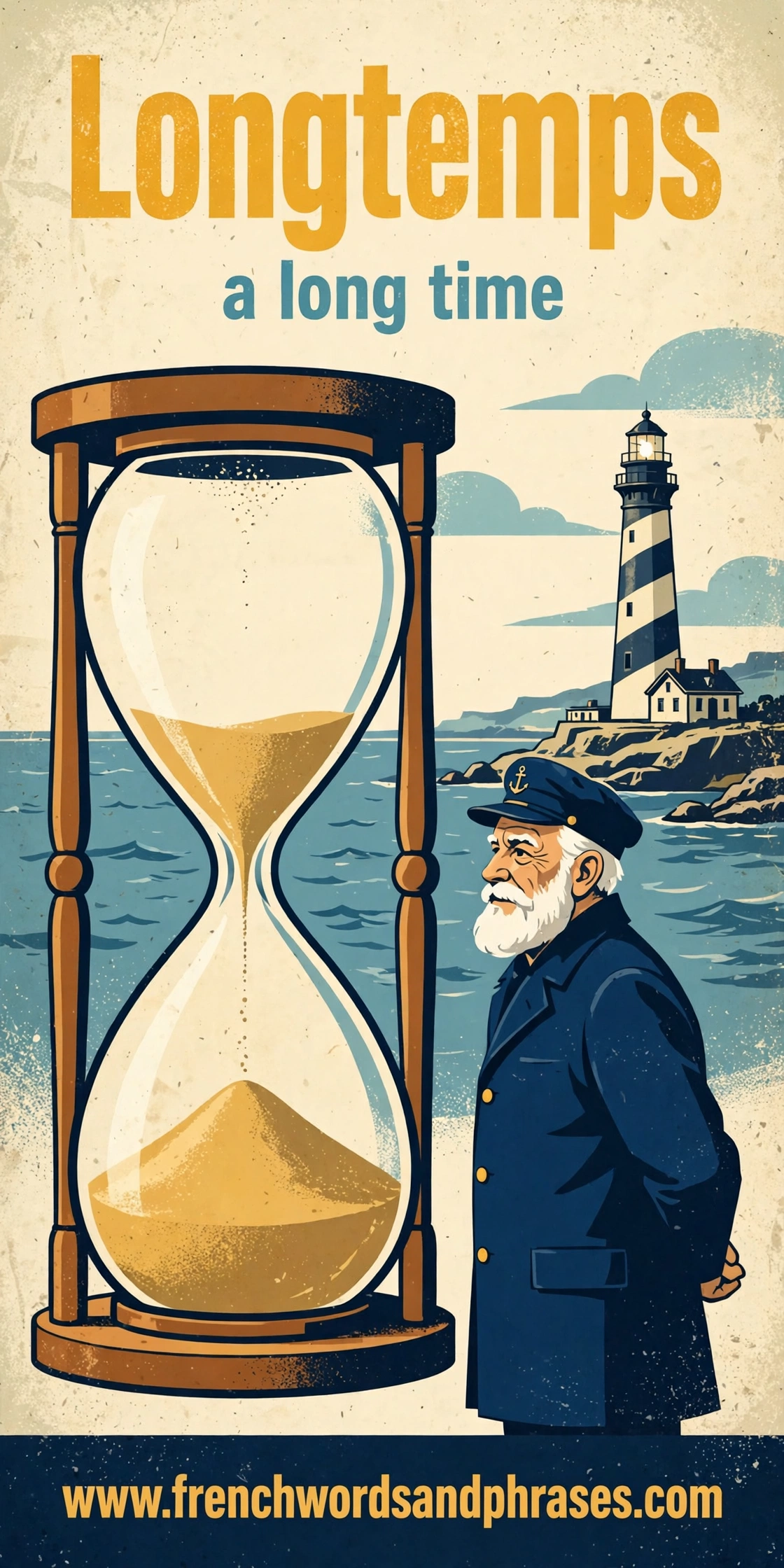
Imagine a lighthouse keeper in the old days, watching the same horizon for thirty winters: longtemps, he would tell you, is not measured in hours but in seasons.
You have not just filled some time. You have measured a life against it.
How to Use Longtemps in French: Complete Guide
Let’s explore how longtemps works in French, beginning with the whole word on one card.
Longtemps at a Glance
Before the details, here is the whole word on one card.
Meaning, type, recipe and partners — the essentials first.
| Point | Longtemps |
|---|---|
| Meaning | a long time |
| Type | adverb of time — duration |
| Built from | long (long) + temps (time) |
| Partners | depuis longtemps, il y a longtemps |
Example
Les enfants ont joué longtemps dans le jardin.
The children played for a long time in the garden.
Depuis Longtemps or Il y a Longtemps?
The same adverb tells two different stories depending on the word in front of it — this is the most useful distinction on this page.
| French | In English |
|---|---|
| depuis longtemps | for a long time (still true now) — Je le connais depuis longtemps |
| il y a longtemps | a long time ago (finished) — Il est parti il y a longtemps |
| ça fait longtemps que… | it has been a long time since… — Ça fait longtemps que je ne l’ai pas vu |
| depuis bien longtemps | for a very long time indeed |
Example
Elle habite ici depuis longtemps, mais son frère est parti il y a longtemps.
She has lived here for a long time, but her brother left a long time ago.
Quick Quiz 1
Which one means a long time ago?
depuis longtemps ou il y a longtemps ?
Reveal the answer
il y a longtemps
Depuis longtemps means for a long time — and it is still true now.
Where Longtemps Goes in the Sentence
Longtemps is a long adverb and a free one: it loves the end of the sentence, but it can also live between the auxiliary and the participle.
| Situation | Pattern |
|---|---|
| End of sentence | phrase + longtemps — nous avons attendu longtemps |
| Passé composé (inside) | auxiliary + longtemps + participle — il a longtemps hésité |
| Head of sentence (thoughtful, literary) | Longtemps, + phrase — Longtemps, le village a dormi sous la neige |
| After depuis / il y a | depuis longtemps; il y a longtemps |
Example
Il a longtemps travaillé dans cette usine.
He worked for a long time in this factory.
How Long Is Longtemps? The Duration Ladder
French measures stretches of time on a ladder — longtemps stands high, between a while and an eternity.
| French | How long? |
|---|---|
| quelques secondes | a few seconds |
| un instant | a moment |
| un moment | a while |
| longtemps | a long time |
| très longtemps | a very long time |
| une éternité | ages (a playful exaggeration) |
Example
Nous avons attendu un moment, puis longtemps, puis une éternité — du moins, c’est l’impression que nous avions.
We waited a while, then a long time, then an eternity — at least, that is how it felt.
Quick Quiz 2
Which is longer: un moment or longtemps?
Reveal the answer
Longtemps
Un moment is a while; longtemps is a long time.
Longtemps with Different Tenses
The adverb never changes — only its neighbours do. Here is longtemps at work across the main tenses.
| Tense | Example |
|---|---|
| Present (with depuis) | Je le connais depuis longtemps. |
| Passé composé | Ils ont longtemps cherché la maison. |
| Imparfait | Autrefois, les lettres mettaient longtemps à arriver. |
| Future | Tu attendras longtemps si tu ne réserves pas. |
| Conditional | Sans voiture, on marcherait longtemps. |
Example
Le vieux phare a longtemps guidé les bateaux.
The old lighthouse guided the boats for a long time.
Everyday Expressions with Longtemps
Longtemps appears in greetings and goodbyes all over France — learn these and you will hear it everywhere.
| Expression | In English |
|---|---|
| depuis longtemps | for a long time (still true) |
| il y a longtemps | a long time ago |
| ça fait longtemps ! | it’s been ages! (a greeting) |
| pas longtemps | not long — je ne reste pas longtemps |
| bien longtemps après | a good long time afterwards |
| longtemps après | long afterwards |
Example
Ça fait longtemps ! Comment vas-tu ?
It’s been ages! How are you?
Quick Quiz 3
What do you say to a friend you haven’t seen for years?
Reveal the answer
Ça fait longtemps !
Ça fait longtemps ! Comment vas-tu ?
It’s been ages! How are you?
Longtemps or Longuement? The Classic Mix-Up
One letter’s difference, two different questions. Longtemps measures how long something lasts; longuement describes how fully something is done — usually speaking, explaining, thinking.
| Word | It answers |
|---|---|
| longtemps | For how long? — the clock’s question (attendre longtemps) |
| longuement | In what way? — at length (parler longuement) |
| The test | If you can replace it with « for hours », choose longtemps |
| The test | If you can replace it with « in detail », choose longuement |
Example
Il a parlé longuement, et nous avons écouté longtemps.
He spoke at length, and we listened for a long time.
Longtemps and Its Neighbours
Learn longtemps with the other measures of duration, and French time stretches out in order.
| French | In English |
|---|---|
| brièvement | briefly (the opposite) |
| un moment | a while (shorter) |
| pendant longtemps | for a long time (the duration, framed) |
| éternellement | for ever (longer still, often joking) |
| depuis toujours | since always — since forever |
Example
Elle a répondu brièvement, après avoir longtemps réfléchi.
She answered briefly, after thinking for a long time.
Quick Quiz 4
What is the opposite of longtemps?
Reveal the answer
Brièvement — briefly.
Il a parlé longtemps; elle a répondu brièvement.
He spoke for a long time; she answered briefly.
Longtemps in Everyday French: Real-Life Examples
Now that you know the word, let’s see how longtemps appears in everyday French.
Example Waiting
Nous avons attendu longtemps devant la gare.
We waited for a long time in front of the station.
Example Old friends
Je connais Marie depuis longtemps.
I have known Marie for a long time.
Example Travel
Le voyage en train a duré longtemps.
The train journey lasted a long time.
Example At work
Il a longtemps travaillé comme boulanger.
He worked for a long time as a baker.
Example A reunion
Ça fait longtemps que nous ne nous sommes pas vus !
It’s been a long time since we saw each other!
Example Childhood
Enfant, je restais longtemps à la bibliothèque.
As a child, I used to stay a long time at the library.
Beyond Translation: The Meaning of Longtemps
English stretches a long time across three words, but French holds it in one: longtemps, length and time fused together.
To say longtemps is to respect what cannot be hurried.
It is the adverb of slow bread and long friendships, of queues endured and gardens grown — the time things take when they are done properly, which in France is a kind of compliment.
How to Remember the French Adverb Longtemps
Remember it this way: Longtemps is a long time in one word — depuis longtemps if it is still true, il y a longtemps if it is long gone.
- You hear its two halves holding hands — long + temps.
- You keep the story running with depuis — depuis longtemps, je la connais.
- You close the story with il y a — il est parti il y a longtemps.
The key idea is a long time — depuis longtemps (still true), il y a longtemps (long ago).
Test Your Knowledge of Longtemps
Let’s see how much you’ve learned. Try answering these questions before revealing the answers.
Question 1
What does longtemps mean?
Reveal the answer
A long time — a long stretch of time.
Question 2
How do you say a long time ago?
Reveal the answer
Il y a longtemps.
Question 3
Translate: We waited a long time.
Reveal the answer
Nous avons attendu longtemps.
Question 4
For something still true now: depuis longtemps or il y a longtemps?
Reveal the answer
Depuis longtemps — Je le connais depuis longtemps, I have known him for a long time.
Question 5
Complete the sentence:
Je te connais depuis ______.
Reveal the answer
longtemps
Je te connais depuis longtemps.
I have known you for a long time.
Your Final Challenge
Can You Use It?
How would you say this in French?
“We have known each other for a long time.”
Reveal the answer
Nous nous connaissons depuis longtemps.
We have known each other for a long time.
A little French. A little curiosity. A richer everyday life.
LEARN FRENCH ONE WORD AT A TIME