A French Word to Live By
Translate Le sien to English
/lə sjɛ̃/
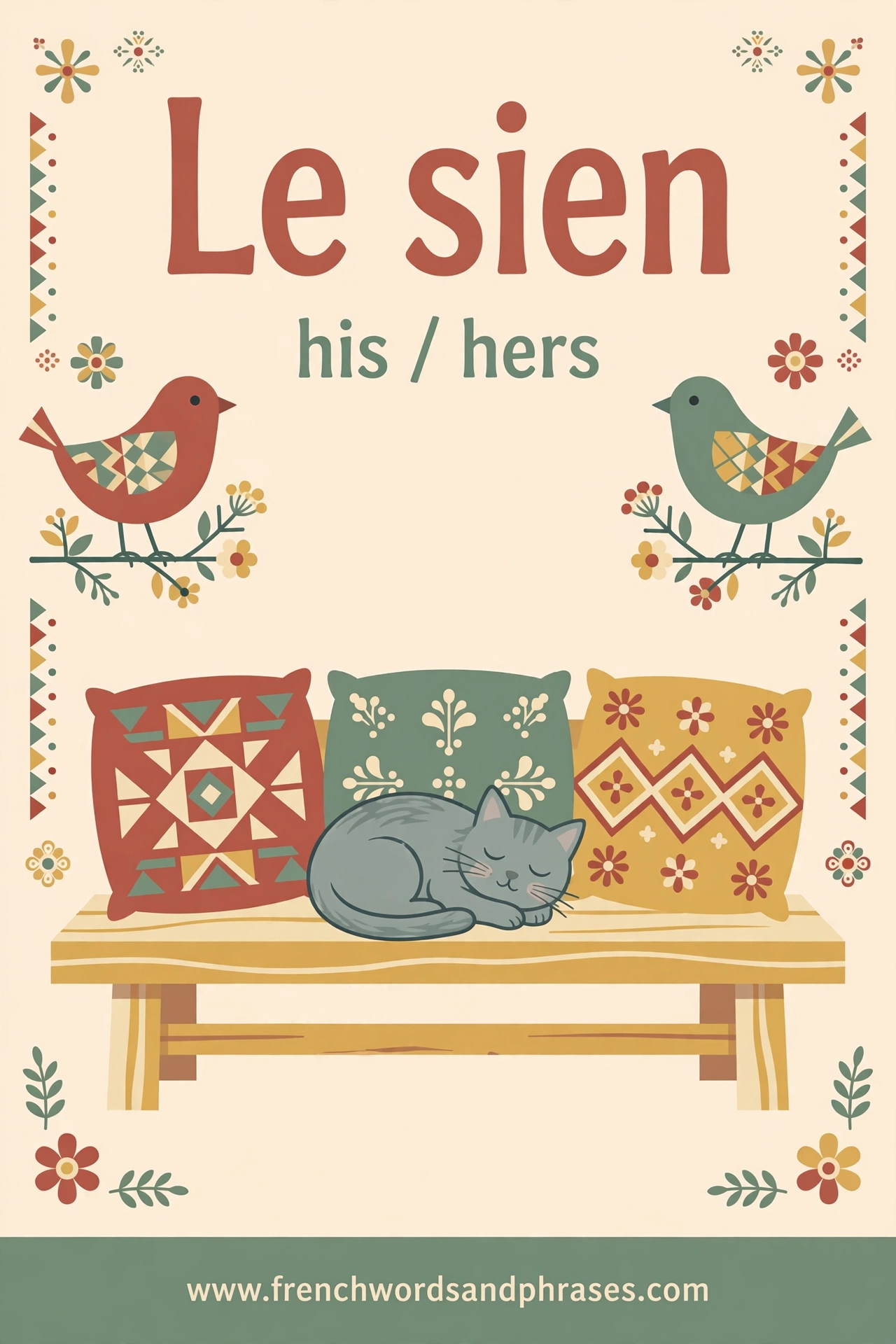
Le sien means his / hers.
Brother and sister compare their schoolbags by the front door. « Le mien est bleu, le sien est vert. » — Mine is blue, his is green. Le sien is the French word for his or hers: the pronoun that hands a thing to a third person — he or she — without ever saying which, and lets the conversation decide.
Let’s explore how le sien works in French, beginning with the whole word on one card.
Understanding the French Pronoun Le sien
Le sien is a French possessive pronoun — his or hers, the third person’s word in the family. It replaces son, sa or ses plus a noun, and takes four shapes — le sien, la sienne, les siens, les siennes — matched to the thing owned, never to the owner.
It means his or hers — French does not say which, because the pronoun copies the thing, not the person. The picture it paints is a third chair at the table: not mine, not yours, but his — or hers — and only the story around it tells you whose hand is on it.
Type: Possessive pronoun — his / hers (third person singular)
Answers the question: À qui ? — Whose? (Answer: his or hers, someone else’s)
What follows it: Nothing has to follow — le sien is a complete noun phrase: le sien est prêt (his is ready)
Watch the pair: le sien (the pronoun, his/hers) vs son (the determiner, his/her) — le sien stands alone, son needs its noun
One important usage detail: les siens has a second life as a noun meaning ‘his people’ — his family, his side, his team: il dîne avec les siens (he is having dinner with his folks). Context makes it clear.
Experience the Word
Le sien is the pronoun of the third chair — the one for the person who is not speaking and not being spoken to.
Imagine three umbrellas drying by a café door: le mien, le tien, et le sien, encore mouillé — mine, yours, and his, still wet.
You have not just replaced a noun. You have handed the thing to someone absent — and trusted the story to say who.
How to Use Le sien in French: Complete Guide
Let’s explore how le sien works in French, beginning with the whole word on one card.
Le sien at a Glance
The Whole Word on One Card
Meaning, job, forms and mystery — le sien in four lines.
| Point | Le sien |
|---|---|
| Meaning | his / hers (the one belonging to him or her) |
| Job | possessive pronoun — replaces son / sa / ses + noun |
| The four forms | le sien (m. sg.), la sienne (f. sg.), les siens (m. pl.), les siennes (f. pl.) |
| The mystery | the form never reveals the owner’s gender — only the thing’s |
Example
Mon café est chaud, le sien est froid.
My coffee is hot, his is cold.
The Pattern in Action: The Third Person’s Things
Le sien connects a sentence to a thing owned by someone else — he or she, already in the story.
| Pattern | Example |
|---|---|
| replacing son + a masculine noun | j’ai réparé mon vélo, il a réparé le sien — I repaired my bike, he repaired his |
| replacing sa + a feminine noun | sa maison est grande ; la sienne est petite — her house is big; his is small |
| replacing ses + a plural noun | ses enfants jouent dehors, les siens aussi — her children play outside, his too |
| les siens as a noun | il passe Noël avec les siens — he spends Christmas with his family |
Example
Ma sœur a fini son travail ; son frère a fini le sien.
My sister finished her work; her brother finished his.
Quick Quiz 1
Does le sien tell you whether the owner is a man or a woman?
Reveal the answer
No — le sien copies the thing owned, so it can be his or hers; only the context knows.
Marie a pris son livre ; Paul a pris le sien.
Marie took her book; Paul took his.
The Tricky Bit: His or Hers? Only the Story Knows
Le sien keeps a polite secret: it agrees with the thing and says nothing about the owner.
| Rule | How it works |
|---|---|
| no gender clue in the word | le sien = his or hers; la sienne = his or hers — the form follows the thing, not the owner |
| context settles it | once the owner is named, le sien points back: Claire a fini ; Pierre a fini le sien aussi |
| agreement is with the thing | un livre → le sien, une lettre → la sienne, des lettres → les siennes |
| the article never drops | always le sien, la sienne — never bare ‘sien’ |
Example
Emma a son chien ; Lucas a le sien.
Emma has her dog; Lucas has his.
Where It Goes: In the Noun’s Old Place
Le sien takes the seat of the phrase it replaces — subject, object, or after a preposition.
| Position / pattern | Example |
|---|---|
| as the subject | le sien est arrivé hier — his arrived yesterday |
| as the object | je connais le sien — I know his |
| after a preposition | nous voyageons dans la sienne — we are travelling in hers (the car) |
| after c’est | c’est le sien, pas le mien — it’s his, not mine |
Example
Prends mon manteau si tu veux, le sien est trop petit.
Take my coat if you want, his is too small.
Quick Quiz 2
How do you say “hers” for une bicyclette?
Reveal the answer
la sienne — bicyclette is feminine, so the pronoun is feminine, whether the owner is a man or a woman.
La sienne est bleue.
Hers is blue.
Everyday Expressions with Le sien
Le sien turns up in comparisons, families and everyone doing their part.
| Expression | In English |
|---|---|
| c’est le sien | it’s his / it’s hers |
| le sien aussi | his too / hers too |
| les siens | his people, her family |
| chacun le sien | each his own / to each his own |
| y mettre du sien | to do one’s part (il y a mis du sien — he did his bit) |
Example
Pour réussir le projet, chacun y a mis du sien.
To make the project succeed, everyone did their part.
Close Cousins: Le sien, Son, Le mien, À elle
Four ways of pointing at a third person’s property — here is who does what.
| Word | The difference |
|---|---|
| son / sa / ses | the determiners ‘his/her’ — they stand before a noun: son livre (his book); le sien replaces the whole phrase |
| le mien | mine — the speaker’s own version |
| le tien | yours — the version for the person listening |
| à lui / à elle | his / hers after être when you must be precise: ce livre est à elle (this book is hers) |
Example
Son livre est sur la table ; le mien est dans le sac.
His book is on the table; mine is in the bag.
Quick Quiz 3
You need to make it crystal clear the book is HERS, not his. Which form helps — le sien or à elle?
Reveal the answer
à elle — le sien keeps the owner’s gender secret; à elle names it.
Ce livre est à elle, pas à lui.
This book is hers, not his.
Le sien and Its Neighbours
The possessive shelf: one pronoun per owner, all built the same way.
| French | In English |
|---|---|
| le mien / la mienne | mine |
| le tien / la tienne | yours (tu) |
| le sien / la sienne | his / hers |
| le nôtre / la nôtre | ours |
| le vôtre / la vôtre | yours (vous) |
| le leur / la leur | theirs |
Example
Le mien est prêt, le tien aussi, mais le sien est en retard.
Mine is ready, yours too, but his is late.
Watch Out: The Traps Around Le sien
The traps: expecting the word to name the owner, and forgetting its family meaning.
| Trap | The truth |
|---|---|
| expecting le sien to say ‘his’ only | it means his OR hers — if it matters, add à lui or à elle |
| agreeing with the owner | a man’s letter is la sienne, because lettre is feminine — the owner never decides |
| dropping the article | never bare ‘sien’ — always le sien, la sienne, les siens, les siennes |
| missing the family meaning | les siens often means ‘his/her people’: il est rentré chez les siens (he went back to his family) |
Example
Elle a rangé ses affaires ; il a rangé les siennes.
She put away her things; he put away his.
Quick Quiz 4
Complete: Ma voiture est bleue, ______ est rouge. (My car is blue, his is red.)
Reveal the answer
la sienne — voiture is feminine, so his takes the feminine form la sienne.
Ma voiture est bleue, la sienne est rouge.
My car is blue, his is red.
Le sien in Everyday French: Real-Life Examples
Now that you know the word, let’s see how le sien appears in everyday French.
Example Example 1 — At school
Mon cahier est plein ; le sien est encore vide.
My notebook is full; his is still empty.
Example Example 2 — Siblings
Sa chambre est rangée, la sienne est en désordre.
Her bedroom is tidy, his is a mess.
Example Example 3 — Phones
Mon téléphone est éteint ; le sien sonne sans arrêt.
My phone is off; his rings nonstop.
Example Example 4 — Cooking
Ma soupe est prête ; la sienne mijote encore.
My soup is ready; hers is still simmering.
Example Example 5 — Family
Il passe le dimanche avec les siens.
He spends Sunday with his family.
Example Example 6 — At work
Nos rapports sont finis ; les siens arrivent demain.
Our reports are finished; his arrive tomorrow.
Beyond Translation: The Meaning of Le sien
French keeps a polite mystery at the heart of le sien: the word refuses to say whether the owner is a man or a woman. English forces the choice — his, hers — but French only asks what the thing is, and lets the owner’s identity float free.
To say le sien is to point at the thing, and let the person stay gracefully in the background.
And when les siens means ‘his people’, the word warms up: it stops counting objects and starts counting family — the ones who are his, in every sense.
How to Remember the French Pronoun Le sien
Remember it this way: Remember it this way: Le sien points at the thing and keeps the owner’s secret — his or hers, the story decides.
- You copy the thing owned — un vélo → le sien, une voiture → la sienne.
- You never learn the owner’s gender from the word — use à lui / à elle when it must be clear.
- You listen for the family meaning — les siens can mean his or her people.
The key idea is le sien means his or hers — its four forms copy the thing owned, and the owner’s gender stays unspoken.
Test Your Knowledge of Le sien
Let’s see how much you’ve learned. Try answering these questions before revealing the answers.
Question 1
What does le sien mean?
Reveal the answer
His / hers — the third person’s possessive pronoun; French does not separate the two.
Question 2
What are the four forms of le sien?
Reveal the answer
Le sien, la sienne, les siens, les siennes — matched to the thing owned.
Question 3
Translate: Mine is ready, his is not.
Reveal the answer
Le mien est prêt, le sien non.
Question 4
What else can les siens mean?
Reveal the answer
His or her people — family, close ones: il dîne avec les siens.
Question 5
Complete the sentence:
Sa maison est petite ; ______ est grande. (Her house is small; his is big.)
Reveal the answer
la sienne
Sa maison est petite ; la sienne est grande.
Her house is small; his is big.
Your Final Challenge
Can You Use It?
How would you say this in French?
“How would you say this in French?”
Reveal the answer
Ton livre est sur la table, le sien est par terre.
Your book is on the table, his is on the floor.
A little French. A little curiosity. A richer everyday life.
LEARN FRENCH ONE WORD AT A TIME