
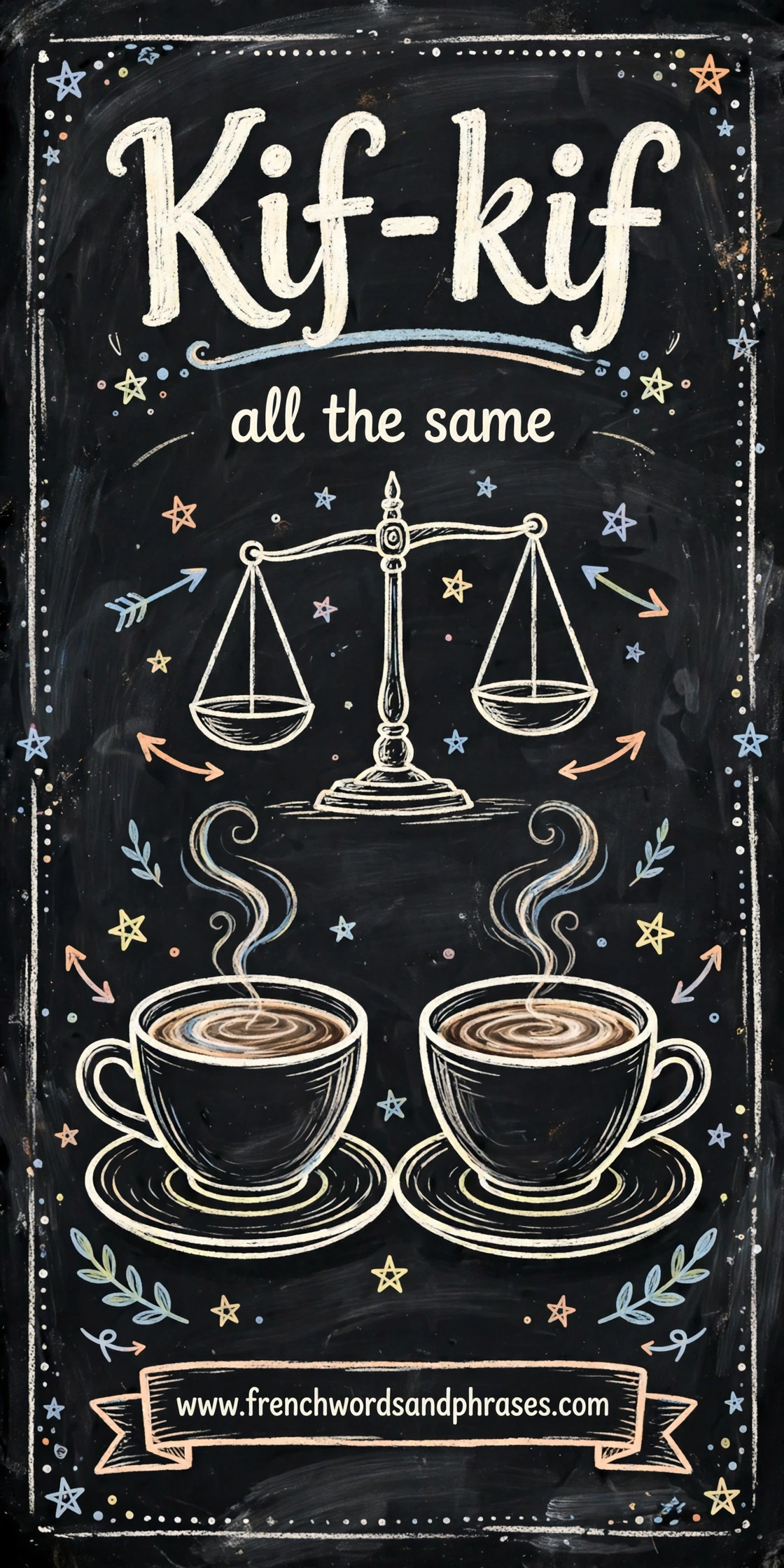
A French Word to Live By
Translate Kif-kif to English
/kif.kif/
Kif-kif means all the same.
A café terrace in Marseille, two old friends over two small coffees. One waves at the menu: train or bus tomorrow, window seat or aisle, the early start or the late one? The other shrugs the great shrug of the south, smiles, and settles everything with two small syllables: « kif-kif ».
In this guide, you’ll learn what kif-kif means in English, why it never changes its form, why it lives almost entirely in one famous sentence — c’est kif-kif — and why, being familiar spoken French, it charms friends and would horrify a job interview. Explore French examples, English translations, and practice quizzes.
Understanding the French Adjective Kif-kif
Kif-kif is a French adjective of the spoken language — register: familiar (familier). It is invariable, like its travel companion kascher: no feminine, no plural, no exceptions. Where most adjectives describe a thing, kif-kif delivers a verdict: the two things in front of you are worth exactly the same.
It means all the same — six of one and half a dozen of the other. Take the train or the bus? C’est kif-kif. The red shirt or the blue one? Kif-kif. It almost always arrives inside its favourite frame, c’est kif-kif, usually with a shrug, and it is also written as one word: kifkif.
Type: Adjective — invariable, familiar register (spoken French)
Answers the question: Which one is better? — neither; they are all the same
Changes form: No — invariable: kif-kif for every gender and number
English equivalents: All the same; six of one and half a dozen of the other.
One important usage detail: register. Kif-kif is warm, funny and strictly informal — perfect between friends, out of place in a letter, an exam essay or a business meeting, where pareil or ça revient au même do the same job politely. And it lives after the verb être: c’est kif-kif is the frame to learn by heart.
Experience the Word
Kif-kif is the adjective of the unhurried — the word of people who have compared two things carefully, found them equal, and decided that life is too short to pretend otherwise.
Imagine the market at closing time: two baskets of peaches, two prices, two sellers calling out. The old lady beside you tastes one, then the other, and delivers the verdict of the whole Mediterranean: « kif-kif, ma chérie, kif-kif ».
You have not just compared two baskets of fruit. You have refused, gracefully, to choose.
How to Use Kif-kif in French: Complete Guide
Let’s explore how kif-kif works in French, beginning with the whole word on one card.
Kif-kif at a Glance
Before the details, here is the whole word on one card.
The Whole Word on One Card
Meaning, type, position and forms — kif-kif in four lines. Also written kifkif, as one word.
| Point | Kif-kif |
|---|---|
| Meaning | all the same — six of one, half a dozen of the other |
| Type | adjective — invariable, familiar register |
| Usual position | after être — c’est kif-kif |
| Form | kif-kif — the same form everywhere |
Example
Le train ou le bus ? C’est kif-kif.
The train or the bus? It’s all the same.
The Four Forms of Kif-kif — All One Form
The agreement table, kif-kif style: nothing to agree. Masculine, feminine, singular, plural — the word shrugs at all four boxes and writes itself the same way in each.
| Form | Kif-kif | Example |
|---|---|---|
| Masculine singular | kif-kif | ce prix est kif-kif — this price is all the same |
| Feminine singular | kif-kif | cette route est kif-kif — this road is all the same |
| Masculine plural | kif-kif | les deux plans sont kif-kif — the two plans are all the same |
| Feminine plural | kif-kif | les deux robes sont kif-kif — the two dresses are all the same |
Example
Les deux appartements sont kif-kif, choisis celui que tu veux.
The two flats are all the same, pick whichever you like.
Quick Quiz 1
Which form of kif-kif goes with robes (feminine plural)?
Reveal the answer
kif-kif
Les robes sont kif-kif.
There is no other form — kif-kif never changes.
The Feminine of Kif-kif: There Isn’t One
Doubling is already this word’s whole personality — kif, then kif again — and French adds nothing more. No e for the feminine, no s for the plural: the lesson is the empty space where the endings should be.
| What learners try | What French says |
|---|---|
| kif-kiffe (adding an e) | wrong — the feminine is kif-kif |
| kif-kifs (adding an s) | wrong — the plural is kif-kif |
| cette chambre est kif-kif | right — one form after être |
| ces hôtels sont kif-kif | right — still one form in the plural |
Example
Les deux chambres sont kif-kif, prends la première.
The two rooms are all the same, take the first one.
Where Kif-kif Goes: After Être
Kif-kif is a homebody: it lives after the verb être, almost always in the frame c’est kif-kif. It does not wander in front of nouns like beau, and it rarely follows one directly.
| Pattern | Example |
|---|---|
| c’est + kif-kif | c’est kif-kif — it’s all the same |
| être + kif-kif (plural) | ils sont kif-kif — they are all the same |
| With a softener | c’est presque kif-kif — it’s almost all the same |
| Before the noun | un kif-kif choix — never; kif-kif stays after être |
Example
Pour le prix, les deux offres sont kif-kif.
For the price, the two offers are all the same.
Quick Quiz 2
Complete the famous frame: « Train ou voiture ? C’est ______ . »
Reveal the answer
kif-kif
C’est kif-kif.
It’s all the same — the classic way to say it.
Comparing with Kif-kif: No Degrees
Kif-kif already means ‘exactly equal’, so it refuses the ladder of plus and moins. French sharpens it with adverbs instead — complètement, exactement, presque — while the word itself never moves.
| Degree | Example |
|---|---|
| Exactly the same | exactement kif-kif — exactly all the same |
| Completely the same | complètement kif-kif — completely all the same |
| Almost the same | presque kif-kif — almost all the same |
| More / less | plus kif-kif — never; equality has no degrees |
Example
Les deux devis sont exactement kif-kif, au centime près.
The two quotes are exactly the same, to the last cent.
Everyday Expressions with Kif-kif
One frame does nearly all the work — c’est kif-kif — with a playful longer cousin, kif-kif bourricot, trotted out when the verdict deserves a smile.
| Expression | In English |
|---|---|
| c’est kif-kif | it’s all the same, it makes no difference |
| pour moi, c’est kif-kif | for me, it’s all the same — I don’t mind either way |
| kif-kif bourricot | exactly the same thing (playful, old-fashioned) |
| c’est kif-kif ou presque | it’s all the same, or nearly |
| tu choisis, c’est kif-kif | you choose, it’s all the same to me |
Example
Thé ou café pour terminer ? Pour moi, c’est kif-kif.
Tea or coffee to finish? For me, it’s all the same.
Quick Quiz 3
Your friend offers you the window seat or the aisle seat and you truly do not mind. What do you say?
Reveal the answer
C’est kif-kif !
The classic frame, shrug included.
Pour moi, c’est kif-kif — for me, it’s all the same.
Kif-kif and Its Neighbours
French is rich in ways to say ‘no difference’. Kif-kif is the familiar, spoken one; its neighbours cover every register from the polite to the proverbial.
| French | In English |
|---|---|
| pareil | the same — the neutral, everyday word |
| ça revient au même | it comes to the same thing — polite and safe everywhere |
| c’est du pareil au même | it’s six of one and half a dozen of the other |
| bonnet blanc et blanc bonnet | two names for the same thing (proverb) |
| différent | different — the opposite |
Example
Écris pareil dans ta lettre ; entre amis, dis kif-kif.
Write pareil in your letter; between friends, say kif-kif.
Watch Out: The Traps Around Kif-kif
The traps here are social as much as grammatical: the wrong audience, the endings that do not exist, and the spelling that splits in two.
| Trap | The truth |
|---|---|
| In a formal letter | never — kif-kif is familiar; write pareil or ça revient au même |
| kif-kiffe, kif-kifs | never written — kif-kif is invariable, no e, no s |
| kifkif | not a trap at all — the one-word spelling is equally correct |
| le kif | a different word: le kif is pleasure, bliss (slang) — not sameness |
Example
Entre amis, c’est kif-kif ; dans le rapport, écris que les deux options sont pareilles.
Between friends, it’s kif-kif; in the report, write that the two options are the same.
Quick Quiz 4
You are writing a formal email to a hotel. Do you write c’est kif-kif?
Reveal the answer
No
Kif-kif is familiar, spoken French.
Write instead: les deux options me conviennent — both options suit me.
Kif-kif in Everyday French: Real-Life Examples
Now that you know the word, let’s see how kif-kif appears in everyday French.
Example 1 — Choosing a train
Le train de huit heures ou celui de neuf heures ? C’est kif-kif.
The eight o’clock train or the nine o’clock one? It’s all the same.
Example 2 — At the café
Un café allongé ou un crème ? Pour moi, c’est kif-kif.
A long coffee or a milky one? For me, it’s all the same.
Example 3 — Two flats to rent
Les deux appartements sont kif-kif, même prix, même quartier.
The two flats are all the same, same price, same neighbourhood.
Example 4 — Picking a shirt
La bleue ou la verte ? Kif-kif, prends celle qui te plaît.
The blue one or the green one? All the same, take the one you like.
Example 5 — Two routes home
Par la côte ou par les terres, c’est kif-kif, on arrive à sept heures.
Along the coast or inland, it’s all the same, we arrive at seven.
Example 6 — The playful verdict
Ces deux excuses, c’est kif-kif bourricot, je n’y crois pas.
Those two excuses are exactly the same thing, I don’t believe either of them.
Beyond Translation: The Meaning of Kif-kif
English says all the same for the meaning of kif-kif — but the French word carries a journey inside it. Kif is Arabic for ‘the same’ — and, in another life, for a pleasant dreamy state. French soldiers serving in North Africa in the nineteenth century heard the word daily, doubled it the way French loves to double things — kif-kif, the same, the same — and carried it home in their kit bags.
Few French adjectives have crossed a sea to reach your café table.
It never lost its barracks-and-market ease: two syllables, one shrug, and a whole philosophy — that most choices, honestly weighed, come out kif-kif.
How to Remember the French Adjective Kif-kif
Remember it this way: Kif-kif is the word that says itself twice because once was already the whole point — the same, the same, and nothing to add, not even an ending.
- You hear the doubling — kif-kif, the same said twice, like two identical cups set side by side.
- You keep it after être — c’est kif-kif, the one frame that does all the work.
- You save it for friends — warm and funny in the café, never in the formal letter.
The key idea is kif-kif never changes and never dresses up — c’est kif-kif, between friends.
Test Your Knowledge of Kif-kif
Let’s see how much you’ve learned. Try answering these questions before revealing the answers.
Question 1
What does kif-kif mean?
Reveal the answer
All the same — six of one and half a dozen of the other; it makes no difference.
Question 2
What are the forms of kif-kif?
Reveal the answer
Just one: kif-kif. It is invariable — the same for masculine, feminine, singular and plural.
Question 3
Translate: Take the bus, it’s all the same.
Reveal the answer
Prends le bus, c’est kif-kif.
Question 4
Which word is the polite, formal neighbour of kif-kif: bourricot or pareil?
Reveal the answer
pareil — kif-kif is familiar and spoken; pareil works everywhere. Bourricot belongs to the playful expression kif-kif bourricot.
Question 5
Complete the sentence:
Les deux hôtels sont ______, alors choisis le moins cher.
Reveal the answer
kif-kif
Les deux hôtels sont kif-kif, alors choisis le moins cher.
The two hotels are all the same, so choose the cheaper one.
Your Final Challenge
Can You Use It?
How would you say this in French?
“The red car or the blue car? For me, it’s all the same.”
Reveal the answer
La voiture rouge ou la voiture bleue ? Pour moi, c’est kif-kif.
The red car or the blue car? For me, it’s all the same.
A little French. A little curiosity. A richer everyday life.
LEARN FRENCH ONE WORD AT A TIME




