A French Word to Live By
Translate Kermesse to English
/kɛʁ.mɛs/
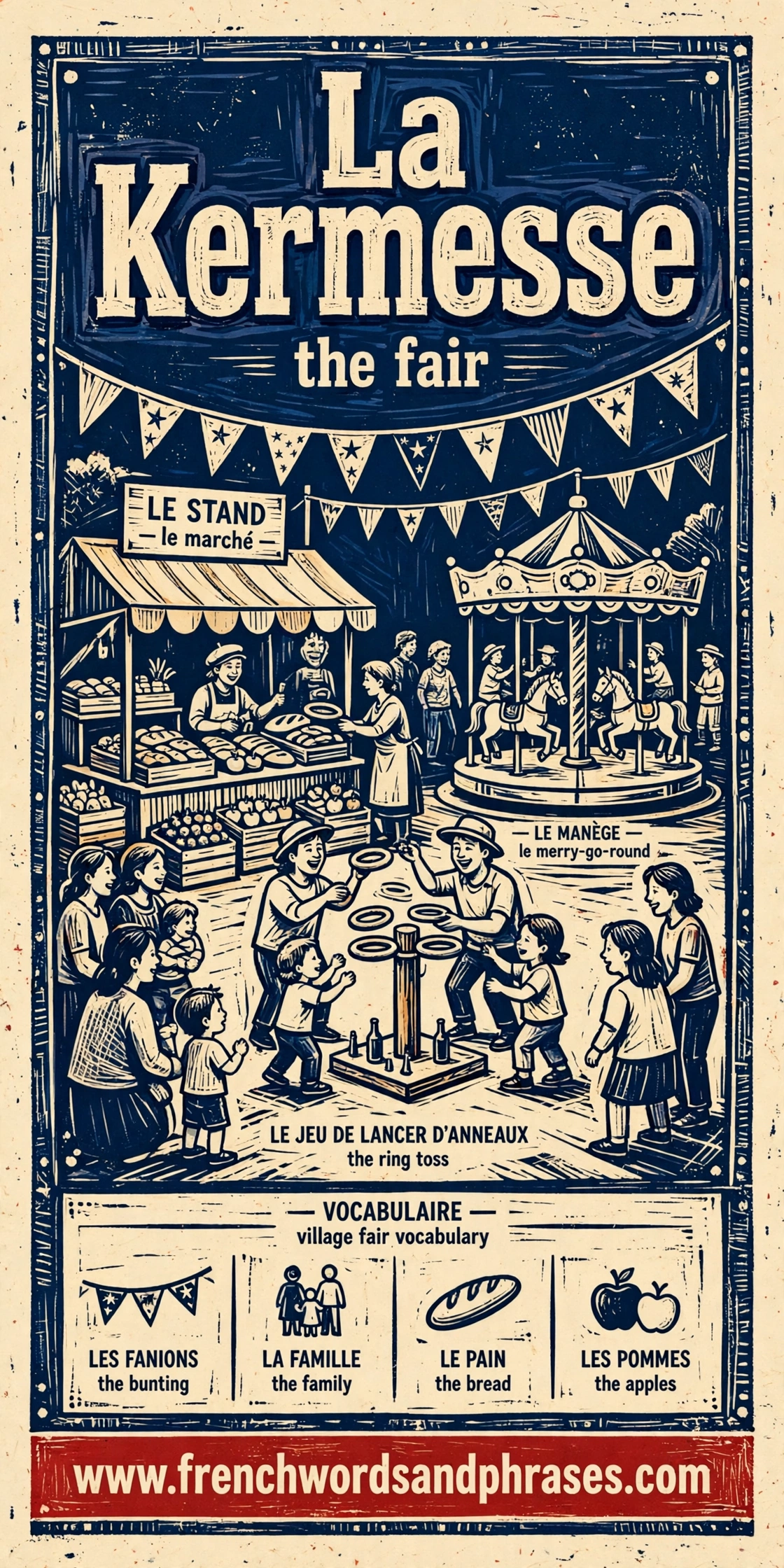
La kermesse means a fair, a village fete.
Strings of flags cross the school courtyard, the smell of crêpes floats over the stalls, and every child in the village is queueing for the raffle. It is the last Saturday of June — la kermesse.
In this guide, you’ll learn what kermesse means in English, how to use it with its articles, how to form its plural, and how it appears in everyday French. Explore French examples, English translations, and practice quizzes.
Understanding the French Noun Kermesse
Kermesse is a feminine French noun. It is learned together with its article: la kermesse, une kermesse.
It means a fair — originally the festival fair of a church parish in Flanders and northern France, held on the saint’s day of the local church. Today the word lives on above all at school: la kermesse de l’école is the school fair, with games, stalls and a raffle, organised by parents to end the school year and raise money. Villages hold them too — part fete, part fundraiser, all noise and colour.
Gender: Feminine
Definite article: la — la kermesse (the fair)
Indefinite article: une — une kermesse (a fair)
Plural: les kermesses
English equivalents: A fair; a village fete; a school fair.
One important usage detail: a kermesse is a fair of stalls and games, not a fairground of rides. A funfair with roller coasters is une fête foraine; a trade fair is une foire. The kermesse is smaller and warmer — tombola, cake stall, hook-a-duck, and the whole village lending a hand.
Experience the Word
Kermesse is more than a fair. It is the village celebrating itself — every parent behind a stall, every child with a ticket, every grandparent on a folding chair.
Imagine the end of the school year: bunting over the courtyard, a microphone that crackles, the smell of waffles, and the raffle draw that the whole street waits for.
You have not just been to a fair. You have been welcomed into the village.
How to Use Kermesse in French: Complete Guide
Let’s explore how kermesse works in French, beginning with its articles.
Kermesse with the Definite Article (La, Les)
Used for the fair everyone knows — the school’s fair, the village’s fair, the one at the end of June.
| Number | French |
|---|---|
| Singular | la kermesse |
| Plural | les kermesses |
Example
La kermesse de l’école a lieu samedi prochain.
The school fair takes place next Saturday.
Kermesse with the Indefinite Article (Une, Des)
Used for a fair you mention for the first time, or for fairs in general.
| Number | French |
|---|---|
| Singular | une kermesse |
| Plural | des kermesses |
Example
Le village organise une kermesse chaque été.
The village organises a fair every summer.
At the Kermesse: Stalls and Games
A kermesse is built of stalls — learn their names and you can play, eat and win in French.
| French | In English |
|---|---|
| la tombola | the raffle |
| le stand de gâteaux | the cake stall |
| la pêche aux canards | hook-a-duck |
| la buvette | the refreshment stall |
| le chamboule-tout | the knock-down game |
| les jeux pour enfants | the children’s games |
Example
Les enfants adorent la pêche aux canards à la kermesse.
The children love hook-a-duck at the fair.
Quick Quiz 1
What is la tombola?
Reveal the answer
The raffle — the draw where tickets win prizes.
J’ai gagné un jambon à la tombola !
I won a ham in the raffle!
The Plural of Kermesse
Kermesse simply adds an -s in the plural — les kermesses, a letter you write but do not hear.
| Number | French |
|---|---|
| Singular | la kermesse |
| Plural | les kermesses |
Example
Les kermesses des villages voisins ont lieu en juillet.
The neighbouring villages’ fairs take place in July.
Kermesse with Possessive Adjectives (Ma, Ta, Sa…)
Possessives agree with the noun, not with the owner — and kermesse is feminine, so it takes ma, ta, sa.
| Owner | French |
|---|---|
| my | ma kermesse |
| your (tu) | ta kermesse |
| his / her | sa kermesse |
| our | notre kermesse |
| your (vous) | votre kermesse |
| their | leur kermesse |
Example
Notre école prépare sa kermesse depuis un mois.
Our school has been preparing its fair for a month.
Quick Quiz 2
Complete the sentence:
Notre école organise ______ kermesse en juin.
Reveal the answer
sa
Notre école organise sa kermesse en juin.
Our school organises its fair in June.
Kermesse with Demonstrative Adjectives (Cette, Ces)
Used to point: this fair here, those fairs there.
| Number | French |
|---|---|
| Singular | cette kermesse |
| Plural | ces kermesses |
Example
Cette kermesse est la plus belle de l’année.
This fair is the finest of the year.
Kermesse with Adjectives
Adjectives agree with kermesse, feminine: une kermesse annuelle, une grande kermesse.
| Adjective | With Kermesse |
|---|---|
| annuelle (annual) | la kermesse annuelle |
| grande (big) | une grande kermesse |
| traditionnelle (traditional) | une kermesse traditionnelle |
| paroissiale (parish) | la kermesse paroissiale |
| réussie (successful) | une kermesse réussie |
Example
La kermesse annuelle du village attire tout le monde.
The village’s annual fair draws everyone.
Quick Quiz 3
Complete the sentence:
C’est une kermesse très ______. (successful)
Reveal the answer
réussie
C’est une kermesse très réussie.
It is a very successful fair.
Everyday Expressions with Kermesse
From the school gate to the village square, these are the kermesse phrases of daily life.
| Expression | In English |
|---|---|
| la kermesse de l’école | the school fair |
| la kermesse du village | the village fete |
| organiser une kermesse | to organise a fair |
| tenir un stand | to run a stall |
| la tombola de la kermesse | the fair’s raffle |
| le jour de la kermesse | fair day |
Example
Les parents tiennent un stand le jour de la kermesse.
The parents run a stall on fair day.
Words from the Same Family as Kermesse
Fairs, stalls and the people who run them — the words that travel with kermesse.
| French | In English |
|---|---|
| la fête | the party, the festival |
| la foire | the (trade) fair |
| le stand | the stall |
| la tombola | the raffle |
| la buvette | the refreshment stall |
| le bénévole | the volunteer |
Example
Les bénévoles préparent la fête depuis le matin.
The volunteers have been preparing the fete since morning.
Quick Quiz 4
What is the difference between une kermesse and une fête foraine?
Reveal the answer
Une kermesse is a fair of stalls and games, often for a school or a village; une fête foraine is a funfair with rides.
Les enfants jouent aux stands de la kermesse.
The children play at the stalls of the fair.
Kermesse in Everyday French: Real-Life Examples
Now that you know the word, let’s see how kermesse appears in everyday French.
Example 1 — At school
La kermesse de l’école commence à dix heures.
The school fair starts at ten o’clock.
Example 2 — Helping out
Ma mère tient le stand de gâteaux à la kermesse.
My mother runs the cake stall at the fair.
Example 3 — Winning a prize
J’ai gagné une plante à la tombola de la kermesse.
I won a plant in the fair’s raffle.
Example 4 — In the village
Tout le village vient à la kermesse en juin.
The whole village comes to the fete in June.
Example 5 — Asking a friend
Tu viens à la kermesse samedi ?
Are you coming to the fair on Saturday?
Example 6 — After the fair
La kermesse a rapporté beaucoup d’argent pour l’école.
The fair raised a lot of money for the school.
Beyond Translation: The Meaning of Kermesse
The word travelled south from Flanders, where a kermesse was the feast of the parish church — part mass, part market, part party.
To say kermesse is to hear the village band warming up.
It evokes bunting over the schoolyard, grandmothers selling waffles, a raffle ham nobody expected to win — the one Saturday of the year when the whole community works together and calls it a celebration.
How to Remember the French Noun Kermesse
Remember it this way: Kermesse is the fair of stalls and games — feminine, with la and une, and the tombola at its heart.
- You take the children — on va à la kermesse de l’école.
- You run a stall — je tiens un stand à la kermesse.
- You buy a ticket — un billet pour la tombola de la kermesse.
The key idea is la kermesse for the fair, la tombola for its raffle.
Test Your Knowledge of Kermesse
Let’s see how much you’ve learned. Try answering these questions before revealing the answers.
Question 1
Is kermesse masculine or feminine?
Reveal the answer
Feminine — la kermesse, une kermesse.
Question 2
Where does the word kermesse come from?
Reveal the answer
Flanders — it was originally the festival fair of a parish church.
Question 3
Translate: The school fair takes place in June.
Reveal the answer
La kermesse de l’école a lieu en juin.
Question 4
What is la tombola?
Reveal the answer
The raffle — the prize draw at the heart of the fair.
Question 5
Complete the sentence:
Les parents organisent ______ kermesse de l’école.
Reveal the answer
la
Les parents organisent la kermesse de l’école.
The parents organise the school fair.
Your Final Challenge
Can You Use It?
How would you say this in French?
“The whole village comes to the fair in June.”
Reveal the answer
Tout le village vient à la kermesse en juin.
The whole village comes to the fair in June.
A little French. A little curiosity. A richer everyday life.
LEARN FRENCH ONE WORD AT A TIME