A French Word to Live By
Translate Italien to English
/italjɛ̃/
Italien means Italian.
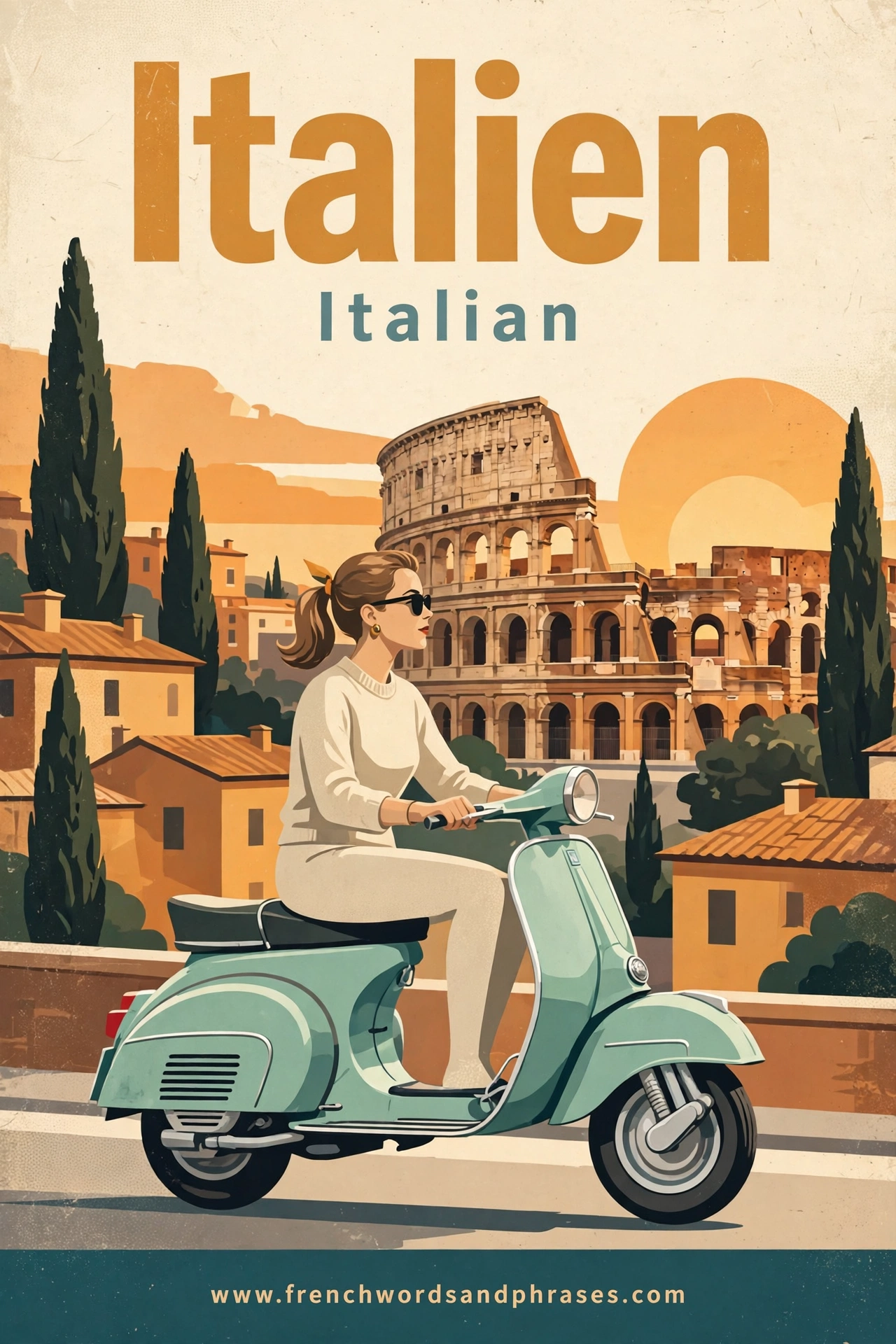
A narrow street in Rome at noon: washing strung between the windows, a Vespa rattling over the cobbles, and from an open doorway the smell of tomatoes, basil and warm bread. Everything in the scene — the noise, the appetite, the sunshine — is summed up by one French word: italien.
In this guide, you’ll learn what italien means in English, how its feminine italienne doubles the n, why the people take a capital letter but the adjective never does, and how the same word names the language itself. Explore French examples, English translations, and practice quizzes.
Understanding the French Adjective Italien
Italien is a French nationality adjective — it says where someone or something comes from: Italy. It has four forms: masculine italien, feminine italienne, masculine plural italiens, feminine plural italiennes. The feminine doubles the n: -ien becomes -ienne.
It means Italian — from Italy, or in the Italian way. It describes people (un acteur italien, an Italian actor; une chanteuse italienne, an Italian singer), things (une voiture italienne, an Italian car; la cuisine italienne, Italian cooking) and, as a noun in the masculine, the language itself: l’italien, Italian.
Type: Nationality adjective — origin and language
Answers the question: Where is it from? — Italian, from Italy
Feminine: italienne — the -ien ending becomes -ienne, with a double n
Changes form: Yes — italien, italienne, italiens, italiennes
English equivalents: Italian.
One important usage detail: as a noun naming a person, italien takes a capital letter — un Italien, une Italienne. But the adjective stays lower-case — un film italien — and so does the language: je parle italien, I speak Italian.
Experience the Word
Italien is the adjective of the long lunch and the loud family table — of espresso taken standing up, of hand-made pasta, of a football crowd singing in blue.
Imagine a small shoe workshop in the Marche, where the same family has cut leather for four generations. The shoes travel the world, but the hands, the patience and the arguments are entirely of this valley — italiennes to the bone.
You have not just named a country of origin. You have pointed at a whole way of eating, talking and living.
How to Use Italien in French: Complete Guide
Let’s explore how italien works in French, beginning with the whole word on one card.
Italien at a Glance
Before the details, here is the whole word on one card.
The Whole Word on One Card
Meaning, type, position and forms — italien in four lines.
| Point | Italien |
|---|---|
| Meaning | Italian |
| Type | nationality adjective — Italy |
| Usual position | after the noun — un film italien |
| Form | italien / italienne / italiens / italiennes |
Example
C’est un film italien.
It’s an Italian film.
The Four Forms of Italien
Italien agrees with the noun it describes. The feminine doubles the n — italien becomes italienne — and the plurals add an s.
| Form | Italien | Example |
|---|---|---|
| Masculine singular | italien | un acteur italien — an Italian actor |
| Feminine singular | italienne | une actrice italienne — an Italian actress |
| Masculine plural | italiens | des acteurs italiens — Italian actors |
| Feminine plural | italiennes | des actrices italiennes — Italian actresses |
Example
Un acteur italien et une actrice italienne jouent dans ce film.
An Italian actor and an Italian actress are in this film.
Quick Quiz 1
Which form of italien goes with actrice (feminine)?
Reveal the answer
italienne
Une actrice italienne.
An Italian actress.
Italienne: The Feminine Doubles the N
Adjectives ending in -ien build their feminine in -ienne: the n doubles and the ending opens up. Italien and italienne do not sound alike — listen for the extra beat: /italjɛ̃/ against /italjɛn/.
| Situation | Example |
|---|---|
| The rule | -ien becomes -ienne — italien → italienne |
| The sound | italien /italjɛ̃/, italienne /italjɛn/ — the n is heard in the feminine |
| Masculine plural | italiens — des vins italiens |
| Feminine plural | italiennes — des chansons italiennes |
Example
Elle est italienne, elle vient de Naples.
She is Italian, she comes from Naples.
Where Italien Goes: After the Noun
Nationality adjectives follow the noun they describe, like most French adjectives, and they sit naturally after être.
| Pattern | Example |
|---|---|
| After the noun | une voiture italienne — an Italian car |
| After être | il est italien — he is Italian |
| With an adverb | un village très italien — a very Italian village |
| Before the noun | un italien film — not in French |
Example
Nous cherchons un restaurant italien dans le quartier.
We’re looking for an Italian restaurant in the neighbourhood.
Quick Quiz 2
How do you say ‘an Italian car’ — une italienne voiture or une voiture italienne?
Reveal the answer
une voiture italienne
The nationality adjective stands after the noun, in the feminine.
An Italian car.
Italien as a Noun: People Take a Capital
The same word works as a noun. For a person it takes a capital letter — un Italien, une Italienne — and in the masculine it also names the language, in lower-case.
| Use | Example |
|---|---|
| A man | un Italien — an Italian (man) |
| A woman | une Italienne — an Italian (woman) |
| People | les Italiens — the Italians |
| The language | l’italien — je parle italien, I speak Italian |
Example
Les Italiens aiment le café, et beaucoup parlent aussi anglais.
Italians love coffee, and many also speak English.
Everyday Expressions with Italien
Italien is everywhere French talks about food, design and football — la cuisine italienne alone could fill a menu.
| Expression | In English |
|---|---|
| la cuisine italienne | Italian cooking, Italian cuisine |
| un café italien | an Italian coffee — a strong espresso |
| le cinéma italien | Italian cinema |
| à l’italienne | in the Italian way, Italian-style |
| un jardin à l’italienne | an Italian-style formal garden |
| la botte italienne | the Italian boot — Italy’s shape on the map |
Example
La cuisine italienne est célèbre dans le monde entier.
Italian cuisine is famous all over the world.
Quick Quiz 3
What does à l’italienne mean?
Reveal the answer
In the Italian way
Un jardin à l’italienne.
An Italian-style garden.
Italien and Its Neighbours
Around italien stand the other great -ien nationalities of Europe and the country noun itself, l’Italie.
| French | In English |
|---|---|
| l’Italie | Italy — the country |
| espagnol | Spanish — the neighbour across the sea |
| autrichien | Austrian — the neighbour over the Alps |
| suisse | Swiss — the other Alpine neighbour |
| méditerranéen | Mediterranean — the sea they share |
| romain | Roman — of Rome, ancient or modern |
Example
L’Italie partage ses frontières avec la France, la Suisse et l’Autriche.
Italy shares its borders with France, Switzerland and Austria.
Watch Out: The Traps Around Italien
The traps here are the wandering capital letter and the double n that learners forget.
| Trap | The truth |
|---|---|
| The capital | people take a capital — un Italien; the adjective and the language do not — un film italien, parler italien |
| The feminine | double the n — italienne, never ‘italiene’ |
| The country | Italy is l’Italie — feminine: en Italie, to/in Italy |
| Agreement | the adjective agrees with its noun — des chaussures italiennes, Italian shoes |
Example
Un Italien de Milan m’a appris cette recette italienne.
An Italian from Milan taught me this Italian recipe.
Quick Quiz 4
Which sentence has the capital letter right: Un italien parle italien or Un Italien parle italien?
Reveal the answer
Un Italien parle italien
The person takes a capital; the language stays lower-case.
An Italian speaks Italian.
Italien in Everyday French: Real-Life Examples
Now that you know the word, let’s see how italien appears in everyday French.
Example 1 — Travel
Nous passons nos vacances dans un petit village italien.
We’re spending our holiday in a small Italian village.
Example 2 — Food
La cuisine italienne est ma préférée.
Italian cooking is my favourite.
Example 3 — People
Ma voisine est italienne, elle vient de Bologne.
My neighbour is Italian, she comes from Bologna.
Example 4 — Language
J’apprends l’italien depuis deux ans.
I’ve been learning Italian for two years.
Example 5 — Cinema
Nous avons vu un film italien hier soir.
We watched an Italian film last night.
Example 6 — Shopping
Ces chaussures italiennes sont en cuir véritable.
These Italian shoes are made of real leather.
Beyond Translation: The Meaning of Italien
English says Italian for the meaning of italien — but French hears the country inside the word, and with it the whole Mediterranean table: the word arrives carrying tomatoes, marble, opera and argument in equal measure.
To call something italien in French is to credit it with a certain art of living.
And the word does triple duty — people, things and language — with only the capital letter to tell you which one is meant: un Italien eats in un restaurant italien and speaks italien.
How to Remember the French Adjective Italien
Remember it this way: Italien is the Italy adjective — its feminine doubles the n, its people take a capital, and its language stays modestly lower-case.
- You double the n in the feminine — italien becomes italienne.
- You give the person a capital — un Italien, une Italienne — but never the adjective or the language.
- You put it after the noun — un film italien, une cuisine italienne.
The key idea is italien doubles its n in italienne, and only the people — un Italien — take a capital.
Test Your Knowledge of Italien
Let’s see how much you’ve learned. Try answering these questions before revealing the answers.
Question 1
What does italien mean?
Reveal the answer
Italian — from Italy, or in the Italian way.
Question 2
What is the feminine of italien?
Reveal the answer
italienne — the -ien ending becomes -ienne, with a double n.
Question 3
Translate: an Italian actress.
Reveal the answer
Une actrice italienne.
Question 4
Complete the sentence:
Je parle ______ et j’adore la cuisine ______ .
Reveal the answer
italien, italienne
Je parle italien et j’adore la cuisine italienne.
I speak Italian and I love Italian cooking.
Question 5
When does italien take a capital letter?
Reveal the answer
When it names a person — un Italien, une Italienne. The adjective and the language stay lower-case.
Your Final Challenge
Can You Use It?
How would you say this in French?
“My neighbour is Italian and she speaks Italian with her children.”
Reveal the answer
Ma voisine est italienne et elle parle italien avec ses enfants.
My neighbour is Italian and she speaks Italian with her children.
A little French. A little curiosity. A richer everyday life.
LEARN FRENCH ONE WORD AT A TIME