A French Word to Live By
Translate Allemand to English
/almɑ̃/
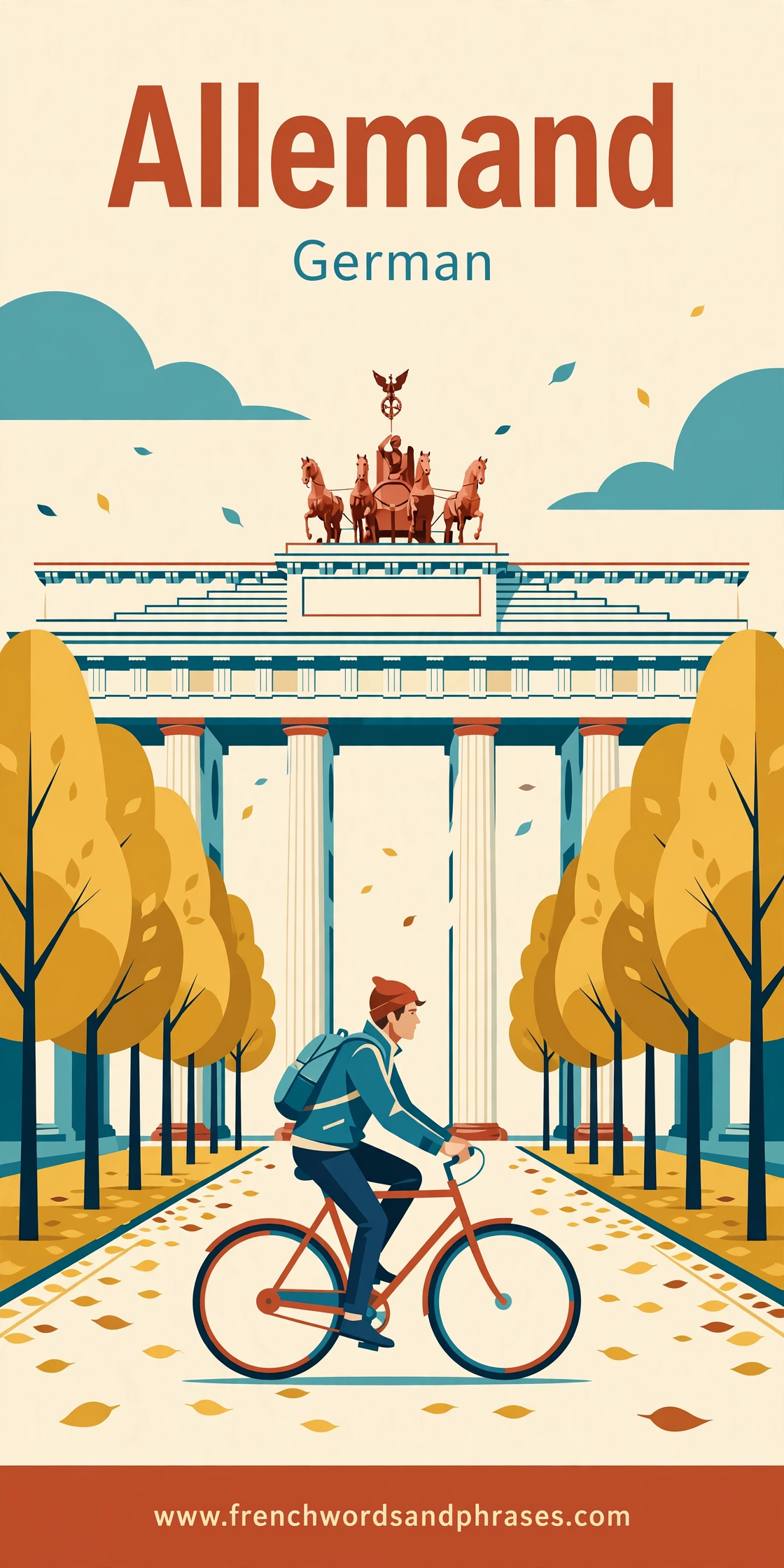
Allemand means German.
A Berlin bakery at seven in the morning: dark rye loaves in rows, the baker’s chalk handwriting on a blackboard, and customers who know exactly which bread they want and say so in one word. Order, craft and a certain seriousness about breakfast — French sums it up as allemand.
In this guide, you’ll learn what allemand means in English, how its feminine allemande simply adds an e, why a German person is un Allemand with a capital while the language stays lower-case, and where the word came from. Explore French examples, English translations, and practice quizzes.
Understanding the French Adjective Allemand
Allemand is a French nationality adjective — it says where someone or something comes from: Germany. It has four forms: masculine allemand, feminine allemande, masculine plural allemands, feminine plural allemandes. The feminine simply adds an e — and the d begins to sound.
It means German — from Germany, or in the German way. It describes people (un écrivain allemand, a German writer; une étudiante allemande, a German student), things (une voiture allemande, a German car) and, as a masculine noun, the language itself: l’allemand, German.
Type: Nationality adjective — origin and language
Answers the question: Where is it from? — German, from Germany
Feminine: allemande — add an e, and the d is pronounced
Changes form: Yes — allemand, allemande, allemands, allemandes
English equivalents: German.
One important usage detail: as a noun naming a person, allemand takes a capital letter — un Allemand, une Allemande. But the adjective stays lower-case — une voiture allemande — and so does the language: elle apprend l’allemand, she is learning German.
Experience the Word
Allemand is the adjective of the well-made thing — of engines that outlive their owners, of timetables that are kept, of bread baked as seriously as cathedrals were built.
Imagine a workshop in the Black Forest where cuckoo clocks have been assembled by the same family since 1880. Every gear is checked twice; nothing leaves the bench until it is exact. That patience, that precision — voilà l’esprit allemand, the German spirit, as French sees it.
You have not just named a country of origin. You have hinted at rigour, craft and a famous love of order.
How to Use Allemand in French: Complete Guide
Let’s explore how allemand works in French, beginning with the whole word on one card.
Allemand at a Glance
Before the details, here is the whole word on one card.
The Whole Word on One Card
Meaning, type, position and forms — allemand in four lines.
| Point | Allemand |
|---|---|
| Meaning | German |
| Type | nationality adjective — Germany |
| Usual position | after the noun — une voiture allemande |
| Form | allemand / allemande / allemands / allemandes |
Example
C’est une voiture allemande.
It’s a German car.
The Four Forms of Allemand
Allemand agrees with the noun it describes. The feminine adds an e — and the plurals add an s.
| Form | Allemand | Example |
|---|---|---|
| Masculine singular | allemand | un écrivain allemand — a German writer |
| Feminine singular | allemande | une étudiante allemande — a German student |
| Masculine plural | allemands | des ingénieurs allemands — German engineers |
| Feminine plural | allemandes | des entreprises allemandes — German companies |
Example
Un écrivain allemand et une étudiante allemande visitent le musée.
A German writer and a German student are visiting the museum.
Quick Quiz 1
Which form of allemand goes with étudiante (feminine)?
Reveal the answer
allemande
Une étudiante allemande.
A German student.
Allemande: The Feminine Wakes the D
The feminine of allemand adds a single e — but it changes the sound: the silent d of allemand /almɑ̃/ wakes up in allemande /almɑ̃d/.
| Situation | Example |
|---|---|
| The rule | just add -e — allemand → allemande |
| The sound | allemand /almɑ̃/, allemande /almɑ̃d/ — the d is heard in the feminine |
| Masculine plural | allemands — des trains allemands |
| Feminine plural | allemandes — des villes allemandes |
Example
Elle est allemande, elle vient de Munich.
She is German, she comes from Munich.
Where Allemand Goes: After the Noun
Nationality adjectives follow the noun they describe, and allemand is perfectly at home after être.
| Pattern | Example |
|---|---|
| After the noun | un orchestre allemand — a German orchestra |
| After être | il est allemand — he is German |
| With an adverb | un style très allemand — a very German style |
| Before the noun | un allemand orchestre — not in French |
Example
Nous écoutons un orchestre allemand ce soir.
We’re listening to a German orchestra tonight.
Quick Quiz 2
How do you say ‘a German student (girl)’ — une allemande étudiante or une étudiante allemande?
Reveal the answer
une étudiante allemande
The nationality adjective stands after the noun, in the feminine.
A German student.
Allemand as a Noun: People Take a Capital
The same word works as a noun. For a person it takes a capital letter — un Allemand, une Allemande — and in the masculine it also names the language, in lower-case.
| Use | Example |
|---|---|
| A man | un Allemand — a German (man) |
| A woman | une Allemande — a German (woman) |
| People | les Allemands — the Germans |
| The language | l’allemand — il parle allemand, he speaks German |
Example
Les Allemands aiment le pain frais, et leur langue est célèbre pour ses mots composés.
Germans love fresh bread, and their language is famous for its compound words.
Everyday Expressions with Allemand
Allemand turns up wherever French talks about engineering, music and Christmas markets.
| Expression | In English |
|---|---|
| un berger allemand | a German shepherd (dog) |
| la cuisine allemande | German cooking |
| un marché de Noël allemand | a German Christmas market |
| la rigueur allemande | German rigour, German thoroughness |
| une autoroute allemande | a German motorway |
| le romantisme allemand | German Romanticism — the poets and painters |
Example
Le berger allemand est un chien loyal et intelligent.
The German shepherd is a loyal, intelligent dog.
Quick Quiz 3
What is un berger allemand?
Reveal the answer
A German shepherd
Berger means shepherd — the dog that guarded the flocks.
A German shepherd dog.
Allemand and Its Neighbours
Around allemand stand the country noun l’Allemagne and the nationalities of Germany’s many neighbours.
| French | In English |
|---|---|
| l’Allemagne | Germany — the country |
| autrichien | Austrian — the German-speaking neighbour |
| suisse | Swiss — German is one of Switzerland’s languages |
| polonais | Polish — the eastern neighbour |
| néerlandais | Dutch — the western neighbour |
| berlinois | of Berlin — un Berlinois, a Berliner |
Example
L’Allemagne est le pays le plus peuplé de l’Union européenne.
Germany is the most populous country in the European Union.
Watch Out: The Traps Around Allemand
The traps here are the capital letter, the country name — and a famous word that has nothing to do with Germany at all.
| Trap | The truth |
|---|---|
| The capital | people take a capital — un Allemand; the adjective and the language do not — une voiture allemande, parler allemand |
| The country | Germany is l’Allemagne — feminine: en Allemagne, to/in Germany |
| allemande (dance) | une allemande is also an old court dance — context tells you which is meant |
| The origin | the word comes from the Alemanni, a Germanic people — not from ‘all men’ |
Example
Un Allemand de Hambourg m’a vendu cette voiture allemande.
A German from Hamburg sold me this German car.
Quick Quiz 4
Which sentence has the capital letter right: Une Allemande apprend le français or Une allemande apprend le Français?
Reveal the answer
Une Allemande apprend le français
The person takes a capital; languages stay lower-case.
A German woman is learning French.
Allemand in Everyday French: Real-Life Examples
Now that you know the word, let’s see how allemand appears in everyday French.
Example 1 — Travel
Nous visitons une petite ville allemande près de la frontière.
We’re visiting a small German town near the border.
Example 2 — Cars
Les voitures allemandes sont réputées pour leur qualité.
German cars are renowned for their quality.
Example 3 — People
Mon collègue est allemand, il vient de Cologne.
My colleague is German, he comes from Cologne.
Example 4 — Language
Elle apprend l’allemand pour son travail.
She’s learning German for her work.
Example 5 — Music
Nous écoutons un orchestre allemand ce week-end.
We’re listening to a German orchestra this weekend.
Example 6 — Food
Ce marché vend des saucisses allemandes et du pain noir.
This market sells German sausages and dark bread.
Beyond Translation: The Meaning of Allemand
English says German for the meaning of allemand — but the French word remembers an older map: it comes from the Alemanni, the confederation of tribes Rome fought along the Rhine, and it is why Spain says alemán and Arabic says Almānyā too.
In French, Germany is not named for the Germans’ own word for themselves — Deutsch — but for their oldest neighbours’ memory of them.
And the word still does its triple duty: un Allemand drives une voiture allemande and speaks allemand — person, thing and language in a single word.
How to Remember the French Adjective Allemand
Remember it this way: Allemand is the Germany adjective — a simple added e for the feminine, a capital for the people, and a lower-case for the language.
- You just add an e for the feminine — allemand becomes allemande, and the d starts to sound.
- You give the person a capital — un Allemand, une Allemande — but never the adjective or the language.
- You remember the country is feminine — l’Allemagne, en Allemagne.
The key idea is allemand adds an e to become allemande, and only the people — un Allemand — take a capital.
Test Your Knowledge of Allemand
Let’s see how much you’ve learned. Try answering these questions before revealing the answers.
Question 1
What does allemand mean?
Reveal the answer
German — from Germany, or in the German way.
Question 2
What is the feminine of allemand?
Reveal the answer
allemande — add an e, and the d is pronounced.
Question 3
Translate: a German car.
Reveal the answer
Une voiture allemande.
Question 4
Complete the sentence:
Elle est ______ , elle vient de Berlin, et elle parle ______ .
Reveal the answer
allemande, allemand
Elle est allemande, elle vient de Berlin, et elle parle allemand.
She is German, she comes from Berlin, and she speaks German.
Question 5
What is Germany called in French?
Reveal the answer
L’Allemagne — a feminine country name: en Allemagne, to or in Germany.
Your Final Challenge
Can You Use It?
How would you say this in French?
“My colleague is German and he speaks German at home.”
Reveal the answer
Mon collègue est allemand et il parle allemand à la maison.
My colleague is German and he speaks German at home.
A little French. A little curiosity. A richer everyday life.
LEARN FRENCH ONE WORD AT A TIME