A French Word to Live By
Translate Il n’y a pas de fumée sans feu to English
/il ni a pa də fy.me sɑ̃ fø/
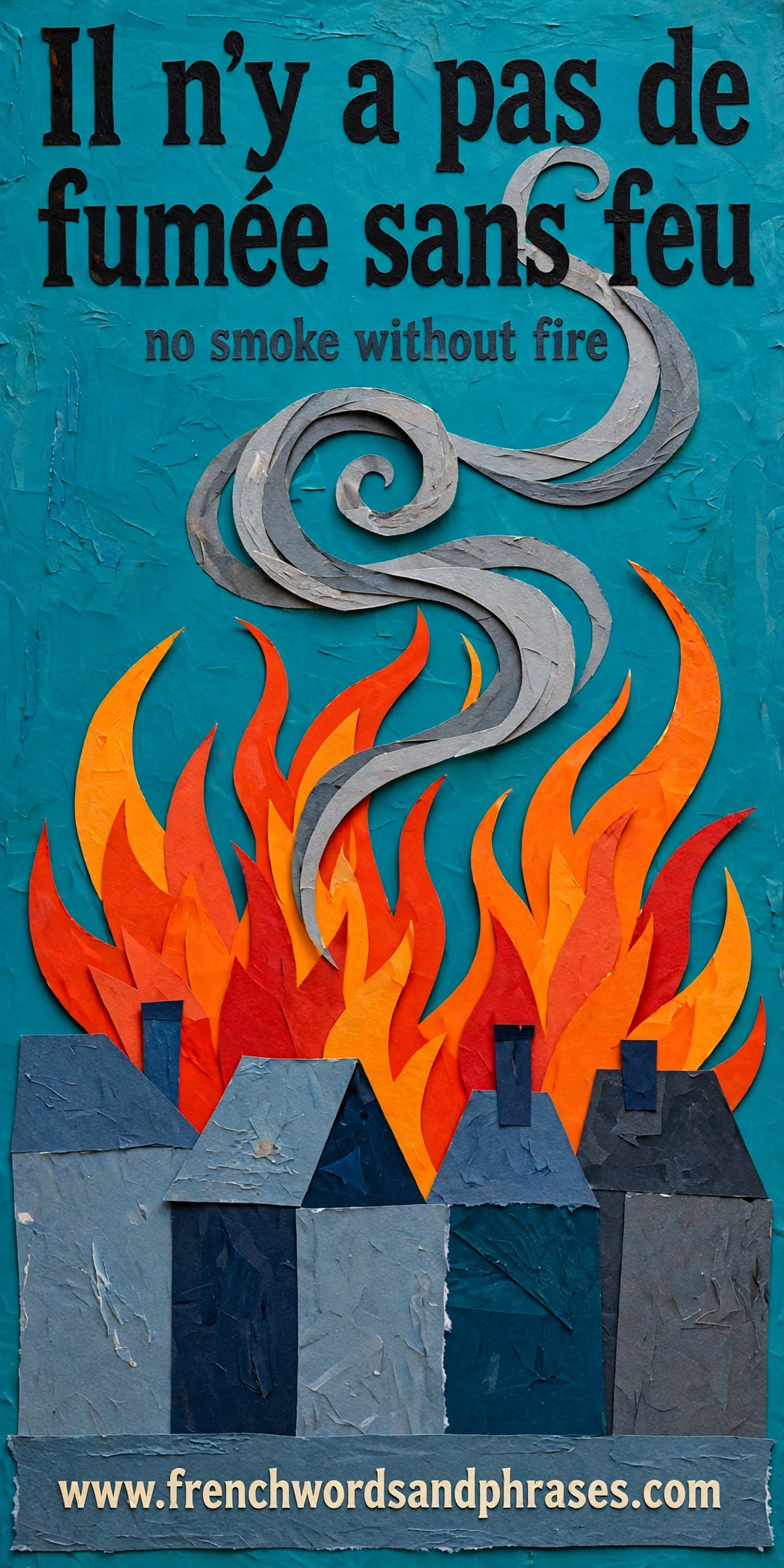
Il n’y a pas de fumée sans feu means no smoke without fire — rumours usually have some truth behind them.
In a bakery queue in Bordeaux, two neighbours are discussing the rumour that the mayor will resign. One of them shrugs: perhaps it is exaggerated, perhaps not. The other buys her baguette and concludes: « Écoute, il n’y a pas de fumée sans feu. »
Let’s explore how il n’y a pas de fumée sans feu works in French, beginning with the whole phrase on one card.
Understanding the French Phrase Il n’y a pas de fumée sans feu
Il n’y a pas de fumée sans feu is a French proverb built from il n’y a pas (there is no), de fumée (smoke) and sans feu (without fire). It is a complete negative sentence: smoke never appears unless something, somewhere, is burning.
It means no smoke without fire — when a rumour keeps circulating, there is probably something real behind it. Nobody is reporting a chimney: the smoke is the talk, the gossip, the hint, and the fire is the hidden fact feeding it. French speakers use it about politics, offices, celebrities and neighbours — always with the suggestion that pure invention rarely spreads so well.
Type: Proverb — a complete negative sentence about rumours
Answers the need: Saying a persistent rumour probably has some truth in it
Register: Neutral — safe everywhere, in speech and writing, often in discussions of news and gossip
Strength: Suggestive, not certain — it says ‘probably something’, never ‘all of it is true’
One important usage detail: the proverb argues probability, not proof. Careful speakers use it to justify a suspicion — il doit y avoir quelque chose, il n’y a pas de fumée sans feu — and careful listeners answer that smoke machines exist too. It opens an investigation; it never closes one.
Experience the Word
Il n’y a pas de fumée sans feu is the proverb of the persistent rumour — the story that will not die because something, somewhere, keeps feeding it.
Imagine a small factory where, for the third month running, people whisper that it will be sold. The director denies it every Friday. Then the surveyors arrive with their tripods on a Tuesday morning, and the oldest worker only nods: he had smelled the smoke for weeks.
French loves this proverb because it flatters observation. The wise do not believe the smoke — they go and look for the fire.
How to Use Il n’y a pas de fumée sans feu in French: Complete Guide
Let’s explore how il n’y a pas de fumée sans feu works in French, beginning with the whole phrase on one card.
Il n’y a pas de fumée sans feu at a Glance
The Whole Phrase on One Card
Real meaning, literal picture, English twin and register — il n’y a pas de fumée sans feu in five lines.
| Point | Il n’y a pas de fumée sans feu |
|---|---|
| What it really means | a lasting rumour usually hides a real fact |
| Word for word | there is no smoke without fire |
| English equivalent | no smoke without fire / where there’s smoke, there’s fire |
| Register | neutral — news, offices, villages, families |
| Use it for | rumours of resignations, sales, scandals — talk that will not die |
Example
Tout le monde parle de sa démission ; il n’y a pas de fumée sans feu.
Everyone is talking about his resignation; no smoke without fire.
Word by Word: Building the Smoke
Five small pieces — take them one by one and the hidden fire appears.
| Word | Literal meaning | Its job in the phrase |
|---|---|---|
| il n’y a pas | there is no | the negative of il y a — the proverb starts by denying |
| de fumée | smoke | the rumour itself: visible, drifting, impossible to hold |
| sans | without | the hinge of the proverb — smoke never travels alone |
| feu | fire | the hidden cause: the fact, the event, the truth at the source |
Example
Regarde la fumée au loin : il y a un feu quelque part.
Look at the smoke in the distance: there is a fire somewhere.
Quick Quiz 1
In the proverb’s picture, what does the fumée stand for — the fact, or the rumour?
Reveal the answer
The rumour — the smoke is what everyone sees and repeats; the feu is the hidden fact feeding it.
La rumeur court, mais où est le feu ?
The rumour is spreading, but where is the fire?
When You Say It: The Rumour Moments
The proverb fires at moments like these — talk is spreading, and someone judges that it cannot be pure invention.
| Situation | Example |
|---|---|
| Politics | on parle de sa démission depuis des semaines, il n’y a pas de fumée sans feu — his resignation has been talked about for weeks; no smoke without fire |
| At the office | la rumeur de la vente revient sans cesse, il n’y a pas de fumée sans feu — the sale rumour keeps coming back |
| Celebrity news | les journaux en parlent partout, il n’y a pas de fumée sans feu — the papers are full of it |
| A village story | au village, tout le monde le murmure : il n’y a pas de fumée sans feu — in the village, everyone is whispering it |
| With caution | peut-être, mais la fumée ne dit pas tout — perhaps, but the smoke doesn’t tell everything |
Example
Trois mois de rumeurs sur la fermeture… il n’y a pas de fumée sans feu.
Three months of rumours about the closure… no smoke without fire.
Make It Yours: The Proverb in Other Forms
The sentence is fixed, but speakers trim it, question it and push back against it.
| Form | French | In English |
|---|---|---|
| The full proverb | il n’y a pas de fumée sans feu | there is no smoke without fire |
| Shortened | pas de fumée sans feu | no smoke without fire (the start is dropped) |
| As a conclusion | alors, il n’y a pas de fumée sans feu | so, no smoke without fire |
| Questioning it | et si la fumée venait d’une machine ? | and what if the smoke came from a machine? |
| Pushing back | la fumée, parfois, c’est juste de la méchanceté | sometimes the smoke is just spite |
| About a person | on ne parle pas de lui pour rien | people don’t talk about him for no reason |
Example
Pas de fumée sans feu, dit-elle en fermant le journal.
No smoke without fire, she said, closing the newspaper.
Quick Quiz 2
Does this proverb prove a rumour is true — yes, or only suggest it?
Reveal the answer
It only suggests — the proverb argues that something real probably feeds the talk; it never says the whole story is accurate.
Il y a du vrai là-dessous, mais pas tout.
There is some truth in it, but not all of it.
Everyday Expressions: Building on the Smoke
The proverb slots into these everyday frames — each one ready to use as it stands.
| Frame | In English |
|---|---|
| il n’y a pas de fumée sans feu | no smoke without fire |
| une rumeur qui court | a rumour that is going around — literally, running |
| il doit y avoir quelque chose | there must be something in it |
| le bruit court que… | word is going around that… — literally, the noise runs that… |
| démentir une rumeur | to deny a rumour |
Example
Le bruit court que le directeur va partir.
Word is going around that the director is going to leave.
Close Cousins: The Other Rumour Phrases
French has a whole shelf for talk and suspicion — the smoke is the suggestive one; its cousins deny, spread or verify.
| Expression | The difference |
|---|---|
| il n’y a pas de fumée sans feu | no smoke without fire — the rumour probably hides a fact |
| le bruit court que… | word is going around that… — simply reports the rumour, no judgment |
| c’est du vent | it’s just wind — the opposite verdict: the story is empty, nothing behind it |
| il y a anguille sous roche | there’s an eel under the rock — something fishy is hidden here |
| vérifier avant de répéter | to check before repeating — the careful person’s rule, not a proverb |
Example
Pour moi, cette histoire, c’est du vent.
As far as I’m concerned, that story is just wind.
Quick Quiz 3
A rumour turns out to be completely invented. Which phrase gives the opposite verdict — c’est du vent or il y a anguille sous roche?
Reveal the answer
C’est du vent — ‘it’s just wind’: nothing behind it at all. Anguille sous roche agrees with our proverb that something is hidden.
Trois jours plus tard, on a su que c’était du vent.
Three days later, we learned it was just wind.
Il n’y a pas de fumée sans feu and Its Neighbours
The rumour shelf around the proverb — the talk, the denial and the search for facts.
| French | In English |
|---|---|
| une rumeur | a rumour |
| un démenti | a denial |
| la fumée | the smoke — the talk everyone sees |
| le feu | the fire — the hidden fact |
| il n’y a pas de fumée sans feu | no smoke without fire |
| chercher la vérité | to look for the truth — what the wise do next |
Example
Malgré le démenti officiel, la rumeur continue de courir.
Despite the official denial, the rumour keeps spreading.
Watch Out: The Traps Around the Smoke
The traps: a proverb mistaken for proof, a fumée that is also steam, and a negation that drops its ne.
| Trap | The truth |
|---|---|
| suggestion is not proof | the proverb justifies looking into a rumour — repeating it as fact is how innocent people get burned by someone else’s smoke |
| fumée is not only smoke | la fumée can rise from a fire, but steam over a hot dish is la vapeur — the proverb’s fumée always belongs to a feu |
| spoken French drops the ne | you will hear ‘y a pas de fumée sans feu’ in fast speech — the written proverb keeps il n’y a pas |
| feu has other lives | un feu is also a traffic light and a hob ring: passer au feu rouge — context keeps the proverb’s fire a fire |
Example
Attention au feu rouge, même si la rumeur dit que la route est libre.
Mind the red light, even if rumour says the road is clear.
Quick Quiz 4
True or false: repeating this proverb about a colleague is a fair way to spread a rumour about him.
Reveal the answer
False — the proverb voices a suspicion; it is not evidence, and using it to spread talk is exactly how smoke harms people.
Avant de répéter, il faut vérifier.
Before repeating, you must check.
Il n’y a pas de fumée sans feu in Everyday French: Real-Life Examples
Now that you know the word, let’s see how il n’y a pas de fumée sans feu appears in everyday French.
Example 1 — The resignation rumour
Tout le journal parle de sa démission : il n’y a pas de fumée sans feu.
The whole paper is talking about his resignation: no smoke without fire.
Example 2 — At the office
La rumeur de la vente revient chaque semaine.
The rumour of the sale comes back every week.
Example 3 — In the village
Au café, tout le monde murmure la même histoire.
At the café, everyone is whispering the same story.
Example 4 — The denial
Le maire a démenti, mais les gens continuent d’en parler.
The mayor denied it, but people keep talking about it.
Example 5 — With caution
Il y a peut-être du vrai, mais attendons les faits.
There may be some truth in it, but let’s wait for the facts.
Example 6 — The conclusion
Trois indices en un mois… pas de fumée sans feu.
Three clues in one month… no smoke without fire.
Beyond Translation: The Meaning of Il n’y a pas de fumée sans feu
English and French share this one almost word for word — where there’s smoke, there’s fire — because every village on both sides of the Channel learned the same lesson: stories that spread usually feed on something. But both languages also keep the proverb’s shadow: smoke can be manufactured, and crowds have believed smoke before.
To say il n’y a pas de fumée sans feu is to trust the signal, not the story.
The proverb at its best sends you looking for the fire. At its worst, it is the fire — a rumour burning a reputation. French speakers know both readings, and the raised eyebrow that comes with the phrase says they are choosing carefully.
How to Remember the French Phrase Il n’y a pas de fumée sans feu
Remember it this way: Il n’y a pas de fumée sans feu is the rumour as weather — visible smoke above, hidden fire below.
- You split the picture — the fumée is the talk everyone sees; the feu is the fact nobody has found yet.
- You keep it a suspicion — the proverb says ‘probably something’, never ‘proven’: it opens investigations, it does not close them.
- You remember its opposite — a story with nothing behind it is du vent, just wind.
The key idea is il n’y a pas de fumée sans feu means no smoke without fire — persistent rumours usually hide a fact.
Test Your Knowledge of Il n’y a pas de fumée sans feu
Let’s see how much you’ve learned. Try answering these questions before revealing the answers.
Question 1
What does il n’y a pas de fumée sans feu mean?
Reveal the answer
No smoke without fire — a persistent rumour usually has some real fact behind it.
Question 2
What is the literal, word-for-word meaning?
Reveal the answer
There is no smoke without fire — la fumée is smoke, and le feu is fire.
Question 3
In the proverb’s picture, what do the smoke and the fire represent?
Reveal the answer
The smoke is the rumour everyone sees; the fire is the hidden fact feeding it.
Question 4
What does c’est du vent mean, as the opposite verdict?
Reveal the answer
It’s just wind — the story is empty; there is nothing behind it at all.
Question 5
Complete the sentence:
Il n’y a pas de ______ sans feu. (There is no smoke without fire.)
Reveal the answer
fumée
Il n’y a pas de fumée sans feu.
There is no smoke without fire.
Your Final Challenge
Can You Use It?
How would you say this in French?
“Everyone is talking about it; there is no smoke without fire.”
Reveal the answer
Tout le monde en parle ; il n’y a pas de fumée sans feu.
Everyone is talking about it; there is no smoke without fire.
A little French. A little curiosity. A richer everyday life.
LEARN FRENCH ONE WORD AT A TIME