A French Word to Live By
Translate C’est en forgeant qu’on devient forgeron to English
/sɛ.tɑ̃ fɔʁ.ʒɑ̃ kɔ̃ də.vjɛ̃ fɔʁ.ʒə.ʁɔ̃/
C’est en forgeant qu’on devient forgeron means practice makes perfect — you become skilled by doing the thing, again and again.
A piano teacher in Nantes watches her young pupil stumble through the same passage for the tenth time. The boy sighs that he will never manage it. She closes the score gently and gives him the blacksmith’s answer: « C’est en forgeant qu’on devient forgeron. »
Let’s explore how c’est en forgeant qu’on devient forgeron works in French, beginning with the whole phrase on one card.
Understanding the French Phrase C’est en forgeant qu’on devient forgeron
C’est en forgeant qu’on devient forgeron is a French proverb built from c’est en forgeant (it is by forging — the gérondif, en + present participle), qu’on devient (that one becomes, from devenir) and un forgeron (a blacksmith). It is a complete sentence about how skill is made.
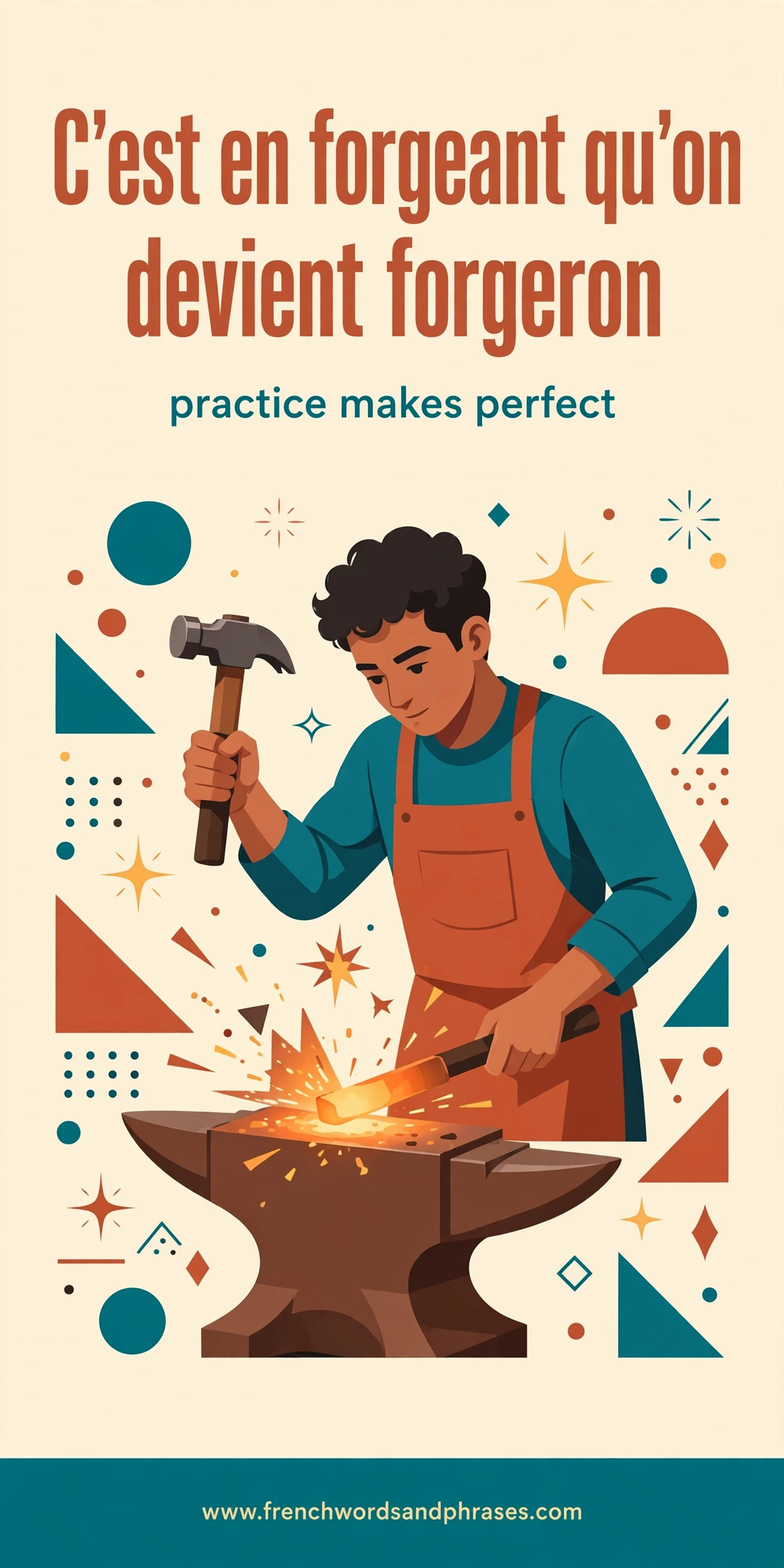
It means practice makes perfect — nobody is born a blacksmith; you become one by forging, badly at first, then less badly, then well. The picture is the village forge: hot iron, a hammer, and an apprentice whose first horseshoes are crooked. French speakers use it for languages, music, sport, cooking — every skill that only repetition can teach.
Type: Proverb — a complete sentence built on a trade, the forge
Answers the need: Encouraging someone who is learning slowly: keep practising
Register: Neutral — safe everywhere, in speech and writing, encouraging in tone
Strength: Patient — it promises mastery, but only through repetition
One important usage detail: the proverb adapts to any trade by swapping the verb and the craftsman — teachers say c’est en lisant qu’on devient lecteur, and language learners hear c’est en parlant qu’on apprend à parler. The frame c’est en + -ant qu’on devient… is the reusable treasure inside the proverb.
Experience the Word
C’est en forgeant qu’on devient forgeron is the apprentice’s proverb — it dignifies every crooked first attempt by making it a necessary step.
Imagine the forge at dawn: the master does not lecture. He hands the boy the hammer and a piece of iron, and lets the metal teach what no speech could. By winter the boy’s horseshoes hold. Nothing was explained; everything was practised.
French trusts the hand more than the lecture. In this proverb, doing is not how you show the skill — it is how you get it.
How to Use C’est en forgeant qu’on devient forgeron in French: Complete Guide
Let’s explore how c’est en forgeant qu’on devient forgeron works in French, beginning with the whole phrase on one card.
C’est en forgeant qu’on devient forgeron at a Glance
The Whole Phrase on One Card
Real meaning, literal picture, English twin and register — the blacksmith’s proverb in five lines.
| Point | C’est en forgeant qu’on devient forgeron |
|---|---|
| What it really means | skill comes from practice, not from talent alone |
| Word for word | it is by forging that one becomes a blacksmith |
| English equivalent | practice makes perfect |
| Register | neutral — encouraging, used by teachers, parents and coaches |
| Use it for | languages, music, sport, crafts — anything learned by doing |
Example
Continue tes gammes : c’est en forgeant qu’on devient forgeron.
Keep up your scales: practice makes perfect.
Word by Word: Building the Forge
Five small pieces — take them one by one and the apprentice picks up the hammer.
| Word | Literal meaning | Its job in the phrase |
|---|---|---|
| c’est en | it is by | the frame that names the method — by doing the thing |
| forgeant | forging | the gérondif of forger: en + -ant means ‘by doing’ |
| qu’on | that one | que + on — on is the apprentice, the learner, anyone |
| devient | becomes | third person of devenir, to become — the slow transformation |
| forgeron | a blacksmith | the master of the forge — the finished skill, in one person |
Example
Le jeune forgeron forge du matin au soir.
The young blacksmith forges from morning to evening.
Quick Quiz 1
What is a forgeron?
Reveal the answer
A blacksmith — the craftsman who works hot iron at the forge, with hammer and anvil.
Le forgeron du village répare les outils des fermiers.
The village blacksmith repairs the farmers’ tools.
When You Say It: The Learning Moments
The proverb fires at moments like these — a learner is discouraged, and someone points at the hammer.
| Situation | Example |
|---|---|
| Music practice | tes gammes sont difficiles, mais c’est en forgeant qu’on devient forgeron — your scales are hard, but practice makes perfect |
| Learning French | parle tous les jours : c’est en forgeant qu’on devient forgeron — speak every day: practice makes perfect |
| A young cook | sa première sauce est ratée, c’est en forgeant qu’on devient forgeron — his first sauce failed; practice makes perfect |
| Sport training | l’entraînement est dur, c’est en forgeant qu’on devient forgeron — training is hard; practice makes perfect |
| About yourself | je débute, mais c’est en forgeant qu’on devient forgeron — I’m a beginner, but practice makes perfect |
Example
Ne lâche pas la guitare : c’est en forgeant qu’on devient forgeron.
Don’t give up the guitar: practice makes perfect.
Make It Yours: The Frame for Every Trade
The proverb’s frame is a machine: swap the -ant verb and the trade, and it encourages anyone.
| Form | French | In English |
|---|---|---|
| The original | c’est en forgeant qu’on devient forgeron | it is by forging that one becomes a blacksmith |
| For readers | c’est en lisant qu’on devient lecteur | it is by reading that one becomes a reader |
| For speakers | c’est en parlant qu’on apprend à parler | it is by speaking that one learns to speak |
| For cooks | c’est en cuisinant qu’on devient cuisinier | it is by cooking that one becomes a cook |
| Shortened | c’est en forgeant… | it’s by forging… (the rest is understood) |
| Question form | comment devient-on forgeron ? en forgeant | how does one become a blacksmith? by forging |
Example
C’est en écrivant tous les jours qu’on devient écrivain.
It is by writing every day that one becomes a writer.
Quick Quiz 2
What does the little structure en forgeant mean — ‘while forging’ or ‘by forging’?
Reveal the answer
By forging — en + present participle (the gérondif) names the means: by doing it, you become it.
C’est en travaillant qu’on réussit.
It is by working that one succeeds.
Everyday Expressions: Building on the Forge
The blacksmith’s proverb slots into these everyday frames — each one ready to use as it stands.
| Frame | In English |
|---|---|
| c’est en forgeant qu’on devient forgeron | practice makes perfect |
| s’exercer tous les jours | to practise every day |
| faire des progrès | to make progress |
| apprendre sur le tas | to learn on the job — literally, on the heap, at the workplace |
| à force de pratiquer | through practising, by dint of practice |
Example
À force de pratiquer, ses progrès sont évidents.
Through practising, his progress is clear.
Close Cousins: The Other Roads to Mastery
French has a whole shelf of learning phrases — the forge is the patient one; its cousins repeat, err or start small.
| Expression | The difference |
|---|---|
| c’est en forgeant qu’on devient forgeron | practice makes perfect — mastery through doing |
| petit à petit, l’oiseau fait son nid | little by little, the bird builds its nest — patience through small steps |
| on apprend de ses erreurs | you learn from your mistakes — the errors are the teachers |
| la répétition est la mère du savoir | repetition is the mother of knowledge — the schoolroom version |
| s’entraîner dur | to train hard — the plain sporting phrase, no picture |
Example
On apprend de ses erreurs, surtout les premières semaines.
You learn from your mistakes, especially in the first weeks.
Quick Quiz 3
Which cousin builds its lesson step by small step — the blacksmith, or petit à petit, l’oiseau fait son nid?
Reveal the answer
The bird — petit à petit is about small steps accumulating; the forge is about doing the very thing itself.
Petit à petit, son français s’améliore chaque semaine.
Little by little, his French improves every week.
C’est en forgeant and Its Neighbours
The workshop shelf around the proverb — the tools, the apprentice and the finished work.
| French | In English |
|---|---|
| la forge | the forge |
| un apprenti | an apprentice |
| le marteau et l’enclume | the hammer and the anvil |
| forger | to forge |
| c’est en forgeant qu’on devient forgeron | practice makes perfect |
| un maître artisan | a master craftsman — the journey’s end |
Example
L’apprenti regarde le maître travailler à l’enclume.
The apprentice watches the master work at the anvil.
Watch Out: The Traps Around the Forge
The traps: a forgeron who is not a forger, an on that is not ‘we’ exactly, and practice praised without an object.
| Trap | The truth |
|---|---|
| forgeron is not a counterfeiter | a forger of documents is un faussaire; le forgeron only works iron — English ‘forger’ splits in two in French |
| on is wider than ‘we’ | on in proverbs means anyone, people in general — the apprentice is everybody |
| devenir needs its destination | on devient forgeron, lecteur, cuisinier — the trade at the end is the point; ‘on devient’ alone says nothing |
| the gérondif keeps its -ant | en forgeant, en lisant, en parlant — the -ant form never changes, whoever is practising |
Example
Le faussaire a été arrêté ; le forgeron, lui, travaille honnêtement.
The forger of documents was arrested; the blacksmith, for his part, works honestly.
Quick Quiz 4
True or false: in this proverb, on means only the blacksmith’s own apprentice.
Reveal the answer
False — on means anyone who learns: every pupil, cook, musician and speaker is inside the proverb.
On devient patient en attendant, dit le pêcheur.
One becomes patient by waiting, says the fisherman.
C’est en forgeant qu’on devient forgeron in Everyday French: Real-Life Examples
Now that you know the word, let’s see how c’est en forgeant qu’on devient forgeron appears in everyday French.
Example 1 — The piano lesson
Encore une fois la même page : c’est en forgeant qu’on devient forgeron.
The same page once more: practice makes perfect.
Example 2 — Learning French
Parle français tous les jours, même dix minutes.
Speak French every day, even for ten minutes.
Example 3 — The young cook
Sa troisième omelette est enfin réussie.
His third omelette is finally a success.
Example 4 — At the gym
Il s’entraîne quatre fois par semaine, sans relâche.
He trains four times a week, without letting up.
Example 5 — The apprentice baker
Après cent pains, ses croissants sont parfaits.
After a hundred loaves, his croissants are perfect.
Example 6 — Encouragement
Ne te décourage pas : c’est en forgeant qu’on devient forgeron.
Don’t be discouraged: practice makes perfect.
Beyond Translation: The Meaning of C’est en forgeant qu’on devient forgeron
English promises perfection; French promises a trade. ‘Practice makes perfect’ aims at a flawless result, but the French apprentice aims at becoming someone — un forgeron, a person whose hands know. The difference is quietly profound: perfection is a performance, but a craft is an identity.
To say c’est en forgeant qu’on devient forgeron is to tell the learner: you are not failing at the skill, you are becoming the person who has it.
That is why the proverb consoles better than its English twin. Perfection can be missed; becoming cannot — it happens a little with every blow of the hammer.
How to Remember the French Phrase C’est en forgeant qu’on devient forgeron
Remember it this way: C’est en forgeant is the apprentice’s law — the hammer teaches the hand, never the lecture.
- You picture the forge — hammer, anvil, hot iron, and an apprentice whose first work is crooked.
- You keep the machine — c’est en + -ant qu’on devient + the trade: swap in lisant/lecteur, parlant, cuisinant/cuisinier.
- You separate the forgers — the iron-worker is a forgeron; the document forger is a faussaire.
The key idea is c’est en forgeant qu’on devient forgeron means practice makes perfect — skill comes from doing.
Test Your Knowledge of C’est en forgeant qu’on devient forgeron
Let’s see how much you’ve learned. Try answering these questions before revealing the answers.
Question 1
What does c’est en forgeant qu’on devient forgeron mean?
Reveal the answer
Practice makes perfect — you become skilled by doing the thing repeatedly.
Question 2
What is the literal, word-for-word meaning?
Reveal the answer
It is by forging that one becomes a blacksmith — forgeant is the gérondif of forger, and a forgeron is a blacksmith.
Question 3
How would you adapt the proverb for a reader?
Reveal the answer
C’est en lisant qu’on devient lecteur — the frame c’est en + -ant qu’on devient… takes any verb and any trade.
Question 4
What is the French for a forger of documents — and why is it not forgeron?
Reveal the answer
Un faussaire — le forgeron works only iron; the dishonest ‘forger’ is a different word entirely.
Question 5
Complete the sentence:
C’est en ______ qu’on devient forgeron. (It is by forging that one becomes a blacksmith.)
Reveal the answer
forgeant
C’est en forgeant qu’on devient forgeron.
It is by forging that one becomes a blacksmith.
Your Final Challenge
Can You Use It?
How would you say this in French?
“Keep practising: practice makes perfect.”
Reveal the answer
Continue de t’exercer : c’est en forgeant qu’on devient forgeron.
Keep practising: practice makes perfect.
A little French. A little curiosity. A richer everyday life.
LEARN FRENCH ONE WORD AT A TIME