A French Word to Live By
How to Conjugate Émincer in French
/e.mɛ̃.se/
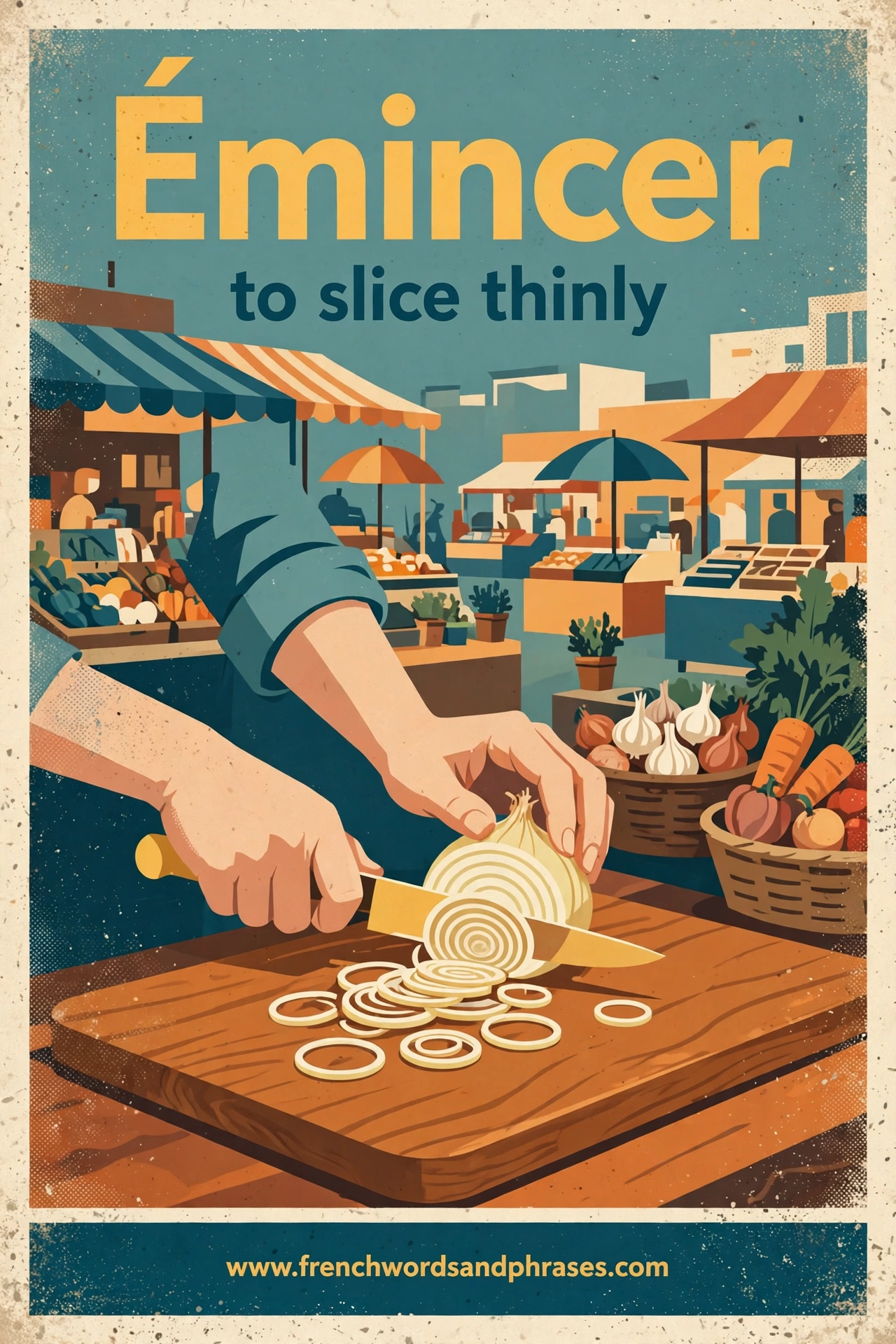
Émincer means to slice thinly — into fine, even strips.
Onions falling into translucent ribbons, chicken cut in strips for the wok, fennel shaved for a salad — émincer is the precise cousin of the knife verbs: not just cut, but cut thin, even and elegant.
In this guide, you’ll learn how to conjugate émincer in all the major French tenses and moods. Explore complete conjugation tables, French examples, English translations, and practice quizzes.
Understanding the French Verb Émincer
Émincer is a regular French verb belonging to the first group of verbs, those ending in -er.
It means to slice thinly. It is commonly used for onions, shallots and mushrooms, for chicken and beef cut in strips for stir-fries, for fennel and cabbage shaved into salads, and on restaurant menus in the noun form — un émincé de volaille, de bœuf, de légumes.
Verb classification: First group (-er)
Auxiliary verb: Avoir
Past participle: émincé
Present participle: éminçant
English equivalents: To slice thinly, to cut into thin strips; un émincé — a dish of thinly sliced meat.
One important detail: émincer is a -cer verb, and the c turns into ç before a and o to keep its soft s sound: nous éminçons, je éminçais — but before i the plain c returns: nous émincions, vous éminciez. The word itself is a recipe: émincer is what you do for a wok or a salad — chicken, beef, onions and peppers in thin strips that cook in minutes. On menus, un émincé de poulet is a dish of chicken sliced exactly this way.
Experience the Word
Émincer is the verb of patience with a knife — every slice the same thinness, so everything cooks at the same speed.
Imagine a cook preparing a wok for six hungry friends. The chicken is émincé, the peppers are émincés, the onion falls in ribbons — and when the pan roars, dinner is five minutes away.
Nothing has been roughly cut. It has been sliced thin — ready for the flash of the pan.
How to Conjugate Émincer: Complete French Conjugation Guide
Let’s explore every major conjugation of émincer, beginning with the indicative mood.
How to Conjugate Émincer in the Indicative Mood
The indicative mood is used to express facts, observations, actions, and events.
How to Conjugate Émincer in the Present Tense (Présent)
Used for actions happening now, habitual actions, and general truths.
| Subject | Conjugation |
|---|---|
| je | émince |
| tu | éminces |
| il / elle | émince |
| nous | éminçons |
| vous | émincez |
| ils / elles | émincent |
Example
Elle émince les champignons pour la poêlée.
She slices the mushrooms thinly for the pan-fry.
Quick Quiz 1
Complete the sentence:
Nous ______ les champignons pour la poêlée.
Reveal the answer
éminçons
Nous éminçons les champignons pour la poêlée.
We slice the mushrooms thinly for the pan-fry. Note the ç in éminçons.
How to Conjugate Émincer in the Passé Composé
Used for completed actions in the past. Émincer takes the auxiliary verb avoir.
| Subject | Conjugation |
|---|---|
| j’ | ai émincé |
| tu | as émincé |
| il / elle | a émincé |
| nous | avons émincé |
| vous | avez émincé |
| ils / elles | ont émincé |
Example
Il a émincé le poulet avant de le faire mariner.
He sliced the chicken thinly before marinating it.
How to Conjugate Émincer in the Imparfait (Imperfect Tense)
Used for habitual past actions, descriptions, and ongoing situations in the past.
| Subject | Conjugation |
|---|---|
| je | éminçais |
| tu | éminçais |
| il / elle | éminçait |
| nous | émincions |
| vous | éminciez |
| ils / elles | éminçaient |
Example
Le cuisinier éminçait les oignons à la mandoline.
The cook used to slice the onions thinly on the mandoline.
Quick Quiz 2
Choose the correct form:
He sliced the chicken thinly.
Il ______ le poulet. (a émincé / est émincé)
Reveal the answer
a émincé
Il a émincé le poulet.
Émincer takes avoir.
How to Conjugate Émincer in the Plus-que-parfait
Used to describe an action that had already been completed before another past event.
| Subject | Conjugation |
|---|---|
| j’ | avais émincé |
| tu | avais émincé |
| il / elle | avait émincé |
| nous | avions émincé |
| vous | aviez émincé |
| ils / elles | avaient émincé |
Example
Nous avions émincé les courgettes avant l’arrivée du chef.
We had thinly sliced the courgettes before the chef arrived.
How to Conjugate Émincer in the Passé Simple
Primarily used in formal writing, literature, and historical narratives. It is rarely used in everyday conversation.
| Subject | Conjugation |
|---|---|
| je | éminçai |
| tu | éminças |
| il / elle | éminça |
| nous | éminçâmes |
| vous | éminçâtes |
| ils / elles | éminçèrent |
Example
Elle éminça le fenouil et le servit en salade.
She sliced the fennel thinly and served it as a salad.
How to Conjugate Émincer in the Passé Antérieur
A literary tense used to express an action completed immediately before another past action, generally in the passé simple.
| Subject | Conjugation |
|---|---|
| j’ | eus émincé |
| tu | eus émincé |
| il / elle | eut émincé |
| nous | eûmes émincé |
| vous | eûtes émincé |
| ils / elles | eurent émincé |
Example
Quand il eut émincé le poivron, il le fit revenir à la poêle.
When he had thinly sliced the pepper, he fried it in the pan.
How to Conjugate Émincer in the Future Tense (Futur Simple)
Used to describe actions that will take place in the future.
| Subject | Conjugation |
|---|---|
| je | émincerai |
| tu | éminceras |
| il / elle | émincera |
| nous | émincerons |
| vous | émincerez |
| ils / elles | éminceront |
Example
Demain, nous émincerons le bœuf pour le wok.
Tomorrow, we will slice the beef thinly for the wok.
How to Conjugate Émincer in the Futur Antérieur (Future Perfect)
Used for an action that will have been completed before a particular point in the future.
| Subject | Conjugation |
|---|---|
| j’ | aurai émincé |
| tu | auras émincé |
| il / elle | aura émincé |
| nous | aurons émincé |
| vous | aurez émincé |
| ils / elles | auront émincé |
Example
À midi, elle aura émincé tous les légumes du marché.
By noon, she will have thinly sliced all the market vegetables.
How to Conjugate Émincer in the Near Future (Futur Proche)
Used to describe something that is going to happen soon. Formed with aller + infinitive.
| Subject | Conjugation |
|---|---|
| je | vais émincer |
| tu | vas émincer |
| il / elle | va émincer |
| nous | allons émincer |
| vous | allez émincer |
| ils / elles | vont émincer |
Example
Je vais émincer l’oignon pour la soupe.
I am going to slice the onion thinly for the soup.
How to Conjugate Émincer in the Conditional Mood
The conditional mood expresses what would happen under certain circumstances. It is also frequently used to make polite requests or express wishes.
How to Conjugate Émincer in the Present Conditional
| Subject | Conjugation |
|---|---|
| je | émincerais |
| tu | émincerais |
| il / elle | émincerait |
| nous | émincerions |
| vous | éminceriez |
| ils / elles | éminceraient |
Example
Avec une mandoline, j’émincerais les pommes de terre en un rien de temps.
With a mandoline, I would slice the potatoes thinly in no time.
How to Conjugate Émincer in the Past Conditional
| Subject | Conjugation |
|---|---|
| j’ | aurais émincé |
| tu | aurais émincé |
| il / elle | aurait émincé |
| nous | aurions émincé |
| vous | auriez émincé |
| ils / elles | auraient émincé |
Example
Elle aurait émincé le poulet plus finement pour le wok.
She would have sliced the chicken more thinly for the wok.
Émincer in the Literary Past Conditional Form
This less common literary form uses the imperfect subjunctive of avoir.
| Subject | Conjugation |
|---|---|
| j’ | eusse émincé |
| tu | eusses émincé |
| il / elle | eût émincé |
| nous | eussions émincé |
| vous | eussiez émincé |
| ils / elles | eussent émincé |
Example
Il eût émincé les champignons avec un soin d’orfèvre.
He would have sliced the mushrooms with a goldsmith’s care.
How to Conjugate Émincer in the Subjunctive Mood
The subjunctive is used to express wishes, emotions, doubts, necessity, and uncertainty. It frequently follows expressions such as il faut que (it is necessary that) or bien que (although).
How to Conjugate Émincer in the Present Subjunctive
| Subject | Conjugation |
|---|---|
| que je | émince |
| que tu | éminces |
| qu’il / qu’elle | émince |
| que nous | émincions |
| que vous | éminciez |
| qu’ils / qu’elles | émincent |
Example
Il faut que tu éminces les échalotes pour la vinaigrette.
You must slice the shallots thinly for the vinaigrette.
Quick Quiz 3
Complete the sentence using the subjunctive:
Il faut que vous ______ les oignons.
Reveal the answer
éminciez
Il faut que vous éminciez les oignons.
You must slice the onions thinly. No ç before i in éminciez.
How to Conjugate Émincer in the Imperfect Subjunctive
A literary tense, rarely encountered in modern spoken French.
| Subject | Conjugation |
|---|---|
| que je | émincasse |
| que tu | émincasses |
| qu’il / qu’elle | émincât |
| que nous | émincassions |
| que vous | émincassiez |
| qu’ils / qu’elles | émincassent |
Example
Je voulais qu’elle éminçât le fenouil très fin.
I wanted her to slice the fennel very thinly.
How to Conjugate Émincer in the Pluperfect Subjunctive
A literary construction used to express an action completed before another past action.
| Subject | Conjugation |
|---|---|
| que j’ | eusse émincé |
| que tu | eusses émincé |
| qu’il / qu’elle | eût émincé |
| que nous | eussions émincé |
| que vous | eussiez émincé |
| qu’ils / qu’elles | eussent émincé |
Example
Il regrettait que nous eussions émincé les oignons si épais.
He regretted that we had sliced the onions so thick.
How to Conjugate Émincer in the Past Subjunctive
| Subject | Conjugation |
|---|---|
| que j’ | aie émincé |
| que tu | aies émincé |
| qu’il / qu’elle | ait émincé |
| que nous | ayons émincé |
| que vous | ayez émincé |
| qu’ils / qu’elles | aient émincé |
Example
Je suis content que tu aies émincé le poulet pour le wok.
I am glad you sliced the chicken thinly for the wok.
How to Conjugate Émincer in the Imperative
The imperative is used to give commands, instructions, invitations, or suggestions. Subject pronouns are omitted.
How to Conjugate Émincer in the Present Imperative
| Person | Conjugation |
|---|---|
| (tu) | émince |
| (nous) | éminçons |
| (vous) | émincez |
Example
Émince les champignons, on les poêle dans cinq minutes !
Slice the mushrooms thinly, we are frying them in five minutes!
Quick Quiz 4
How would you say Slice the onion thinly (tu form)?
Reveal the answer
Émince l’oignon !
French Participles of Émincer
Participles are verb forms that can be used in compound tenses and other grammatical constructions.
Present Participle of Émincer
éminçant
En éminçant les oignons, elle gardait le couteau bien droit.
While slicing the onions thinly, she kept the knife nice and straight.
Past Participle of Émincer
émincé
Émincé très fin, le fenouil devient doux et croquant.
Sliced very thinly, fennel becomes sweet and crunchy.
Émincer in Everyday French: Real-Life Examples
Now that you know the conjugations, let’s see how émincer appears in everyday French.
Example 1 — Present
J’émince toujours les oignons pour la soupe.
I always slice the onions thinly for the soup.
Example 2 — Passé composé
Il a émincé le poulet pour le wok.
He sliced the chicken thinly for the wok.
Example 3 — Imparfait
On éminçait les légumes à la mandoline, autrefois.
In the old days, vegetables were sliced thinly on the mandoline.
Example 4 — Future
Nous émincerons les courgettes ce soir.
We will slice the courgettes thinly this evening.
Example 5 — Conditional
Tu émincerais le bœuf, s’il te plaît ?
Would you slice the beef thinly, please?
Example 6 — Imperative
Émincez les échalotes pour la sauce !
Slice the shallots thinly for the sauce!
Beyond Translation: The Meaning of Émincer
English needs a whole phrase — slice thinly, cut into strips; French émincer says it in one word, thinness included.
It is the wok’s favourite verb.
Thin strips cook fast and evenly, so émincer is less a cutting style than a promise: prepare it this way, and dinner will be ready in minutes.
How to Remember the French Verb Émincer
Remember it this way: Émincer is about thin and even — strips for the wok and ribbons for the salad.
- The ç keeps the s soft: nous éminçons — but nous émincions without it.
- Un émincé de poulet — on menus, the noun is the dish itself.
- Regular -cer: j’émince, il émince, past participle émincé.
The key idea is thin and even — strips for the wok and ribbons for the salad.
Test Your Knowledge of Émincer
Let’s see how much you’ve learned. Try answering these questions before revealing the answers.
Question 1
Why does nous éminçons have a ç?
Reveal the answer
To keep the c soft — before o, a plain c would sound like a k, so French writes ç.
Question 2
How do you say We slice the beef thinly in French?
Reveal the answer
Nous éminçons le bœuf.
Question 3
Translate: She sliced the chicken thinly for the wok.
Reveal the answer
Elle a émincé le poulet pour le wok.
Question 4
What is the past participle of émincer?
Reveal the answer
Émincé.
Question 5
Complete the sentence:
Il faut que tu ______ les échalotes.
Reveal the answer
éminces
Il faut que tu éminces les échalotes.
You must slice the shallots thinly.
Your Final Challenge
Can You Use It?
How would you say this in French?
She slices the chicken thinly, and the wok already sizzles on the heat.
Reveal the answer
Elle émince le poulet, et le wok chante déjà sur le feu.
She slices the chicken thinly, and the wok already sizzles on the heat.
A little French. A little curiosity. A richer everyday life.
LEARN FRENCH ONE WORD AT A TIME