
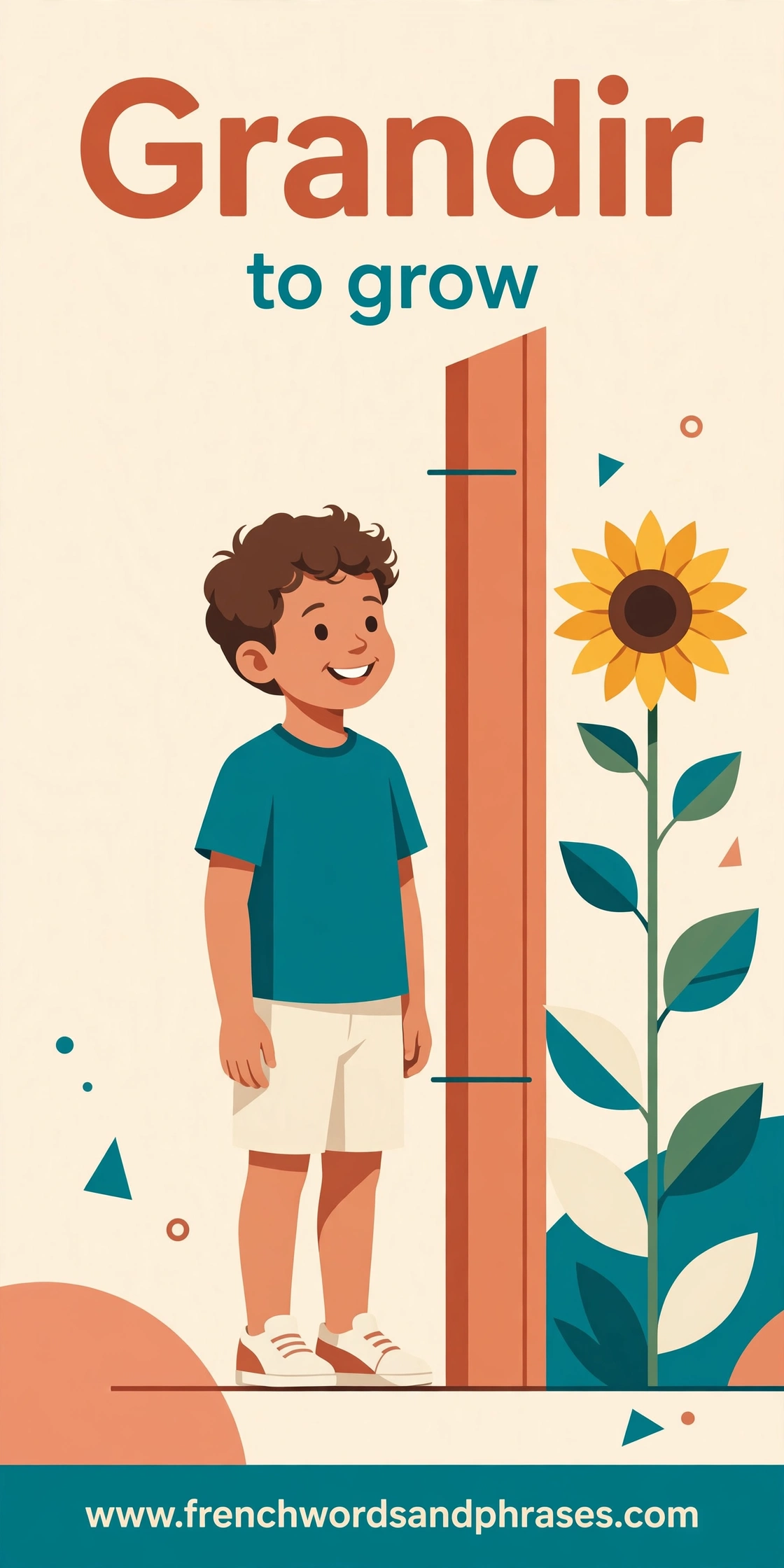
A French Word to Live By
How to Conjugate Grandir in French
/ɡʁɑ̃.diʁ/
Grandir means to grow, to grow up, or to make bigger.
Marks on the kitchen doorframe, shoes that no longer fit, a tree that was once a stick. Growing — of children, of plants, of whole cities — is grandir.
In this guide, you’ll learn how to conjugate grandir in all the major French tenses and moods. Explore complete conjugation tables, French examples, English translations, and practice quizzes.
Understanding the French Verb Grandir
Grandir is a regular French verb belonging to the second group of verbs, those ending in -ir.
It means to grow, to grow up, or to make bigger. It is commonly used for children growing up, for plants and trees growing taller, and for growing in wisdom, power or importance.
Verb classification: Second group (-ir)
Auxiliary verb: Avoir or être, depending on the construction
Past participle: grandi
Present participle: grandissant
English equivalents: To grow, to grow up, to make bigger.
One important detail: grandir works with two auxiliary verbs. The growing itself takes avoir — l’enfant a grandi (the child grew) — and so does the transitive use: cette épreuve l’a grandi (the ordeal made him a greater person). Être appears in older and literary French, to describe the resulting state — l’enfant est bien grandi (the child is well grown) — where the participle behaves almost like an adjective. Modern French uses avoir, and the tables on this page use avoir too.
Experience the Word
Grandir is growth itself — the slow, silent work of becoming bigger.
Imagine the marks a grandmother keeps on her kitchen doorframe, one line per summer, each a little higher than the last. The child does not feel himself growing; the doorframe tells the story.
You have not just changed size. You have grown up — and grandir is the whole journey in one word.
How to Conjugate Grandir: Complete French Conjugation Guide
Let’s explore every major conjugation of grandir, beginning with the indicative mood.
How to Conjugate Grandir in the Indicative Mood
The indicative mood is used to express facts, observations, actions, and events.
How to Conjugate Grandir in the Present Tense (Présent)
Used for actions happening now, habitual actions, and general truths.
| Subject | Conjugation |
|---|---|
| je | grandis |
| tu | grandis |
| il / elle | grandit |
| nous | grandissons |
| vous | grandissez |
| ils / elles | grandissent |
Example
L’enfant grandit vite.
The child is growing fast.
Quick Quiz 1
Complete the sentence:
Nous ______ chaque année.
Reveal the answer
grandissons
Nous grandissons chaque année.
We grow every year.
How to Conjugate Grandir in the Passé Composé
Used for completed actions in the past. Grandir takes the auxiliary verb avoir or être, depending on the construction.
| Subject | Conjugation |
|---|---|
| j’ | ai grandi |
| tu | as grandi |
| il / elle | a grandi |
| nous | avons grandi |
| vous | avez grandi |
| ils / elles | ont grandi |
Example
Il a grandi de dix centimètres cette année.
He grew ten centimetres this year.
How to Conjugate Grandir in the Imparfait (Imperfect Tense)
Used for habitual past actions, descriptions, and ongoing situations in the past.
| Subject | Conjugation |
|---|---|
| je | grandissais |
| tu | grandissais |
| il / elle | grandissait |
| nous | grandissions |
| vous | grandissiez |
| ils / elles | grandissaient |
Example
Quand j’étais petit, je grandissais chaque été.
When I was small, I grew every summer.
Quick Quiz 2
Choose the correct form:
The child has grown.
L’enfant ______ . (a grandi / est grandi)
Reveal the answer
a grandi
L’enfant a grandi.
In modern French, grandir takes avoir for the growing itself.
How to Conjugate Grandir in the Plus-que-parfait
Used to describe an action that had already been completed before another past event.
| Subject | Conjugation |
|---|---|
| j’ | avais grandi |
| tu | avais grandi |
| il / elle | avait grandi |
| nous | avions grandi |
| vous | aviez grandi |
| ils / elles | avaient grandi |
Example
Il avait grandi depuis notre dernière rencontre.
He had grown since our last meeting.
How to Conjugate Grandir in the Passé Simple
Primarily used in formal writing, literature, and historical narratives. It is rarely used in everyday conversation.
| Subject | Conjugation |
|---|---|
| je | grandis |
| tu | grandis |
| il / elle | grandit |
| nous | grandîmes |
| vous | grandîtes |
| ils / elles | grandirent |
Example
L’arbre grandit jusqu’au ciel.
The tree grew up to the sky.
How to Conjugate Grandir in the Passé Antérieur
A literary tense used to express an action completed immediately before another past action, generally in the passé simple.
| Subject | Conjugation |
|---|---|
| j’ | eus grandi |
| tu | eus grandi |
| il / elle | eut grandi |
| nous | eûmes grandi |
| vous | eûtes grandi |
| ils / elles | eurent grandi |
Example
Dès qu’il eut grandi, il quitta le village.
As soon as he had grown up, he left the village.
How to Conjugate Grandir in the Future Tense (Futur Simple)
Used to describe actions that will take place in the future.
| Subject | Conjugation |
|---|---|
| je | grandirai |
| tu | grandiras |
| il / elle | grandira |
| nous | grandirons |
| vous | grandirez |
| ils / elles | grandiront |
Example
Les tomates grandiront vite cet été.
The tomatoes will grow fast this summer.
How to Conjugate Grandir in the Futur Antérieur (Future Perfect)
Used for an action that will have been completed before a particular point in the future.
| Subject | Conjugation |
|---|---|
| j’ | aurai grandi |
| tu | auras grandi |
| il / elle | aura grandi |
| nous | aurons grandi |
| vous | aurez grandi |
| ils / elles | auront grandi |
Example
À la fin de l’année, il aura grandi de cinq centimètres.
By the end of the year, he will have grown five centimetres.
How to Conjugate Grandir in the Near Future (Futur Proche)
Used to describe something that is going to happen soon. Formed with aller + infinitive.
| Subject | Conjugation |
|---|---|
| je | vais grandir |
| tu | vas grandir |
| il / elle | va grandir |
| nous | allons grandir |
| vous | allez grandir |
| ils / elles | vont grandir |
Example
Le bébé va grandir vite.
The baby is going to grow fast.
How to Conjugate Grandir in the Conditional Mood
The conditional mood expresses what would happen under certain circumstances. It is also frequently used to make polite requests or express wishes.
How to Conjugate Grandir in the Present Conditional
| Subject | Conjugation |
|---|---|
| je | grandirais |
| tu | grandirais |
| il / elle | grandirait |
| nous | grandirions |
| vous | grandiriez |
| ils / elles | grandiraient |
Example
Avec plus de soleil, les fleurs grandiraient plus vite.
With more sun, the flowers would grow faster.
How to Conjugate Grandir in the Past Conditional
| Subject | Conjugation |
|---|---|
| j’ | aurais grandi |
| tu | aurais grandi |
| il / elle | aurait grandi |
| nous | aurions grandi |
| vous | auriez grandi |
| ils / elles | auraient grandi |
Example
Il aurait grandi davantage avec plus de sport.
He would have grown more with more sport.
Grandir in the Literary Past Conditional Form
This less common literary form uses the imperfect subjunctive of avoir or être, depending on the construction.
| Subject | Conjugation |
|---|---|
| j’ | eusse grandi |
| tu | eusses grandi |
| il / elle | eût grandi |
| nous | eussions grandi |
| vous | eussiez grandi |
| ils / elles | eussent grandi |
Example
Elle eût grandi plus vite dans un autre climat.
She would have grown faster in another climate.
How to Conjugate Grandir in the Subjunctive Mood
The subjunctive is used to express wishes, emotions, doubts, necessity, and uncertainty. It frequently follows expressions such as il faut que (it is necessary that) or bien que (although).
How to Conjugate Grandir in the Present Subjunctive
| Subject | Conjugation |
|---|---|
| que je | grandisse |
| que tu | grandisses |
| qu’il / qu’elle | grandisse |
| que nous | grandissions |
| que vous | grandissiez |
| qu’ils / qu’elles | grandissent |
Example
Il faut que l’enfant grandisse en bonne santé.
The child needs to grow up healthy.
Quick Quiz 3
Complete the sentence using the subjunctive:
Il faut que l’enfant ______ en bonne santé.
Reveal the answer
grandisse
Il faut que l’enfant grandisse en bonne santé.
The child needs to grow up healthy.
How to Conjugate Grandir in the Imperfect Subjunctive
A literary tense, rarely encountered in modern spoken French.
| Subject | Conjugation |
|---|---|
| que je | grandisse |
| que tu | grandisses |
| qu’il / qu’elle | grandît |
| que nous | grandissions |
| que vous | grandissiez |
| qu’ils / qu’elles | grandissent |
Example
Il voulait que son fils grandît en sagesse.
He wanted his son to grow in wisdom.
How to Conjugate Grandir in the Pluperfect Subjunctive
A literary construction used to express an action completed before another past action.
| Subject | Conjugation |
|---|---|
| que j’ | eusse grandi |
| que tu | eusses grandi |
| qu’il / qu’elle | eût grandi |
| que nous | eussions grandi |
| que vous | eussiez grandi |
| qu’ils / qu’elles | eussent grandi |
Example
Il regrettait que l’arbre eût grandi si lentement.
He regretted that the tree had grown so slowly.
How to Conjugate Grandir in the Past Subjunctive
| Subject | Conjugation |
|---|---|
| que j’ | aie grandi |
| que tu | aies grandi |
| qu’il / qu’elle | ait grandi |
| que nous | ayons grandi |
| que vous | ayez grandi |
| qu’ils / qu’elles | aient grandi |
Example
Je suis content que tu aies grandi en confiance.
I am glad you have grown in confidence.
How to Conjugate Grandir in the Imperative
The imperative is used to give commands, instructions, invitations, or suggestions. Subject pronouns are omitted.
How to Conjugate Grandir in the Present Imperative
| Person | Conjugation |
|---|---|
| (tu) | grandis |
| (nous) | grandissons |
| (vous) | grandissez |
Example
Grandis en sagesse, mon enfant !
Grow in wisdom, my child!
Quick Quiz 4
How would you say Grow in wisdom, using the tu form?
Reveal the answer
Grandis en sagesse !
French Participles of Grandir
Participles are verb forms that can be used in compound tenses and other grammatical constructions.
Present Participle of Grandir
grandissant
En grandissant, il apprit à se débrouiller seul.
While growing up, he learned to manage on his own.
Past Participle of Grandir
grandi
L’enfant est bien grandi depuis l’été dernier.
The child is well grown since last summer.
Grandir in Everyday French: Real-Life Examples
Now that you know the conjugations, let’s see how grandir appears in everyday French.
Example 1 — Present
Les enfants grandissent vite.
Children grow up fast.
Example 2 — Passé composé — avoir
Il a grandi de dix centimètres.
He grew ten centimetres.
Example 3 — Passé composé — être (older use)
L’enfant est bien grandi.
The child is well grown.
Example 4 — Imparfait
Le chêne grandissait chaque année.
The oak tree grew every year.
Example 5 — Future
Les tomates grandiront vite cet été.
The tomatoes will grow fast this summer.
Example 6 — Conditional
Avec plus de pluie, le jardin grandirait mieux.
With more rain, the garden would grow better.
Beyond Translation: The Meaning of Grandir
English splits growing into ‘grow’, ‘grow up’ and ‘make bigger’; French hands all three to grandir and lets the sentence decide. A child grandit, a tree grandit, and an ordeal can grandir a person — make him greater.
And grandir carries the same lesson as its -ir cousins.
The process of growing takes avoir — il a grandi. Only the finished state, the grown-up result, still takes être in older French: l’enfant est bien grandi. Process or state — watch which one you mean, and the auxiliary follows.
How to Remember the French Verb Grandir
Remember it this way: Grandir is about growing — avoir for the growing, être only for the grown-up state.
- A child or a plant grows — il a grandi: auxiliary avoir.
- Something makes a person greater — cette épreuve l’a grandi: auxiliary avoir.
- Only the finished state, in older French, takes être — l’enfant est bien grandi.
The key idea is growing — avoir for the growing, être only for the grown-up state.
Test Your Knowledge of Grandir
Let’s see how much you’ve learned. Try answering these questions before revealing the answers.
Question 1
When does grandir take être?
Reveal the answer
Only in older or literary use, to describe the resulting state — l’enfant est bien grandi. In modern French the growing takes avoir: il a grandi.
Question 2
How do you say I will grow in French?
Reveal the answer
Je grandirai.
Question 3
Translate: The child grew ten centimetres.
Reveal the answer
L’enfant a grandi de dix centimètres.
Question 4
What is the past participle of grandir?
Reveal the answer
Grandi.
Question 5
Complete the sentence:
Si tu mangeais plus de légumes, tu ______ plus vite.
Reveal the answer
grandirais
Si tu mangeais plus de légumes, tu grandirais plus vite.
If you ate more vegetables, you would grow faster.
Your Final Challenge
Can You Use It?
How would you say this in French?
The child grew up in the village.
Reveal the answer
L’enfant a grandi dans le village.
The child grew up in the village.
A little French. A little curiosity. A richer everyday life.
LEARN FRENCH ONE WORD AT A TIME




