A French Word to Live By
How to Conjugate Monter in French
/mɔ̃.te/
Monter means to go up, to climb, or to rise.
Stairs, hills, ladders and trains — life is full of going up. You climb to the top floor, you get on the train, the tide comes in and prices rise. In French, all of that upward movement is monter.
In this guide, you’ll learn how to conjugate monter in all the major French tenses and moods. Explore complete conjugation tables, French examples, English translations, and practice quizzes.
Understanding the French Verb Monter
Monter is a regular French verb belonging to the first group of verbs, those ending in -er.
It means to go up, to climb, or to rise. It is commonly used for going up stairs, getting on a train or a bicycle, prices and temperatures rising, and carrying or bringing things up.
Verb classification: First group (-er)
Auxiliary verb: Être or avoir, depending on the construction
Past participle: monté
Present participle: montant
English equivalents: To go up, to climb, to rise, to get on, to bring up.
One important detail: monter works with two auxiliary verbs. When it means going up or rising and has no direct object, it takes être and the past participle agrees with the subject — elle est montée (she went up). When it has a direct object — carrying something up, bringing something up, putting something together — it takes avoir: il a monté les valises (he carried the suitcases up). The tables on this page use être, the auxiliary of the main ‘go up’ meaning.
Experience the Word
Monter is the verb of every staircase and every hilltop — the small effort of rising above where you started.
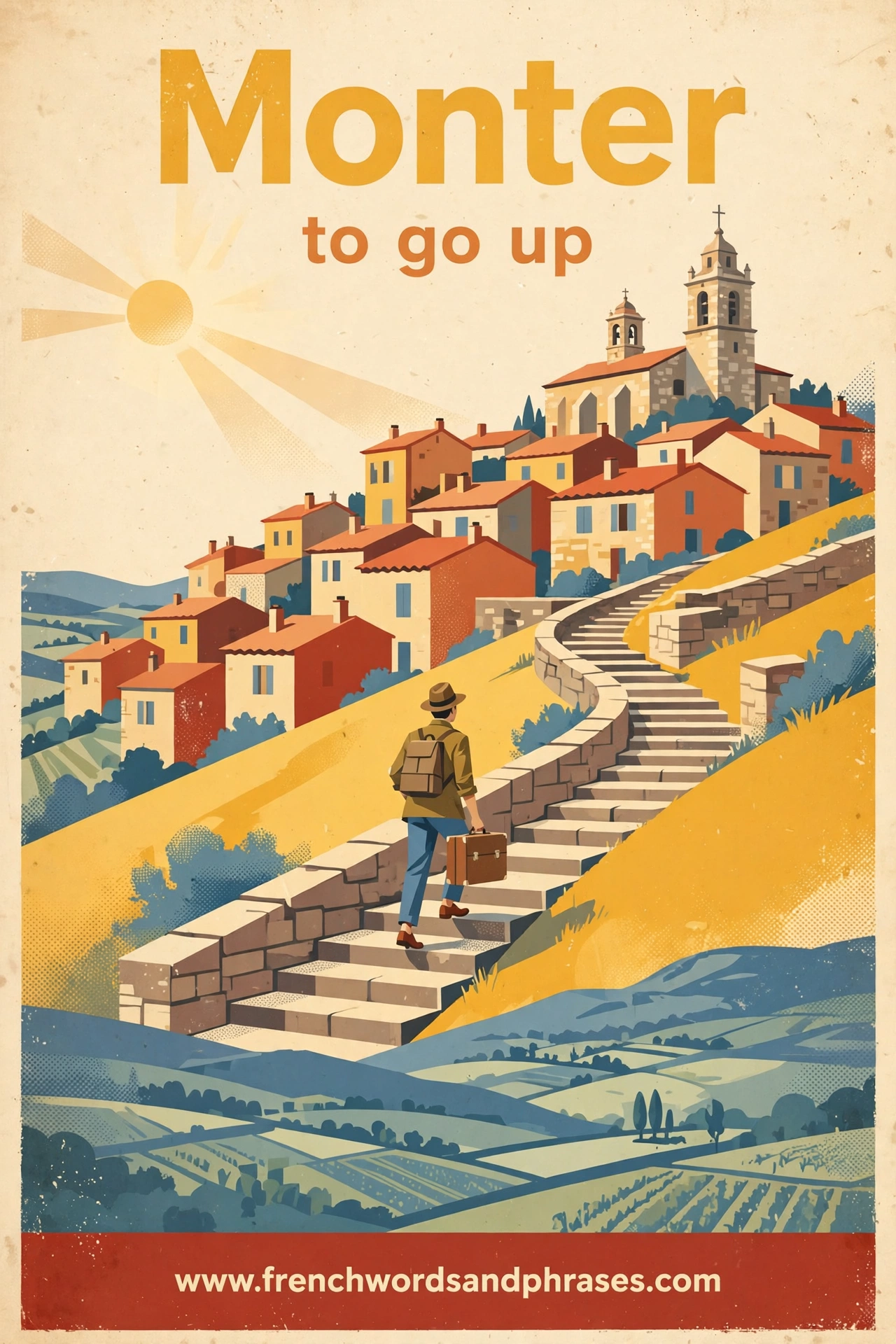
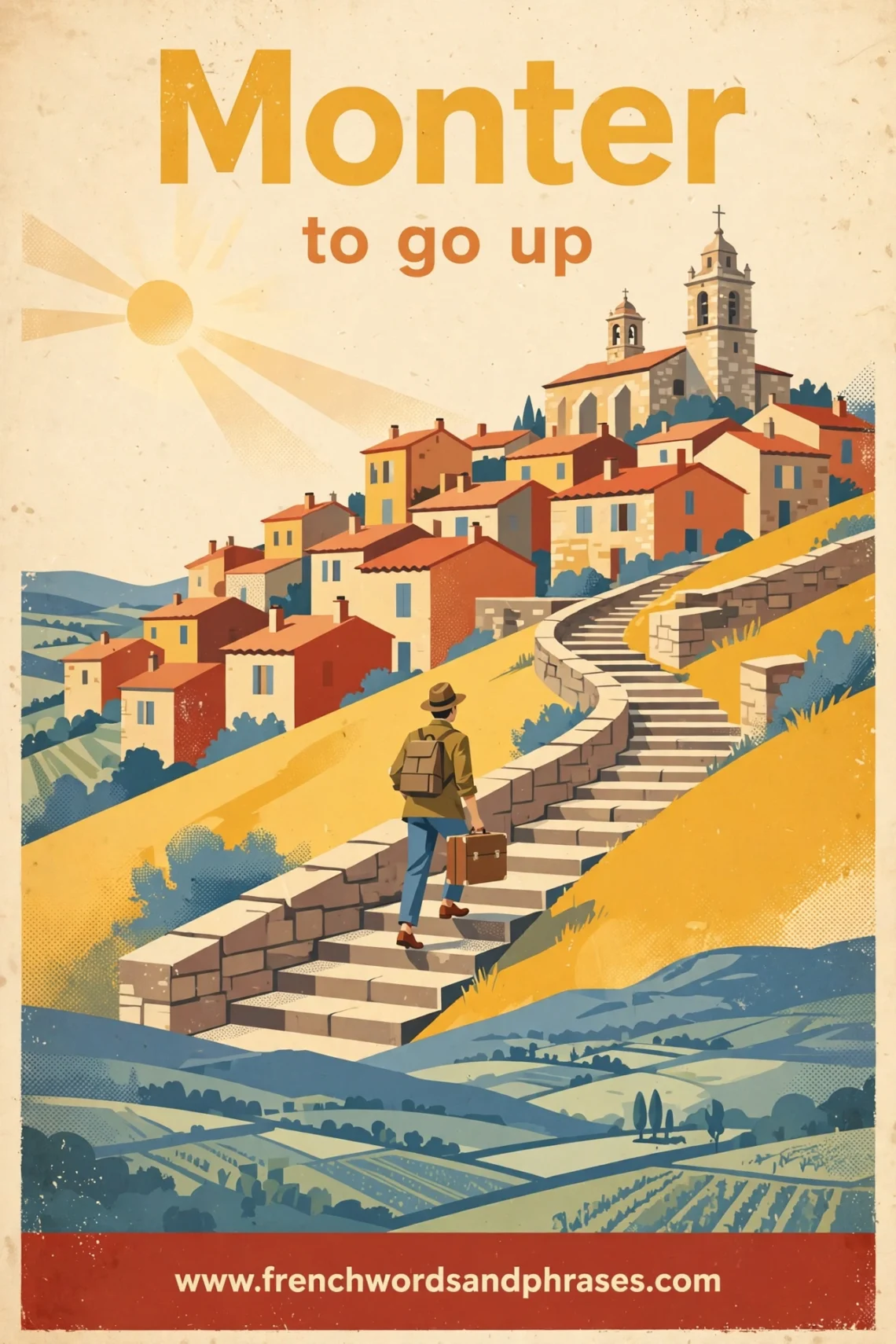
Imagine arriving at a hilltop village in Provence. You climb the narrow lanes one by one, past the bakery, past the fountain, until the whole valley opens out below you.
You have not just moved. You have gone up — and the view is your reward.
How to Conjugate Monter: Complete French Conjugation Guide
Let’s explore every major conjugation of monter, beginning with the indicative mood.
How to Conjugate Monter in the Indicative Mood
The indicative mood is used to express facts, observations, actions, and events.
How to Conjugate Monter in the Present Tense (Présent)
Used for actions happening now, habitual actions, and general truths.
| Subject | Conjugation |
|---|---|
| je | monte |
| tu | montes |
| il / elle | monte |
| nous | montons |
| vous | montez |
| ils / elles | montent |
Example
Nous montons au troisième étage.
We are going up to the third floor.
Quick Quiz 1
Complete the sentence:
Nous ______ au dernier étage.
Reveal the answer
montons
Nous montons au dernier étage.
We are going up to the top floor.
How to Conjugate Monter in the Passé Composé
Used for completed actions in the past. Monter takes the auxiliary verb être or avoir, depending on the construction.
| Subject | Conjugation |
|---|---|
| je | suis monté / suis montée |
| tu | es monté / es montée |
| il / elle | est monté / est montée |
| nous | sommes montés / sommes montées |
| vous | êtes montés / êtes montées / êtes monté / êtes montée |
| ils / elles | sont montés / sont montées |
Example
Elle est montée dans le train juste avant le départ.
She got on the train just before departure.
How to Conjugate Monter in the Imparfait (Imperfect Tense)
Used for habitual past actions, descriptions, and ongoing situations in the past.
| Subject | Conjugation |
|---|---|
| je | montais |
| tu | montais |
| il / elle | montait |
| nous | montions |
| vous | montiez |
| ils / elles | montaient |
Example
Quand il était enfant, il montait dans les arbres.
When he was a child, he used to climb trees.
Quick Quiz 2
Choose the correct form:
She went up to the attic.
Elle ______ au grenier. (est montée / a montée)
Reveal the answer
est montée
Elle est montée au grenier.
Monter has no direct object here, so it takes être — and montée agrees with elle.
How to Conjugate Monter in the Plus-que-parfait
Used to describe an action that had already been completed before another past event.
| Subject | Conjugation |
|---|---|
| je | étais monté / étais montée |
| tu | étais monté / étais montée |
| il / elle | était monté / était montée |
| nous | étions montés / étions montées |
| vous | étiez montés / étiez montées / étiez monté / étiez montée |
| ils / elles | étaient montés / étaient montées |
Example
J’étais déjà monté quand la réunion a commencé.
I had already gone up when the meeting started.
How to Conjugate Monter in the Passé Simple
Primarily used in formal writing, literature, and historical narratives. It is rarely used in everyday conversation.
| Subject | Conjugation |
|---|---|
| je | montai |
| tu | montas |
| il / elle | monta |
| nous | montâmes |
| vous | montâtes |
| ils / elles | montèrent |
Example
Il monta l’escalier quatre à quatre.
He bounded up the stairs.
How to Conjugate Monter in the Passé Antérieur
A literary tense used to express an action completed immediately before another past action, generally in the passé simple.
| Subject | Conjugation |
|---|---|
| je | fus monté / fus montée |
| tu | fus monté / fus montée |
| il / elle | fut monté / fut montée |
| nous | fûmes montés / fûmes montées |
| vous | fûtes montés / fûtes montées / fûtes monté / fûtes montée |
| ils / elles | furent montés / furent montées |
Example
Dès qu’elle fut montée, le train partit.
As soon as she had got on, the train left.
How to Conjugate Monter in the Future Tense (Futur Simple)
Used to describe actions that will take place in the future.
| Subject | Conjugation |
|---|---|
| je | monterai |
| tu | monteras |
| il / elle | montera |
| nous | monterons |
| vous | monterez |
| ils / elles | monteront |
Example
Demain, nous monterons au sommet.
Tomorrow, we will climb to the summit.
How to Conjugate Monter in the Futur Antérieur (Future Perfect)
Used for an action that will have been completed before a particular point in the future.
| Subject | Conjugation |
|---|---|
| je | serai monté / serai montée |
| tu | seras monté / seras montée |
| il / elle | sera monté / sera montée |
| nous | serons montés / serons montées |
| vous | serez montés / serez montées / serez monté / serez montée |
| ils / elles | seront montés / seront montées |
Example
À midi, nous serons montés au refuge.
By noon, we will have climbed up to the refuge.
How to Conjugate Monter in the Near Future (Futur Proche)
Used to describe something that is going to happen soon. Formed with aller + infinitive.
| Subject | Conjugation |
|---|---|
| je | vais monter |
| tu | vas monter |
| il / elle | va monter |
| nous | allons monter |
| vous | allez monter |
| ils / elles | vont monter |
Example
Je vais monter voir le grenier.
I am going to go up and look at the attic.
How to Conjugate Monter in the Conditional Mood
The conditional mood expresses what would happen under certain circumstances. It is also frequently used to make polite requests or express wishes.
How to Conjugate Monter in the Present Conditional
| Subject | Conjugation |
|---|---|
| je | monterais |
| tu | monterais |
| il / elle | monterait |
| nous | monterions |
| vous | monteriez |
| ils / elles | monteraient |
Example
Je monterais volontiers au dernier étage pour la vue.
I would gladly go up to the top floor for the view.
How to Conjugate Monter in the Past Conditional
| Subject | Conjugation |
|---|---|
| je | serais monté / serais montée |
| tu | serais monté / serais montée |
| il / elle | serait monté / serait montée |
| nous | serions montés / serions montées |
| vous | seriez montés / seriez montées / seriez monté / seriez montée |
| ils / elles | seraient montés / seraient montées |
Example
Je serais monté plus tôt si l’ascenseur avait marché.
I would have gone up earlier if the lift had worked.
Monter in the Literary Past Conditional Form
This less common literary form uses the imperfect subjunctive of être or avoir, depending on the construction.
| Subject | Conjugation |
|---|---|
| je | fusse monté / fusse montée |
| tu | fusses monté / fusses montée |
| il / elle | fût monté / fût montée |
| nous | fussions montés / fussions montées |
| vous | fussiez montés / fussiez montées / fussiez monté / fussiez montée |
| ils / elles | fussent montés / fussent montées |
Example
Il fût monté sans hésiter si on le lui avait demandé.
He would have gone up without hesitating if he had been asked.
How to Conjugate Monter in the Subjunctive Mood
The subjunctive is used to express wishes, emotions, doubts, necessity, and uncertainty. It frequently follows expressions such as il faut que (it is necessary that) or bien que (although).
How to Conjugate Monter in the Present Subjunctive
| Subject | Conjugation |
|---|---|
| que je | monte |
| que tu | montes |
| qu’il / qu’elle | monte |
| que nous | montions |
| que vous | montiez |
| qu’ils / qu’elles | montent |
Example
Il faut que tu montes par l’escalier.
You need to go up by the stairs.
Quick Quiz 3
Complete the sentence using the subjunctive:
Il faut que vous ______ par l’escalier.
Reveal the answer
montiez
Il faut que vous montiez par l’escalier.
You need to go up by the stairs.
How to Conjugate Monter in the Imperfect Subjunctive
A literary tense, rarely encountered in modern spoken French.
| Subject | Conjugation |
|---|---|
| que je | montasse |
| que tu | montasses |
| qu’il / qu’elle | montât |
| que nous | montassions |
| que vous | montassiez |
| qu’ils / qu’elles | montassent |
Example
Il voulait qu’elle montât lentement.
He wanted her to go up slowly.
How to Conjugate Monter in the Pluperfect Subjunctive
A literary construction used to express an action completed before another past action.
| Subject | Conjugation |
|---|---|
| que je | fusse monté / fusse montée |
| que tu | fusses monté / fusses montée |
| qu’il / qu’elle | fût monté / fût montée |
| que nous | fussions montés / fussions montées |
| que vous | fussiez montés / fussiez montées / fussiez monté / fussiez montée |
| qu’ils / qu’elles | fussent montés / fussent montées |
Example
Il regrettait que nous fussions montés si tard.
He regretted that we had gone up so late.
How to Conjugate Monter in the Past Subjunctive
| Subject | Conjugation |
|---|---|
| que je | sois monté / sois montée |
| que tu | sois monté / sois montée |
| qu’il / qu’elle | soit monté / soit montée |
| que nous | soyons montés / soyons montées |
| que vous | soyez montés / soyez montées / soyez monté / soyez montée |
| qu’ils / qu’elles | soient montés / soient montées |
Example
Je suis content que tu sois monté nous voir.
I am glad you came up to see us.
How to Conjugate Monter in the Imperative
The imperative is used to give commands, instructions, invitations, or suggestions. Subject pronouns are omitted.
How to Conjugate Monter in the Present Imperative
| Person | Conjugation |
|---|---|
| (tu) | monte |
| (nous) | montons |
| (vous) | montez |
Example
Monte doucement, l’escalier est raide !
Go up slowly, the stairs are steep!
Quick Quiz 4
How would you say Go up, using the tu form?
Reveal the answer
Monte !
French Participles of Monter
Participles are verb forms that can be used in compound tenses and other grammatical constructions.
Present Participle of Monter
montant
En montant, il écoutait la radio.
While going up, he was listening to the radio.
Past Participle of Monter
monté
Il a monté les valises au grenier.
He carried the suitcases up to the attic.
Monter in Everyday French: Real-Life Examples
Now that you know the conjugations, let’s see how monter appears in everyday French.
Example 1 — Present
Le chemin monte jusqu’au village.
The path climbs up to the village.
Example 2 — Passé composé — être
Ils sont montés à bord du bateau.
They got on board the boat.
Example 3 — Passé composé — avoir
Tu as monté les courses au cinquième étage ?
Did you carry the shopping up to the fifth floor?
Example 4 — Imparfait
La marée montait doucement.
The tide was slowly rising.
Example 5 — Future
Les prix monteront cet hiver.
Prices will rise this winter.
Example 6 — Conditional
Je monterais bien au sommet demain.
I would happily climb to the summit tomorrow.
Beyond Translation: The Meaning of Monter
English needs several verbs where French uses just monter: go up, climb, rise, get on, bring up, even assemble. What holds them together is upward movement — of a person, a price, a tide, or a suitcase carried by hand.
And monter carries its famous lesson with it.
It is one of the verbs that change auxiliary with their meaning: the climber est monté, but the suitcases he carries up take avoir — il a monté les valises. Watch what the verb is doing, and the auxiliary follows.
How to Remember the French Verb Monter
Remember it this way: Monter is about going up — être when you simply go up, avoir when you take something up.
- You go up yourself, with nothing in your hands — elle est montée: auxiliary être, and the participle agrees.
- You carry something up, or put something together — il a monté les valises: auxiliary avoir.
- Prices, tides and temperatures rise with monter too — la marée monte.
The key idea is going up — être when you simply go up, avoir when you take something up.
Test Your Knowledge of Monter
Let’s see how much you’ve learned. Try answering these questions before revealing the answers.
Question 1
When does monter take être, and when does it take avoir?
Reveal the answer
Être when it means going up or rising with no direct object — elle est montée. Avoir when it has a direct object — il a monté les valises.
Question 2
How do you say I will go up in French?
Reveal the answer
Je monterai.
Question 3
Translate: They (masculine) got into the car.
Reveal the answer
Ils sont montés dans la voiture.
Question 4
What is the past participle of monter?
Reveal the answer
Monté.
Question 5
Complete the sentence:
Si l’ascenseur ne marchait pas, nous ______ à pied.
Reveal the answer
monterions
Si l’ascenseur ne marchait pas, nous monterions à pied.
If the lift were not working, we would go up on foot.
Your Final Challenge
Can You Use It?
How would you say this in French?
She went up to her room to rest.
Reveal the answer
Elle est montée dans sa chambre pour se reposer.
She went up to her room to rest.
A little French. A little curiosity. A richer everyday life.
LEARN FRENCH ONE WORD AT A TIME