A French Word to Live By
How to Conjugate Faillir in French
/fa.jiʁ/
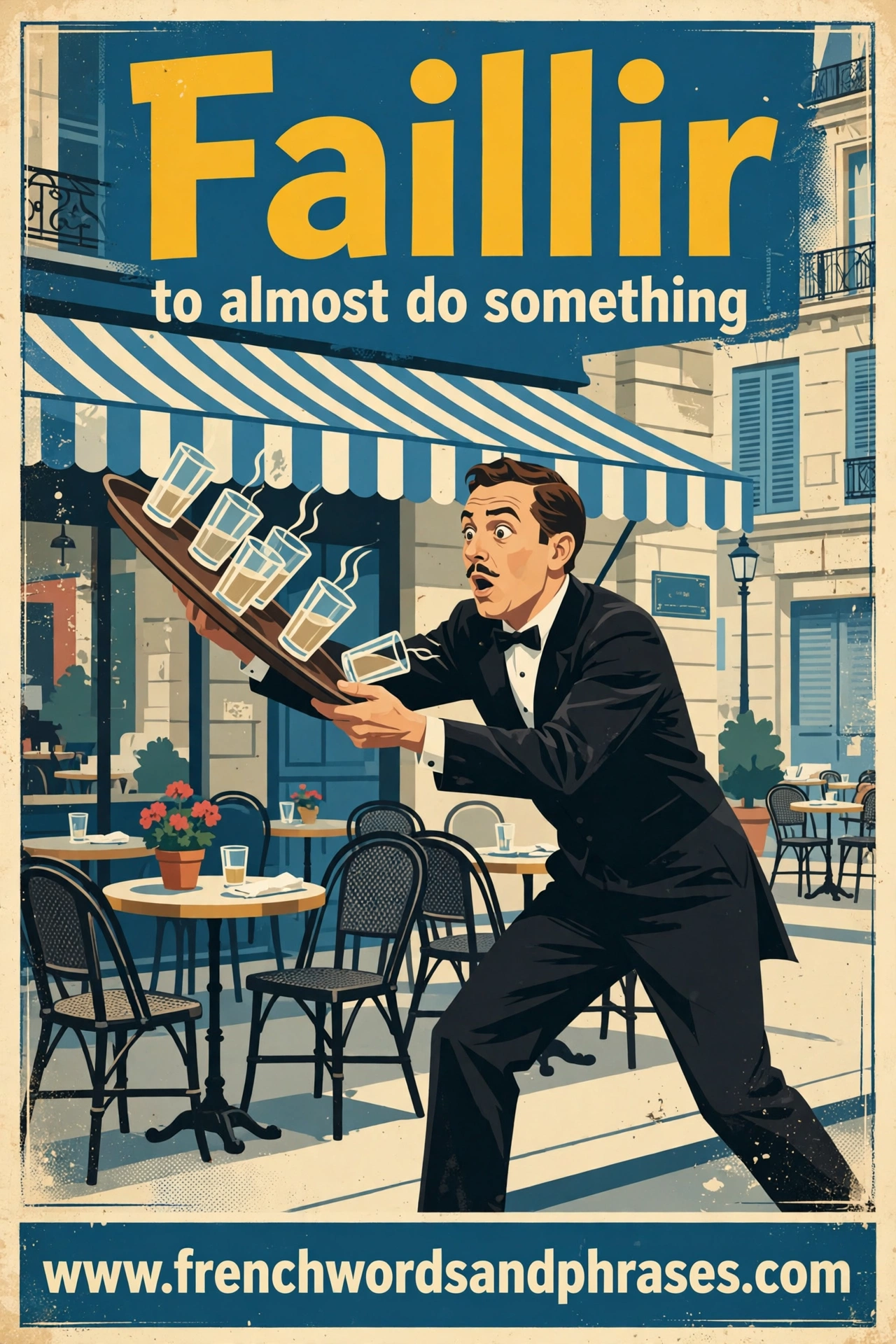
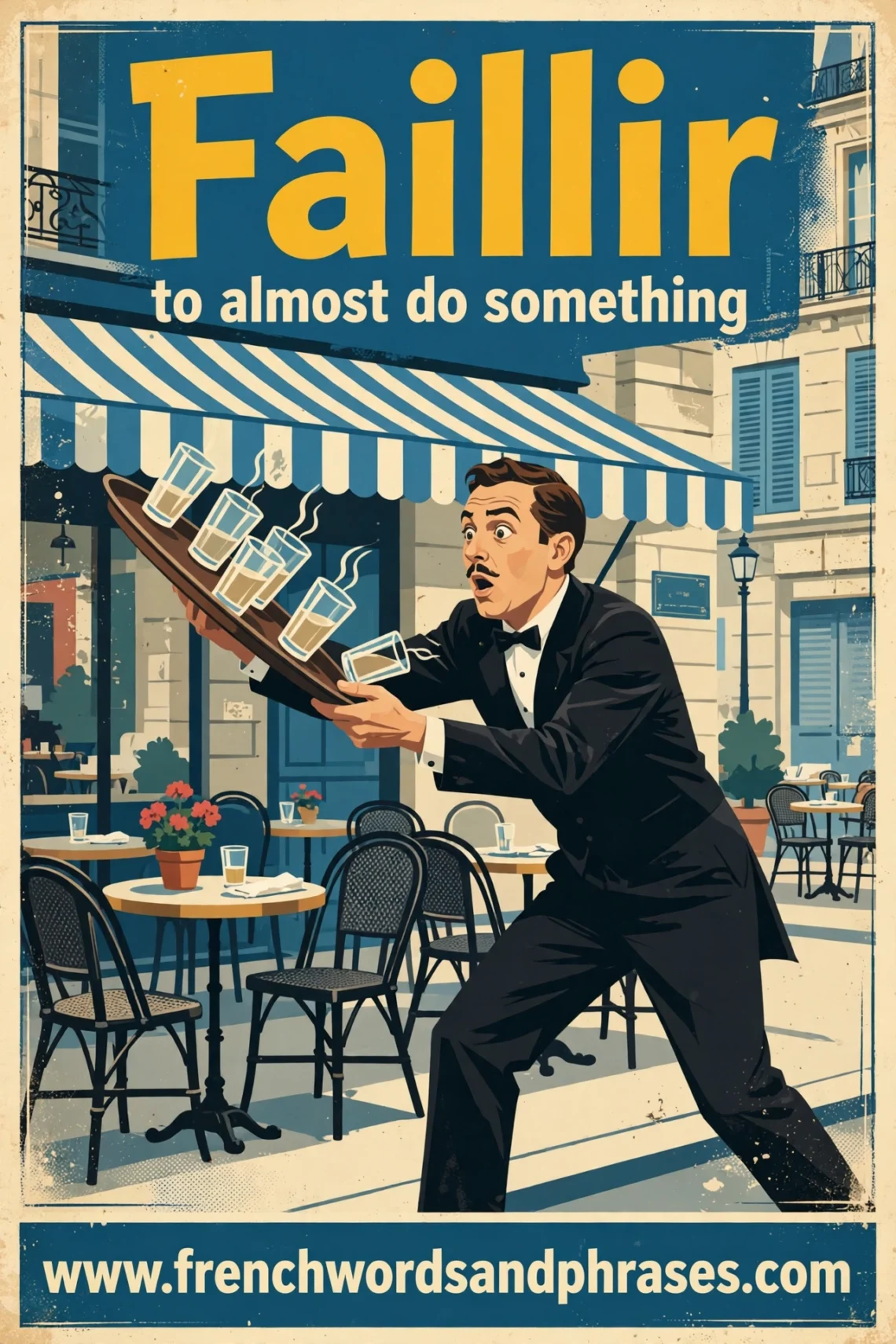
Faillir means to almost do something, or to fail.
The train door closes in your face, the vase tips and is caught, the keys are found in your pocket. Almost falling, almost forgetting, almost missing — the near-miss is faillir.
In this guide, you’ll learn how to conjugate faillir in all the major French tenses and moods. Explore complete conjugation tables, French examples, English translations, and practice quizzes.
Understanding the French Verb Faillir
Faillir is an irregular French verb belonging to the third group of verbs, those ending in -ir.
It means to almost do something, or to fail. It is commonly used to say that something almost happened: j’ai failli tomber, j’ai failli oublier. In literature it can also mean to fail in one’s duty, to be lacking.
Verb classification: Third group (irregular -ir verb)
Auxiliary verb: Avoir or être, depending on the construction
Past participle: failli
Present participle: faillant
English equivalents: To almost do, to nearly, to fail.
One important detail: faillir works with two auxiliary verbs, but the modern verb lives almost entirely with avoir. It is a semi-auxiliary followed by an infinitive, and its home tense is the passé composé — j’ai failli tomber (I almost fell). In older and literary French, faillir could take être in the sense of failing or being at fault — il est failli à son devoir (he failed in his duty) — but that use has disappeared from modern French. Its simple tenses are rare too, except the literary passé simple: il faillit. The tables on this page use avoir.
Experience the Word
Faillir is the verb of the near-miss — the disaster that almost happened and the relief that follows it.
Imagine running for the train, bag in hand, and jumping through the doors as they close. Your heart pounds, you laugh out loud: you almost missed it.
You have not just escaped. You have lived the near-miss — and j’ai failli is how French tells it.
How to Conjugate Faillir: Complete French Conjugation Guide
Let’s explore every major conjugation of faillir, beginning with the indicative mood.
How to Conjugate Faillir in the Indicative Mood
The indicative mood is used to express facts, observations, actions, and events.
How to Conjugate Faillir in the Present Tense (Présent)
Used for actions happening now, habitual actions, and general truths.
| Subject | Conjugation |
|---|---|
| je | faillis |
| tu | faillis |
| il / elle | faillit |
| nous | faillissons |
| vous | faillissez |
| ils / elles | faillissent |
Example
Elle faillit à sa promesse une seule fois.
She failed in her promise a single time.
Quick Quiz 1
Complete the sentence:
Elle ______ à sa promesse une seule fois.
Reveal the answer
faillit
Elle faillit à sa promesse une seule fois.
She failed in her promise a single time.
How to Conjugate Faillir in the Passé Composé
Used for completed actions in the past. Faillir takes the auxiliary verb avoir or être, depending on the construction.
| Subject | Conjugation |
|---|---|
| j’ | ai failli |
| tu | as failli |
| il / elle | a failli |
| nous | avons failli |
| vous | avez failli |
| ils / elles | ont failli |
Example
J’ai failli tomber dans l’escalier.
I almost fell down the stairs.
How to Conjugate Faillir in the Imparfait (Imperfect Tense)
Used for habitual past actions, descriptions, and ongoing situations in the past.
| Subject | Conjugation |
|---|---|
| je | faillissais |
| tu | faillissais |
| il / elle | faillissait |
| nous | faillissions |
| vous | faillissiez |
| ils / elles | faillissaient |
Example
Quand il était jeune, il faillissait parfois à ses devoirs.
When he was young, he sometimes failed in his duties.
Quick Quiz 2
Choose the correct form:
I almost fell.
J’______ tomber. (ai failli / suis failli)
Reveal the answer
ai failli
J’ai failli tomber.
In modern French, faillir takes avoir.
How to Conjugate Faillir in the Plus-que-parfait
Used to describe an action that had already been completed before another past event.
| Subject | Conjugation |
|---|---|
| j’ | avais failli |
| tu | avais failli |
| il / elle | avait failli |
| nous | avions failli |
| vous | aviez failli |
| ils / elles | avaient failli |
Example
J’avais failli rater le train.
I had almost missed the train.
How to Conjugate Faillir in the Passé Simple
Primarily used in formal writing, literature, and historical narratives. It is rarely used in everyday conversation.
| Subject | Conjugation |
|---|---|
| je | faillis |
| tu | faillis |
| il / elle | faillit |
| nous | faillîmes |
| vous | faillîtes |
| ils / elles | faillirent |
Example
Il faillit tomber de sa chaise.
He almost fell off his chair.
How to Conjugate Faillir in the Passé Antérieur
A literary tense used to express an action completed immediately before another past action, generally in the passé simple.
| Subject | Conjugation |
|---|---|
| j’ | eus failli |
| tu | eus failli |
| il / elle | eut failli |
| nous | eûmes failli |
| vous | eûtes failli |
| ils / elles | eurent failli |
Example
Dès qu’il eut failli perdre son emploi, il changea de vie.
As soon as he had almost lost his job, he changed his life.
How to Conjugate Faillir in the Future Tense (Futur Simple)
Used to describe actions that will take place in the future.
| Subject | Conjugation |
|---|---|
| je | faillirai |
| tu | failliras |
| il / elle | faillira |
| nous | faillirons |
| vous | faillirez |
| ils / elles | failliront |
Example
Un jour, tu failliras oublier tes clés.
One day, you will almost forget your keys.
How to Conjugate Faillir in the Futur Antérieur (Future Perfect)
Used for an action that will have been completed before a particular point in the future.
| Subject | Conjugation |
|---|---|
| j’ | aurai failli |
| tu | auras failli |
| il / elle | aura failli |
| nous | aurons failli |
| vous | aurez failli |
| ils / elles | auront failli |
Example
À la fin de la semaine, il aura failli perdre patience.
By the end of the week, he will have almost lost his patience.
How to Conjugate Faillir in the Near Future (Futur Proche)
Used to describe something that is going to happen soon. Formed with aller + infinitive.
| Subject | Conjugation |
|---|---|
| je | vais faillir |
| tu | vas faillir |
| il / elle | va faillir |
| nous | allons faillir |
| vous | allez faillir |
| ils / elles | vont faillir |
Example
Elle va faillir rater son train.
She is going to almost miss her train.
How to Conjugate Faillir in the Conditional Mood
The conditional mood expresses what would happen under certain circumstances. It is also frequently used to make polite requests or express wishes.
How to Conjugate Faillir in the Present Conditional
| Subject | Conjugation |
|---|---|
| je | faillirais |
| tu | faillirais |
| il / elle | faillirait |
| nous | faillirions |
| vous | failliriez |
| ils / elles | failliraient |
Example
Sans ton aide, je faillirais oublier l’anniversaire.
Without your help, I would almost forget the anniversary.
How to Conjugate Faillir in the Past Conditional
| Subject | Conjugation |
|---|---|
| j’ | aurais failli |
| tu | aurais failli |
| il / elle | aurait failli |
| nous | aurions failli |
| vous | auriez failli |
| ils / elles | auraient failli |
Example
J’aurais failli tomber sans la rampe.
I would have almost fallen without the handrail.
Faillir in the Literary Past Conditional Form
This less common literary form uses the imperfect subjunctive of avoir or être, depending on the construction.
| Subject | Conjugation |
|---|---|
| j’ | eusse failli |
| tu | eusses failli |
| il / elle | eût failli |
| nous | eussions failli |
| vous | eussiez failli |
| ils / elles | eussent failli |
Example
Il eût failli rater le train sans son réveil.
He would have almost missed the train without his alarm.
How to Conjugate Faillir in the Subjunctive Mood
The subjunctive is used to express wishes, emotions, doubts, necessity, and uncertainty. It frequently follows expressions such as il faut que (it is necessary that) or bien que (although).
How to Conjugate Faillir in the Present Subjunctive
| Subject | Conjugation |
|---|---|
| que je | faillisse |
| que tu | faillisses |
| qu’il / qu’elle | faillisse |
| que nous | faillissions |
| que vous | faillissiez |
| qu’ils / qu’elles | faillissent |
Example
Il faut que je ne faillisse pas à ma promesse.
I must not fail in my promise.
Quick Quiz 3
Complete the sentence using the subjunctive:
Il faut que je ne ______ pas à ma promesse.
Reveal the answer
faillisse
Il faut que je ne faillisse pas à ma promesse.
I must not fail in my promise.
How to Conjugate Faillir in the Imperfect Subjunctive
A literary tense, rarely encountered in modern spoken French.
| Subject | Conjugation |
|---|---|
| que je | faillisse |
| que tu | faillisses |
| qu’il / qu’elle | faillît |
| que nous | faillissions |
| que vous | faillissiez |
| qu’ils / qu’elles | faillissent |
Example
Il voulait que je ne faillisse pas à mon devoir.
He wanted me not to fail in my duty.
How to Conjugate Faillir in the Pluperfect Subjunctive
A literary construction used to express an action completed before another past action.
| Subject | Conjugation |
|---|---|
| que j’ | eusse failli |
| que tu | eusses failli |
| qu’il / qu’elle | eût failli |
| que nous | eussions failli |
| que vous | eussiez failli |
| qu’ils / qu’elles | eussent failli |
Example
Il regrettait que j’eusse failli oublier le rendez-vous.
He regretted that I had almost forgotten the appointment.
How to Conjugate Faillir in the Past Subjunctive
| Subject | Conjugation |
|---|---|
| que j’ | aie failli |
| que tu | aies failli |
| qu’il / qu’elle | ait failli |
| que nous | ayons failli |
| que vous | ayez failli |
| qu’ils / qu’elles | aient failli |
Example
Je suis content que nous n’ayons pas failli rater le train.
I am glad we did not almost miss the train.
How to Conjugate Faillir in the Imperative
The imperative is used to give commands, instructions, invitations, or suggestions. Subject pronouns are omitted.
How to Conjugate Faillir in the Present Imperative
| Person | Conjugation |
|---|---|
| (tu) | faillis |
| (nous) | faillissons |
| (vous) | faillissez |
Example
Ne faillis pas à ta promesse !
Do not fail in your promise!
Quick Quiz 4
How would you say Don’t fail in your promise, using the tu form?
Reveal the answer
Ne faillis pas à ta promesse !
French Participles of Faillir
Participles are verb forms that can be used in compound tenses and other grammatical constructions.
Present Participle of Faillir
faillant
En faillissant à son devoir, il perdit la confiance de tous.
By failing in his duty, he lost everyone’s trust.
Past Participle of Faillir
failli
J’ai failli oublier mon passeport.
I almost forgot my passport.
Faillir in Everyday French: Real-Life Examples
Now that you know the conjugations, let’s see how faillir appears in everyday French.
Example 1 — Present
Elle faillit à sa promesse une seule fois.
She failed in her promise a single time.
Example 2 — Passé composé — avoir
J’ai failli oublier mes clés.
I almost forgot my keys.
Example 3 — Passé composé — être (old literary use)
Il est failli à son devoir.
He failed in his duty.
Example 4 — Imparfait
Quand il était jeune, il faillissait parfois à ses devoirs.
When he was young, he sometimes failed in his duties.
Example 5 — Future
Un jour, tu failliras oublier tes clés.
One day, you will almost forget your keys.
Example 6 — Conditional
Sans ton aide, je faillirais oublier l’anniversaire.
Without your help, I would almost forget the anniversary.
Beyond Translation: The Meaning of Faillir
English says ‘almost’ and moves on; French gives the near-miss a verb of its own. Faillir is almost always followed by an infinitive — faillir tomber, faillir oublier, faillir rater — and almost always appears in the passé composé.
And faillir carries a small history lesson with it.
Its older sense, to fail in one’s duty, once took être — il est failli à son devoir. Modern French keeps the verb for the near-miss and gives it avoir: j’ai failli tomber. The meaning changed, and the auxiliary changed with it.
How to Remember the French Verb Faillir
Remember it this way: Faillir is about almost doing something — j’ai failli, the near-miss verb.
- You almost do something — j’ai failli tomber: auxiliary avoir, and faillir is followed by an infinitive.
- The home tense of faillir is the passé composé — j’ai failli oublier.
- The old literary form with être — il est failli à son devoir — belongs to the sense ‘to fail’, and to old books.
The key idea is almost doing something — j’ai failli, the near-miss verb.
Test Your Knowledge of Faillir
Let’s see how much you’ve learned. Try answering these questions before revealing the answers.
Question 1
Which auxiliary does faillir take in modern French?
Reveal the answer
Avoir: j’ai failli tomber. The old literary form with être — il est failli à son devoir — belongs to the sense ‘to fail’ and is no longer used today.
Question 2
How do you say I almost fell in French?
Reveal the answer
J’ai failli tomber.
Question 3
Translate: I almost forgot my keys.
Reveal the answer
J’ai failli oublier mes clés.
Question 4
What is the past participle of faillir?
Reveal the answer
Failli.
Question 5
Complete the sentence:
Si je n’avais pas fait attention, je ______ tomber.
Reveal the answer
aurais failli
Si je n’avais pas fait attention, j’aurais failli tomber.
If I had not paid attention, I would have almost fallen.
Your Final Challenge
Can You Use It?
How would you say this in French?
I almost missed the train.
Reveal the answer
J’ai failli rater le train.
I almost missed the train.
A little French. A little curiosity. A richer everyday life.
LEARN FRENCH ONE WORD AT A TIME