A French Word to Live By
Translate Gêné to English
/ʒɛ.ne/
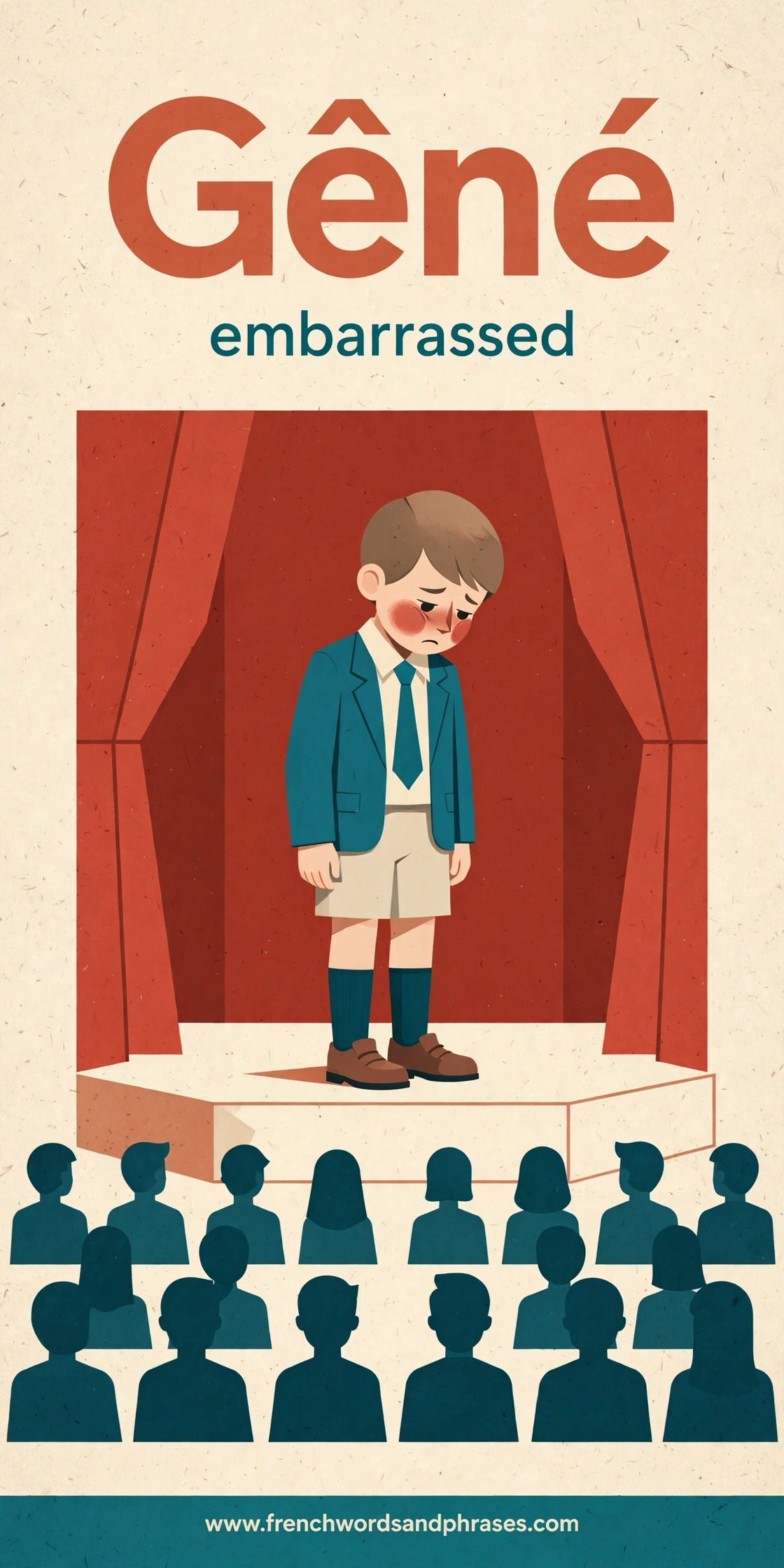
Gêné means embarrassed.
A dinner party in Bordeaux: the guest of honour reaches for the bread, knocks her glass, and watches red wine bloom across the white tablecloth. Eight people look at their plates with sudden interest. She smiles, burning: gênée, completely.
In this guide, you’ll learn what gêné means in English, its four forms, and its whole range — embarrassed, uncomfortable, bothered — plus the great polite question ça te gêne ? that unlocks French good manners. Explore French examples, English translations, and practice quizzes.
Understanding the French Adjective Gêné
Gêné is a French adjective of quality — an adjective of feelings and discomfort. It is the past participle of the verb gêner (to bother, to embarrass, to be in the way) working as an adjective, so it agrees fully: gêné, gênée, gênés, gênées.
It means embarrassed — and also uncomfortable, awkward and bothered. Je suis gêné, I’m embarrassed; gêné par le bruit, bothered by the noise; and the thing that causes the discomfort is gênant: un siège gênant, an awkward seat. Gêné covers the whole territory of social and physical discomfort, from the spilled wine to the too-tight shoe.
Type: Adjective of quality — feelings (past participle of gêner)
Answers the question: How does someone feel? — embarrassed, uncomfortable
Changes form: Yes — gêné, gênée, gênés, gênées
English equivalents: Embarrassed; uncomfortable; bothered; awkward.
One important usage detail: the verb gêner runs the great permission question of French politeness — ça te gêne si… ?, do you mind if…? Ça te gêne si j’ouvre la fenêtre ? And the answer that frees you: non, ça ne me gêne pas — no, it doesn’t bother me at all.
Experience the Word
Gêné is the adjective of the social wobble — the blush, the pause, the sentence that comes out wrong in front of exactly the wrong audience.
Imagine arriving at a birthday dinner in jeans and finding every other guest in evening dress. Nobody says a word. Everybody is kind. And yet, for one long minute by the door, you are the most gêné person in the city.
You have not just felt awkward. You have discovered that French has a word for precisely that minute.
How to Use Gêné in French: Complete Guide
Let’s explore how gêné works in French, beginning with the whole word on one card.
Gêné at a Glance
Before the details, here is the whole word on one card.
The Whole Word on One Card
Meaning, type, position and forms — gêné in four lines.
| Point | Gêné |
|---|---|
| Meaning | embarrassed |
| Type | adjective of quality — feelings and discomfort |
| Usual position | after être — je suis gêné |
| Form | gêné / gênée / gênés / gênées — full agreement |
Example
Elle est gênée, elle a renversé son verre.
She is embarrassed, she knocked over her glass.
The Four Forms of Gêné
Gêné agrees like a past participle: the feminine adds a written -e, and the plurals add -s. The circumflex on the ê never moves.
| Form | Gêné | Example |
|---|---|---|
| Masculine singular | gêné | il est gêné — he is embarrassed |
| Feminine singular | gênée | elle est gênée — she is embarrassed |
| Masculine plural | gênés | ils sont gênés — they are embarrassed |
| Feminine plural | gênées | elles sont gênées — they are embarrassed |
Example
Les invités sont gênés par le silence.
The guests are made uncomfortable by the silence.
Quick Quiz 1
Which form of gêné goes with elle — gêné or gênée?
Reveal the answer
gênée
Elle est gênée.
She is embarrassed.
Where Gêné Goes: After Être, and in the Great Question
Gêné stands after être to report the feeling — and its verb twin gêner asks the most useful polite question in French: ça te gêne si… ?
| Pattern | Example |
|---|---|
| After être | je suis gêné — I am embarrassed |
| gêné de + infinitive | gêné de vous déranger — sorry to bother you |
| gêné par + noun | gêné par le bruit — bothered by the noise |
| The great question | ça te gêne si je fume ? — do you mind if I smoke? |
Example
Je suis gêné de vous déranger à cette heure.
I’m sorry to bother you at this hour.
More Embarrassed: Comparing with Gêné
Gêné compares the regular way, with plus, moins and aussi — a scale measured in blushes.
| Degree | Example |
|---|---|
| As embarrassed as | aussi gêné que — as embarrassed as |
| More embarrassed | plus gêné — plus gêné que moi |
| Less embarrassed | moins gêné — less embarrassed |
| The most embarrassed | le plus gêné — le plus gêné de la soirée |
| Intensified | très gêné — very embarrassed |
Example
C’est lui le plus gêné de la soirée.
He’s the most embarrassed person of the evening.
Quick Quiz 2
What does ça te gêne si j’ouvre la fenêtre ? mean?
Reveal the answer
Do you mind if I open the window?
Non, ça ne me gêne pas.
No, it doesn’t bother me at all.
Everyday Expressions with Gêné
The gêner family runs French politeness — asking permission, giving it, apologising, and naming the person who never feels any of it.
| Expression | In English |
|---|---|
| ça me gêne | it bothers me, I mind |
| ça ne me gêne pas | I don’t mind, it doesn’t bother me |
| je suis gêné de vous déranger | I’m sorry to bother you |
| sans gêne | without embarrassment, shamelessly — agir sans gêne |
| un sans-gêne | a cheeky person with no manners |
| la gêne | embarrassment, awkwardness — the noun; also financial difficulty |
Example
Il a pris la dernière part sans gêne.
He took the last slice without a trace of embarrassment.
Gêné and Its Neighbours
Discomfort has degrees in French. Gêné is the everyday word; its neighbours separate the blush from the shame and the shyness.
| French | In English |
|---|---|
| embarrassé | embarrassed — the close twin of gêné |
| mal à l’aise | ill at ease, uncomfortable |
| honteux | ashamed — stronger, with real shame |
| timide | shy — a character trait, not a moment |
| confus | flustered, confused |
| détendu | relaxed — the happy opposite |
Example
Il n’est pas timide, il est juste gêné ce soir.
He isn’t shy, he’s just embarrassed this evening.
Quick Quiz 3
What does sans gêne mean in il a pris la chaise sans gêne?
Reveal the answer
Without embarrassment — shamelessly
Il a pris la chaise sans gêne.
He took the chair without a trace of embarrassment.
Gêné in French Politeness: A Tour of Small Awkwardnesses
French daily life is a choreography of not bothering people — and gêner is its stage direction. A tour of the classic moments.
| Moment | Example |
|---|---|
| Opening a window | ça vous gêne si j’ouvre ? — do you mind if I open it? |
| Arriving late | je suis gêné d’arriver en retard — I’m sorry to arrive late |
| Refusing a dish | elle est gênée de refuser — she is embarrassed to refuse |
| Borrowing a chair | ça te gêne si je prends cette chaise ? — do you mind if I take this chair? |
Example
Ça vous gêne si je m’assieds ici ? Pas du tout !
Do you mind if I sit here? Not at all!
Watch Out: The Traps Around Gêné
Four traps surround this word — its wider range, its twin’s second job, the compulsory de, and a spelling that has nothing to do with biology.
| Trap | The truth |
|---|---|
| gêné = embarrassed only | gêné also covers physical bother: gêné par la fumée, bothered by the smoke; des chaussures qui gênent, shoes that pinch |
| embarrassé | the twin also means cluttered or encumbered: un couloir embarrassé de cartons, a corridor cluttered with boxes |
| gêné + infinitive | the de is compulsory: gêné de vous déranger |
| gêne / gene | the French word wears a circumflex and has nothing to do with the English word ‘gene’ |
Example
Il est gêné par la fumée, ouvrons la fenêtre.
He is bothered by the smoke, let’s open the window.
Quick Quiz 4
How do you ask ‘do you mind if I smoke?’ — ça te gêne si je fume ? or tu es gêné je fume ??
Reveal the answer
ça te gêne si je fume ?
The permission question runs on the verb gêner with si.
Ça te gêne si je fume ? — do you mind if I smoke?
Gêné in Everyday French: Real-Life Examples
Now that you know the word, let’s see how gêné appears in everyday French.
Example 1 — The spilled wine
Elle est très gênée, elle a renversé du vin sur la nappe.
She is very embarrassed, she spilled wine on the tablecloth.
Example 2 — The window
Ça te gêne si j’ouvre la fenêtre ? Il fait chaud ici.
Do you mind if I open the window? It’s hot in here.
Example 3 — The easy answer
Non, ça ne me gêne pas du tout, assieds-toi.
No, it doesn’t bother me at all, sit down.
Example 4 — The apology
Je suis gêné de vous déranger un dimanche.
I’m sorry to bother you on a Sunday.
Example 5 — Tight shoes
Il marche lentement, il est gêné par ses chaussures neuves.
He is walking slowly, he is bothered by his new shoes.
Example 6 — No manners
Il a pris ma place sans gêne, incroyable.
He took my seat without any embarrassment, unbelievable.
Beyond Translation: The Meaning of Gêné
English says embarrassed for the meaning of gêné — but the French word patrols a much bigger border: the blush, the bother, the pinch of a tight shoe and the smoke in your eyes all report to gêner.
French politeness is largely the art of not gêner other people — and of asking before you do.
And the word keeps one secret: la gêne is also the old word for money trouble. To be dans la gêne is to be short of money — discomfort of the wallet, filed under the same word.
How to Remember the French Adjective Gêné
Remember it this way: Gêné is the blush and the bother in one word — and its verb asks the politest question in France: ça te gêne ?
- You hear the permission question everywhere — ça te gêne si… ? — and answer ça ne me gêne pas.
- You give the feminine its written -e — elle est gênée — and keep the circumflex on the ê.
- You apologise like a local: je suis gêné de vous déranger, with the little de in place.
The key idea is gêné means embarrassed and bothered — ça te gêne ? asks ‘do you mind?’, feminine gênée.
Test Your Knowledge of Gêné
Let’s see how much you’ve learned. Try answering these questions before revealing the answers.
Question 1
What does gêné mean?
Reveal the answer
Embarrassed — also uncomfortable and bothered.
Question 2
What are the forms of gêné?
Reveal the answer
gêné, gênée, gênés, gênées — full past-participle agreement.
Question 3
Translate: do you mind if I open the window?
Reveal the answer
Ça te gêne si j’ouvre la fenêtre ?
Question 4
What does ça ne me gêne pas mean?
Reveal the answer
It doesn’t bother me / I don’t mind
Ça ne me gêne pas du tout.
It doesn’t bother me at all.
Question 5
Complete the sentence:
Je suis ______ de vous déranger à cette heure.
Reveal the answer
gêné (or gênée for a woman)
Je suis gêné de vous déranger à cette heure.
I’m sorry to bother you at this hour.
Your Final Challenge
Can You Use It?
How would you say this in French?
“Do you mind if I open the window? Not at all, it doesn’t bother me.”
Reveal the answer
Ça te gêne si j’ouvre la fenêtre ? Pas du tout, ça ne me gêne pas.
Do you mind if I open the window? Not at all, it doesn’t bother me.
A little French. A little curiosity. A richer everyday life.
LEARN FRENCH ONE WORD AT A TIME