A French Word to Live By
Translate Foncé to English
/fɔ̃.se/
Foncé means dark.
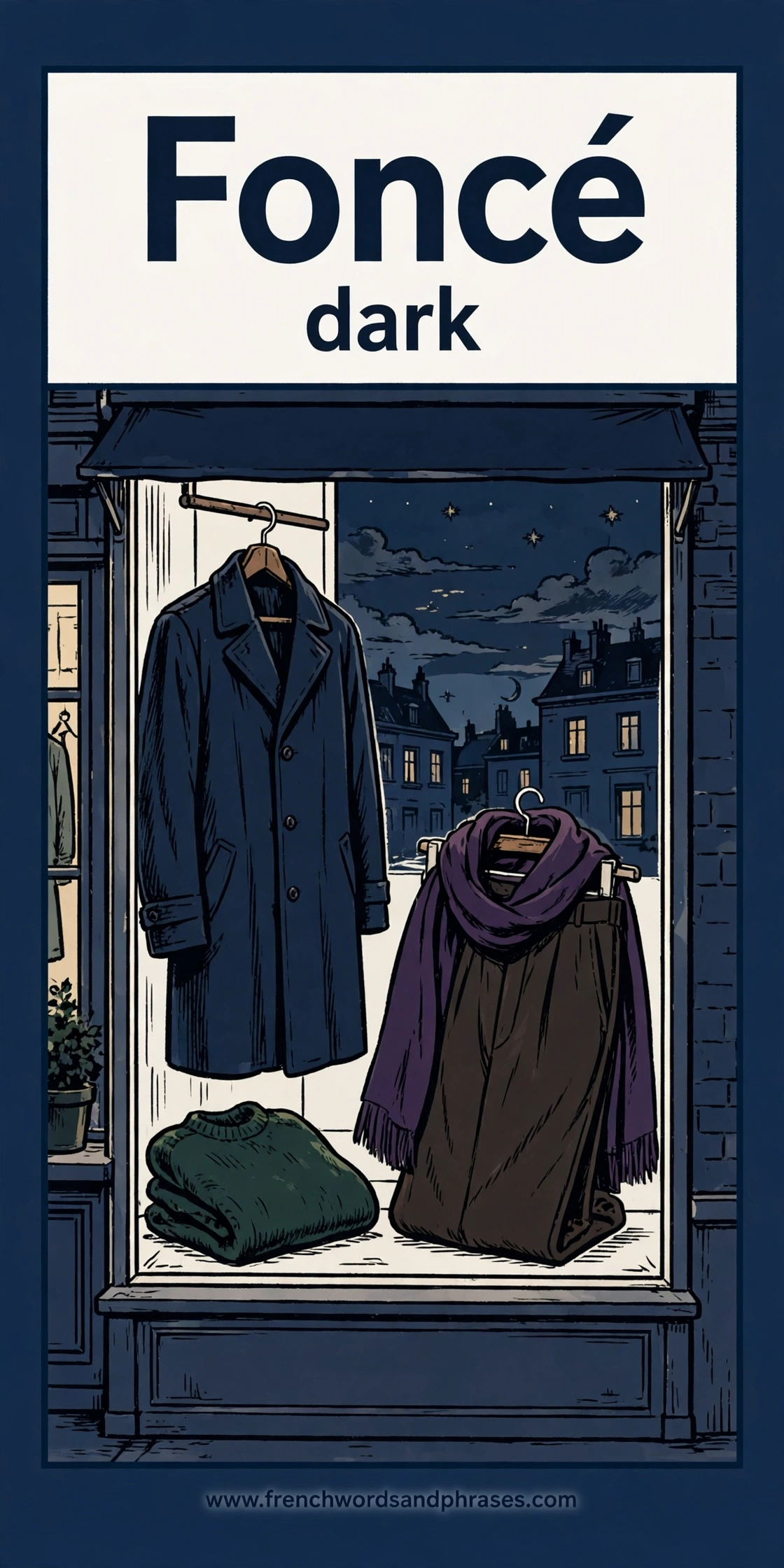
Two blue shirts hang in the shop window, the same blue at two depths: one the colour of a summer morning, the other of the sea before a storm. The customer points to the deeper one: « Je prends la foncée. » Foncé is the adjective of dark shades — the word that turns any colour towards the night.
In this guide, you’ll learn what foncé means in English, how it pairs with colour words, how its four forms work, and how it differs from noir and sombre. Explore French examples, English translations, and practice quizzes.
Understanding the French Adjective Foncé
Foncé is a French adjective of shade, the past participle of the verb foncer in its colour sense — to darken, to go deeper. It has four regular forms: foncé, foncée, foncés, foncées. Foncé almost never travels alone: it follows a colour — bleu foncé, dark blue; vert foncé, dark green; rouge foncé, dark red — and states the depth of that colour. Its opposite is clair, light: bleu clair, light blue.
It means dark — of a colour, deep and strong rather than pale: un bleu foncé, a dark blue; des yeux foncés, dark eyes; une couleur foncée, a dark colour. Foncé is not noir: a foncé colour still shows its colour fully, only deeper. A room or a mood is not foncé but sombre; foncé belongs to colours, fabrics, hair and eyes. Hair that is dark brown is châtain foncé; skin that is dark is une peau foncée.
Type: Adjective of shade — states the depth of a colour
Answers the question: How dark? — dark, deep (of a colour)
Changes form: Four forms — foncé, foncée, foncés, foncées; agrees with the noun, not the colour word
English equivalents: Dark; deep.
One important usage detail: in un bleu foncé, foncé agrees with the noun the colour describes, through the colour word — une robe bleu foncé, a dark-blue dress, where foncé stays masculine singular in form because bleu is treated as a noun there; but une couleur foncée, des teintes foncées show full agreement when foncé describes the noun directly. In everyday French, the safe pattern is: colour + foncé right after the noun phrase — une voiture rouge foncé, des cheveux châtain foncé.
Experience the Word
Foncé is the adjective of depth — the same colour, further from the light.
Imagine the dyer’s workshop in the old town: skeins of wool hang in a row, each colour in three depths, pale, full and deep. The dyer lifts the last skein of blue, dark as deep water. Pour un manteau d’hiver, il faut du bleu foncé — for a winter coat, it must be dark blue. Foncé is the colour that means business: winter, evening, formality.
You have not just darkened a colour. You have given it depth and weight — foncé, the shade that stays serious.
How to Use Foncé in French: Complete Guide
Let’s explore how foncé works in French, beginning with the whole word on one card.
Foncé at a Glance
Before the details, here is the whole word on one card.
The Whole Word on One Card
Meaning, type, position and forms — foncé in four lines.
| Point | Foncé |
|---|---|
| Meaning | dark, deep — of a colour |
| Type | adjective of shade, from foncer, to darken |
| Usual position | after a colour — bleu foncé; or after the noun — une couleur foncée |
| Forms | foncé, foncée, foncés, foncées |
Example
Elle choisit un bleu foncé pour la chambre.
She chooses a dark blue for the bedroom.
The Four Forms of Foncé
When foncé describes a noun directly, it agrees in the regular way: -é, -ée, -és, -ées.
| Form | Foncé | Example |
|---|---|---|
| Masculine singular | foncé | un ton foncé — a dark shade |
| Feminine singular | foncée | une couleur foncée — a dark colour |
| Masculine plural | foncés | des tons foncés — dark shades |
| Feminine plural | foncées | des teintes foncées — dark tints |
Example
Les teintes foncées dominent dans ce tableau.
Dark tints dominate in this painting.
Quick Quiz 1
What is the feminine of foncé?
Reveal the answer
foncée
Une couleur foncée — the feminine adds an e.
A dark colour.
Foncé After a Colour: The Everyday Pattern
Ninety times out of a hundred, foncé follows a colour word — bleu foncé, vert foncé — to deepen it.
| Situation | Example |
|---|---|
| Dark blue | un bleu foncé — a dark blue |
| Dark green | un vert foncé — a dark green |
| Dark red | un rouge foncé — a dark red |
| The opposite | bleu clair — light blue, with clair |
Example
Il porte un costume bleu foncé.
He wears a dark-blue suit.
Where Foncé Goes: After the Colour
Foncé comes last in the colour phrase — noun, colour, then foncé to deepen it.
| Pattern | Example |
|---|---|
| Noun + colour + foncé | une robe bleu foncé — a dark-blue dress |
| After être | cette couleur est foncée — this colour is dark |
| Before the noun | une foncée robe — not in French |
| With très | très foncé — very dark (of a shade) |
Example
Cette encre est très foncée, presque noire.
This ink is very dark, almost black.
Quick Quiz 2
How do you say ‘a dark-blue suit’ — un costume foncé bleu or un costume bleu foncé?
Reveal the answer
un costume bleu foncé
The order is noun, colour, then foncé to deepen the colour.
A dark-blue suit.
More Foncé: Comparing with Foncé
Shades compare with plus, moins and aussi — and clair is always waiting on the other side.
| Degree | Example |
|---|---|
| As dark as | aussi foncé que — as dark as |
| Darker | plus foncé — darker, deeper |
| Less dark | moins foncé — less dark |
| The darkest (masc.) | le plus foncé — le plus foncé des bleus |
| The darkest (fem.) | la plus foncée — la plus foncée des teintes |
Example
Ce bleu est plus foncé que l’autre.
This blue is darker than the other one.
Everyday Expressions with Foncé
Foncé is the word of paint charts, wardrobes and hairdressers — wherever a shade must be pinned down.
| Expression | In English |
|---|---|
| un bleu foncé | a dark blue |
| des yeux foncés | dark eyes |
| une peau foncée | dark skin |
| châtain foncé | dark brown (of hair) |
| une couleur foncée | a dark colour |
| bleu clair | light blue — the opposite pole |
Example
Elle a les yeux foncés et les cheveux châtain foncé.
She has dark eyes and dark-brown hair.
Quick Quiz 3
What is the opposite of foncé for a colour?
Reveal the answer
clair
Bleu foncé, dark blue; bleu clair, light blue — the two poles of every French colour chart.
Light.
Foncé and Its Neighbours
The darkness words — foncé for colours, the others for rooms, skies and moods.
| French | In English |
|---|---|
| clair | light, pale — the opposite of foncé |
| sombre | dark, gloomy — of rooms, skies, moods |
| noir | black — the colour itself, darker than foncé |
| profond | deep — of colour and of water |
| pâle | pale — washed-out, lighter than clair suggests |
| foncer | to darken; also to charge ahead (the verb) |
Example
La pièce est sombre, mais le rideau est seulement bleu foncé.
The room is gloomy, but the curtain is only dark blue.
Watch Out: The Traps Around Foncé
The traps: using foncé where French wants sombre, and hunting for a colour it must follow.
| Trap | The truth |
|---|---|
| A dark room | une pièce sombre — foncé is for colours, not atmospheres |
| Foncé alone | it usually deepens a colour: bleu foncé; alone it needs a noun like couleur or teinte |
| Agreement in bleu foncé | une robe bleu foncé — the pair stays in its set form after a feminine noun |
| The verb foncer | foncer also means to charge, to rush — il fonce sur la porte, he charges at the door |
Example
Il fonce vers la sortie dans son costume bleu foncé.
He rushes towards the exit in his dark-blue suit.
Quick Quiz 4
How do you say ‘dark eyes’?
Reveal the answer
des yeux foncés
Yeux is masculine plural, so foncés with an s.
Dark eyes.
Foncé in Everyday French: Real-Life Examples
Now that you know the word, let’s see how foncé appears in everyday French.
Example 1 — Shopping
Je préfère le bleu foncé pour un costume.
I prefer dark blue for a suit.
Example 2 — Painting
Cette couleur est trop foncée pour la chambre.
This colour is too dark for the bedroom.
Example 3 — Describing
Elle a des yeux foncés et un beau sourire.
She has dark eyes and a lovely smile.
Example 4 — Hair
Il a les cheveux châtain foncé.
He has dark-brown hair.
Example 5 — Clothes
Elle porte une jupe rouge foncé.
She wears a dark-red skirt.
Example 6 — The sky
Le ciel devient foncé avant l’orage.
The sky turns dark before the storm.
Beyond Translation: The Meaning of Foncé
Foncé is the past participle of foncer — a verb with two lives. In the dyer’s and painter’s world it means to darken, to deepen a shade; in the street it means to charge headlong, foncer sur quelqu’un. The adjective kept the quiet, colourful life: it is the word that lets French grade every colour by depth, where English must borrow dark and deep and hope for the best.
Foncé is depth made grammatical — one word that darkens any colour it touches.
Learn it locked to its opposite, clair: bleu foncé, bleu clair. With those two poles and the colour words between them, you can describe any shade in France, from paint charts to hair dye, exactly.
How to Remember the French Adjective Foncé
Remember it this way: Foncé is the dark-shade adjective — it deepens a colour, agrees when it describes a noun directly, and pairs forever with clair.
- You attach it to a colour — bleu foncé, vert foncé, rouge foncé.
- You keep the pair together — foncé contre clair, dark against light.
- You leave the gloom to sombre — une pièce sombre, une couleur foncée.
The key idea is foncé = dark, deep (of a colour); opposite clair; sombre = dark of rooms and moods.
Test Your Knowledge of Foncé
Let’s see how much you’ve learned. Try answering these questions before revealing the answers.
Question 1
What does foncé mean?
Reveal the answer
Dark, deep — of a colour: bleu foncé, dark blue.
Question 2
What is the feminine plural of foncé?
Reveal the answer
foncées — des teintes foncées.
Question 3
Translate: He wears a dark-blue suit.
Reveal the answer
Il porte un costume bleu foncé.
Question 4
Complete the sentence:
Elle a des yeux ______. (dark)
Reveal the answer
foncés
Elle a des yeux foncés.
She has dark eyes.
Question 5
How do you say a dark, gloomy room?
Reveal the answer
une pièce sombre — foncé is for colours; sombre is for rooms and moods.
Your Final Challenge
Can You Use It?
How would you say this in French?
“She has dark eyes and a lovely smile.”
Reveal the answer
Elle a des yeux foncés et un beau sourire.
She has dark eyes and a lovely smile.
A little French. A little curiosity. A richer everyday life.
LEARN FRENCH ONE WORD AT A TIME