A French Word to Live By
Translate Turquoise to English
/tyʁ.kwaz/
Turquoise means turquoise.
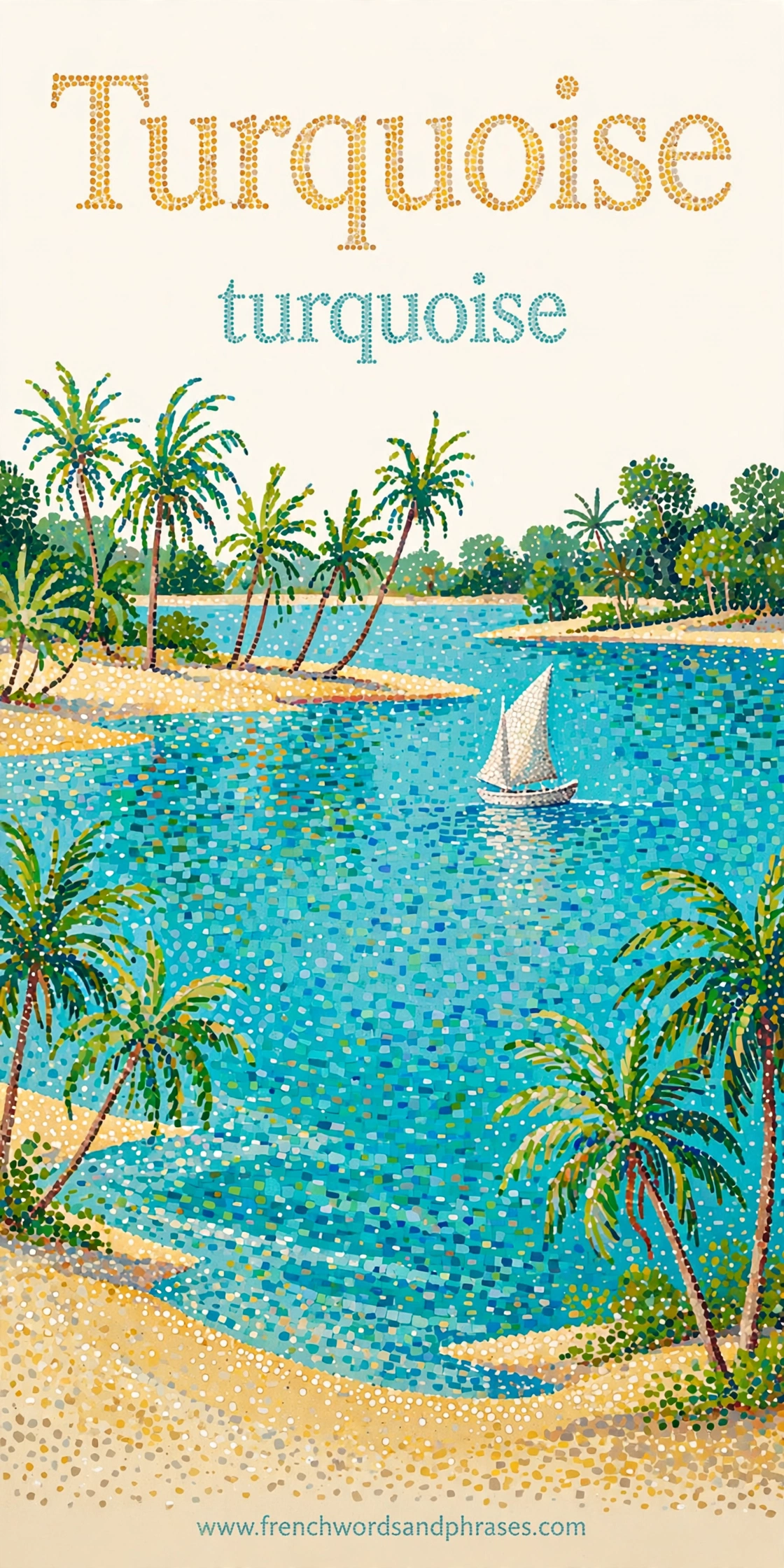
The boat crosses the lagoon and the water changes three times: deep blue, bright green, and then a colour that is both at once, clear as glass. « Quelle eau turquoise ! » Turquoise is the blue-green of tropical seas and of the stone that gave the colour its name.
In this guide, you’ll learn what turquoise means in English, why this colour adjective never changes its form, where it stands in the sentence, and how it differs from bleu and vert. Explore French examples, English translations, and practice quizzes.
Understanding the French Adjective Turquoise
Turquoise is a French colour adjective taken from the noun la turquoise, the turquoise stone — a stone named for the Turkish trade routes that brought it to Europe. Because it is a colour borrowed from a noun, turquoise is invariable: it never changes for gender or number. Une mer turquoise, des yeux turquoise, des robes turquoise — one single form everywhere.
It means turquoise — the bright blue-green between blue and green: une eau turquoise, turquoise water; des yeux turquoise, turquoise eyes; une robe turquoise, a turquoise dress. It is the colour word of holidays and lagoons, lighter and greener than bleu, bluer than vert. As a noun, la turquoise is the semi-precious stone itself, worn in jewellery for thousands of years.
Type: Colour adjective — borrowed from the noun la turquoise, the stone
Answers the question: What colour? — turquoise, bright blue-green
Changes form: Never — invariable for gender and number: des robes turquoise
English equivalents: Turquoise.
One important usage detail: do not add endings to turquoise. Colour adjectives borrowed from nouns — turquoise, orange, marron — stay frozen: une écharpe turquoise, des écharpes turquoise. The agreement happens in the noun and the article; the colour word itself never moves.
Experience the Word
Turquoise is the adjective of the lagoon — the colour water turns when it is shallow, warm and lit from below by white sand.
Imagine the traveller’s first morning in the islands: she opens the shutters expecting the grey-blue sea of home, and the whole window is filled with a green-blue light she has only seen in photographs. Elle reste là, café à la main, devant la mer turquoise — and understands why people cross the world for a colour.
You have not just named a colour between two others. You have named the colour of clear water over white sand — turquoise, the blue that went green in the sun.
How to Use Turquoise in French: Complete Guide
Let’s explore how turquoise works in French, beginning with the whole word on one card.
Turquoise at a Glance
Before the details, here is the whole word on one card.
The Whole Word on One Card
Meaning, type, position and forms — turquoise in four lines.
| Point | Turquoise |
|---|---|
| Meaning | turquoise — bright blue-green, the colour of lagoons |
| Type | colour adjective borrowed from the noun la turquoise, the stone |
| Usual position | after the noun — une mer turquoise |
| Forms | one only — turquoise for every gender and number |
Example
La mer turquoise brille sous le soleil.
The turquoise sea shines under the sun.
The Forms of Turquoise: One Word for All
Turquoise never changes — the same form serves masculine, feminine, singular and plural.
| Form | Turquoise | Example |
|---|---|---|
| Masculine singular | turquoise | un lac turquoise — a turquoise lake |
| Feminine singular | turquoise | une eau turquoise — turquoise water |
| Masculine plural | turquoise | des yeux turquoise — turquoise eyes |
| Feminine plural | turquoise | des robes turquoise — turquoise dresses |
Example
Des robes turquoise sèchent au soleil du village.
Turquoise dresses are drying in the village sun.
Quick Quiz 1
What is the feminine plural of turquoise?
Reveal the answer
turquoise
Des robes turquoise — the word is invariable: no e, no s, ever.
Turquoise dresses.
Why Turquoise Never Changes
Colour adjectives borrowed from nouns keep the noun’s frozen form — turquoise behaves like orange and marron.
| Situation | Example |
|---|---|
| Masculine | un foulard turquoise — a turquoise scarf |
| Feminine | une écharpe turquoise — identical: nothing is added |
| Why | the colour is a noun used as an adjective, so it stays invariable |
| The plural | still turquoise — des écharpes turquoise |
Example
Elle a acheté une écharpe turquoise au marché.
She bought a turquoise scarf at the market.
Where Turquoise Goes: After the Noun
Like every French colour adjective, turquoise follows the noun — and follows être when it describes a scene.
| Pattern | Example |
|---|---|
| After the noun | une mer turquoise — a turquoise sea |
| After être | l’eau est turquoise — the water is turquoise |
| Before the noun | une turquoise mer — not in French |
| With a shade word | un bleu turquoise — a turquoise blue |
Example
Près de la plage, l’eau est turquoise et transparente.
Near the beach, the water is turquoise and transparent.
Quick Quiz 2
How do you say ‘turquoise dresses’ — des robes turquoises or des robes turquoise?
Reveal the answer
des robes turquoise
Turquoise is invariable — the plural s goes on robes, never on the colour.
Turquoise dresses.
Shades of Turquoise: Comparing the Colour
An invariable adjective still compares — with plus, moins, aussi, and with clair and foncé for the shade.
| Degree | Example |
|---|---|
| As turquoise as | aussi turquoise que — as turquoise as |
| More turquoise | plus turquoise — more turquoise |
| Less turquoise | moins turquoise — less turquoise |
| Light turquoise | turquoise clair — light turquoise |
| Dark turquoise | turquoise foncé — dark turquoise |
Example
Ici, la mer est plus turquoise qu’à la maison.
Here, the sea is more turquoise than at home.
Everyday Expressions with Turquoise
Turquoise belongs to holidays, jewellery and summer clothes — the bright end of the colour box.
| Expression | In English |
|---|---|
| une mer turquoise | a turquoise sea |
| des yeux turquoise | turquoise eyes |
| une robe turquoise | a turquoise dress |
| une pierre turquoise | a turquoise stone |
| un bleu turquoise | a turquoise blue |
| la turquoise | the turquoise stone itself (the noun) |
Example
Elle porte un collier avec une pierre turquoise.
She wears a necklace with a turquoise stone.
Quick Quiz 3
What is la turquoise, with the article?
Reveal the answer
The turquoise stone
With la, turquoise is the noun — the blue-green semi-precious stone. Without an article after a noun, it is the invariable colour adjective.
The turquoise (stone).
Turquoise and Its Neighbours
The blue-green family — where turquoise sits between its two parent colours.
| French | In English |
|---|---|
| bleu | blue |
| vert | green |
| bleu-vert | blue-green — the descriptive compound |
| émeraude | emerald — deeper, greener |
| azur | azure — the bright blue of the sky |
| orange | orange — another invariable colour from a noun |
Example
Entre l’azur du ciel et l’émeraude de la forêt, la mer turquoise fait le lien.
Between the azure of the sky and the emerald of the forest, the turquoise sea makes the link.
Watch Out: The Traps Around Turquoise
One trap rules them all: the endings that English speakers want to add and French forbids.
| Trap | The truth |
|---|---|
| Adding an s | des robes turquoise — never turquoises as an adjective |
| Adding an e | une robe turquoise — the feminine changes nothing |
| Position | after the noun — une mer turquoise, never before |
| The noun | la turquoise is the stone; it does take a plural: des turquoises, turquoise stones |
Example
Ses yeux turquoise, sans e et sans s, brillent comme le lagon.
Her turquoise eyes, with no e and no s, shine like the lagoon.
Quick Quiz 4
How do you say ‘a turquoise sea’?
Reveal the answer
une mer turquoise
The adjective follows the noun and stays unchanged.
A turquoise sea.
Turquoise in Everyday French: Real-Life Examples
Now that you know the word, let’s see how turquoise appears in everyday French.
Example 1 — Holidays
La mer est turquoise près de la plage.
The sea is turquoise near the beach.
Example 2 — Eyes
Le bébé a des yeux turquoise.
The baby has turquoise eyes.
Example 3 — Clothes
Elle porte une robe turquoise en été.
She wears a turquoise dress in summer.
Example 4 — Jewellery
Ce collier a une pierre turquoise.
This necklace has a turquoise stone.
Example 5 — The pool
L’eau de la piscine est turquoise.
The pool water is turquoise.
Example 6 — Painting
Il mélange du bleu et du vert pour faire du turquoise.
He mixes blue and green to make turquoise.
Beyond Translation: The Meaning of Turquoise
Turquoise is a geography lesson in a word: the stone reached Europe from Persia through Turkey, and French named it for the route — pierre turquoise, the Turkish stone. The colour kept the traveller’s name, and grammar kept the souvenir: a colour borrowed whole from a noun stays invariable, a little foreigner in the sentence that never takes French endings.
Turquoise is the colour of the journey — a stone from the East that became the blue-green of every lagoon.
Learn it with its fellow travellers orange and marron: three colours, three nouns, three adjectives that never change — the invariable corner of the French colour box.
How to Remember the French Adjective Turquoise
Remember it this way: Turquoise is the invariable colour adjective — one form for everything, borrowed from the stone, standing after the noun.
- You add nothing, ever — une robe turquoise, des robes turquoise.
- You picture the stone — la turquoise, la pierre bleu-vert venue de Turquie.
- You place it after the noun — une mer turquoise, des yeux turquoise.
The key idea is turquoise = turquoise (colour), invariable; la turquoise = the stone.
Test Your Knowledge of Turquoise
Let’s see how much you’ve learned. Try answering these questions before revealing the answers.
Question 1
What does turquoise mean?
Reveal the answer
Turquoise — the bright blue-green colour of lagoons and of the stone.
Question 2
Does turquoise change for the feminine plural?
Reveal the answer
No — it is invariable: des robes turquoise.
Question 3
Translate: The sea is turquoise near the beach.
Reveal the answer
La mer est turquoise près de la plage.
Question 4
Complete the sentence:
Le bébé a des yeux ______. (turquoise)
Reveal the answer
turquoise
Le bébé a des yeux turquoise.
The baby has turquoise eyes.
Question 5
Where does the word turquoise come from?
Reveal the answer
From the Turkish trade route — the stone reached Europe through Turkey: pierre turquoise, the Turkish stone.
Your Final Challenge
Can You Use It?
How would you say this in French?
“The baby has turquoise eyes.”
Reveal the answer
Le bébé a des yeux turquoise.
The baby has turquoise eyes.
A little French. A little curiosity. A richer everyday life.
LEARN FRENCH ONE WORD AT A TIME