A French Word to Live By
Translate Festival to English
/fɛs.ti.val/
Le festival means the festival.
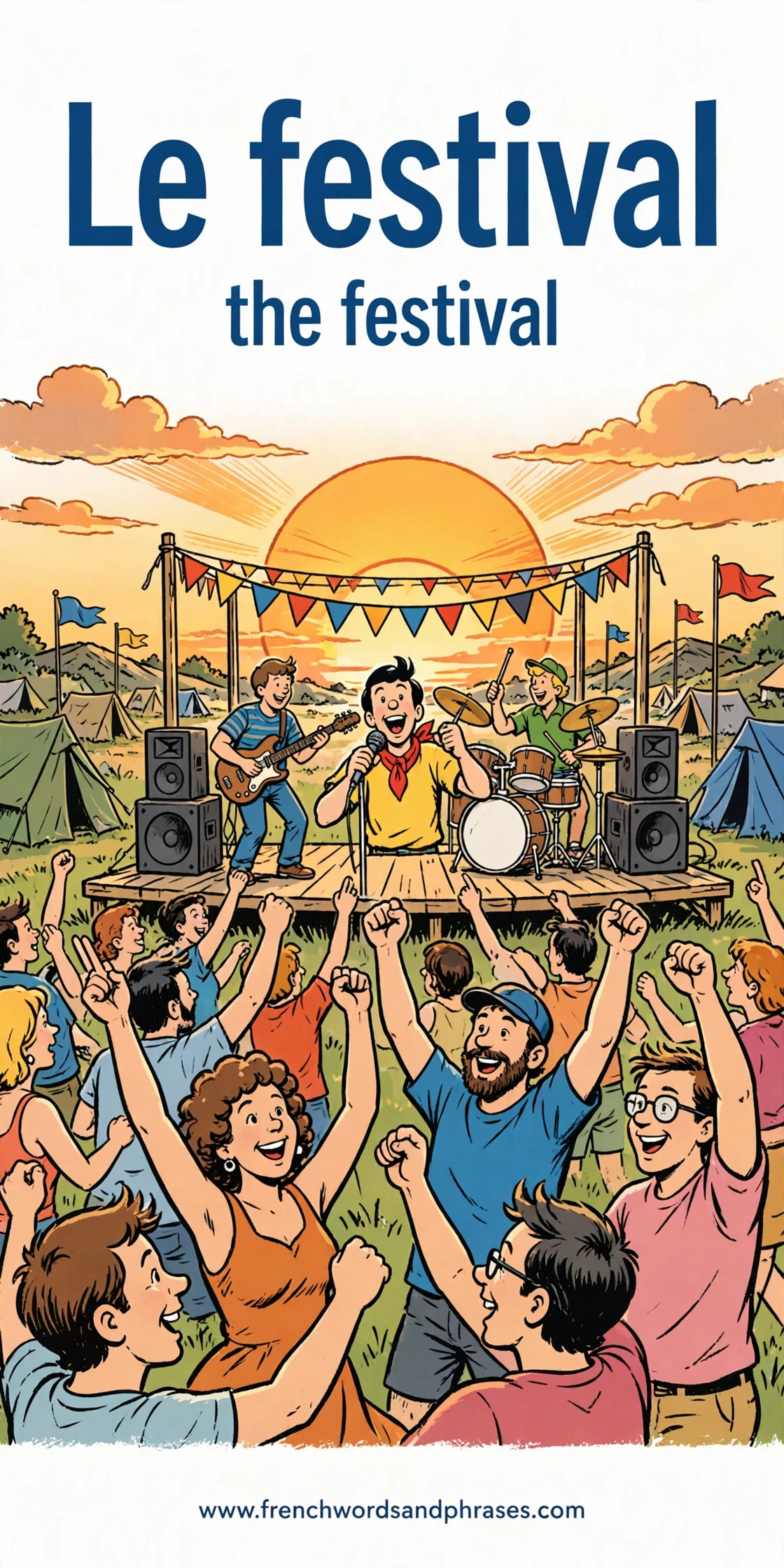
Stages in the fields, lights in the old town, music drifting over the river until midnight: le festival, the festival — the days when a town stops its ordinary life and gives itself over to film, music, theatre or food.
In this guide, you’ll learn what festival means in English, how to use it with its articles, how to form its plural, and how it appears in everyday French. Explore French examples, English translations, and practice quizzes.
Understanding the French Noun Festival
Festival is a masculine French noun, learned with its article: le festival, un festival. English borrowed the word from French long ago, and modern French borrowed the modern sense back — the two languages now share it almost unchanged. Its plural is regular in French: les festivals, with an -s, not the English-style spelling some expect.
It means a festival — an organised series of performances or celebrations, usually lasting several days: un festival de musique, a music festival, un festival de cinéma, a film festival. France is the land of them: le Festival de Cannes for film, le Festival d’Avignon for theatre, and thousands of village festivals all summer long. People who go are les festivaliers.
Gender: Masculine — le festival
Definite article: le — le festival (the festival)
Indefinite article: un — un festival (a festival)
Plural: les festivals — regular, with a simple -s
Spelling note: the plural is festivals, not festivaux — unlike carnaval, which makes carnavals too
Close neighbour: la fête — a party or a local feast day; le festival is the big organised event
English equivalents: The festival.
Festivals are located with à and attended with aller à or participer à: aller au festival de Cannes. The programme is la programmation, and a festival-goer is un festivalier, une festivalière. Watch the plural: French writes des festivals, one plain -s — English speakers often want to invent festivaux, but the word stays regular.
Experience the Word
Festival is a town with its hair down: streets closed, stages up, strangers dancing where the buses usually turn.
Imagine the first evening of the Avignon theatre festival — posters on every wall, actors performing in courtyards and garages, the whole city become a stage. C’est le festival, and ordinary life waits outside the walls until it ends.
You have not just named an event. You have named the days a place gives to art — le festival, the celebration that takes over the streets.
How to Use Festival in French: Complete Guide
Let’s explore how festival works in French, beginning with its articles — le festival, un festival, aller au festival.
Festival with the Definite Article (Le, Les)
Used for a specific festival — the famous one, the one this weekend.
| Form | French |
|---|---|
| Masculine singular | le festival |
| Plural | les festivals |
Example
Le festival commence vendredi et dure trois jours.
The festival starts on Friday and lasts three days.
Festival with the Indefinite Article (Un, Des)
Used for a festival in general — one of the hundreds France holds each summer.
| Form | French |
|---|---|
| Masculine singular | un festival |
| Plural | des festivals |
Example
Chaque été, un festival anime la vieille ville.
Every summer, a festival brings the old town to life.
Festival with Quantities and Kinds (De musique, de cinéma…)
Festivals are named by their art — the vocabulary of the summer programme.
| Quantity | French |
|---|---|
| a music festival | un festival de musique |
| a film festival | un festival de cinéma |
| a theatre festival | un festival de théâtre |
| a big festival | un grand festival |
| festival season | la saison des festivals |
Example
Nous allons à un festival de musique en juillet.
We’re going to a music festival in July.
Quick Quiz 1
Complete the sentence:
______ festival de Cannes a lieu au mois de mai. (the)
Reveal the answer
Le
Le festival de Cannes a lieu au mois de mai.
The Cannes festival takes place in May — festival is masculine, so le.
The Plural of Festival
Festival takes a regular plural in -s — festivals, never festivaux.
| Number | French |
|---|---|
| Singular | le festival |
| Plural | les festivals |
Example
Les festivals attirent des milliers de visiteurs.
The festivals attract thousands of visitors.
Festival with Possessive Adjectives (Mon, Ton, Son…)
Possessives agree with the noun: festival is masculine, so mon, ton, son in the singular.
| Owner | French |
|---|---|
| my | mon festival |
| your (tu) | ton festival |
| his / her | son festival |
| our | notre festival |
| your (vous) | votre festival |
| their | leur festival |
Example
Mon festival préféré a lieu au bord de la mer.
My favourite festival takes place by the sea.
Quick Quiz 2
Complete the sentence:
Ils préparent ______ festival depuis le mois de janvier. (their)
Reveal the answer
leur
Ils préparent leur festival depuis le mois de janvier.
They have been preparing their festival since January — leur, for a singular possessed noun.
Festival with Demonstrative Adjectives (Ce, Ces)
Used to point: ce festival, this festival — the one on all the posters.
| Form | French |
|---|---|
| Masculine singular | ce festival |
| Plural | ces festivals |
Example
Ce festival attire des artistes du monde entier.
This festival attracts artists from all over the world.
Festival with Adjectives
Adjectives agree with festival — masculine singular: un festival célèbre, un festival annuel.
| Adjective | With Festival |
|---|---|
| célèbre (famous) | un festival célèbre |
| annuel (annual) | un festival annuel |
| grand (big) | un grand festival |
| international (international) | un festival international |
| gratuit (free) | un festival gratuit |
Example
Avignon accueille un festival de théâtre célèbre.
Avignon hosts a famous theatre festival.
Quick Quiz 3
Complete the sentence:
C’est un festival très ______ dans toute la région. (famous)
Reveal the answer
célèbre
C’est un festival très célèbre dans toute la région.
It’s a very famous festival throughout the region — célèbre has the same form for masculine and feminine.
Everyday Expressions with Festival
Programmes, tickets and stages — the festival phrases of daily life.
| Expression | In English |
|---|---|
| aller à un festival | to go to a festival |
| un festival de musique | a music festival |
| un festivalier | a festival-goer |
| la programmation | the line-up, the programme |
| un pass festival | a festival pass |
Example
Les festivaliers arrivent avec leurs tentes et leurs guitares.
The festival-goers arrive with their tents and guitars.
Words from the Same Family as Festival
Celebrating — the words that travel with festival.
| French | In English |
|---|---|
| la fête | the party, the celebration |
| fêter | to celebrate (the verb) |
| festif | festive (adjective) |
| un festivalier | a festival-goer |
| le carnaval | the carnival |
Example
L’ambiance festive envahit la ville pendant une semaine.
The festive atmosphere takes over the town for a week.
Quick Quiz 4
What is un festivalier?
Reveal the answer
A festival-goer — someone who attends a festival.
Des milliers de festivaliers dorment au camping.
Thousands of festival-goers sleep at the campsite.
Festival in Everyday French: Real-Life Examples
Now that you know the word, let’s see how festival appears in everyday French.
Example 1 — Summer plans
Nous allons au festival de musique ce week-end.
We’re going to the music festival this weekend.
Example 2 — Cinema
Le festival de Cannes récompense les meilleurs films.
The Cannes festival rewards the best films.
Example 3 — At the village
Le festival du village dure trois jours en août.
The village festival lasts three days in August.
Example 4 — Tickets
J’ai acheté un pass pour tout le festival.
I bought a pass for the whole festival.
Example 5 — Theatre
Pendant le festival, on joue dans les cours et les garages.
During the festival, plays are performed in courtyards and garages.
Example 6 — The crowd
Les festivaliers dansent jusqu’à minuit.
The festival-goers dance until midnight.
Beyond Translation: The Meaning of Festival
Festival is a word that crossed the Channel twice: English took it from Old French centuries ago, then the modern entertainment sense grew up in English and sailed back into French. France then made it entirely its own — no country on earth packs its summer with more festivals, from Cannes and Avignon down to the smallest village fête with a stage and a string of lights.
To say festival is to hear music over the rooftops.
It evokes poster-covered walls, wristbands, fields of tents and towns that belong, for a few days, to art and to the night.
How to Remember the French Noun Festival
Remember it this way: Festival is the festival — masculine: le festival, plural les festivals with a plain -s, never festivaux.
- Always masculine — le festival, un festival, mon festival.
- The plural trap — les festivals, one simple -s; festivaux does not exist.
- The people — les festivaliers, the festival-goers.
The key idea is le festival — the festival, masculine; plural festivals (not festivaux); un festivalier = a festival-goer.
Test Your Knowledge of Festival
Let’s see how much you’ve learned. Try answering these questions before revealing the answers.
Question 1
Is festival masculine or feminine?
Reveal the answer
Masculine — le festival, un festival.
Question 2
What is the plural of festival?
Reveal the answer
Les festivals — a regular -s; festivaux is not a French word.
Question 3
Translate: We’re going to a music festival in July.
Reveal the answer
Nous allons à un festival de musique en juillet.
Question 4
How do you say a festival-goer?
Reveal the answer
Un festivalier (une festivalière for a woman).
Question 5
Complete the sentence:
______ festivals attirent des milliers de visiteurs. (the)
Reveal the answer
Les
Les festivals attirent des milliers de visiteurs.
The festivals attract thousands of visitors.
Your Final Challenge
Can You Use It?
How would you say this in French?
“We’re going to a music festival in July.”
Reveal the answer
Nous allons à un festival de musique en juillet.
We’re going to a music festival in July.
A little French. A little curiosity. A richer everyday life.
LEARN FRENCH ONE WORD AT A TIME