A French Word to Live By
Translate Déguisement to English
/de.ɡiz.mɑ̃/
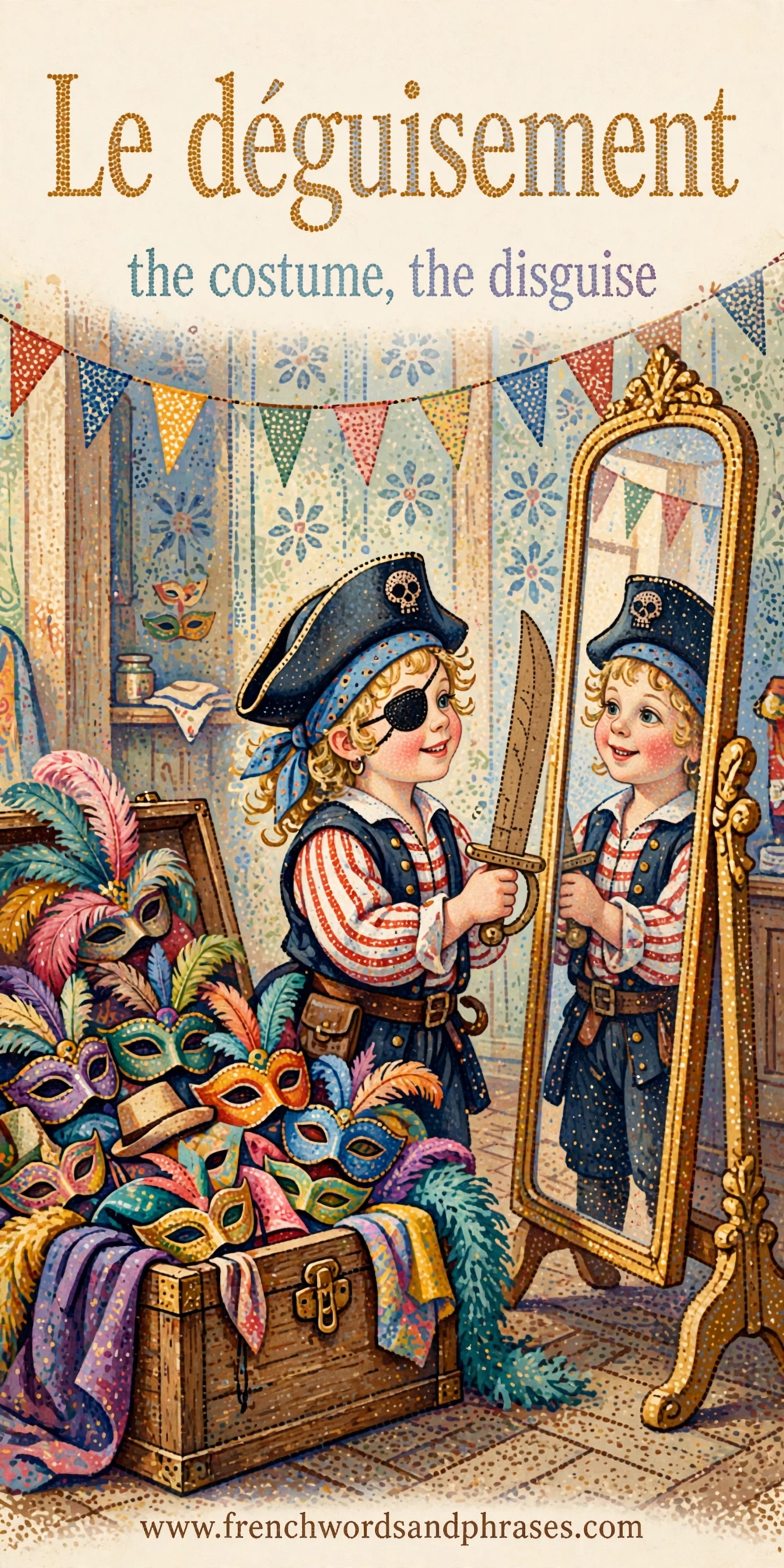
Le déguisement means the costume, the disguise.
The classroom door opens and in walks a pirate with a cardboard sword, followed by a princess, two vampires and a very small dragon: le déguisement, the costume — the outfit that lets a child, or a grown-up at carnival, become somebody else for a day.
In this guide, you’ll learn what déguisement means in English, how to use it with its articles, how to form its plural, and how it appears in everyday French. Explore French examples, English translations, and practice quizzes.
Understanding the French Noun Déguisement
Déguisement is a masculine French noun, learned with its article: le déguisement, un déguisement. It is built on the verb déguiser, to disguise, with the suffix -ment that names the result of an action. The same word covers both halves of its world: the joyful fancy dress of a party, and the serious disguise of a spy or a runaway.
It means a costume or a disguise — clothes worn to look like someone or something else: un déguisement de pirate, a pirate costume, un déguisement d’Halloween, a Halloween costume. A party where everyone wears one is une fête déguisée or un bal costumé. In its darker sense, porter un déguisement is to wear a disguise so as not to be recognised — the word itself stays neutral; the intention decides.
Gender: Masculine — le déguisement
Definite article: le — le déguisement (the costume)
Indefinite article: un — un déguisement (a costume)
Plural: les déguisements — regular, with a simple -s
Spelling note: built on déguiser (to disguise) + -ment, the suffix of results
Close neighbour: un costume — a costume, but also a man’s suit; déguisement always means dressing up
English equivalents: The costume, the disguise, fancy dress.
Children se déguisent — they dress up — and what they wear is un déguisement: se déguiser en pirate, to dress up as a pirate. Shops sell them in a magasin de déguisements, and carnival season is their great moment. Do not confuse déguisement with un costume in a business context: un costume is the suit a man wears to the office, no pirate hat involved.
Experience the Word
Déguisement is permission to be someone else — the pirate’s hat that turns the shyest child in the class into the captain of the room.
Imagine the village carnival in February: the whole square is unrecognisable, the mayor is a Roman emperor, the baker is a bee, and nobody’s real name survives the afternoon — le déguisement has levelled everyone into play.
You have not just named an outfit. You have named the joyful lie of carnival — le déguisement, the costume that sets the wearer free.
How to Use Déguisement in French: Complete Guide
Let’s explore how déguisement works in French, beginning with its articles — le déguisement, un déguisement, se déguiser en pirate.
Déguisement with the Definite Article (Le, Les)
Used for a specific costume — the one in the box, the one she wore last year.
| Form | French |
|---|---|
| Masculine singular | le déguisement |
| Plural | les déguisements |
Example
Le déguisement de pirate est dans la malle du grenier.
The pirate costume is in the trunk in the attic.
Déguisement with the Indefinite Article (Un, Des)
Used for a costume in general — any disguise to become someone else.
| Form | French |
|---|---|
| Masculine singular | un déguisement |
| Plural | des déguisements |
Example
Il faut un déguisement pour la fête de l’école.
You need a costume for the school party.
Déguisement with Quantities and Kinds (De pirate, d’Halloween…)
Costumes are chosen by character — the vocabulary of carnival and Halloween.
| Quantity | French |
|---|---|
| a pirate costume | un déguisement de pirate |
| a Halloween costume | un déguisement d’Halloween |
| a homemade costume | un déguisement fait maison |
| two costumes | deux déguisements |
| a box of costumes | une malle de déguisements |
Example
Elle a choisi un déguisement de sorcière cette année.
She chose a witch costume this year.
Quick Quiz 1
Complete the sentence:
______ déguisement de mon fils est trop petit cette année. (the)
Reveal the answer
Le
Le déguisement de mon fils est trop petit cette année.
My son’s costume is too small this year — déguisement is masculine, so le.
The Plural of Déguisement
Déguisement takes a regular plural in -s — a whole trunk of them at carnival time.
| Number | French |
|---|---|
| Singular | le déguisement |
| Plural | les déguisements |
Example
Les déguisements sont rangés dans la grande malle.
The costumes are stored in the big trunk.
Déguisement with Possessive Adjectives (Mon, Ton, Son…)
Possessives agree with the noun: déguisement is masculine, so mon, ton, son in the singular.
| Owner | French |
|---|---|
| my | mon déguisement |
| your (tu) | ton déguisement |
| his / her | son déguisement |
| our | notre déguisement |
| your (vous) | votre déguisement |
| their | leur déguisement |
Example
Mon déguisement de dragon a toujours du succès.
My dragon costume is always a success.
Quick Quiz 2
Complete the sentence:
Elle a cousu ______ déguisement elle-même. (her)
Reveal the answer
son
Elle a cousu son déguisement elle-même.
She sewed her costume herself — son, because déguisement is masculine.
Déguisement with Demonstrative Adjectives (Ce, Ces)
Used to point: ce déguisement, this costume — usually the one with the best hat.
| Form | French |
|---|---|
| Masculine singular | ce déguisement |
| Plural | ces déguisements |
Example
Ce déguisement de vampire est vraiment effrayant.
This vampire costume is really frightening.
Déguisement with Adjectives
Adjectives agree with déguisement — masculine singular: un déguisement effrayant, un déguisement fait maison.
| Adjective | With Déguisement |
|---|---|
| effrayant (frightening) | un déguisement effrayant |
| drôle (funny) | un déguisement drôle |
| fait maison (homemade) | un déguisement fait maison |
| complet (complete) | un déguisement complet |
| magnifique (magnificent) | un déguisement magnifique |
Example
Un déguisement fait maison coûte moins cher.
A homemade costume costs less.
Quick Quiz 3
Complete the sentence:
Son déguisement de sorcière est très ______. (frightening, feminine form not needed — think!)
Reveal the answer
effrayant
Son déguisement de sorcière est très effrayant.
Her witch costume is very frightening — effrayant agrees with déguisement, masculine, not with sorcière.
Everyday Expressions with Déguisement
Carnivals, school parties and Halloween — the déguisement phrases of daily life.
| Expression | In English |
|---|---|
| se déguiser en pirate | to dress up as a pirate |
| une fête déguisée | a fancy-dress party |
| un magasin de déguisements | a costume shop |
| porter un déguisement | to wear a costume / a disguise |
| un déguisement fait maison | a homemade costume |
Example
Les enfants se déguisent en animaux pour le carnaval.
The children dress up as animals for the carnival.
Words from the Same Family as Déguisement
Dressing up and hiding — the words that travel with déguisement.
| French | In English |
|---|---|
| déguiser | to disguise (the verb) |
| se déguiser | to dress up, to disguise oneself |
| un masque | a mask |
| un costume | a costume; also a man’s suit |
| le carnaval | the carnival |
Example
Avec un masque et une cape, son déguisement est complet.
With a mask and a cape, his costume is complete.
Quick Quiz 4
What is une fête déguisée?
Reveal the answer
A fancy-dress party — a party where everyone comes in costume.
Samedi, c’est une fête déguisée chez Léa.
On Saturday there’s a fancy-dress party at Léa’s.
Déguisement in Everyday French: Real-Life Examples
Now that you know the word, let’s see how déguisement appears in everyday French.
Example 1 — Carnival
Pour le carnaval, il porte un déguisement de pirate.
For the carnival, he’s wearing a pirate costume.
Example 2 — At the shop
Ce magasin vend des déguisements pour enfants.
This shop sells costumes for children.
Example 3 — Halloween
Son déguisement d’Halloween fait peur aux voisins.
His Halloween costume frightens the neighbours.
Example 4 — Homemade
Nous avons fabriqué un déguisement avec de vieux draps.
We made a costume out of old sheets.
Example 5 — The party
Tout le monde arrive en déguisement à la fête.
Everyone arrives in costume at the party.
Example 6 — A disguise
Le voleur portait un déguisement pour ne pas être reconnu.
The thief wore a disguise so as not to be recognised.
Beyond Translation: The Meaning of Déguisement
Déguisement is built from déguiser, and déguiser hides an older word inside it: guise, an old French word for manner or appearance, cousin of the English word guise itself. To dé-guiser was to un-make someone’s usual appearance — to take away the face the world knows. Carnival understood the freedom in that: one day a year, the déguisement dissolves rank, age and shyness together.
To say déguisement is to open the trunk where other selves are kept.
It evokes painted faces, cardboard swords and a square full of strangers who are, for one afternoon, exactly who they pretend to be.
How to Remember the French Noun Déguisement
Remember it this way: Déguisement is the costume and the disguise — masculine: le déguisement, and you se déguiser en pirate, dress up as a pirate.
- Always masculine — le déguisement, un déguisement, mon déguisement.
- The dressing-up phrase — se déguiser en…, to dress up as…
- Not a suit — un costume can be office wear; a déguisement is always dressing up.
The key idea is le déguisement — the costume, the disguise, masculine; se déguiser en = to dress up as.
Test Your Knowledge of Déguisement
Let’s see how much you’ve learned. Try answering these questions before revealing the answers.
Question 1
Is déguisement masculine or feminine?
Reveal the answer
Masculine — le déguisement, un déguisement.
Question 2
How do you say to dress up as a pirate?
Reveal the answer
Se déguiser en pirate.
Question 3
Translate: She chose a witch costume.
Reveal the answer
Elle a choisi un déguisement de sorcière.
Question 4
What is the difference between un déguisement and un costume at the office?
Reveal the answer
Un costume at the office is a man’s suit — a déguisement is always fancy dress or a disguise.
Question 5
Complete the sentence:
______ déguisements sont dans la malle. (the)
Reveal the answer
Les
Les déguisements sont dans la malle.
The costumes are in the trunk.
Your Final Challenge
Can You Use It?
How would you say this in French?
“For the carnival, he’s wearing a pirate costume.”
Reveal the answer
Pour le carnaval, il porte un déguisement de pirate.
For the carnival, he’s wearing a pirate costume.
A little French. A little curiosity. A richer everyday life.
LEARN FRENCH ONE WORD AT A TIME