
A French Word to Live By
How to Conjugate Farcir in French
/faʁ.siʁ/
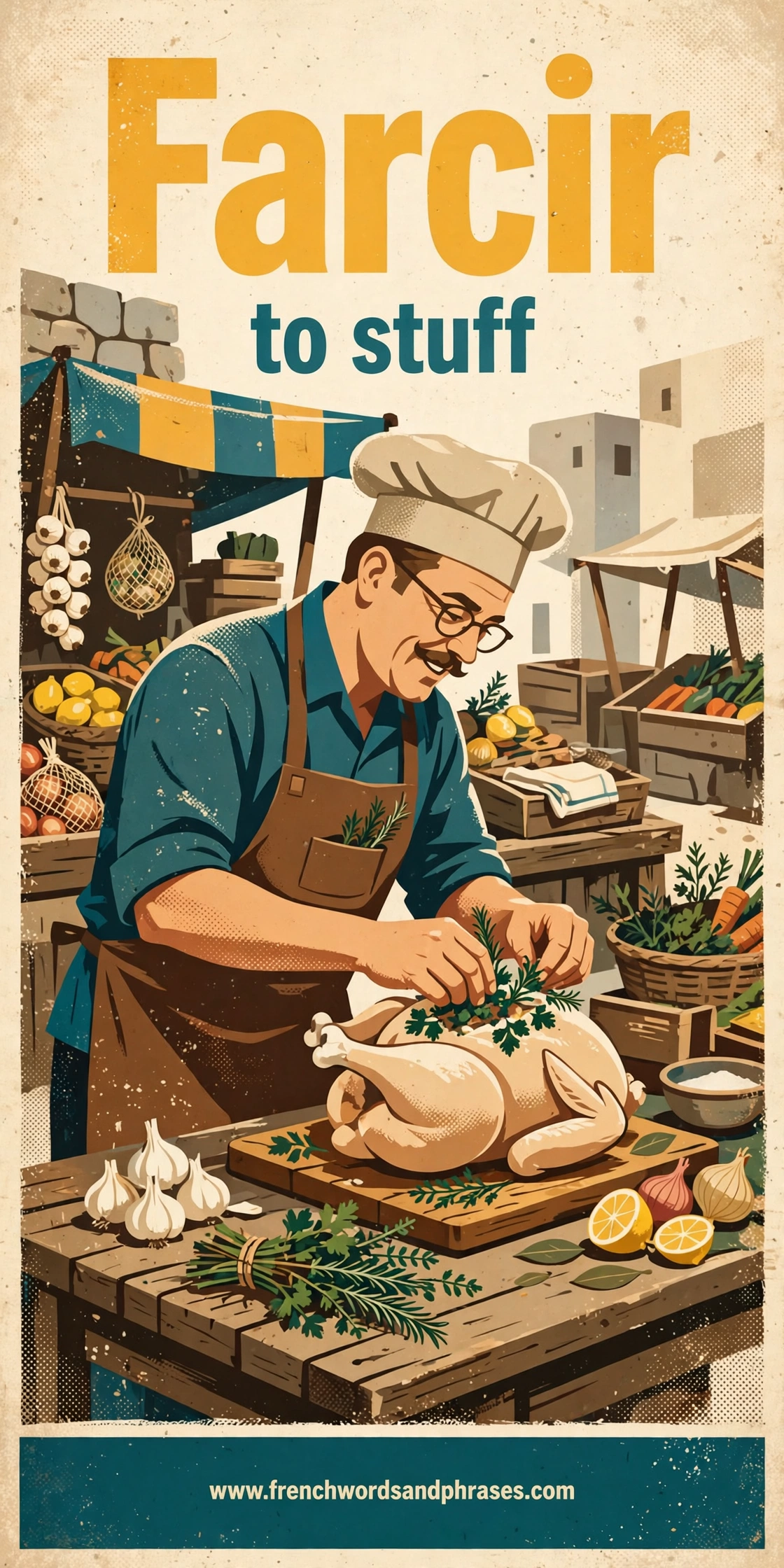
Farcir means to stuff — a pepper, a chicken, a turkey.
A pepper filled with herbed rice, a Christmas turkey carrying its chestnut treasure, tomatoes crowned with golden crumbs — farcir is the verb of the generous filling, the dish inside the dish.
In this guide, you’ll learn how to conjugate farcir in all the major French tenses and moods. Explore complete conjugation tables, French examples, English translations, and practice quizzes.
Understanding the French Verb Farcir
Farcir is a regular French verb belonging to the second group of verbs, those ending in -ir.
It means to stuff (a pepper, a turkey). It is commonly used for stuffing peppers, tomatoes, courgettes and mushrooms with rice, meat or herbs, for the Christmas turkey and other poultry, and in Provence for the famous petits farcis — a whole tray of little stuffed vegetables.
Verb classification: Second group (-ir)
Auxiliary verb: Avoir
Past participle: farci
Present participle: farcissant
English equivalents: To stuff (vegetables, poultry); la farce — the stuffing itself; (se, familiar) to put up with, to stuff oneself with.
One important detail: farcir works as a team with its noun — la farce is the stuffing, and the finished dish wears the participle as an adjective: des poivrons farcis, une dinde farcie, les petits farcis of Nice. In familiar speech the reflexive takes revenge: se farcir is to put up with something tedious — je me suis farci tout le rapport — or to stuff yourself: se farcir un gâteau entier.
Experience the Word
Farcir is the verb of the hidden feast — the plain vegetable or bird that turns out to be carrying dinner inside it.
Imagine a kitchen in Nice in August. On the table, a tray of tomatoes, onions and courgettes, each hollowed and filled, each wearing its little hat of flesh again — les petits farcis, ready for the oven and the whole street’s envy.
The vegetable has not been decorated. It has been stuffed — farci — and it is a meal in itself now.
How to Conjugate Farcir: Complete French Conjugation Guide
Let’s explore every major conjugation of farcir, beginning with the indicative mood.
How to Conjugate Farcir in the Indicative Mood
The indicative mood is used to express facts, observations, actions, and events.
How to Conjugate Farcir in the Present Tense (Présent)
Used for actions happening now, habitual actions, and general truths.
| Subject | Conjugation |
|---|---|
| je | farcis |
| tu | farcis |
| il / elle | farcit |
| nous | farcissons |
| vous | farcissez |
| ils / elles | farcissent |
Example
Elle farcit les poivrons avec du riz et des herbes.
She stuffs the peppers with rice and herbs.
Quick Quiz 1
Complete the sentence:
Nous ______ les tomates avec du riz.
Reveal the answer
farcissons
Nous farcissons les tomates avec du riz.
We stuff the tomatoes with rice.
How to Conjugate Farcir in the Passé Composé
Used for completed actions in the past. Farcir takes the auxiliary verb avoir.
| Subject | Conjugation |
|---|---|
| j’ | ai farci |
| tu | as farci |
| il / elle | a farci |
| nous | avons farci |
| vous | avez farci |
| ils / elles | ont farci |
Example
Il a farci la dinde pour le repas de Noël.
He stuffed the turkey for the Christmas meal.
How to Conjugate Farcir in the Imparfait (Imperfect Tense)
Used for habitual past actions, descriptions, and ongoing situations in the past.
| Subject | Conjugation |
|---|---|
| je | farcissais |
| tu | farcissais |
| il / elle | farcissait |
| nous | farcissions |
| vous | farcissiez |
| ils / elles | farcissaient |
Example
Ma grand-mère farcissait les tomates chaque dimanche.
My grandmother used to stuff tomatoes every Sunday.
Quick Quiz 2
Choose the correct form:
He stuffed the turkey.
Il ______ la dinde. (a farci / est farci)
Reveal the answer
a farci
Il a farci la dinde.
Farcir takes avoir.
How to Conjugate Farcir in the Plus-que-parfait
Used to describe an action that had already been completed before another past event.
| Subject | Conjugation |
|---|---|
| j’ | avais farci |
| tu | avais farci |
| il / elle | avait farci |
| nous | avions farci |
| vous | aviez farci |
| ils / elles | avaient farci |
Example
Nous avions farci les courgettes quand le four fut chaud.
We had stuffed the courgettes when the oven was hot.
How to Conjugate Farcir in the Passé Simple
Primarily used in formal writing, literature, and historical narratives. It is rarely used in everyday conversation.
| Subject | Conjugation |
|---|---|
| je | farcis |
| tu | farcis |
| il / elle | farcit |
| nous | farcîmes |
| vous | farcîtes |
| ils / elles | farcirent |
Example
La cuisinière farcit le poulet de marrons.
The cook stuffed the chicken with chestnuts.
How to Conjugate Farcir in the Passé Antérieur
A literary tense used to express an action completed immediately before another past action, generally in the passé simple.
| Subject | Conjugation |
|---|---|
| j’ | eus farci |
| tu | eus farci |
| il / elle | eut farci |
| nous | eûmes farci |
| vous | eûtes farci |
| ils / elles | eurent farci |
Example
Quand il eut farci les champignons, il les enfourna.
When he had stuffed the mushrooms, he put them in the oven.
How to Conjugate Farcir in the Future Tense (Futur Simple)
Used to describe actions that will take place in the future.
| Subject | Conjugation |
|---|---|
| je | farcirai |
| tu | farciras |
| il / elle | farcira |
| nous | farcirons |
| vous | farcirez |
| ils / elles | farciront |
Example
Demain, tu farciras les tomates avec la viande hachée.
Tomorrow, you will stuff the tomatoes with the minced meat.
How to Conjugate Farcir in the Futur Antérieur (Future Perfect)
Used for an action that will have been completed before a particular point in the future.
| Subject | Conjugation |
|---|---|
| j’ | aurai farci |
| tu | auras farci |
| il / elle | aura farci |
| nous | aurons farci |
| vous | aurez farci |
| ils / elles | auront farci |
Example
À midi, elle aura farci tous les poivrons.
By noon, she will have stuffed all the peppers.
How to Conjugate Farcir in the Near Future (Futur Proche)
Used to describe something that is going to happen soon. Formed with aller + infinitive.
| Subject | Conjugation |
|---|---|
| je | vais farcir |
| tu | vas farcir |
| il / elle | va farcir |
| nous | allons farcir |
| vous | allez farcir |
| ils / elles | vont farcir |
Example
Je vais farcir les courgettes, prépare la farce.
I am going to stuff the courgettes, get the stuffing ready.
How to Conjugate Farcir in the Conditional Mood
The conditional mood expresses what would happen under certain circumstances. It is also frequently used to make polite requests or express wishes.
How to Conjugate Farcir in the Present Conditional
| Subject | Conjugation |
|---|---|
| je | farcirais |
| tu | farcirais |
| il / elle | farcirait |
| nous | farcirions |
| vous | farciriez |
| ils / elles | farciraient |
Example
Sans riz, je farcirais les poivrons à la viande.
Without rice, I would stuff the peppers with meat.
How to Conjugate Farcir in the Past Conditional
| Subject | Conjugation |
|---|---|
| j’ | aurais farci |
| tu | aurais farci |
| il / elle | aurait farci |
| nous | aurions farci |
| vous | auriez farci |
| ils / elles | auraient farci |
Example
Elle aurait farci la dinde la veille.
She would have stuffed the turkey the day before.
Farcir in the Literary Past Conditional Form
This less common literary form uses the imperfect subjunctive of avoir.
| Subject | Conjugation |
|---|---|
| j’ | eusse farci |
| tu | eusses farci |
| il / elle | eût farci |
| nous | eussions farci |
| vous | eussiez farci |
| ils / elles | eussent farci |
Example
Il eût farci le poulet comme on le faisait autrefois.
He would have stuffed the chicken as people did in the old days.
How to Conjugate Farcir in the Subjunctive Mood
The subjunctive is used to express wishes, emotions, doubts, necessity, and uncertainty. It frequently follows expressions such as il faut que (it is necessary that) or bien que (although).
How to Conjugate Farcir in the Present Subjunctive
| Subject | Conjugation |
|---|---|
| que je | farcisse |
| que tu | farcisses |
| qu’il / qu’elle | farcisse |
| que nous | farcissions |
| que vous | farcissiez |
| qu’ils / qu’elles | farcissent |
Example
Il faut que tu farcisses les tomates généreusement.
You must stuff the tomatoes generously.
Quick Quiz 3
Complete the sentence using the subjunctive:
Il faut que vous ______ les champignons.
Reveal the answer
farcissiez
Il faut que vous farcissiez les champignons.
You must stuff the mushrooms.
How to Conjugate Farcir in the Imperfect Subjunctive
A literary tense, rarely encountered in modern spoken French.
| Subject | Conjugation |
|---|---|
| que je | farcisse |
| que tu | farcisses |
| qu’il / qu’elle | farcît |
| que nous | farcissions |
| que vous | farcissiez |
| qu’ils / qu’elles | farcissent |
Example
Je voulais qu’elle farcît les poivrons avant midi.
I wanted her to stuff the peppers before noon.
How to Conjugate Farcir in the Pluperfect Subjunctive
A literary construction used to express an action completed before another past action.
| Subject | Conjugation |
|---|---|
| que j’ | eusse farci |
| que tu | eusses farci |
| qu’il / qu’elle | eût farci |
| que nous | eussions farci |
| que vous | eussiez farci |
| qu’ils / qu’elles | eussent farci |
Example
Il regrettait que nous eussions farci les légumes trop tôt.
He regretted that we had stuffed the vegetables too early.
How to Conjugate Farcir in the Past Subjunctive
| Subject | Conjugation |
|---|---|
| que j’ | aie farci |
| que tu | aies farci |
| qu’il / qu’elle | ait farci |
| que nous | ayons farci |
| que vous | ayez farci |
| qu’ils / qu’elles | aient farci |
Example
Je suis content que tu aies farci les champignons.
I am glad you stuffed the mushrooms.
How to Conjugate Farcir in the Imperative
The imperative is used to give commands, instructions, invitations, or suggestions. Subject pronouns are omitted.
How to Conjugate Farcir in the Present Imperative
| Person | Conjugation |
|---|---|
| (tu) | farcis |
| (nous) | farcissons |
| (vous) | farcissez |
Example
Farcis les poivrons, et n’oublie pas le persil !
Stuff the peppers, and do not forget the parsley!
Quick Quiz 4
How would you say Stuff them (tu form)?
Reveal the answer
Farcis-les !
French Participles of Farcir
Participles are verb forms that can be used in compound tenses and other grammatical constructions.
Present Participle of Farcir
farcissant
En farcissant les tomates, elle racontait ses vacances.
While stuffing the tomatoes, she talked about her holiday.
Past Participle of Farcir
farci
Farci aux herbes, le poivron devient un plat complet.
Stuffed with herbs, the pepper becomes a complete dish.
Farcir in Everyday French: Real-Life Examples
Now that you know the conjugations, let’s see how farcir appears in everyday French.
Example 1 — Present
Je farcis les tomates avec du riz parfumé.
I stuff the tomatoes with fragrant rice.
Example 2 — Passé composé
Nous avons farci le poulet pour dimanche.
We stuffed the chicken for Sunday.
Example 3 — Imparfait
En Provence, on farcissait tous les légumes d’été.
In Provence, people used to stuff all the summer vegetables.
Example 4 — Future
Elle farcira les champignons à l’ail.
She will stuff the mushrooms with garlic.
Example 5 — Conditional
Je farcirais bien des courgettes ce soir.
I would love to stuff some courgettes tonight.
Example 6 — Imperative
Farcissez la dinde et fermez-la bien !
Stuff the turkey and close it up well!
Beyond Translation: The Meaning of Farcir
English stuff is a blunt word for a delicate art; French farcir names the whole operation and its treasure at once — the verb, the filling (la farce) and the finished dish (les farcis) all share one root.
Its comic twin is never far away.
A farce in the theatre is a farce — a play stuffed with jokes, exactly as a pepper is stuffed with rice. The kitchen and the comedy were seasoned together from the start.
How to Remember the French Verb Farcir
Remember it this way: Farcir is about the hidden feast — poivrons farcis, dinde farcie.
- La farce is the stuffing; farcis is the dish: des poivrons farcis, les petits farcis.
- Se farcir (familiar) — to put up with, or to stuff yourself: se farcir un gâteau entier.
- Regular -ir: je farcis, nous farcissons, past participle farci.
The key idea is the hidden feast — poivrons farcis, dinde farcie.
Test Your Knowledge of Farcir
Let’s see how much you’ve learned. Try answering these questions before revealing the answers.
Question 1
What is la farce?
Reveal the answer
The stuffing — the filling that goes inside the pepper, the tomato or the turkey.
Question 2
How do you say She stuffs the peppers in French?
Reveal the answer
Elle farcit les poivrons.
Question 3
Translate: He stuffed the turkey for Christmas.
Reveal the answer
Il a farci la dinde pour Noël.
Question 4
What is the past participle of farcir?
Reveal the answer
Farci — farcie, farcis, farcies when it agrees as an adjective.
Question 5
Complete the sentence:
Il faut que tu ______ les tomates généreusement.
Reveal the answer
farcisses
Il faut que tu farcisses les tomates généreusement.
You must stuff the tomatoes generously.
Your Final Challenge
Can You Use It?
How would you say this in French?
Stuff the peppers, put them in the oven, and the house smells wonderful.
Reveal the answer
Farcis les poivrons, mets-les au four, et la maison embaume.
Stuff the peppers, put them in the oven, and the house smells wonderful.
A little French. A little curiosity. A richer everyday life.
LEARN FRENCH ONE WORD AT A TIME




